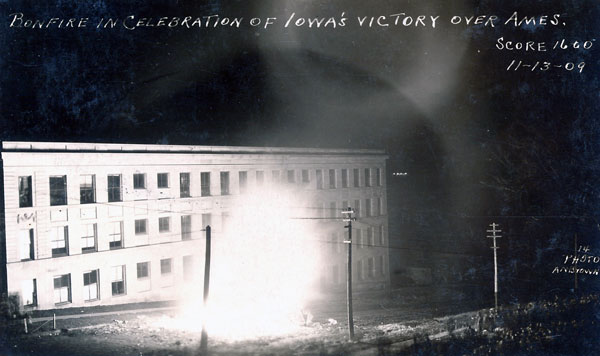
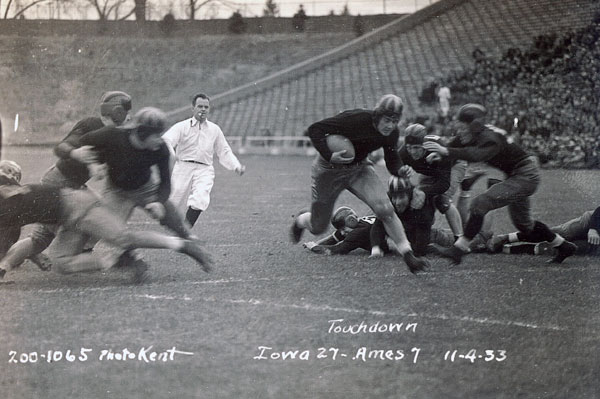
Congrats to the Hawkeyes for Saturday’s win over Iowa State — the latest in a long line, as shown in these images from the Iowa Digital Library:
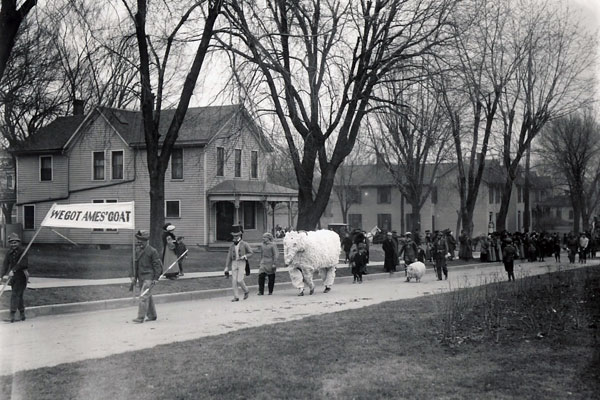
Parade, The University of Iowa, 1920s
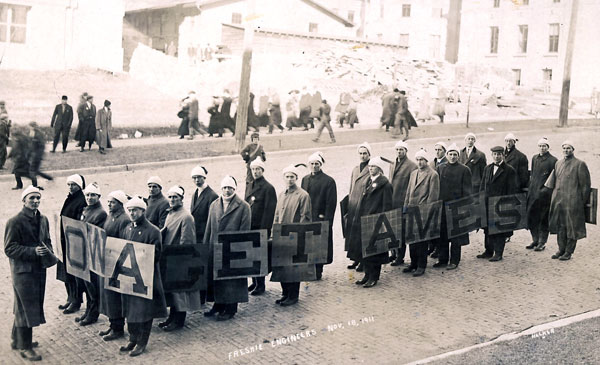
Freshman engineers, Nov. 18, 1911
Congrats to the Hawkeyes for Saturday’s win over Iowa State — the latest in a long line, as shown in these images from the Iowa Digital Library:
Parade, The University of Iowa, 1920s
Freshman engineers, Nov. 18, 1911
Get to Know Iowa City, Flex Your Creative Muscles, Win Fame and Prizes!
As you’re getting to know Iowa City, you’re finding new places and people. What did those places look like in the past? Who were the people? Now it’s your turn to make your mark on the Iowa City landscape.
Our criteria for judging the winners: accuracy to the original photo and creativity in interpreting the original photo.
Contest Rules and Eligibility Requirements
Iowa City Then & Now photo contest is open to all undergraduate and graduate University of Iowa students. University of Iowa staff may also participate, but are not eligible for any prizes. Participants must complete all of the required tasks and answer the related questions on the entry form. Each student can enter only once, duplicates will be discarded. No entries will be accepted after 5 p.m. on Friday, October 1, 2010. The decision of the judges is final.
For questions about the contest, please contact Kristi Bontrager, Coordinator, Public Relations, University of Iowa Libraries.
Iowa Research Online has just passed the 100,000 mark!
The repository launched in January 2009. Since that time, we have added 3,630 items to the collection which have now been used over 100,000 times. We are very pleased that our local scholarship has been receiving so much use.
Our highest use collection is our electronic thesis and dissertation collection, which shows the importance of our recent graduates’ scholarship. This collection has a wide range of content across all disciplines. The theses receiving the most use are:
Our peer-reviewed journals also receive high use. Walt Whitman Quarterly Review and Medieval Feminist Forum were both print only and now the back content is freely available and the current issue is available to subscribers. Poroi and Electronic Journal of Africana Bibliography moved into Iowa Research Online to provide an improved interface. Some of the articles receiving the most use are:
Our collections of faculty scholarship are also receiving high use. Highlights from these collections include:
Our partnership with the University of Iowa Press to make the back volumes of selected series available has also contributed several popular items:
Several reports from the Public Policy Center have also been receiving a lot of use, including:
We have found that IRO is used by people all over the world. While most use comes from the United States, substantial use also comes from people in the United Kingdom, Canada, India, Germany, Australia, France, Hong Kong, Italy, the Netherlands, Spain and China, demonstrating the international nature of our collection and of research.
Thanks to everyone who has helped make the collection such a success!
The UI Libraries is proud to be a part of “Scandal!”, the featured exhibit at the Museum of American Finance in New York:
“From betrayals of the public trust by government officials to betrayals of investors by Ponzi artists, and from corporate accounting fraud to egregious failures of risk management in more recent years, ‘Scandal!’ explores the history of these episodes in American history, scrutinizing the people involved and the damage they caused. Even though names like Teapot Dome, Credit Mobilier, Ivar Krueger and Tino De Angelis have all but faded from history, they created shockwaves in their time and continue to echo in events that are unfolding today.”
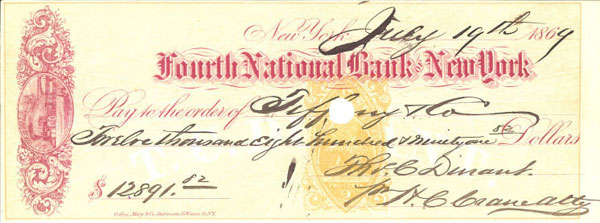
On loan are a number of documents from the UI Special Collections’ Papers of Levi O. Leonard collection that formerly belonged to financier and railroad executive Thomas C. Durant (1820-1885), a central figure in the Credit Mobilier financial scandal. Three of these digitized artifacts can be seen in slides 4-6 of this New York Times feature; thousands more may be viewed at the Iowa Digital Library’s Levi O. Leonard Railroadiana digital collection.
After being displaced along with the rest of the UI Museum of Art in the 2008 floods, Grant Wood’s celebrated 1931 painting Plaid Sweater is back in town. For those of you unable to drop by its new home in the student union’s Richey Ballroom, it’s one of the nearly 10,000 items available for browsing in the Iowa Digital Library’s University of Iowa Museum of Art Digital Collection. While you’re there, you can also check out the original plaid sweater worn in the painting — slightly disguised, since the sleeves were subsequently shortened to allow use in warmer weather.
“Plaid Sweater is a portrait of Mel Blumberg of Clinton, Iowa. According to Wood’s sister, Nan, he was to paint the boy, but did not want him to be wearing his ‘Sunday Best’ for the portrait. He was discussing the matter when the subject burst into the room wearing the plaid sweater and carrying a football. Grant Wood thought this was the perfect way to represent the football player; the portrait was not to be staged, and Wood shows the boy as a heroic archetype of the ‘All-American Boy.’ Wood portrays this youth as a healthy symbol of the future and a natural extension of his environment.” — http://uima.uiowa.edu/grant-wood/
RAGBRAI sign by Michael W. Lemberger, July 2009
Good luck to everyone on RAGBRAI! For those of you unable to race your bike across Iowa, please enjoy vicarious cycling with these historic images from the Iowa Digital Library.
“WAC messengers ride bikes in parade,” Des Moines Register, Aug. 1943
“By the way, how about a place in the sun…” by Ding Darling, Des Moines Register, May 1921
Herman Glenn Rodriguez, Bettendorf, Iowa, 1925
Bicyclists, The University of Iowa, 1940s
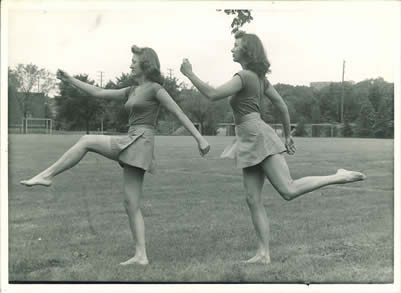
Bicycle acrobatics, The University of Iowa, 1940s
“Clark’s Cotton” tradecard, 1880s
Arlene Roberts Morris cover portrait for Eyes magazine, 1946
In honor of the upcoming Iowa City Book Festival (July 16-18, 2010), we’re featuring some of the literary collections in Iowa Digital Library and Iowa Research Online. We hope you’ll explore the content online and the book fest in real life.
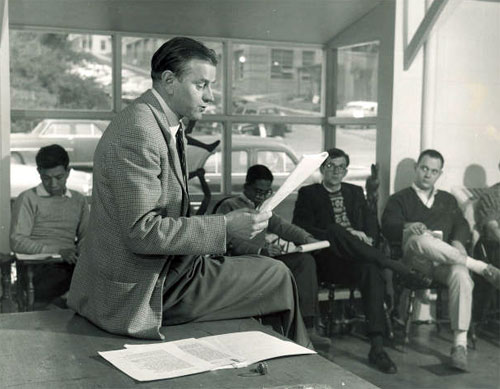
Paul Engle teaching at the Iowa Writers’ Workshop, The University of Iowa, ca. 1950s
View similar images from Iowa City Town and Campus Scenes
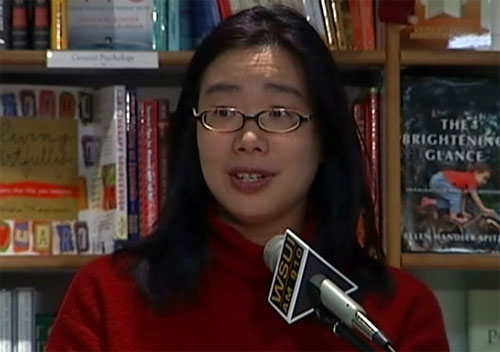
Lan Samantha Chang reading, Prairie Lights bookstore, Nov. 10, 2006
Listen to more audio from Live From Prairie Lights
Out of the girls’ room and into the night by Thisbe Nissen
Read more e-books from the Iowa Short Fiction Awards
The Digital Library Services staff hopes everyone has a great Fourth of July weekend.
We hope you have good times with family and friends.

We hope you eat good food.

We hope you enjoy fireworks displays.


And we hope you stay safe.

The Korean War started 60 years ago today. I grew up knowing about the war as fictionalized by M*A*S*H. In history class, we never made it that far into the twentieth century and, unlike today, the conflict between North & South Korea never came up in our current events conversations, making it a forgotten war.
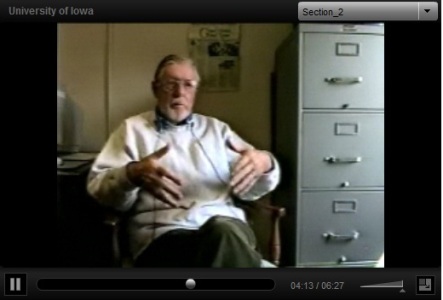
The University of Iowa Libraries digital collections have a small amount of material relevant for people interested in learning more about this conflict.
In an oral history interview, Otto Knauth, a former Des Moines register reporter, recounts putting together the story of the invasion.
“I think it was on June 25, 1950, and the North Koreans invaded South Korea. I got the job of editing that story. It was a Saturday night and it was for the Sunday Register. That was, by far, the biggest story that I had ever handled. I worked on it all night long because we kept getting updates all the way through. So, from edition to edition, it meant changing the story, maybe putting a new lead on it, expanding the text down below, and writing new headlines for it.”
According to the October 1950 issue of the Iowa Alumni Review, the war was featured as part of the 1950 summer lecture series, with three speakers giving different perspectives on the war. One speaker, Max Lerner, stated “We must help the revolutionary forces in Asia become a democratic force. We must be on the side of racial equality and social reform everywhere—and at home, too.”
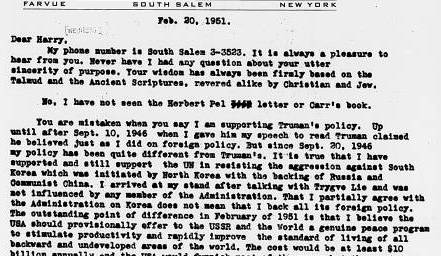
Our collections also include papers of Henry A. Wallace. His view towards communism changed due to the Korean War, so some of these letters are of particular importance for learning about the effects of the war on attitudes in the United States. A Feb 20 1951 letter to Harry Weinberg clarifies his differences of opinion with Truman.
“That I partially agree with the Administration on Korea does not mean I back all its foreign policy … I believe the USA should provisionally offer to the USSR and the World a genuine peace program to stimulate productivity and rapidly improve the standard of living of all backward and undeveloped areas of the world.”
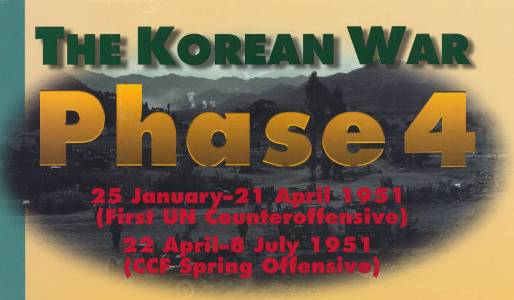
Our government poster collection includes a chronology of phase 4 of the war, detailing events of 25 January-21 April 1951. During this time the US and republic of Korea forces decided to cross the 38th parallel again and General MacArthur was relieved of duty.
You can also learn about the war from the broader social context in the United States, including the Cold war and fears of the “Red Menace”. One of the speakers on the Chautauqua circuit, Edward Hunter, the author of Brain-washing in Red China,
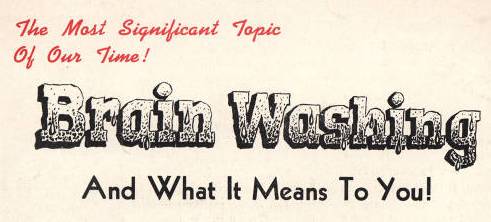
advertised his talk about the communist brainwashing, by saying “Here is an expose of the Communists’ best kept secret, a glimpse behind the bamboo curtain at the sinister, ruthlessly effective technique by which the Reds are attempting to conquer the minds of men.”
This is not the only view presented on the Chautauqua circuit; our collections include a brochure for a movie by Thomas E. Benner showing life and culture of the Korean film, made before and after the communist invasion.
While the UI press book Memoirs of a Cold War Son doesn’t directly talk about the Korean War, it gives a first hand account of growing up in this era.
Our collections also include analyses of various aspects of the war. For example, we have a 1997 interview of Han Ki about the effect of the Korean War on literary production in Korea. You can also listen to Marshall Poe’s interview of Julian E. Zelizer about his book Arsenal of Democracy: The Politics of National Security From WWII to the War on Terrorism.
Unfortunately, the armistice between North and South Korea is fragile and the world still is dealing with hostilities. Our Foreign Relations Council series includes several talks about North Korea, including a lecture by Scott Snyder on Dec 1, 2009 about the 6 party talks.