Skip to content
Skip to main content

Cleaning the Rust

Thursday, March 19, 2009

The pictured objects were actively corroding after the flood. To slow that process we put the objects in sealed containers with silica gel packets. The dessicant pulls in moisture so it doesn’t permeate the objects. 

Now we are trying to clean up the effects of the corrosion and stabilize the metal so that the objects can be put on display and preserved. To begin with, we take small knives (carpenter’s marking knives or exactos) and carefully scrape away the flaking rust spots. Some of these objects were painted so we must be careful not to disturb that while we are removing the rust.

Once the large areas have been scraped a brass or bronze (named for the bristles) brush is used to begin to even out the surface. A couple different weights of steel wool are used and finally a coat of oil which is rubbed into the metal with a fine grain steel wool. 

I cleaned the drill bit last week, it took about 4 hours and the coils were very hard to clean. Looking at it now it doesn’t seem like the same object, It is amazing the difference in the condition. It is tedious work, rivaling the basket cleaning, but there is no saliva involved in this project!


Sewing a Booklet Back Together

Tuesday, March 10, 2009

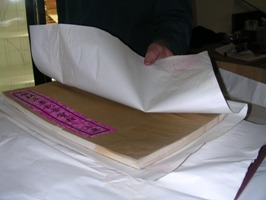
Some of the records we cleaned were accompanied by pamphlets like the one pictured here. They were mostly coated paper with rusting staples. The pamphlet pictured was held together with rusting staples and the middle folio had pulled almost completely free. I removed the staples. Dry cleaned the pages and guarded the innermost and outermost folios with thin, tinted kozo, and wheat starch paste, to create a strong base to anchor the sewing. I used a simple pamphlet stitch to re-sew it and Voila! a happy little pamphlet.

Cleaning Moldy Books and Magazines

Thursday, March 5, 2009

Over the past few days, I have received several inquiries on how to deal with mold on books or magazines. Here are some tips.

The items need to be dry before working on them. Set them out somewhere away from people (I use my garage), to let the items dry. If the pages are damp, you may need to interleaf the pages with paper towels or copy paper (paper without any print). Once the items are dry you can start cleaning. You don’t need to use any disinfectants. Lightly dust mold off with a clean paint brush. If there is some stubborn mold you can try a damp cloth or sponge and gently wipe. Or, better yet, a non chemical natural sponge – usually advertised as a sponge for cleaning off soot. The sponge might be called absorene or dirt eraser. You should be able to get the sponge in a hardware store. You need to be careful not to erase the print! Mold can leave stains and those won’t come out. You’ll need to be careful that you are not trying to rub out a stain – you’ll just rub a hole in the page.

THE MOST IMPORTANT THING IS GUARDING PERSONAL HEALTH. Here’s what I recommend:

Wash hands frequently whenever handling material with mold. Monitor your own heath.

Mold spores enter the body by inhalation and through small breaks in the skin. It is impossible to determine ahead of time who will or will not be affected by exposure to mold. The best safeguard is to exercise appropriate precautions whenever there is an exposure to mold. The following safety precautions are recommended.
* Wear a N95 disposable respirator available in the Conservation Lab
* Use disposable gloves if handling the material
* Goggles or protective eyewear should be worn
* Don’t touch your eyes or mouth if you’ve touched a moldy item
* Wash your hands as soon as possible once vacated infected area
* Take a shower and wash your clothes in hot water and bleach
Illnesses due to exposure to mold can result from both high level, short-term exposures and lower level, long-term exposures.

The most common symptoms to exposures are runny nose, eye irritation, cough, congestion, aggravation of asthma, headache, and fatigue. Also, regardless of the species present, individuals with serious allergies, diabetes, asthma, respiratory problems, or compromised immune systems, as well as those taking steroid therapy, should avoid the affected area and materials.

Call your local conservation lab or preservation librarian for additional assistance. The can advise you as to whether you need a professional and how to obtain one. Or they can walk you through the steps.

Metal Cleaning Party

Wednesday, March 4, 2009

Several weeks ago, Steve Stenstrom offered to give us a quick workshop on metal cleaning and preservation techniques. Our best guess is that we have a bout 100 metal items to clean — most are from the African American Museum of Iowa. We really needed his assistance, took him up on his offer, and decided to hold a metal cleaning party.

On Tuesday, Caitlin set up the Oakdale storage room with tables, covered with plastic, and worklights. She also swept out the room and made it look presentable–we have been taking pictures of each item out there and finishing the inventory, so we had a few things to tidy. I was to gather the tools and cleaning items that we might need and bring them out to Oakdale.

Bryan Stusse and I met Steve out at Oakdale Hall around 10:00AM so we could set up the tools and go through items with him. While Nancy and I talked to Steve, Caitlin and Bryan went to meet Leigh Ann Randak, Johnson County Historical Society curator, in order to help her navigate the Oakdale maze.

After we had settled in, Steve gave us an intro lecture, discussing briefly the problems with alloy and non-alloy metals, a little background in metal manufacture, basic tools and solutions for removing corrosion, and then tried to convince Nancy to set up an electrolysis bath in the lab for some of the items. She wasn’t convinced.

Each of us selected a metal object to work on. At the end of the day we had two horse shoes and a knife cleaned and two other items partially cleaned. Our original intent was to start cleaning metal in the conservation lab. After a day of scraping, flaking, sanding rust and other debris from the metal, we decided this particular task is too dirty for the lab and will continue our work out at Oakdale.

We still need to learn how to finish the cleaned metal object to protect it from contaminates. Steve offered to come back another day. His offer was gratefully accepted.


The three photos on the left are courtesy George McCrory, University of Iowa News Service.

Art Books To Campus Freezer

Tuesday, March 3, 2009

Once the art books were safely stashed in the freezer truck, we began looking for on campus freezers. We found one in Macbride Hall — a nice sized walk in freezer. We were able to get all but 50 boxes into the freezer.

As Rijn and I were brainstorming how to squeeze the final 50 boxes into the freezer, Cindy Opitz stopped by and asked us if we needed any more freezer space. Her department, right around the corner, has a walk in freezer, too! Problem solved. The final group will go to her freezer on Thursday.

All our books will be in the same building, just a couple blocks away from the Main Library. It will be easy to pick up a few boxes every couple weeks to put new books into the freeze dryer as we pull dry ones out.

It was refreshing to see such a simple freezer monitoring device after the day and half training on the book freeze dryer controls.

Putting the Book Freeze Dryer to Work

Tuesday, March 3, 2009

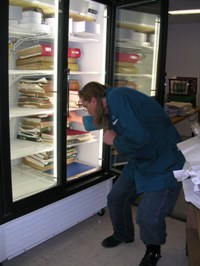
We spent the first part of the morning practicing setting the controls and reviewing the maintenance procedures. Then we loaded up the freezer — a much awaited event. Our old freeze dryer had started losing freezer capability a few days ago. The books were still cold but had begun to thaw. We transferred them to our new freezer and turned the old one off. The freezer typically holds 200 books. However, since the art books are oversized, 103 volumes filled the freezer.

The purchase of the new freezer was made using Friends of the Libraries donations. The freezer arrived in the nick of time. The old freezer is beyond repair. The new freezer is allowing us to dry out the books on site, instead of sending them out of state to a commercial freeze dryer. We can inspect each book as it goes into the freezer, perhaps do some minor re-shaping, and pull it out as it dries and make any needed repairs before sending it back to the library. We can work a few through at a time and incorporate the art books into our regular work flow.

We wrapped some of our books before we boxed them up to transfer from the Art Library to the freezer in the Main Library as a precaution in case the inks on the cover bled. You can see that this book transferred some of the ink onto the paper. Without the paper wrap, the ink would have transferred to another book. The ink on the paper doesn’t quite line up with the image on the cover because it got shifted around during inspection before the transfer to the new freezer.

Richard Smith Provides Freeze Dryer Training

Monday, March 2, 2009

Dick Smith, the inventor of the Wei T’o Book Freeze Dryer and Insect Exterminator, after checking all the controls to make sure they had survived the trip, spent the day training us on how to use the freezer. The first step is to set the controls to freeze the books. Once the books are frozen, the freezer controls are changed slightly for the freeze drying process. The drying is done through with additional fans and controlled defrost cycles. It’s similar to a home freezer. If you leave a tray of ice cubes in your home self-defrosting freezer long enough, the ice will disappear. Wet books typically dry within 2-4 weeks in a book freeze dryer.

We have probes that we set inside 2-3 different size books to monitor the internal temperature. One of our first tasks was to uncoil the probes and plug into the freezer.

ISU Preservation staff joined us for the day. They have a freeze dryer and welcomed the chance to get a refresher class from Dick.

Kraft Receives Midwest Archives Conference Presidents’ Award

Thursday, February 26, 2009

This morning at 8:30 I received the following email. Imagine my surprise! For years I’ve been a strong advocate for the preservation of all types of collections, including library, museum, manuscripts, and archives. I’ve spent time learning about the issues, organization, and language unique to each collection type. It’s really great that I’m receiving an award “outside” my profession.

“Nancy,

We are very pleased to inform you that you have been selected as a 2009 recipient of the Presidents’ Award presented by the Midwest Archives Conference.

This award, established in 1986, recognizes significant contributions to the archival profession by individuals, institutions, and organizations not directly involved in archival work but knowledgeable about its purpose and value. Recipients are chosen by a committee comprising the three most recent past presidents of MAC from nominations submitted by committees in each of the 13 states in the MAC region.

The four of us agree that your tireless efforts following last June’s devastating floods alone merit this recognition. In addition, your lifelong commitment to assisting our profession is deeply appreciated by your colleagues. Thank you for all you have done for us in preserving and strengthening our collections.

The award committee will send you a more formal letter of notification soon, along with information about MAC’s annual meeting, which this year will be held in St. Louis, Missouri, from April 29 to May 2. We hope you can join us as our guest. Awards will be presented during the annual membership meeting at that time.

Again, congratulations! We are fortunate to know you as a colleague and as a friend.”

David McCartney
Kären Mason
Rachel Vagts
Tanya Zanish-Belcher

Bringing In Book Freeze Dryer No Small Task

Wednesday, February 25, 2009

We’ve been eagerly awaiting our new book freeze dryer, especially since our old one is on its last leg AND we have lots of frozen art books waiting to be dried out. It took 2 hours to get the Wei T’o Hussmann freeze dryer in place.

The book freezer weighs 1730 lbs crated and 1430 lbs uncrated. It stands 86″ high x 67 1/2″ wide x 36 1/2″ deep. It was too tall to make it through the doors in the upright position so it had to be turned on its side. BUT not on the side with all the controls.

So how many people does it take to get such a large freezer into the building? And how does one turn it on it’s side without damaging the freezer? I’ll let the photos tell the story! Or see it on YouTube at http://www.youtube.com/watch?v=LSelj2zmukQ
Special thanks to everyone who helped get the freezer in place.

Art Library Books Looking Good

Friday, February 20, 2009

Caitlin and Kristin spent most of the day at the Art Library sorting through the air-drying books. They inspected almost 400 books. At the end of the day there were still 18 volumes needing more air drying time. The rest were put on carts. About 200 volumes will need repair work — flattening, small repairs, or new enclosures. About 180 books are ready for reshelving. Yes, we know the book in the photo is upside down! As a book is air-dried the book is rotated to make sure that all sides are dry. As a book starts to dry the water settles to the bottom. You can actually feel that the bottom of the book is heavier as you lift to turn it over.