Thursday, March 4, 2010
 The long awaited day arrived at last. We moved out of our “dirty room” at Oakdale Hall, took down our sign, and turned in our keys! Over 18 months ago in the midst of finding space for faculty and students, University of Iowa officials took time to find us a room where we could store the flood damaged items from the National Czech & Slovak Museum & Library and the African American Museum of Iowa. I’m still amazed at the fast turn around time we had for the flood response. The flood waters hit these two museums June 12, 2008. We were salvaging collections by June 18 and had a place at the University secured by
 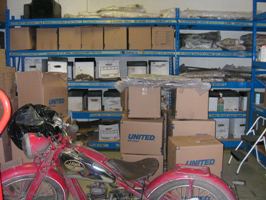 June 23 with collections arriving the next day. Work on collections began immediately. Wow!
I suspect that this time table seemed really slow for the staffs of the two museums. I know it would feel slow if it were my collections. However, for an area disaster on the scale we had, this is very quick response time.
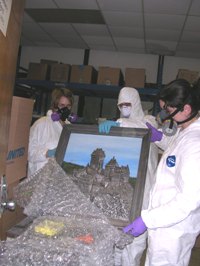
At one time this room was so full of items that we could barely move. The room allowed us to put things on hold until the museums could decide how 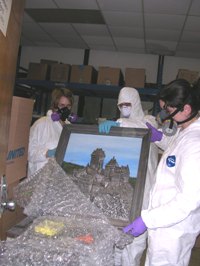 to move forward. We started to clean the Czech LPs immediately as they were the most valuable and at highest risk of further damage. The Czech/Slovak staff took several boxes of items back for volunteers to clean. The African American staff brought in a consultant conservator to assist in prioritizing material.
We stored close to 5,000 records and 500 museum objects until we had them clean enough to bring into the conservation lab. Not all items were taken to the lab for final cleaning. Many were cleaned at Oakdale either because they were too big or the cleaning process was too dirty and smelly. Several objects were sent off to other conservation labs. All the LP and 45 records are clean and returned to the Czech/Slovak Museum and close to 300 objects have been returned to the African American museum. Others are waiting to be picked up. We have less than 30 objects left to clean.
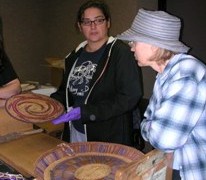
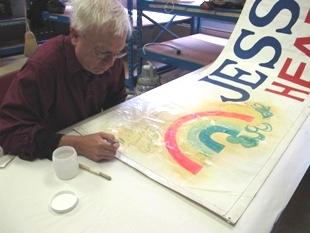
We owe a special thanks to Steve Stenstrom (Wooden Object Conservator, Windsor Heights, IA) who conducted several sessions on cleaning metals and wooden objects; Helen Alten (Objects Conservator, West Virginia) who provided training and guidance on baskets and gourds; and Gary Frost (UI Libraries Conservator) who provided assistance with cleaning of the records, miscellaneous paper items, and the Jackson banner.
We could not have provided the flood recovery work for the African American Museum of Iowa and the National Czech & Slovak Museum & Library without this room.
The rest of our work will be conducted in our conservation lab.
Though we still have much to do, it was a big step (physically and psychologically) to move out of the Oakdale campus. The end is in sight!!
 This afternoon, Brian Baird, Vice President for Library Services, Bridgeport National Bindery, presented an overview of print on demand operations from the factory floor including an early review of the PUR (new adhesive) technology. It appears that high speed copier books are now approaching a large portion of the print acquisitions. Academic and university presses have shifted to POD and a whole range of publishers, large and small are using the technology. The shift does not necessarily pose concern from the preservation perspective….but it is worthy of attention. There is indication that the library binding streams will be converted to POD methods. At issue is continuing improved performance for print books, especially those wrong grain and paperback bound coming from POD production. Brian is also tracking the self-publishing industries such as LuLu, Amazon BookSurge and Lightning Source and described the current photo book craze.
 For months we’ve looked at the Jesse Jackson banner trying to figure out what to do with it. It was obvious from inspecting the banner that part of the damage was from folding the banner and not from the flood. Once repaired or at least stablized we didn’t want to fold it back up. The ideal would be to store it rolled rather than flat. We thought it was too fragile to withstand a tight roll. Purchasing a tube with an 8″ or larger diameter would cost $150 or more.
 of adhesive and cloth between the banner and acidic tube. Other type liners could have just as easily been used — several layers of Mylar, polyethylene plastic sheeting, Tyvek, or heavy-weight acid-free paper.


 One project that Kallie is working on is cleaning a collection of busts. After Caitlin tested a couple different treatment methods she settled on using a mixture of water and photo flo roughly a 4:1 ratio. Kallie has been using swabs and cotton pads to remove the mud covering the busts. This process is particularly time consuming due to all the small crevices in the sculptures. There are 7 busts and Kallie has completed one and is halfway finished with a second.
 Company bourbon whisky promotion. For $5 you could buy a sculptured bust of an ingenious American. They belonged to Mrs. Gerolyn Banks, a teacher who used them as instructional tools in her classroom (incidentally, she didn’t drink alcohol). Kallie is working on Lewis Latimer who worked with Thomas Edison and developed an improved method for the production of carbon filaments in Edison’s light bulb. The ad for this particular bust can be found in


 I have a cool tip that I thought I’d pass along. Last week we decided to take a poster to the American Library Association preservation section meeting describing how the flood and other recent events have impacted our department. Hauling a poster through the airport and onto an airplane is no picnic. I decided that the poster needed to fit in my suitcase (14″ x 20″) for hassle free transport. As you can image this makes for small pictures and text.
 photographs and text. I’m not sure which was more interesting to our audience — the message or the poster design!
 Last night I attended a reception for the grand opening of the African American Museum of Iowa’s permanent exhibit “Endless Possibilities” which traces the journey of Iowa’s African Americans. This event was also a farewell to curator Susan Kuecker who is moving to Pittsburgh.
 preservation concerns. Since the flood I’ve gotten to know Susan even better and am impressed with all the work she’s done post flood. This exhibit is a fine example of her ability to bring a story to the public.
 going through the exhibit could discern which was which.
 This carved wooden pipe from the Czech Slovak Museum was covered in mud and dust. Since it has so many small crevices it was very hard to clean. I used dampened swabs to remove the dirt. It is in three pieces and combined it took 6 hours to clean.
