The University of Iowa Libraries Digital Scholarship & Publishing Studio is excited to announce the launch of Genetic Privacy in the U.S.: Insurance and Law Enforcement Use, a collaborative digital project developed with the University of Iowa College of Law and the University of Maryland Francis King Carey School of Law.
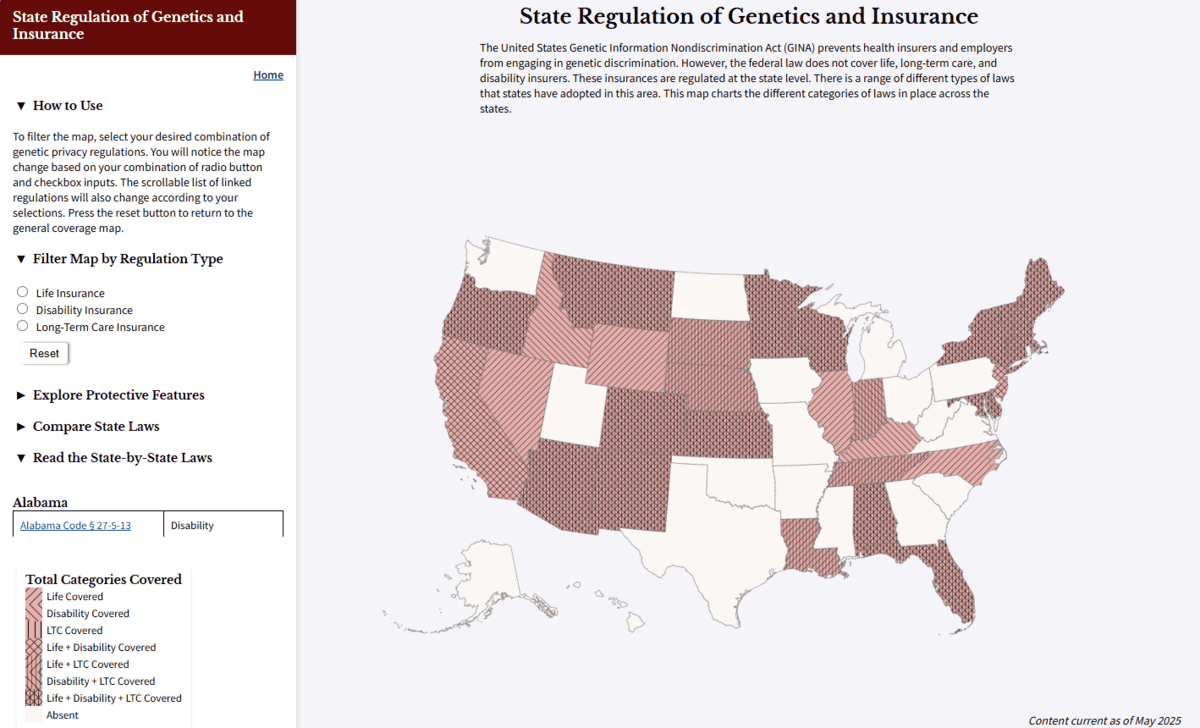
This project builds on a comprehensive 50-state survey published in 2021 and aims to inform individuals and policymakers about how the use of genetic information by law enforcement and for life, long-term care, and disability insurance is regulated on a state-by-state basis across the United States. Within this site, users can explore interactive maps and visualizations of how states regulate what genetic data is available to insurance companies and law enforcement, as well as protective features that can help to strengthen regulation of sensitive genetic information.
“The goal of this project was to work with data visualization experts to develop a website aimed at educating policymakers, journalists, and others about the importance of key issues related to genetic privacy,” says Anya Prince, UI professor of law. “Genetic information is powerful. It can reveal insights into identity, predispositions to disease, family members, and ancestry. It is therefore not surprising that people care deeply about the privacy of their genetic information. United States federal law is fairly quiet on this front.”
Federal regulation gives privacy protections for genetic test results within clinical care and research. However, many individuals undergo genetic testing outside these contexts, such as through direct-to-consumer genetic testing companies.
“Federal law does little to regulate privacy in this space,” says Prince. “Individuals are also worried about how genetic test results, no matter where they were conducted, might be used against them to discriminate.”
At the federal level, the Genetic Information Nondiscrimination Act (GINA) prohibits health insurers and employers from discriminating against individuals on the basis of genetic information, but the law does not cover other entities. Explore Genetic Privacy to learn more about how your data is being protected in your state.
The project was funded by the Greenwall Foundation Bridging Bioethics Research & Policymaking Grant Program.