Skip to content
Skip to main content

Beautiful Boxes Assembly Line Style

Thursday, May 14, 2009

In the lab, we refer to Linda as “the Machine.” As Caitlin and I have occasionally constructed a few blueboard clamshell boxes for items from the African American Museum, Linda has been spitting out cloth covered drop spine boxes. She primarily makes these types of enclosures for Hardin, the Art Library, the Music Library and Special Collections–where the boxes beautify the shelves as well as supporting and sheltering books. Drop spine boxes can be labor intensive, and require careful measuring and construction. Linda manages to produce perfectly snug, incredibly well aligned, no-stray-glue-spots boxes, and all that at an amazing pace.

Linda usually works on ten to fifteen boxes at a time, depending on the size. She measures the books in need, cuts the board, and begins assembly. In the pictures below, you can see some of the drop spine boxes being put together and weighted (the Elmer’s glue bottle we refill with PVA, as its a handy little bottle). Weighting is important as it ensures thorough connection between all the glued up surfaces, and also prevents possible warping. In the bottom left image, a tray of the box is being covered with Hardin Library approved cloth. On the the bottom right, the drop spine is complete–it is open–but must be weighted overnight before becoming acquainted with its proper book.

Suitcase Saga Part 1

Tuesday, May 12, 2009

This metal suitcase from the African American Museum collection was covered in rust and mold. It is also lined with brittle patterned paper. It’s a mess. I consulted with Gary to determine the best course of treatment.

To begin, I used the Nilfisk Vacuum with pipette attachment to get the fuzziest mold, being very careful to avoid catching the paper lining which is detached in many areas.

 Gary shows me how to lift out the loosened lining paper. �

Art Folio Portfolio

Wednesday, May 6, 2009

We are making steady progress on the books damaged in the Art Library sprinkler incident. We have been very fortunate in that most books show no to minimal damage. If you look closely at the first couple photos, you can see that there is water staining along the edges. This is fairly typical of the type of damage the books received. The staining can not be removed and will remain as a reminder of sprinkler incident.

This particular book has a soft cover and needs extra protection before going back on the shelf. Linda Lundy made a portfolio box or a four flap enclosure attached to book covers. This is entirely produced in house, using our equipment and purchased archival materials. The box will give the book added protection for handling, shelving, and other hazards.


Majestic troublemakers

Thursday, April 23, 2009

Three volcanoes overlook the city of Arequipa. Arequipa is known as ¨La Ciudad Blanca¨ or The White City, because of Sillar, the white volcanic rock that many of the buildings are constructed of. Another less desirable byproduct of the volcanoes is a fine glassy dust carried by the wind to settle in a fine layer over everything, including books. The dust is so fine it permeates even the smallest of openings. Many of the books are centuries old and have accumulated centuries of dust. One of the ongoing projects here in Arequipa is to clean and remove the books from the San Francisco Monastery. The Books are housed in a condemned building. Pictures of the library are unavailable at the moment but will be added later. You´ll just have to settle for the volcanoes which really are majestic troublemakers. Picchu Picchu is trying to hide beneath the cloud bank, but it´s there.

Misti

Chachani

Picchu Picchu

Book Studies and Political Science Collide!

Tuesday, April 21, 2009

Alvaro Meneses, Bibliographer, and Professor of Political Science at the University of San Pablo, paid a visit to our ¨conservation lab¨with his class today. Gary and Joyce talked about different book structures.

Chris Ryan gave a brief talk on early books printed at the Oldest University in Spain which is in Salamanca.


I demonstrated the construction of the ¨z¨ flags we use for cataloging and the reconstruction of a torn page. Gary showed a very large bible he has been working on by flattening pages and mending tears.

Ojos Halcones Take Peru by Storm

Monday , April 20, 2009

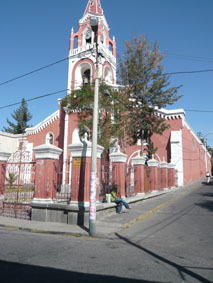
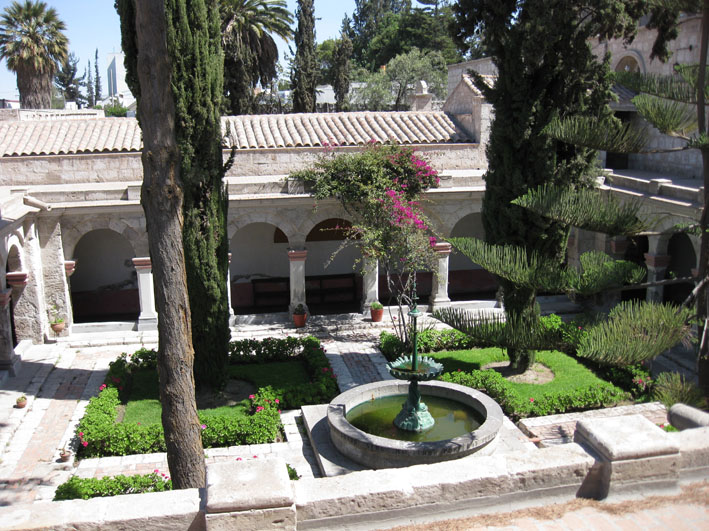
For a week and a half, Gary, Joyce, and I have been working in Arequipa, Peru at the Recoleta Monastery. We have been stabilizing and protecting damaged books. Many of these books have been damaged in earthquakes. They are in suprisingly good condition considering how old they are and what they have been through. We have been doing some mending and uniting books with custom boxes built by Linda Lundy and Joyce Miller in Iowa City.  Below are pictures of the Recoleta and the collections we are working with.   �
                     �


Marcas del Fuego or Metal Brands

Tuesday, April 14, 2009

We are currently working in the library of the Recoleta Convent in Arequipa, Peru. One of the most interesting things we have come across in this collection are the Marcas del Fuego. Marcas del Fuego are metal brands that were used to burn identifying marks into books. They were usually an initial or symbol associated with a library or collection. The Recoleta had different versions of it´s mark over time, these are a few examples.

Czech letter 2

Monday, April 6, 2009


This letter, besides being filthy, had a severe crease across the center. It was a manuscript rather than printed so I couldn’t wash it. I dry cleaned the three pages of the letter and placed it in a humidification chamber to relax the paper. I then put it between slightly misted blotters and under a board with no weights to make sure I didn’t set the crease. The staining remained but I was able to stabilize and flatten the letter. Most of the manuscript is still legible with the exception of one area on the front page that couldn’t be cleaned any further without risk.