Skip to content
Skip to main content

Material Instability and Other Woes

Tuesday, July 7, 2009


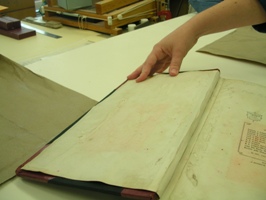
We have encountered every problem in the book (no pun intended) while treating these ledgers for the Johnson County Historical Society. These two pictures of the same ledger are good examples. The structure of the book was sound. It needed a little bit of cosmetic repair and hinge repair. The inside is a different story. Almost all the pages are illegible, the ink has run and bled obscuring most of the text in the ledger.

In the front of the ledger was taped a small pamphlet. It was in relatively good shape. When it
got wet in the flood some of the dye from the orange paper transferred to the pages around it. I dry cleaned it, removed the staples and took off the tape with a heat spatula and vinyl eraser.

The tape left in the ledger I did not remove because it would have made a mess of the paper trying to scrape and melt it off. While it is not ideal to have tape in the book, as it gets older the tape will become brittle and flake away doing far less damage.

Repairing Ledgers One at a Time

Monday, July 6, 2009

There are several different types of ledgers from the Johnson County Historical Society. This ledger was completely detached from the covers, but the case was intact. The spine and corner pieces were in good shape but the cover cloth was warped and bunched.

I began with the text block. I tipped in some pages that had become detached and then put the ledger in the job backer to re-form the round of the spine. It’s not hard to do with these books since they are so used to being rounded they just need a little coaxing. When I got the spine into the position I wanted it I used wheat paste to line the spine with a piece of kozo, a thin japanese paper which I stippled on with a stiff brush. While that dried I used a piece of kozo and wheat paste to reinforce the spine inside the cover, carrying it across onto the boards to give the hinge area more strength. I added new black cloth to the covers to “pretty them up” and set it under weight to dry. When the spine of the text block was dry, I added a cambric (cloth) lining with flanges overhanging each side of the spine about an inch. When that was dry I put the text block back into the original cover using pva to put down the cambric onto the japanese paper lining inside the cover. I then pasted the original paste-downs to the cover using wheat paste. When the whole thing was put together I placed it in between press boards and put it in the job backer so it would dry in the right shape.

Peeling The Smells Away

Wednesday, July 1, 2009

This ledger from the Johnson County Historical Society was in bad shape. The boards were warped, the spine piece had come detached, and the covers were almost completely off but for one small area. The covers were so far gone I decided to replace them altogether. I kept the cloth from the front board so I could attach the title to the front of the new case.

The board that most of the covers are made of was excellent at sopping up all kinds of flood goo and smells absolutely horrible. When we
can, we keep the original covers but in a situation like this it made more sense to completely rebind the ledger. Since we didn’t need to keep the cover boards I was able to peel the layers away from the areas of the page that didn’t release easily, without risk of tearing the paste-downs.

Adherography

Tuesday, June 30, 2009

While processing manuscript archive documents from the African American Museum of Iowa we fortuned upon an old, mysterious and extremely problematic form of document duplication.

What we believe we have, perhaps hundreds of, are adherography documents.  A definition, found in “Guide to the identification of prints and photographs : featuring a chronological history of reproduction technologies” – a supplement to the book “Encyclopedia of printing, photographic and photomechanical processes,” by Luis Nadeau, 2002 – is as follows:
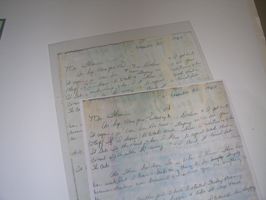
ADHEROGRAPHY: A duplicating process developed by 3M. Images were formed by the adherence of powder to a tacky latent image created by the effect of infrared heat. This provided a master from which 200 to 250 copies could be made. The powder image of the resulting print was fused to the paper by heat. [A process used during the 1960’s.]

These adherographs, recognized as inherently volatile, did not respond well to the moisture, humidity, and high temperatures generated by last June’s floods.  The powder image described above, once fused to a slick-feeling, glossy-looking paper carrier, have lost their bind to their paper hosts.

Reformatting is simple where the powder images free themselves in large pieces.  Unfortunately, many of the documents have experienced a shattering of the powder image layer.  Attempts to stabilize these particular documents in sonically-welded Mylar encapsulations have both pros and cons.  On one hand, the Mylar, having a strong static charge, lock the powder image fragments into place… useful for reformatting.  On the other hand, this same static charge has the tendency to agitate the fragments into incomprehensible disorder.

With the jury still out on encapsulation, we simply reformat through the best possible means.  Where the documents are relatively stable, we quickly scan them face down on the Ricoh.  Where the documents are highly volatile, we image them under the Zeutschel top-down scanner.  No digital files are maintained.  Determining the best solution for the shattered documents requires further research.  Stay tuned.

Inventorying Flood-Affected Collections

Friday, June 26, 2009

As conservation work moves along for flood-affected artifacts from the African American Museum of Iowa, we momentarily shifted away from treatment of metals to pick up our inventory of small objects comprised of a variety of media. Two primary functions of the inventory are to verify the holdings under our care against the original AAMI data and also to provide our own identification number for the artifacts. Tagging the artifacts with both IDs and generating descriptive data for our flood recovery inventory helps us track and evaluate where we are in the treatment process, and, consequently, how much work we have left to do.

Volunteer Dawn Completes Docket Project

Tuesday, June 23, 2009

One of our volunteers, Dawn Wellington, has been working on a project re-ordering and re-housing a collection of court dockets for the Johnson County Historical Society. She went through hundreds of dockets and put them back in order and into new document boxes. When she finished, we had Leigh Ann Randak, the curator of the historical society come down to meet Dawn and check out our progress on that as well as other projects in the works. Our volunteers have been invaluable for projects like this one. It’s so satisfying to have one more thing to check off the list!

Stuck Pages

Thursday, June 18, 2009

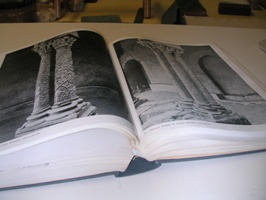
This week when Susan Hansen and I reviewed the work for the Art Library, she pointed out a book that had a block of pages stuck together. It felt like a brick. We were convinced that the book was beyond repair. However, before declaring the book a loss, we forwarded the book to conservator Gary Frost. To our complete and total amazement, he was able to salvage the book.

Gary took the book apart and pulled the section with the stuck pages. Then he trimmed the pages until he found the spot where the pages were no longer sticking together. The outer edges had sealed together tightly, keeping water from getting into the main part of the page. No text or photographic image was lost; only the margin. He chose to leave the rest of the pages at their regular length rather than risk cutting into text just to keep the book looking “good.”

If you look carefully at the book in the press, you’ll see that the stitching of the different sections no longer line up. All text is jogged to the top, this will keep the exposed edges clean, reducing chances of dust and dirt build up. This is important as bugs and mold thrive on dirt. We don’t want this book to suffer any more than it already has!

We try to salvage and reuse the book covers whenever possible. This cover was too far gone, so Gary made a new one. The book is now back on the shelf ready for use.

A Pressing Job

Tuesday, June 16, 2009

One of our biggest workstreams at the moment is the rescue of the files from the African American Museum. We have over one hundred boxes of manuscripts which unlike the working files, which can just be photocopied, need to be saved. They are mainly records and correspondence, there are some photographs and newspaper clippings and other miscellany. These boxes were all submerged and the wet boxes smashed into odd shapes so sometimes it’s a trial just getting the folders out of the boxes! The fact that the museum used waterproof boxes saved them. While they were damaged, the boxes took the brunt of it. The files are warped and did get wet but most of the mud and dirt stopped at the boxes so there is minimal dry cleaning. There is some staining from the water but mostly on the edges of the paper and it is purely cosmetic.

Before any treatment we’ve been discarding and replacing the boxes and folders, carefully transferring all the accession information. They were all well labeled which makes it much easier to keep things in order.

I’ve been separating out the photographs as we haven’t yet determined a treatment plan. The bulk of the file material is paper which is warped and dirty. We dry clean the sheets and then flatten them. The flattening method I’ve been using is using a spray mister to moisten the pages and then sandwiching them between sheets of blotter in the press. The water relaxes the paper to help eliminate the creases. The blotter paper is a very absorbent material which takes up the water as the pages are pressed under weight. The sheets come out perfectly flat and dry. If a sheet has water soluble ink I mist the blotter very slightly instead of misting the page directly to avoid feathering. Since the files were submerged most of the ink that would be affected by the water has already so it’s easy to tell where to be careful.

While they aren’t pristine and do still have a slight eau d’flood aroma they are mostly back to normal and mostly in good working order.

Commemorating Flood of 2008

Monday, June 15, 2009

Blog DSCN0754 We were invited to participate in the university’s special event, “Remember, Reimagine, Rebuild,” at the Old Capitol Museum commemorating the one-year anniversary of last year’s historic flood. The Old Capitol was open from 11 a.m. to 3 p.m. for the free event, which included displays of flood-related photographs and research, audio excerpts from the StoryCorps oral history project, remarks and a musical performance.The event was attended and included food (always a plus).

Anytime we can give preservation of cultural objects, The State Historical Society of Iowa Historic Resource Development Program, and our department a little visibility, I’m all for it.

Record Cleaning

Wednesday, June 10, 2009

Caitlin and I discussed the timeline for returning the LPs and 45s to the Czech Museum yesterday, and we decided to start forging ahead with the final wash of the albums. We are using the same method we used right after the flood, when there was still a ton of mud on the records. One tray with a mild and dilute soap, and another tray filled with only water for rinsing. As you can see, we  switched brushes–we needed a slightly stiffer brush for these more sturdy records. I am also holding the record upright, in order to minimize the water contact with the paper label, as we have found some of the inks will run.  After a quick dry on a rack, I don cotton gloves and wipe them to make sure there are no drips and then stack them to dry while I wash another round. In the afternoon, I then use a microfiber brush on the dry records and sleeve them. Then, after nearly a year of separation, the freshly washed record is reunited with a clean and newly sleeved cover.