Skip to content
Skip to main content

Colfax flood

Thursday, August 19, 2010

A team from the University of Iowa and the State Historical Society of Iowa spent two days early this week assisting Colfax Historical Society members with evacuating collections from their flood-damaged museum.

The museum was in the middle of a new building project next door to the current museum when the flooding hit. The older building, which housed the collections, took on at least four feet of water while the newer building, which is on higher ground, took only a few inches. The team was able to dry out the new building and use it to temporarily store the retrieved collections. Several volumes of the Colfax Tribune and other paper items are now drying in UI Libraries’ book freeze-dryer.

It will take several days to complete the evacuation of the entire collection and the UI/ State Historical Society team will continue to provide advice to museum staff.

The Colfax Historical Society has several other smaller buildings that were also damaged by the flood. Donations may be sent to Colfax Historical Society, PO Box 123, Colfax, IA 50054, to the attention of “Flood Recovery.”

Disaster Response Drill

Wednesday, July 7, 2010

Today we put into practice everything that we had learned over the five days. When students came to class they learned that there had been a “disaster.” They had to work in teams to recover the water and mud covered CDs, photographs, and books. They even had to deal with the paparazzi who asked them about the disaster and how much it would cost to recover. They knew that they should just tell the reporter that they didn’t know the extent of the damage and were working to stabilize the situation.

They learned that snakes and bugs could be a problem and that they needed to take appropriate precautions. They rinsed the books and packed them for freeze drying and set the CDs and photographs aside for air drying.

They learned that working in a team is a good thing. No one can handle a disaster onhis/her own. Students were encouraged practice the drills with colleagues once back home.

Outing to a Conservation Lab and Archives

Tuesday, July 6, 2010

This afternoon we went to Bruges to visit the conservation school which is a part of SYNTRA West. The students and teacher provided many demonstrations. We learned that wet paper needs a support when handling the paper or it will tear. We also saw several different ways of making boxes and were given a pattern that we could use.

After our visit we went to the National Archives building to observe the graduation ceremonies for the first class of conservation students. The course is two years long and costs about 3,000 euros.

We concluded our evening with a lecture by the Archivist. He showed us many different documents and explained about the archives program.

My Aunt’s Dinner

Monday, July 5, 2010

We checked our books after 5 days of air drying to see if they were dry. None were completely dry. Although several looked dry, when we touched the pages with the palms of our hands, the pages felt cool which meant they were still damp. A few books were ready to press. The rest we set out to air dry. We’ve learned that air drying takes a lot of patience.

We continue to learn about being prepared for a disaster.Today we did an exercise called ” My Aunt’s Dinner,” an exercise learned from the Campbell Center in Illinois. We divided into teams and discussed how we could host a dinner for 40 relatives after our Aunt had a fire in her kitchen and asked the team to host the dinner. The team had two days to host the dinner.

Some teams decided to call the relatives and delay the dinner. Other teams held the dinner on the regularly scheduled day and asked the relatives to bring chairs, dishes and a prepared dish. This exercise put the team through the disaster planning steps and had a group work together to deal with a disaster.

Book Drying Continues

Friday, July 2, 2010

After close to two days of air drying many, but not all, books were ready to press. We used a make shift press of books and bricks. Fans were set up to create good air circulation to continue the drying process over the weekend.

We began discussions on disaster planning and started to develop a plan for the individual libraries using DPlan Lite.

OceanTeacher Academy Course on Disaster Planning and Preparedness

Thursday, July 1, 2010

Today was our first session on disaster planning and preparedness at the Intergovernmental Oceanographic Commission Office for the International Oceanographic Data and Information Exchange in Ostend, Belgium. This is a five day course. One of our activities was to dry a wet book.

Each student pulled a book out of a tub of water. Although all books had been sitting in the tub for the same amount of time, some books were only wet around the edges and others were very, very wet. The books were interleaved with plain paper to wick the water out of the pages. For the glossy print books, a paper was inserted between each page; nonglossy paper books were interleafed every 10-20 pages. The papers in the books were changed 3 times during the day. By the end of the day, several books were dry enough to stand up and fan out to enhance the drying process.

More information about IOC/IODE can be found at
http://www.iode.org/


Exciting forum at ALA Annual

The forum Strategic Future of Print Collections attracted over 300 librarians. The forum was produced by Debbie Noland, Library Binding Institute, and Gary Frost, University of Iowa, and was sponsored by the Preservation and Reformatting  sub group and the Rare Books and Manuscripts sub group of the American Library Association. The program featured three presentations offering three perspectives on print delivery in a context of digital technologies.

Walt Crawford, commentator on role of libraries in society, offered an overview of the current dynamic use of print and screen resources in research libraries. He suggested that libraries promote “inclusionary” or “multiplatform” reading that combines use of print and screen resources. He also projects such interplay into the future; “We don’t know how interdependence (of print and screen) will play out – but can guess that all-digital is an inherently unlikely future except as an ideological assertion.”

Shannon Zachary, preservation librarian at the University of Michigan, described the intensive interaction of print and screen resources caused by Google Print reformatting. This processing has features of selection and de-selection that indicates a continuing role for print in a context of digital delivery. While Google reformatting of print books exponentially improves access there is more conflicted appraisal of the preservation implications. As with microfilm conversion, digital conversion progresses in context with a continuing role for print.

Doug Nishimura, senior researcher at IPI, continued a theme of interplay between print and digital technologies. He discussed how print on demand books enabled by digital sources and electrostatic printing promises to project the role of print far into the future. Research at the Image Permanence Institute is assessing the digital printing technologies and evolving diagnostic tools for performance and permanence of print on demand books.

The program proved very cohesive and conveyed a consensus across the wide perspectives presented. This consensus was that there is a digital future for print in libraries collections as both screen access, digital book manufacturing technologies and print reading all invigorate the future of books. A lively discussion concluded the forum and follow-up materials and bibliography will be available at an LBI web portal.

Rare Book Exhibit Completed in Peru

A University of Iowa Library Preservation team Gary Frost, Conservator, Joyce Miller, project support and technician and Bill Voss, Exhibit Conservator, has completed a project to prepare and install a 26 case comprehensive exhibit of the treasures of the Library of the Convent of the Recoleta in Arequipa Peru. The two week project (May 26 to June 5) was completed on-site with materials supplied by Archival Products and the UI Libraries.

exhibit cases

This education exhibit depicts the amazing story of historical libraries in this highland colonial city. These books introduced European learning into equally complex indigenous culture and so advanced dynamics of empire still in motion in the Americas. The library of the Recoleta contains 22,000 volumes spanning the 16th to 19th centuries and is rich in linguistics, history, sciences, arts and literature, religious doctrine and scripture, and philosophy. The library was founded in 1661. It features early Peruvian imprints including unique copies.

Fabulous voyages were required to bring European books to Peru. Outward voyages went southward to the Canary Islands where the westward winds were encountered. A long Atlantic crossing brought the cargo to Hispaniola in the Caribbean. Another voyage across pirate waters came finally to land at the isthmus of Panama. This overland crossing of swamp and mountains was no less difficult than the previous sailings. On the Pacific coast newly constructed ships began the long voyage down to Lima. Finally, books destine for Arequipa still required the long desolate crossing of the vast inland desert before the books reached the start of the highlands.

gary and guests in the workshop

The Library was used by a Franciscan Order with missions to many colonial communities. Here readers prepared their minds for great dramas of contact between cultures and great challenges of interaction. For the Padres the library is not just books but it is also a state of mind. UI Staff members enjoyed this exotic excursion into a different book culture. The UI team was honored at a spectacular opening reception given at the historical Cloister.

OLLI Creating Post-Bound Digital Photo Album Class

Friday, April 16, 2010

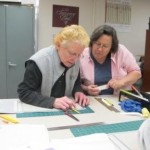
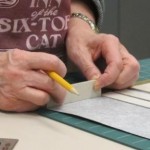
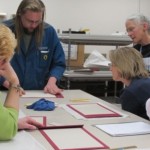
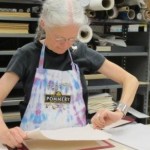
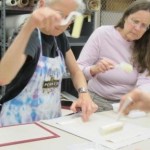
This is the fourth class that we have taught for the Osher Lifelong Learning Institute. It’s a lot of fun introducing students to the joys (and trials) of working in a conservation lab. All the material is pre-cut for the class participants ready for them to assemble. Well, almost ready to assemble. They still have to cut the cloth down to size, miter the corners, attach the cloth and pastedown, and make a hinge. Bill Voss has made jigs of various sizes to assist with spacing of hinge strips and mitering. The album has a fold-in hinge so that the posts are hidden.

Banner Repaired

Thursday, April 15, 2010

Blog IMG_0858This banner from the African American Museum was signed by Jesse Jackson. The signature and surrounding illustration were sprayed with some sort of fixative which didn’t end up being very sound. The large part of the banner was fine but the areas with the fixative were detached and curling up away from the image, taking with it the signature and image.

Blog IMG_0853After consulting with Gary we decided the best course of treatment would be using diluted lascaux adhesive. I applied this with a tiny brush and tacked down all the small curling flags. It was very time consuming but for the most part successful. The image and signature remain intact.

Blog IMG_0915