Skip to content
Skip to main content

OceanTeacher Academy Disaster Response Session 2011

Monday, May 23, 2011

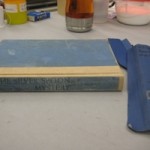
I am, once again, teaching a Disaster Planning and Recovery course at the OceanTeacher Academy in Ostend, Belgium. Today we learned about air drying books which can be very tedious and time consuming. Each book needs to have plain paper inserted between the covers and every few pages to wick up the water. Once the paper is wet, the paper needs to be changed for dry paper to continue to wick up the water to hasten the drying of the pages in the books.

We also learned that we needed to look at our building inside and out to see if there is anything that could become a disaster. Librarian Jan Haspeslagh gave us a tour of his library and pointed out things that are problems for his library. In particular, this library has drain spouts that are disconnected.
.

Celebrate ALA Preservation Week: Learn about Disaster Preparedness

Thursday, April 21, 2011

FREE ALCTS webinar for Preservation Week!

On Tuesday, April 26, 2011, Nancy E Kraft, UI Libraries Preservation Librarian will present a webinar, “Accidents Happen: Protecting & Saving Family Treasures” at 2pm Eastern, 1pm Central, noon Mountain, and 11am Pacific Time. It’s an hour in length.

Accidents and disasters happen. When it does are you prepared? Are your family treasures stored safely in your home or elsewhere? How do you save your photos when they’ve been submerged in flood water? What do you do if your books smell mildewy? What if your basement floods or worse? Kraft will provide tips and tools for checking out possible hazards around the house, dealing with mold and salvaging keepsakes, documenting damage for insurance purposes, and keeping your family safe.

These webinars are developed for the general audience. You could show them as a program at your institution. Past webinars are freely-accessible to the public.

This is a complimentary webinar presented as part of the Preservation Week events. To view a recording of the webinar, go to http://www.ala.org/alcts/confevents/upcoming/webinar/pres/042611. For all other questions or comments related to the webinars, contact Julie Reese, ALCTS Events Manager at 1-800-545-2433, ext. 5034 or jreese@ala.org.

Posted on behalf of the ALCTS Continuing Education Committee.

A Big Box for a Big Book

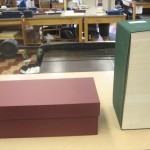
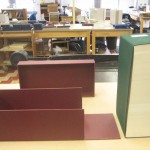
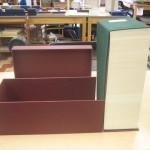
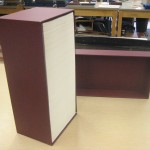
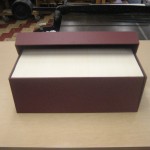
Say you have a really big book and need to house it in a box.  How can you get a two foot thick book in and out of a lidded box?

Answer:  a tailgate

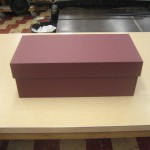
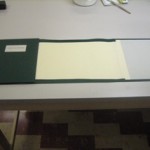
This double walled box with lid and tailgate (side flap) was made by Conservation Assistant and boxmaker extraordinaire Linda Lundy.  It is constructed two layers of 100 pt. board and covered with maroon buckram.  It is quite sturdy and allows the user to get the book in and out without difficulty.

UI Libraries Preserve Selected Websites

Thursday, February 3, 2011

Those hard copies of course catalogs, University annual reports, and department newsletters are becoming a thing of the past. In their place are “born digital” records – publications created and available exclusively online. This poses a preservation challenge to the University Archives, which has traditionally collected paper versions of these records. Web sites are not always permanent, unlike paper records, and are often at risk for loss. UI Libraries’ Preservation Department, the UI Archives and other units in the Libraries are now using ArchiveIt, a service provided by the Internet Archive based in Palo Alto, CA. It allows us to select University-created web sites for scheduled capture and future access. The Libraries began using this service in 2008 – about the time of the flood – and since that time has been tracking over 200 selected University web sites for on-line preservation. Recently links to the service were added to the Libraries’ web site.

To access the Internet Archive’s gateway to preserved UI web sites, go to http://archive-it.org/public/partner.html?id=120 and choose from the four collections available. Or go to the University Archives’ web site at http://www.lib.uiowa.edu/sc/archives/ and click on “Internet Archive.” It is also linked from the archives’ resource guides gateway at http://www.lib.uiowa.edu/sc/archives/faq/.

Sometimes Duct Tape Is Not The Answer

Wednesday, January 26, 2011

Susan Hansen has seen and fixed a lot of books in her tenure in Book Repair, but every once in a while one stands out.

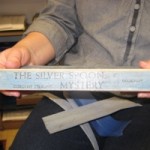
Recently, a 1958 copy of “The Silver Spoon Mystery” by Dorothy Sterling came to Susan, and she knew she could make it more stable, as well as more visually appealing. In fact, she had to.

This book was held together by royal blue duct tape, and the title was hand written on the tape in thick black permanent marker. To say these are Preservation “no-nos” is an understatement.

To stabilize the book, Susan did a reback treatment to replace the spine. During this process, Susan carefully removed the duct tape, and was pleasantly surprised to find the original spine. She removed it, and carefully scraped away the large amount of tape residue. Susan completed the reback by reattaching the original spine cloth to the volume, making the book appear much more like it would have when first published.

It’s all in a day’s work in Book Repair, but Susan’s effort has given “The Silver Spoon Mystery” a longer shelf life.

Spitler Donates to Bookbinding Model Collection

Wednesday, January 19, 2011

Priscilla Spitler has donated three workshop sample bindings to the University of Iowa Libraries Bookbinding Model Collection. These models present Priscilla’s superior skills of artistry and craft and provide instructional models equivalent to other workshop sets by Bill Anthony and Robert Espinosa also in the collection.
The first model demonstrates a full leather, sewn board, fine edition binding on a Franz Kafka text published by Press Intermezzo, Austin, 1997. This unique sample binding features a reveal of the uncovered upper board with the unattached board leather that exemplifies expert hand paring. The second model presents another sewn board variation with acrylic paste paper and line decoration throughout. It is sewn on a concertina guard to enable additional collage. The third model presents a lapped component cover, case construction binding with goatskin spine.

Together this set of workshop samples provides physical inspiration and enables detailed observation by students. Here is the evidence of the work of a great, fine binder.

Big Book Explained

Thursday, January 13, 2011
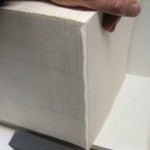
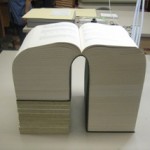
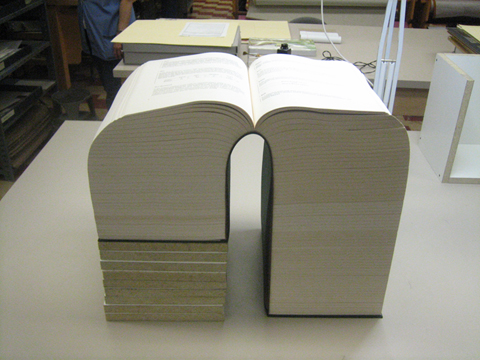
Binding a 10,000 page book is no small task! You can’t get your hands around all 10,000 pages at once so the book needs to be assembled into smaller units and then bound together using a specially constructed press to hold everything in place, nicely squared up, until the book text block is dry. Then there is the special challenge of making and attaching a book cover. The binding and cover must be strong and flexible so that the book can be opened and read. Finally, the book must be supported while reading, which can be done by using blocks to support the “shorter” side and adjusted as the reader turns the page. It generally takes about 3 hours to bind a 200-page book. This book took 24 hours spread over 4 days with a ½ day devoted to making a special press.

The text below describes the process that Bill Voss used. Feel free to skip the explanation and go straight to the slide show below at the end of the blog!

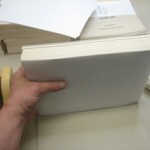
After research and consultation with others, Bill decided to use what we call a “perfect” binding, which is done by fanning the spine of a text block of loose sheets, applying PVA glue and then fanning the other way and applying more glue.

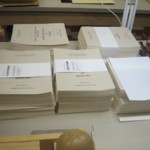
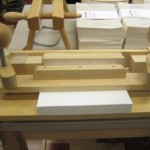
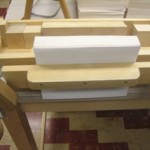
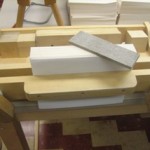
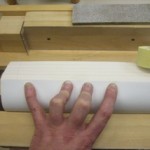
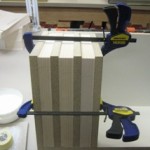
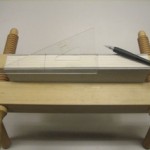
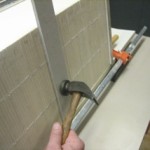
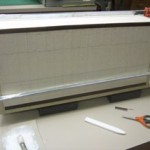
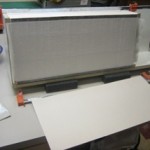
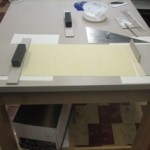
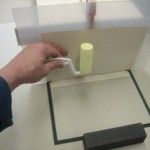
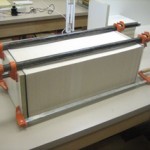
Since a two foot thick text block can’t be fanned all at once, Bill broke the text into 20 sections of five chapters (500 pages) each and glued them separately. A special press was constructed which would allow the sections to be jogged and hammered square to each other while under pressure. This press consists of a three sided box and press boards constructed from melamine particle board so as to accommodate the dimensions of the sections, which are a standard 8 ½ x 11”. After each section was glued up it was placed vertically between boards and pressed with clamps.

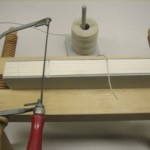
When all the sections were dry, kerfs (narrow channels) were sawn into them so that two sunken cords could be glued into the spine across its width to further strengthen the binding. All 20 sections were then assembled together in the press and clamped tightly while the cords and subsequent linings (kozo, cotton acrylic cloth, paper) were applied to the spine. Finally a large case was constructed and attached to the text block.

The finished binding is somewhat unwieldy, but can still be carried and opened to any point by a single person and can be supported while open by the simple expediency of placing a sufficient number of boards under one of the covers while the other cover rests on the table.

Kudos to Bill Voss, Bu Wilson and Dave Morice (Dr Alphabet) for working together to create, publish and bind the “Poetry City Marathon”.

10,000 page book bound at Conservation Lab

In Celebration of Iowa City being named a “City of Literature” by UNESCO,   Dr. Alphabet (Dave Morice) sponsored by Sackter House Media has completed his largest, longest, world-record breaking poetry marathon by creating a 100 volume work of 10,000 pages in 100 days.
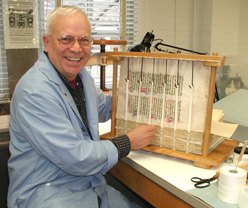
The marathon was a highlight of a four-month exhibit at the University of Iowa Main Library honoring the history of the University of Iowa Writers Workshop and the Actualist Poetry Movement.  The full text is available online at

http://iowacitypoetrymarathon.com/index.html

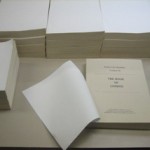
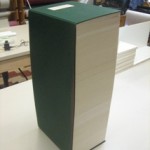
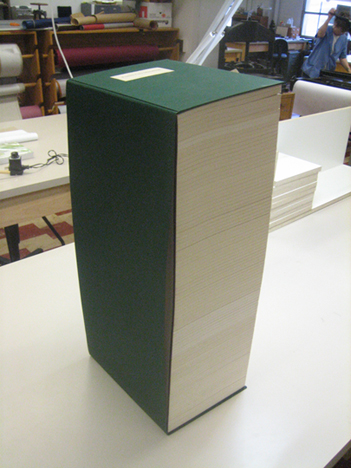
The final text of 10,119 pages was printed out by Bu Wilson and bound by Bill Voss of the UI Library Preservation Dept.  The binding measures 8 1/2 x 11 x 24 inches and is possibly the thickest single volume book ever bound.

Poetry City Mararthon

Frost Honored by Guild of Book Workers

Wednesday, October 13, 2010

Gary Frost, Conservator, University of Iowa Libraries, has been given the Lifetime Achievement Award for 2010 by the Guild of Book Workers. The Guild, founded in 1906, is focused on service to the hand bookbinding community. Frost joins other Awards recipients Bernard Middleton, Hedi Kyle, Don Etherington and Michael Wilcox. He is cited for contributions to conservation education and bookbinding studies. The Award will be presented this week during the “Standards of Excellence Seminar” in Tucson, Arizona, October 14-16.

The GBW article citing Gary’s achievments notes that Gary was a “key player during the pivotal period in the ’70s when the bookbinding field turned its attention from the traditional focus on the decoration of the book to the new fascination with the structure of the book.” The article talks about Gary’s fine drawings detailing book structures and his thought-provoking website http://futureofthebook.com/. The article concludes that “Gary is a rare bird who over four decades has become a monumental personality in the book world.” For entire article see http://guildofbookworkers.org/awards

What the article doesn’t note is Gary’s tendency to make up words when he can’t find one to describe something. Those of us who work with Gary have caught on to his unique use of words and have even started using some of his words and phrases. So much so that when we write something for public consumption, we have someone else read the text for “Garyisms” so we can re-write into plain English!

Congratulations, Gary, it’s an honor to have worked with you these past 10 years.

Czech book project

Tuesday, August 24, 2010

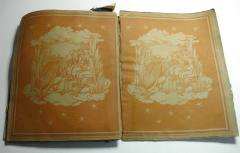
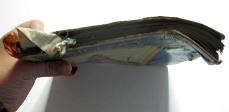
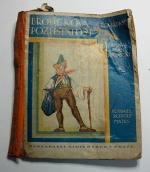
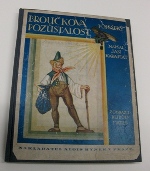
One of the projects that we’ve just begun to address has been waiting two years. The Czech Slovak library has roughly 7500 books that were frozen post flood. They estimate that 20 % of the books are damaged beyond repair and will need to be replaced.  Nancy and I went up to meet with Dave Muhlena to get an idea of the range of material and extent of the damage to the books. We took a random sample of 19 books which I brought back to the lab to work on. This children’s book was in such bad shape I thought it would be a good example. These images are of the book in it’s post flood condition before it’s been worked on.

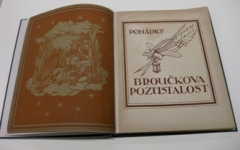
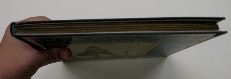
To flatten this book I humidified it, interleaved with 10 pt. card and put it in the press overnight. The moisture relaxed the paper and the card interleaving absorbed the excess. The pressure of the press reshaped the warped pages to lie flat again. I lined the pastedowns and endsheets with paste and thin japanese paper so I could reattach them to the text block. I made new endpapers and a new case for the cover and reattached the cover image to the front of the book. This was the result: