
Skip to content
Skip to main content

American Indian Powwow & Exhibit Share Native Living Traditions

Addendum to blog entry on August 7, 2012:


Are you looking for a cultural activity for this coming weekend? How about attending the Meskwaki Powwow in Tama, Iowa? Here is a little historical preview from our exhibition titled “American Indian Dancing: Ethnic Stereotypes, Community Resources, Living Traditions”:


The Powwow Then and Now

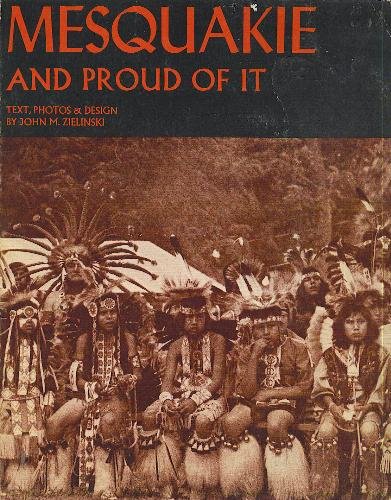
By the 1960s, American Indians were using the so-called “powwow circuit” – a network of dance competitions held near Native population centers across the U.S. – to socialize and revitalize their cultures. Eastern Iowa also hosted Indian dancing events. In dated language, Laurence Lafore mentioned it in the October 1971 issue of Harper’s Magazine.

“The surviving red men of the Mesquakie tribe are said to be degraded and oppressed, although the Tama Pow-Wow is a celebrated and good-natured show, and at the approach to Sac City there is a large billboard announcing “Welcome to the home of friendly Indians. You’ll like them without reservations”.”


John M. Zielinski, Mesquakie and Proud of It. Kalona, Iowa: Photo-Art Gallery, 1976. Special Collections x-Collection FOLIO E99.F7 Z5


The Meskwaki are proud that they got some of their territory back not through the grace of the U.S. government, but through their own peaceful efforts: they bought their old lands back from white settlers in Tama, Iowa. Thus they made Tama a settlement, and not a reservation. The billboard’s phrasing not only advertised the powwow, but it also expressed Native resistance to oppressive U.S. Indian policy with subtle humor.

This year’s Meskwaki powwow will be held in Tama between August 9 and 12, 2012. For details, please see the powwow website at http://www.meskwakipowwow.com/


Original blog entry on April 5, 2012:
 

Are you going to attend the University of Iowa Powwow this weekend (April 7-8)? Have you ever wondered about the origins of the event? This June, Special Collections and University Archives will be presenting an exhibit on the popular history of American Indian dancing from our collections. Here is a preview that can help you understand what goes on at the powwow.

UI Powwow 2009 poster - made by Christine Nobiss


The Powwow as Cultural Revival

Even as white Americans appropriated some of their culture to define Americanness, Indians never stopped using music and dancing for their own purposes. Having moved to the big cities on the U.S. government’s post-World War Two relocation programs, many Native Americans reached back to their tribal cultures for spiritual sustenance and dignity in the face of prejudice and poverty. By the 1960s, American Indians were using the so-called “powwow circuit” – a network of dance competitions held near Native population centers across the U.S. – to socialize and revitalize their cultures.

Student lobbying for more ethnic inclusion and cultural diversity on The University of Iowa campus led to the 1971 creation of the Chicano and Indian American Cultural Center, the predecessor of today’s Latino and Native American Cultural Center. The UI’s American Indian Student Association (AISA) became a separate entity in 1990. In addition to organizing conferences, service learning projects and outreach, the Center and AISA have been greatly enriching our communities with the annual University of Iowa Powwow ever since.

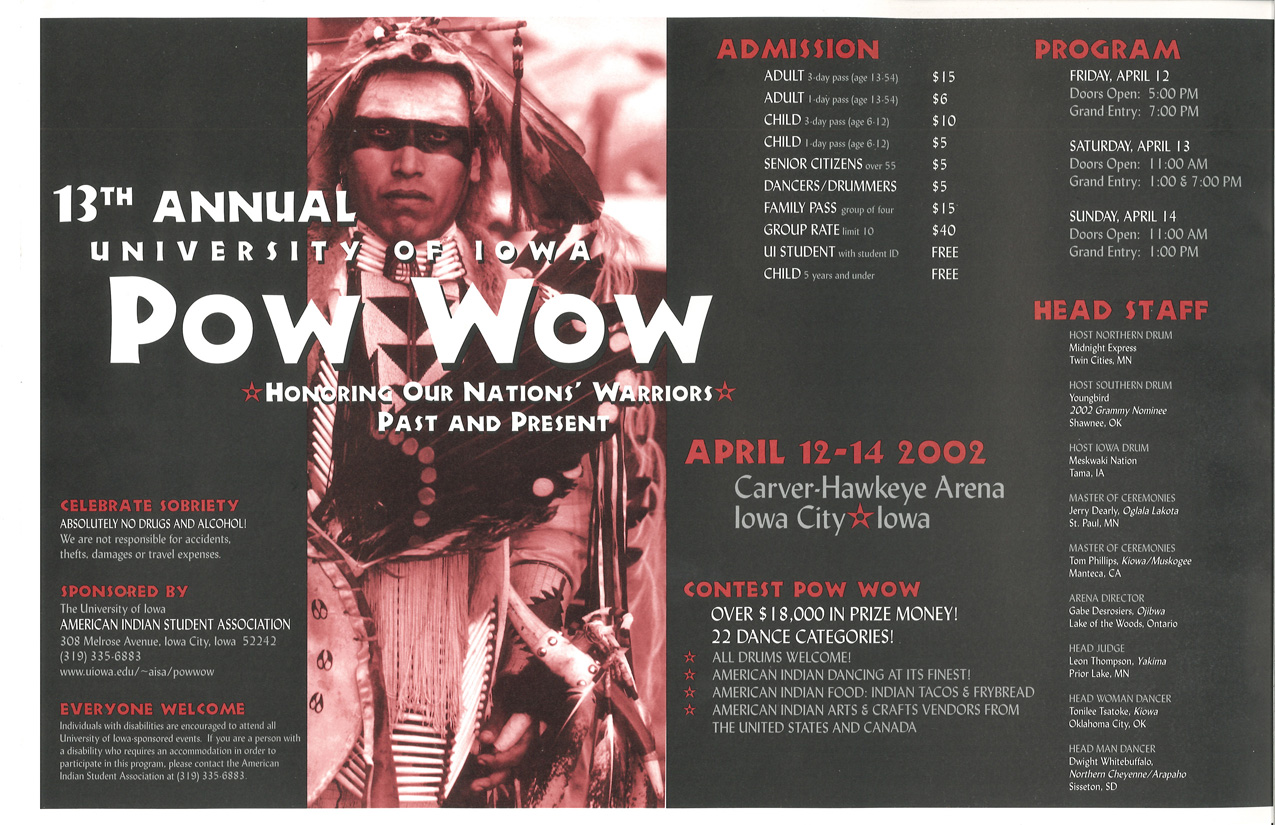
2002 UI Powwow poster


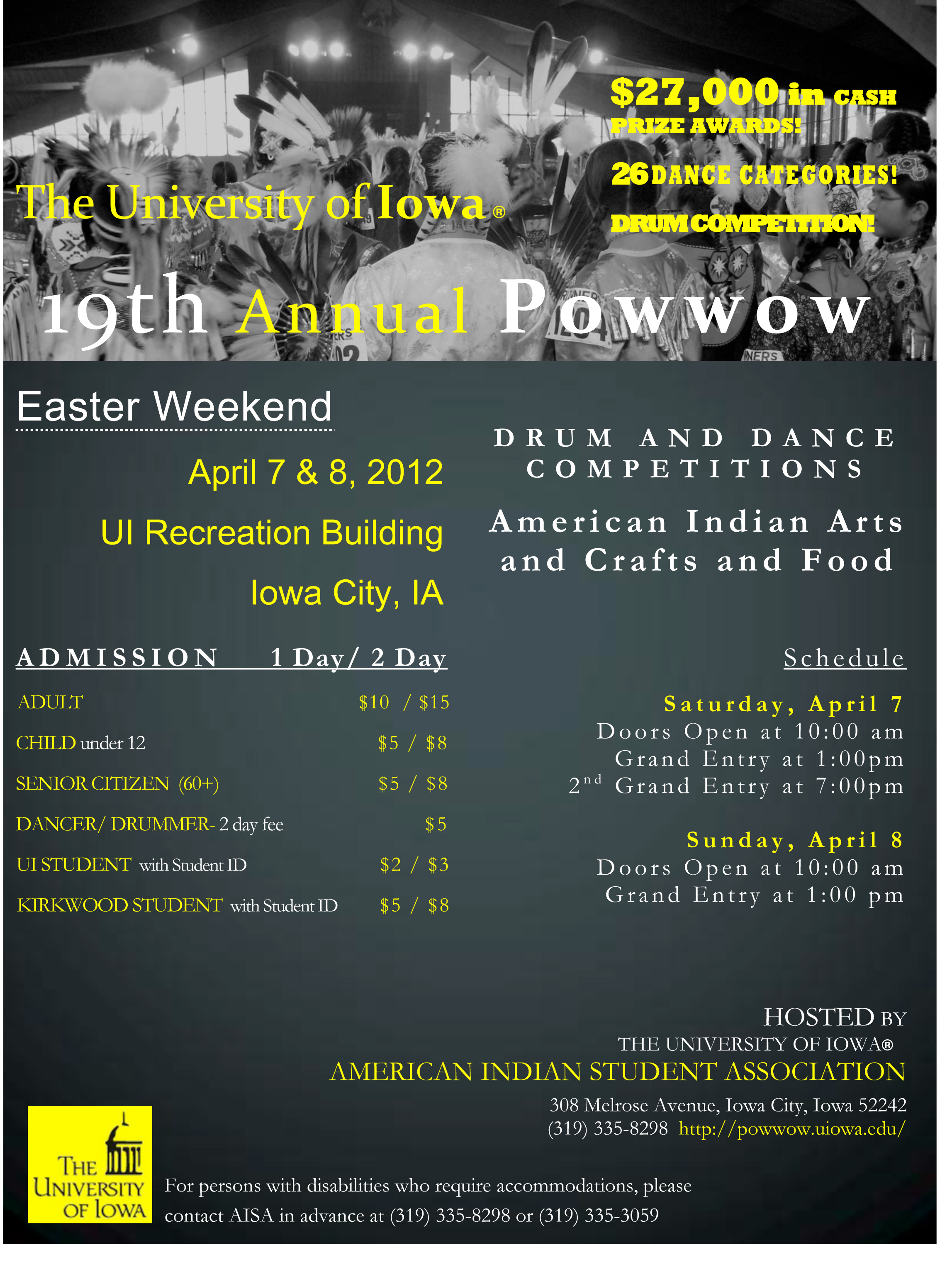
The powwow is an opportunity for all to respectfully share and support Native American cultures. The event has a well-defined structure and a program. It is usually held in a large hall with the dance arena in the center, with places for the drum groups, and surrounded by sections designated for resting dancers and their relatives, and the audience. Along the inner walls of the hall are the booths of arts and crafts vendors, as well as stands that sell Native American foods such as fry bread.

There is a protocol all must follow to make the event enjoyable and respectful. The program usually opens with an invocation or prayer ceremony. The opening event is almost always the marching in of veterans of U.S. wars with the country’s colors, stepping to a song that honors their military service. The subsequent dances have a strict order, and they are announced by the master of ceremony, a position of honor in Native America. Various dances for each sex include traditional style, jingle, and fancy dancing, and they differ in footwork, regalia, posture, and meaning. Often dancers perform their own story. Their regalia are the result of years of hard work, monetary investment, and meaningful gifts. Judges evaluate the dancers in each category, but also the drum groups and singers, who come from many corners of Native America. Besides the cash prize, winning a powwow category honors the dancer or musician, and furthers their own and their family’s reputation across Native communities.

2012 UI Powwow poster


The American Indian powwow is a combination of a variety of cultural forms. Some of its most prominent dance forms like the Omaha or the Grass Dance are derived from the old warrior society dances that Karl Bodmer and George Catlin recorded in their paintings back in the 1830s. Another origin of the modern powwow are the Old Glory Blowout gatherings held by Buffalo Bill in the 1880s near Indian reservations as auditions for the rodeos, dancing and re-enactment performances of his Wild West Show. These events encouraged inter-tribal interaction and cultural exchange, and led to more frequent gatherings with participants from a variety of Native nations. Community dancing also expressed resistance to white domination when the government’s officials were suspicious of or tried to suppress dancing on reservations. Since the mid-20th century, powwows have also featured honoring dances for Native American veterans of the U.S. military – which makes them events of veterans homecoming. When you experience a powwow, you can ‘read’ the event for traces of this rich history of Native-white relations.


Please mark your calendars and visit the UI Powwow website here: http://powwow.uiowa.edu/


The American Indian Student Association welcomes donations to offset the costs of staging the powwow in our community. AISA accept checks sent to their address at

The American Indian Student Association, The University of Iowa, 308 Melrose Avenue, Iowa City, Iowa  52246 Fax: 319-335-2245 Email: studorg-aisa@uiowa.edu


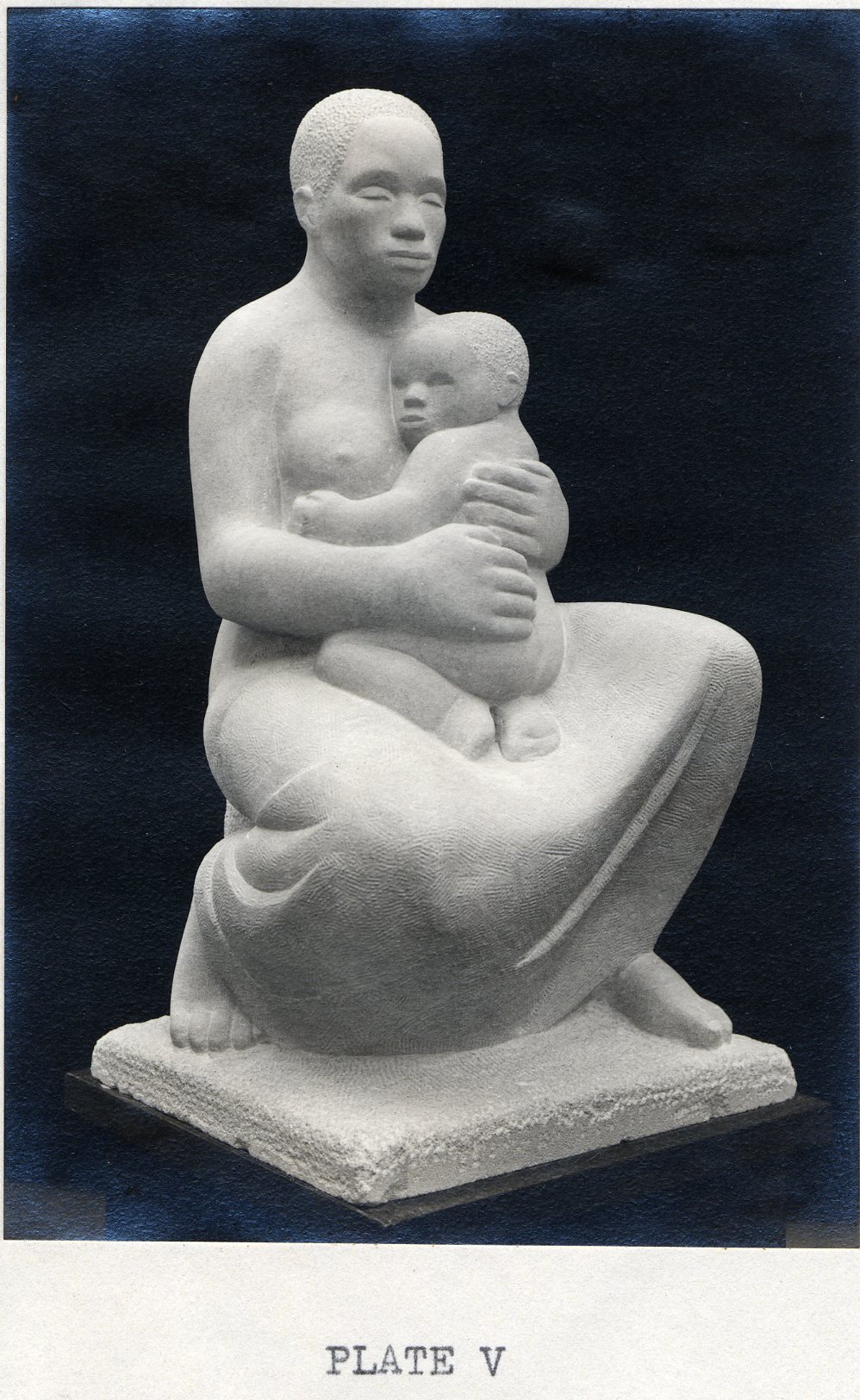
Farewell to Elizabeth Catlett

Image of Catlett's final sculpture "Negro Mother and Child"The New York Times reported today that “Elizabeth Catlett, whose abstracted sculptures of the human form reflected her deep concern with the African-American experience and the struggle for civil rights, died on Monday at her home in Cuernavaca, Mexico, where she had lived since the late 1940s. She was 96. “
 
Elizabeth was among the first three students to be awarded the MFA degree at the State University of Iowa, and the first African American woman. Her 1940 thesis is in the University Archives; it is a discussion of her sculpture in stone, “Negro Mother and Child.” SUI (as it was known until 1964) was the first public university in the U.S. to accept creative works in lieu of written theses for the Master of Fine Arts degree.
 

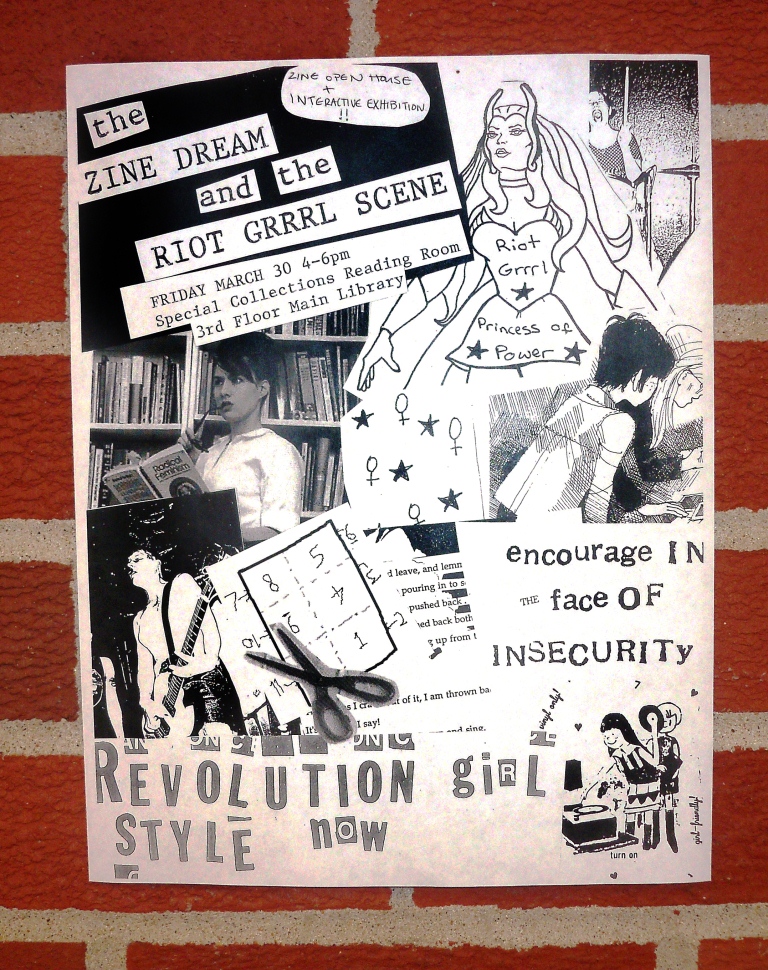
The Zine Dream and the Riot Grrrl Scene March 30th 4-6PM

Event posterBECAUSE us girls crave records and books and fanzines that speak to US that WE feel included in and can understand in our own ways…

BECAUSE we must take over the means of production in order to create our own meanings.

                                                from “Riot Grrrl Manifesto,” Bikini Kill #2


In conjunction with the Mission Creek Festival of music and literature, Special Collections hosts “The Zine Dream and the Riot Grrrl Scene” on Friday, March 30 from 4-6 pm. A cooperative project of librarians, scholars, and zine-makers, this event will highlight the 1990s Riot Grrrl movement and its independent publishing zine culture by exploring the intersection of music, writing, and social issues.


The zine open house and interactive exhibition will give visitors the opportunity to interact with and learn about zines in a variety of ways. Monica Basile, a zine-maker, artist, and PhD candidate in Gender, Women’s, and Sexuality Studies, will curate a browseable selection of zines in the reading room. We hope to open a conversation on the importance of zines and zine culture by inviting participants to share their experiences and thoughts for up to five minutes each, using the egg timer discussion format. Attendees will also have the chance to work on a collaborative zine which we will copy, collate, and share with all of the contributors. Zine newbies, Riot Grrrls, librarians, zine-makers, students, scholars, punk rockers, writers, community members – all are welcome; please join us!

We’re Moving on Up!


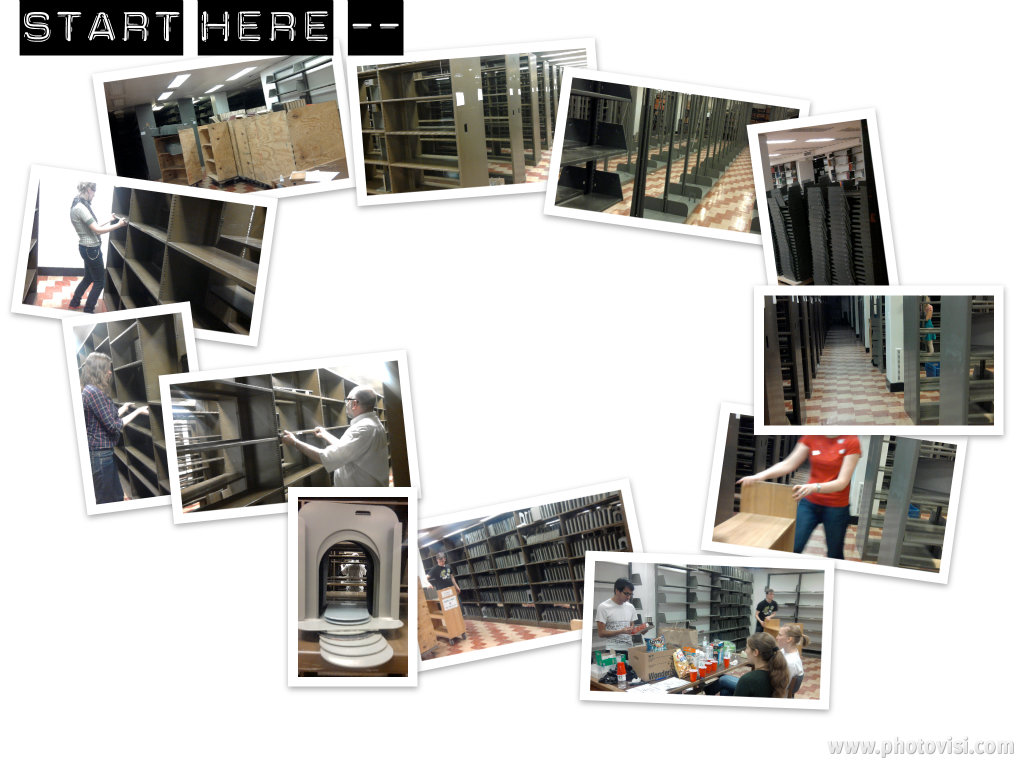
The thunderous noise in the halls near Special Collections & University Archives is not an approaching storm, (we have had enough water for a lifetime), but rather the sound of cart wheels rolling back and forth carrying shelves.  The Books are on the Move all over the Main Library and Special Collections is no exception.  Our basement storage area is infamous from the 2008 flood, when hundreds of volunteers from across the campus and the community joined in an effort to relocate 14,000 linear feet of books and manuscripts to higher floors. Now, as a consequence of the upcoming renovation work in the Main Library, we have an opportunity to honor their contribution by ensuring it will not likely be needed again. We are moving all of the collections up from the basement to the third floor.  Our collections will all be housed together, greatly increasing our ability to page items quickly for our patrons. 

We are undertaking this move internally so yesterday our dedicated student workers finished replacing small shelves with larger ones that will safely hold Special Collections materials and archival boxes.  Our students, trained in handling rare materials and familiar with our storage locations proved themselves this summer when they shifted thousands of volumes in our third floor stacks in far less time than we planned for the project. Lindsay Morecraft has helped with both moves and she thinks student movers have advantages.  “We know these materials and know that they have to be taken care of.  We can see them as individual items and not as just objects to be moved so we can handle the materials better and be sure nothing gets lost, out of order, or damaged.  It’s a lot of work, but in the end not going down to the basement and having everything in a central area will be a big help.”

Our heartfelt thanks go out to all of our student workers and volunteers. Though their work is hidden, today, like every day, the paging, shelving, processing, and moving are what make it possible for everyone from visiting classes, to researchers in the reading room, to junior high students working on National History Day projects, to be able to see and learn from our collections and contribute to the life of the university and our UNESCO City of Literature, Iowa City. 


Books in the World of Downton Abbey

Downton Abbey exhibition image

Our new exhibit in the departmental cases is now open. It focuses on the ITV/PBS series Downton Abbey, which is currently in its second season on Masterpiece Theater. The exhibition can be viewed on the third floor of the Main Library anytime the building is open. The items on display include books mentioned in the dialogue from the show, as well as books on household customs, World War I, and the English aristocracy, all selected to bring the era depicted in the show to life.

Special thanks are due to Pete Balestrieri for conducting the research for the exhibition.

Here is a list of the items in the exhibition. An asterisk means the title or author was mentioned in dialogue from the series.

Elisabeth Balch, Glimpses of Old English Homes, 1890

Mrs. Beeton’s Book of Household Management, 1861

*Burke’s Landed Gentry, 1937

*Elizabeth von Arnim, Elizabeth and Her German Garden, 1900

*Arthur Conan Doyle, The Lost World, 1912

*H.G. Wells, The War of the Worlds, 1898

*Kenneth Grahame, The Wind in the Willows, 1940 edition

*Photoplay magazine, 1919

*J.A.R. Marriott, England Since Waterloo, 1918

*G.A. Henty, St. George for England: A Tale of Cressy and Poitiers, 1900

Journal des dames et des modes, 1914

English Illustrated Magazine, 1912

Play Pictorial, 1916

Florence Hull Winterburn, Principles of Correct Dress, 1914

John Buchan, Battle of the Somme, 1915

Edmund Blunden, Undertones of War, 1928

Hallie Eustace Miles, Economy in War Time, 1915

Illustrated War News, 1916

Baron Dunsany, Tales of War, 1918

Siegfried Sassoon, Memoirs of an Infantry Officer, 1930

The Sinn Fein Rebellion Handbook, 1917

Edmund Blunden, manuscript letter to Cambridge Magazine and draft of the poem “The Hawthorn Lane,” 1917

Illustrated London News, 1923 (depicting the discovery of the Tomb of Tutankhamen by Lord Carnarvon of Highclere Castle, the English country house where Downton Abbey is filmed).

Once Upon a January Day: Presidential Politics in Iowa

Are you getting ready for the Iowa Caucuses next Tuesday? The University of Iowa Special Collections has some remarkable holdings of the history of presidential politics. Come visit us to catch a glimpse of caucuses and elections past, and even see the signatures of U.S. presidents!


The Iowa caucuses have been the first major event in the U.S. presidential nomination process since 1972. Would you like to learn more about these early caucuses? Request to look at some of the personal papers in our collections – here are two examples:

Outside of his business interests, W.H. Goodrich (1914- ) has been active in Republican politics at both the state and national levels. He has served as the state finance chairman of the Republican Party in Iowa, he was a delegate to the 1976 Republican National Convention, and was a regional coordinator of delegate operations for President Gerald R. Ford in 1976. The papers of W.H. Goodrich are all related to his work for the Republican Party, especially to his home area of Humboldt and Webster Counties in Iowa. Much of the collection concerns the 1976 election, with materials relating to the national convention, finances, and the national committee. Correspondence with President Ford is found throughout the papers, as well as letters from Wiley Mayne, Robert D. Ray, and William J. Scherle. http://www.lib.uiowa.edu/spec-coll/MSC/ToMsc400/MsC351/MsC351_goodrich.html

From the late 1960s, Paul A. Smith both participated in and shaped the Iowa Democratic caucuses by developing their policies and procedures. His papers include records for precinct caucuses, papers related to setting up precinct caucuses, papers related to platform planks submitted to precinct caucuses, reports of who was elected from precinct caucuses to the Central Committee and Committee on Committees, Platform Committee to the County Convention. (Smith served as Chair in about 1972). At the time of donating his papers, Smith also wrote a personal account of his experience with Iowa Democratic politics. http://www.lib.uiowa.edu/spec-coll/MSC/ToMsC850/MsC808/paulsmith.html


The Iowa caucuses have also been documented through photography. The Michael W. Lemberger Photography Collection documents the life work of the Ottumwa, Iowa, photojournalist and collector. Lemberger has been an active photojournalist and artist for more than 50 years. In his photography Lemberger captured presidential candidates in the Iowa caucus season. http://digital.lib.uiowa.edu/lemberger/index.php


Do you remember the feverish caucus season of 2007/08? You can relive the personal visits of some of the candidates by watching a recording of their campaign events online:

A number of talks were hosted by the Iowa City Foreign Relations Council, a non-profit association interested in learning more about U.S. foreign policy, world affairs, and current global issues impacting society. These presentations were all held in Iowa City and many were broadcast on public radio stations in Iowa and the Iowa City Cable TV Channel 4. The Iowa Digital Library collection brings presentations of these experts on-line to a wider audience. http://digital.lib.uiowa.edu/icfrc/index.php

From 2007-2008, Political Science professor G. R. Boynton collected nearly 2000 online videos posted by eight of the 2008 presidential candidates’ campaigns. Four Democratic and four Republican candidates are represented in this archive featuring videos spanning from each candidate’s announcement of candidacy to their withdrawal from the race (or procurement of the nomination). As a collection, these videos highlight the flurry of regional political activity leading up to the Iowa caucuses. As these videos begin to disappear from their original online sources, archiving them in the Iowa Digital Library will also serve to support their research value through long-term access. http://digital.lib.uiowa.edu/pcv/index.php


What did would-be-presidents and sitting commanders-in-chief think of Iowa and Iowans? School of Library and Information Science graduate student Julie Zimmerman created an exciting mini-exhibition of materials that answer this question. Julie’s display features presidential photographs and letters written to and about Iowans, and signed by Presidents Lincoln, Theodore Roosevelt, Taft, Kennedy, and Reagan. Which presidential letter is a forgery and why? To find out, please come and visit the installation on the 3rd floor of the University of Iowa Main Library during opening hours.

Special thanks to Julie Zimmerman for putting together the display on U.S. presidential materials in our collections!

The U.S. Goes to War – and the War Comes to Iowa IV.

We are commemorating the 70th anniversary of the U.S. entry into World War Two by highlighting some items in our collections relating to this event.  Library and Information Science graduate student Katherine Wilson’s exhibition at Special Collections & University Archives brings the Iowan war effort to life.

How did the University of Iowa and ordinary Iowans respond to the coming of World War Two to America?

Jackson Lester Hyde of Cedar Rapids, Iowa, enlisted in the U.S. Army in 1942. Hyde was first stationed at Fort Custer, Fort Knox, Fort Benning, and Camp Gordon. A technician fourth grade, he was trained as a radio operator in the 210th Armored Infantry Battalion, 10th Armored (Tiger) Division, U.S. Army. After being shipped overseas in late May or early June of 1944, Jackson L. Hyde, served in France, Belgium, and Germany, surviving the grueling Battle of the Bulge. Hyde was killed in action, March 2, 1945, presumably at Trier, Germany. He was posthumously awarded the Bronze Star “for heroic achievement in connection with military operations…at Noville, Belgium during the period 19 – 20 December 1944,” and the Purple Heart for the wounds resulting in his death. Hyde’s Purple Heart, division indignia, and other objects from his service are featured in Katherine’s display.


The University of Iowa responded to the U.S. entry into the war by strengthening its existing programs and launching new initiatives to help the war effort. In addition to its Department of Military Science, the University opened one of the nation’s first U.S. Navy pre-flight training schools.

In addition to training men, the University of Iowa community also offered chances for women to help in the war effort. “War Time Services Open to Women Students” included Red Cross nursing and volunteering in hospitals, being office workers and makers of signs, helping with war bond drives, and hostessing at the U.S.O. and troop recreation events.

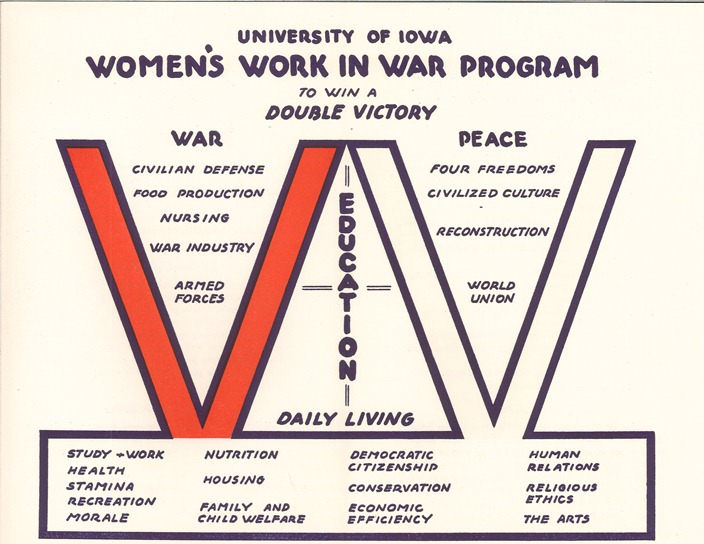
A UI student organization envisioned the war effort and the future in their promotional poster featured in Katherine’s installation:


UI Womens Work victory program poster

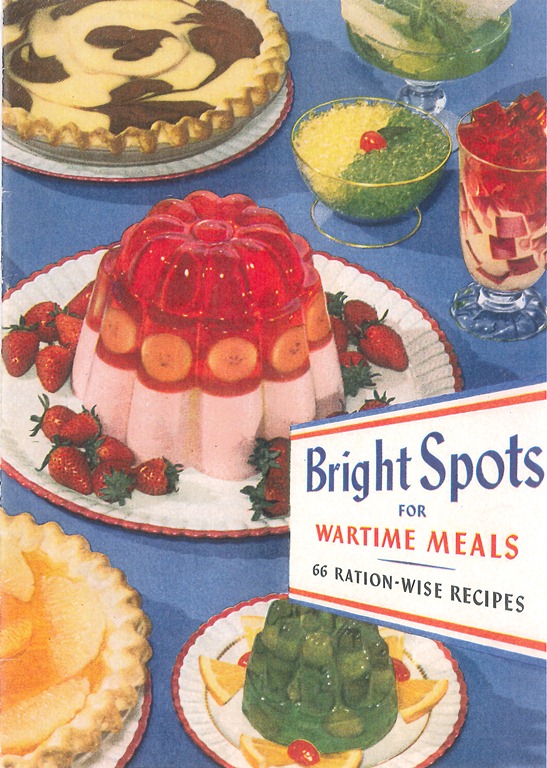
As nation wide rationing was introduced in the United States in 1942, housewives were hard pressed to make do with limited amounts of food ingredients like sugar, meat, cheese, and margarine. Food companies and the U.S. government published recipe pamphlets to help families make ample and nutritious meals from these rationed resources. Our Szathmary Collection of the Culinary Arts features many such pamphlets in addition to cookbooks and manuscripts. Katherine’s display used this one:

Wartime jello recipe pamphlet, 1944

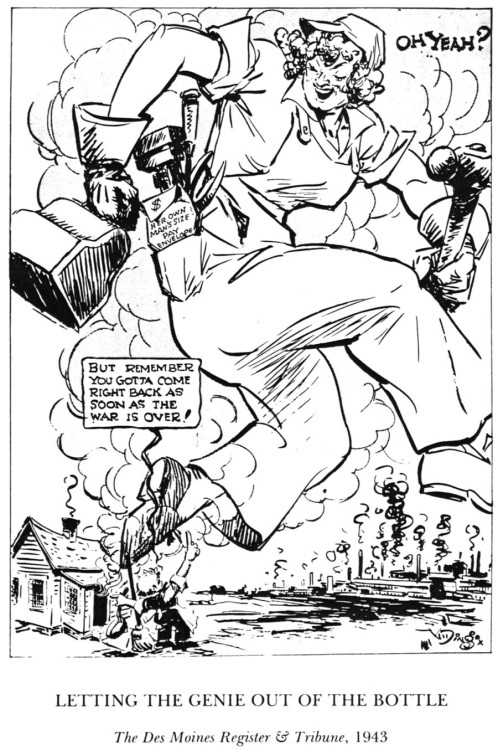
In wartime America, millions of women were encouraged to step up and work in the factories and industries that men had to leave to serve in the military. This was a major economic and social revolution, and the implications were not lost on the people of Iowa. In 1943 editorial cartoonist J. N. “Ding” Darling published in the Des Moines Register  a picture titled “Letting the genie out of the bottle.” Darling is oubviously apprehensive of the newy found economic and social power of women.


Letting the genie out of the bottle 1943
"Letting the genie out of the bottle." By J. N. "Ding" Darling, Des Moines Register, 1943


Special thanks to Katherine Wilson for putting together a display about the wartime experience in Iowa. Please come and check out her installation on the 3rd floor of the UI Main Library.


For a description of our collection of the papers of Jackson Hyde, go to

http://www.lib.uiowa.edu/spec-coll/MSC/ToMsc450/MsC422/MsC422.htm

For a description of our collections about military and wartime service at the University of Iowa, go to

http://www.lib.uiowa.edu/scua/archives/guides/RG28.01.htm

For the digitized part of the Szathmary Culinary Arts collection, please go to

http://digital.lib.uiowa.edu/szathmary/

The U.S. Goes to War – and the War Comes to Iowa III.

We are commemorating the 70th anniversary of the U.S. entry into World War Two by highlighting some items in our collections relating to this event.


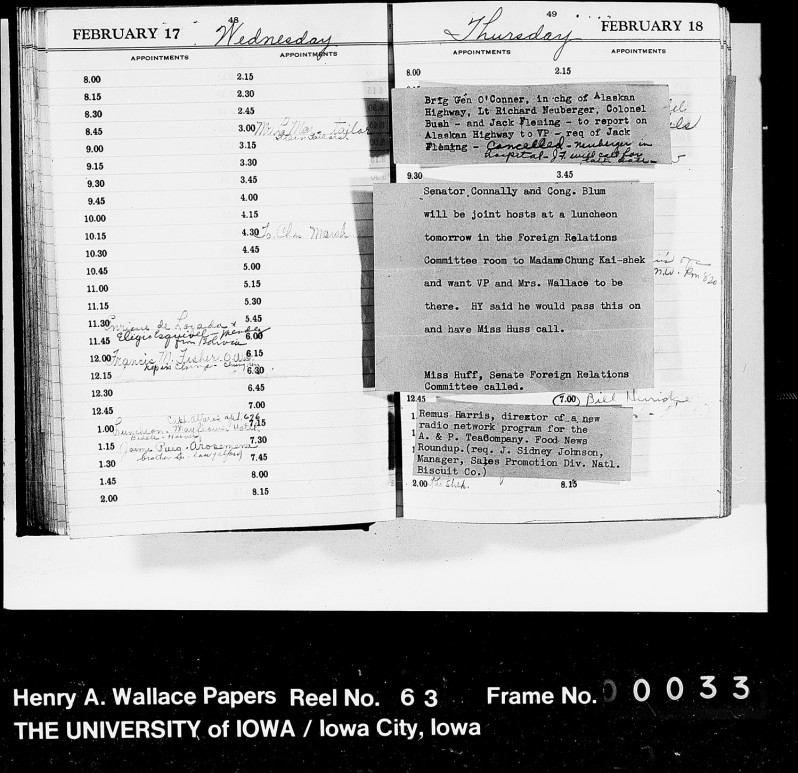
Vice President Henry Wallace's appointment book 1943


How did Henry A. Wallace, an Iowan and national politician respond to the coming of World War II to the United States? A look at his official Vice Presidential diaries reveals little.  The day when the Japanese attacked Pearl Harbor was December 7, 1941, a Sunday. Vice President Wallace’s schedule for that day is empty. But that does not mean that he was not busy that day. John C. Culver and John Hyde in their biography of Wallace titled American Dreamer, write:


“[…] Wallace went to New York City with Secretary of Labor Frances Perkins to meet with Latin American officials. They were there to discuss the need for pan-American unity and his vision for a world in which democracy and abundance would become reality.  […]

Shortly after lunch that day (1:25 PM on the East coast; 7:55 AM in Hawaii) Japan launched an air attack on the U.S. fleet stationed at Pearl Harbor. Wallace learned of the attack from someone who heard a news flash on the radio. A few minutes later a White House operator reached him on the phone and said a plane was waiting at the airport to return him to Washington immediately.

Wallace went directly to the White House, where he learned the grim facts: 2,403 American lives lost, hundreds more wounded, the battleship Arizona and 18 other ships ruined, hundreds of planes destroyed or damaged. Roosevelt had cabled the words “Fight Back” when he learned of the attack. […]

Wallace stayed at the White House through the long evening, discussing the situation with Roosevelt personally, then sitting through somber meetings with the cabinet and congressional leaders, remaining until almost midnight to talk again with Roosevelt and [Under Secretary of State] Sumner Welles. The president was “really very gravely concerned,” Wallace later said. “We all were drawn very close together by the emergency. Americans are very good when they really get up against it.” (Culver and Hyde, American Dreamer: A Life of Henry A. Wallace. W. W. Norton & Company, 2000, 264)


Walllace’s vice presidential diary for the next day lists a 10 AM White House conference, and a noontime “Joint Session of Congress – Declaration of War on Japan.”


To see our digital Henry A. Wallace collection, go to

http://wallace.lib.uiowa.edu/

To see the description of our larger, physical collection of the papers of Henry A. Wallace, got to

http://www.lib.uiowa.edu/spec-coll/MSC/ToMsc200/MsC177/Wallace%20new%20template%20FA.htm

The U.S. Goes to War – and the War Comes to Iowa II.

We are commemorating the 70th anniversary of the U.S. entry into World War Two by highlighting some items in our collections relating to this event.
How did Iowans see the coming of World War Two to the United States? The works of Jay Norwood “Ding” Darling, editorial cartoonist of the Des Moines Register regularly commented on the conflict brewing in Europe and the Pacific.


J.N. Darling cartoon in Des Moines Register
"The Delicate Situation in the Pacific." By J.N. "Ding" Darling. December 5, 1941, Des Moines Register


Darling’s sketch published just two days before the Japanese attack on Pearl Harbor depicts Uncle Sam on the one side, and Japanese and Chinese characters on the other, maintaining a precarious balance on a tightrope over the abyss of war. Uncle Sam, standing in for the United States, is valiantly trying to uphold the “Lamp of Civilization,” while the Japanese is holding a sword against the chest of the Chinese (Japan had invaded the Chinese region of Manchuria in 1931 and had been maneuvering against China in preceding years), and another Asian character is juggling a keg of dynamite.


Darling cartoon
"Now why should anyone mistrust Japan?" By J.N. "Ding" Darling. December 7, 1941, Des Moines Register

Appearing on the very day of the attack on Pearl Harbor, Darling’s cartoon may not be directly responding to the attack. However, using an Iowa farm metaphor, Darling depicts Japan as a fox wreaking havor in the chicken coop of the Pacific region. This use of the scenarios of farm life both dramatized the situation for newspaper readers and explained to them the complexity of the international conflict. Darlin’s cartoon was syndicated, so it appeared in several big cities of the United States – thus shaping the national perception of the conflict and the possible U.S. responses to it.


J. N. Darling cartoon
"Beginning to understand the Nazi philosophy." By J.N. "Ding" Darling. December 9, 1941, Des Moines Register

When he felt that the occasion demanded it, Darling switched into a more elevated drawing style to create cartoons that spoke to higher values and emotions. His picture published two days after the attack on Pearl Harbor depicts the German and Japanese threat as one and the same, personified by a snake rattling an olive branch even as it is preparing to strike at Uncle Sam, who holds a wounded figure in civilian clothes, while multitudes at his feet are pleading with him to help repel the monster.  The features of Uncle Sam are suggesting grief but also a grim determination to resolve the conflict. This was America preparing for war.


The University of Iowa has the most complete holdings of Jay Norwood Darling’s cartoons and his personal papers. To see a description of the collection, please go to

http://www.lib.uiowa.edu/spec-coll/MSC/ToMsc200/MsC170/MsC170_DarlingDing.html

To see more of Darling’s cartoons about World War Two, please visit our online cartoon database here:

http://digital.lib.uiowa.edu/cdm4/results.php?CISOOP1=exact&CISOFIELD1=subjed&CISOROOT=/ding&CISOBOX1=World+War%2C+1939-1945


The U.S. Goes to War – and the War Comes to Iowa

We are commemorating the 70th anniversary of the U.S. entry into World War Two by highlighting some items  in our collections relating to this event.

Nile C. Kinnick, Jr. was a University of Iowa student in 1939. The war began in Europe the same fall season when Kinnick and the UI “Iron Men” once again put Iowa on the nation’s sports map with their football victories. By the end of November, the team stood at 6-1-1, and Kinnick had won most major football awards in the country. Kinnick traveled to New York City, where on December 6, 1939 he accepted the Heisman Memorial Trophy Award at the Downtown Athletic Club.

Already before his acceptance speech, Kinnick had earned the high praise of sports writers and journalists across the country, some of who had called him “The Cornbelt Comet.” Yet even as he was achieving unprecedented fame at such a young age, Kinnick was aware of the terrible conflict unfolding in Europe, and the challenge it posed to Americans. In his brief acceptance speech, he devoted the last 3 sentences to taking a position on World War Two.


Kinnick Heisman acceptance speech
Nile Kinnick’s Heisman Trophy acceptance speech, December 6, 1939, New York City Downtown Athletic Club.


Kinnick’s thoughtful words show an appreciation of football as a physical tournament, peaceful conflict resolution through a contact sport. In preferring the Heisman to the famous French war decoration, he echoed an independent-minded version of U.S. isolationism, and an appreciation of the values of his American society.

Kinnick graduated from the University of Iowa in 1940 with a BA in Commerce, and turned down some NFL offers to go to law school. As the global conflict unfolded, Kinnick’s view of U.S. involvement in the war also changed. In 1941 he enlisted in the Navy Air Corps Reserve. He was called to active duty just three days after the bombing of Pearl Harbor – on December 10, 1941. Nile Clarke Kinnick, Jr. died on June 2, 1943, after his plane developed mechanical difficulties and was ditched in the Gulf of Paria.

The Papers of Nile C. Kinnick, Jr. are one of the most treasured collections of The University of Iowa Special Collections. Please see the online description of their contents here:

http://www.lib.uiowa.edu/spec-coll/MSC/ToMsc150/MsC112/MsC112.htm