Open Again
Special Collections & University Archives is now fully operational again following the floods of June 2008. Our collections are secure and undamaged, and we are able to once again provide a full range of normal services.

Special Collections & University Archives is now fully operational again following the floods of June 2008. Our collections are secure and undamaged, and we are able to once again provide a full range of normal services.
Science fiction writer Arthur C. Clarke, author of 2001: A Space Odyssey and many other famous and influential works of speculative fiction, died yesterday at his home in Sri Lanka. Before he was well-known as a writer, he was active in the British science fiction fan community. He appears in our collections in fanzines produced during the 1940s now held in the M. Horvat Collection of Science Fiction Fanzines. One example is provided below in tribute.
The images are hard to read, as the ink used in the printing of the zine has faded to almost imperceptible levels - so light, in fact, that it fools our scanner and results in washed out images. The images are the cover and first page of the zine Gargoyle from March, 1940. War had already come to Britain by this date, and this first issue of Gargoyle features a news update reporting that a house shared by fans including Arthur C. Clarke, had been destroyed by Nazi bombing:
“War is responsible for some funny things, and I don’t necessarily mean the goings on in the blackouts. The most famous establishment in British fandom the flat at 88 Grey’s Inn Road is finally smashed and Bill Temple is settling down (we hope) to a tranquil existence with his wife. Arthur Clarke we hear is somewhere in Enfield living on top of a hill - or is it two hills? The other hill must be for his famous Ego.”
Clarke had many friends in fandom and was well known in its circles. He went on to a long and highly successful writing career, one that will continue to exert influence even after his death.
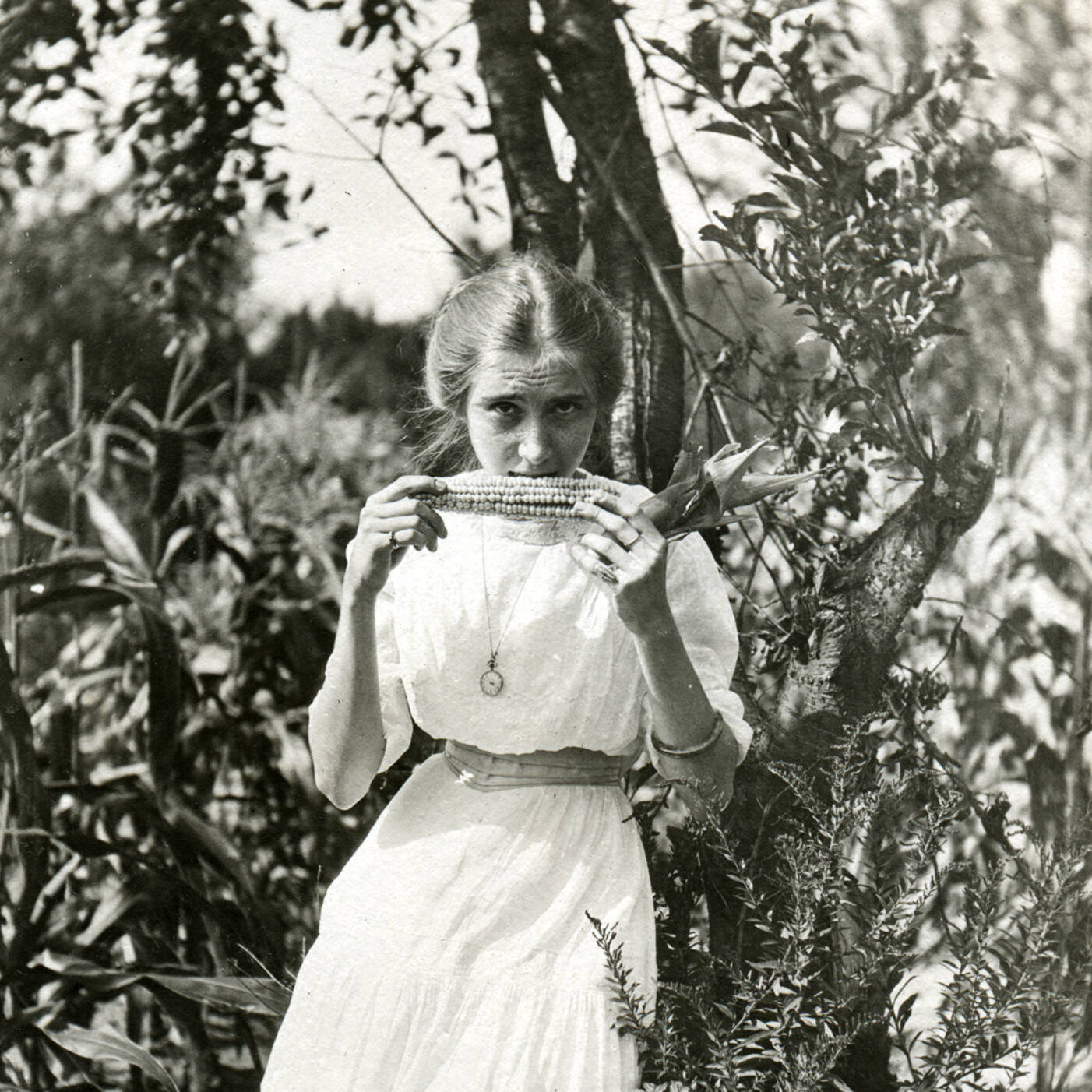
In need of some relief from winter? This month’s Item of the Month provides a break from snow and ice in the form of…fruit!
Download PDF of Item of the Month - March 2008.

Writer Kurt Vonnegut passed away April 11, 2007 at the age of 84. His influence is felt throughout contemporary literature. One of his fondest experiences as a writer was the two years he spent as an instructor here in Iowa City at the Writers’ Workshop, where his presence is still significant.
At Special Collections & University Archives, traces of Vonnegut’s time here are preserved, beginning with his letter accepting the position, where he describes himself as “very pleased.” He also asks about housing, starting a process that would eventually lead him to take up residence at 800 N. Van Buren Street, where a tradition of May Day parties begun while he was a resident blossomed, after he left, into one of Iowa City’s larger gatherings, known as the “Vonnegut Party.” Click the images below to view the letter, along with the response from John C. Gerber, Chair of the English Department.
While he was teaching at the Workshop, and living at 800 N. Van Buren, Vonnegut wrote to Paul Engle, director of the Writers’ Workshop, in a letter characteristic of his loose and fluid style of correspondence. Of particular note is a paragraph containing Vonnegut’s thoughts regarding improvements to the Workshop (click for the full-size image):
A letter written to Engle’s successor, George Starbuck, in 1968, after Vonnegut had left Iowa City, reveals the affection he had for his time in Iowa. He mentions his daughter’s fondness for the years spent here, saying “boy, is she ever happy out there!” (click for the full-size image):
The bulk of Vonnegut’s papers and manuscripts now reside at the Lilly Library at Indiana University. In our collections, however, is another of Vonnegut’s works. It is a series of eight untitled drawings made in 1984 and given to a close friend and student of Vonnegut’s at the Workshop, Loree Rackstraw. These drawings provide a glimpse of a different aspect of Vonnegut’s creativity. Click on the image in the title of this post for a full-size view of one of the drawings.
Vonnegut’s novels, stories, and essays, and his influence on his contemporaries, will continue to inspire future generations. His time in Iowa City was important both for him as a writer, and for his contributions to the development of the Writers’ Workshop during an important period of its history.
The University of Iowa recently announced the beginning of a project to lay pipes beneath the Iowa River to improve cooling on the east side of campus. The work will involve creating temporary dams on the river that will allow the riverbed to be dug up. The project is in its preliminary stages and can be monitored with a webcam view of the construction area.
While the Iowa River project will be conducted using the latest in engineering technology, it will follow principles of river construction that have existed for centuries–which provides an opportunity for Special Collections to highlight an important resource: the History of Hydraulics Collection. Assembled by the former director of the Iowa Institute of Hydraulic Research, Hunter Rouse, the collection contains many important works on fluid motion and engineering applications.
The current work on the Iowa River will use a cofferdam to halt the flow of water. The principles behind a cofferdam have been understood and used for centuries in the construction of bridges and other water-based structures, which can be seen in a book from the History of Hydraulics Collections. The 1685 book L’arte di restituire à Roma la tralasciata nauigatione del suo Teuere, by Cornelis Meijer, features many engravings demonstrating engineering principles, including two pages showing the construction of a temporary dam on a river. The detail above depicts a crew placing long wooden logs in a double-row diamond shaped pattern. The space between rows will be filled with dirt or some other packing material to minimize leaks, and once completed, the water inside can be drained, allowing work to be conducted on the riverbed. The illustration below shows the end result, with a work crew inside the structure. This technique was often used to build the foundations for bridges.
The History of Hydraulics Collection contains many works illustrating the development of engineering principles still in use today. The collection also complements the holdings of the Lichtenberger Engineering Library, providing access on campus to both primary and secondary sources in this important engineering field. A case in point is the 1680 book De aquis et aquaeductibus veteris Romae, Raffaele Fabretti’s survey of Roman Aqueducts that is one of the first major studies of them to be conducted scientifically. The original, seen below, is part of the History of Hydraulics Collection and can be viewed in the Special Collections Reading Room. The Lichtenberger Engineering Library has a copy of an English translation, Aqueduct Hunting in the Seventeenth Century, that includes recent commentary on Fabretti’s accomplishments. Together, these resources provide a detailed look at historical ideas still relevant to modern practices.

The James Bond franchise has been reinvigorated once again, with an adaptation of Ian Fleming’s first Bond novel, Casino Royale, climbing to the top of the box office. The long-running film series has produced many memorable films, and most of them were written by a University of Iowa alumnus, Richard Maibaum, whose papers reside in the Special Collections & University Archives department.
Pictured below are a selection of items from the collection, which can be viewed full-size by clicking on the thumbnail. The first image is a typical page from an early story treatment for The Man With The Golden Gun, with Maibaum’s extensive revisions adding and deleting portions of the text. Most of the Bond films in the collection are represented by several groups of notes, multiple story treatments (an outline of the plot and characterization before specific dialogue is written), and many different forms of the screenplay - early versions, drafts, and shooting scripts. The film widely considered the best by most Bond fans, From Russia With Love, features only incomplete treatments and one screenplay, which are still valuable documentation of the development of the series. The second image below is a photograph of lines outside a theater on the opening day of From Russia With Love.
All films are the result of collaboration, and the James Bond material in the Maibaum collection provides evidence of the process. The actor first cast to portray Bond, Sean Connery, had a vested interest in the integrity of the character and participated in critiques of the material he was contracted to play. The third image is a two-page summary of a meeting between Maibaum, Connery, and producer Albert Broccoli to discuss an early draft of Goldfinger. Connery offers his view of the script, pointing out numerous inconsistencies and areas he feels need improvement.
An unusual aspect of the Maibaum papers is the presence of a large series of plastic models, which represent the vehicles that appear in all of the films he wrote. Although these are described as film miniatures, they are not miniatures created by the production crew and filmed for special effects purposes. Rather, Maibaum appears to have been an amatuer modeller, and in some cases created the miniatures to aid in his writing process. Others were purchased commercially and made long after a film’s release.
Finally, the creator of James Bond, Ian Fleming, appears in the Special Collections & University Archives department in the papers of Norman Felton, producer of the espionage-related television series The Man From U.N.C.L.E. The series’ main character, Napoleon Solo, was created by Ian Fleming, and extensive negotiations took place to involve Fleming in the show’s production. He ultimately disassociated himself from the project, but remained cordial with Felton, as seen in the piece of correspondence shown here (click for the full size image).
All of these materials are available for consultation in the Special Collections & University Archives reading room, along with many other valuable collections documenting television and film from the perspective of actors, producers, directors, and writers.

The life of Marie Antoinette, Queen of France, is the focus of a controversial new film as well as television documentaries and historical fiction novels. Marie Antoinette has been re-imagined countless times since her death, and current interest attempts once again to understand her according to contemporary attitudes.
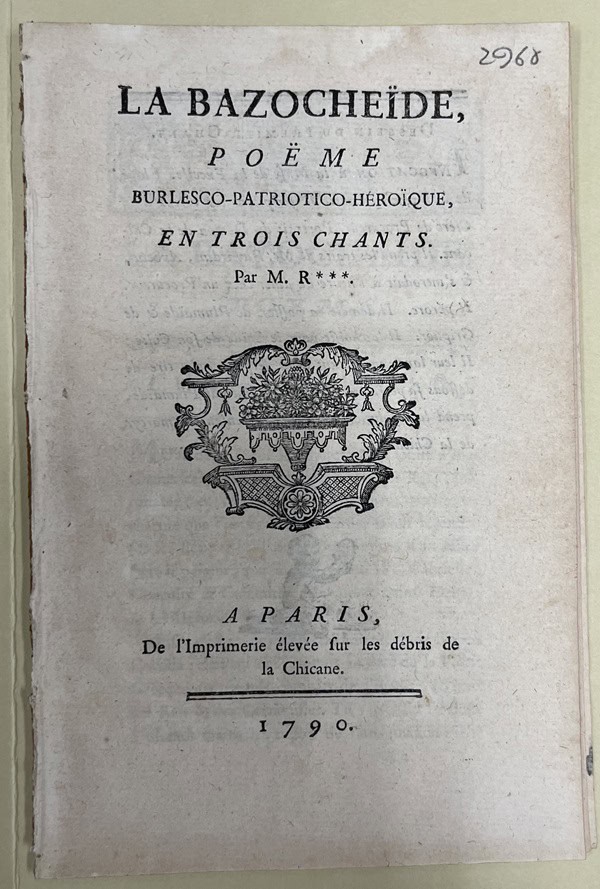
At the University of Iowa Libraries Special Collections & University Archives department, a collection of pamphlets brings Marie Antoinette and the upheaval of the French Revolution to life. Pamphlets – cheap, quickly printed gatherings of sheets that were sold unbound – were one of the primary forms of mass communication during the eighteenth century. The French Revolution collection contains
pamphlets commenting on many of the events and attitudes that defined the Revolution, written in the highly charged, propagandistic style that is found today in weblogs. Marie Antoinette is a common topic in these publications, where she is both praised and (more often than not) mocked and criticized. There are pamphlets discussing the affair of the diamond necklace – a public scandal that solidified opinion against her, and the trial and execution of her husband, Louis XVI. Click on the image at left to view examples.
A famous example of a longer work in the collection is Essais sur la vie de Marie Antoinette. This book is a “libel” – a salacious account intended to harm the Queen’s reputation. It was first published in 1783 and was immediately suppressed by the government. Unfortunately for Marie Antoinette it proved to be very popular, and was secretly reprinted in France and abroad many times over the next decade. Special Collections holds several copies, and viewing them together provides a sense of the wide reach this type of political discourse had. Today, modern scholarship is attempting to balance this tradition of scandalous myth with historical context and perhaps a greater sympathy to the unique circumstances that overwhelmed Marie Antoinette’s colorful life.
The French Revolution pamphlet collection is currently accessible through a card catalog that may be viewed by visiting the Special Collections & University Archives reading room.

On September 8, 1966 an episode of Star Trek first appeared on television. In the forty years since, Star Trek has developed into an international phenomenon and holds a cherished place in American popular culture. Many events are being held this month to commemorate the franchise’s history. Here at the University of Iowa Libraries, it is possible to experience the history of Star Trek in person through two important collections, the papers of writer and director Nicholas Meyer and the M. Horvat Collection of Science Fiction Fanzines.
Nicholas Meyer directed two of the Star Trek feature films, and also wrote screenplays and provided a creative perspective that re-energized the franchise. Star Trek II: The Wrath of Khan is widely regarded as the best of the films featuring the original cast, and Meyer’s papers, held in the Special Collections department, contain a wealth of information on the development of the story, the technicalities of filming, and the controversies within fandom over the fate of Spock. Meyer corresponded directly with many fans, and these letters provide a fascinating glimpse of the level of dedication among the fan community. In addition to many screenplays from Star Trek IV: The Voyage Home, which Meyer wrote, the collection also contains an enormous amount of material related to Star Trek VI: The Undiscovered Country, including storyboards, concept art, and production memos.
The fanzines in the Horvat collection reveal the development of early Star Trek fandom, from its simple beginnings in meetings of like-minded friends to the large media conventions of today. The zines contain fan fiction, discussion of the future of the franchise (particularly during the 1970s when Star Trek was almost entirely sustained by fan activities), and news of conventions. The collection contains a copy of the first Star Trek fanzine ever produced, Spockanalia, and other examples of early fan creations such as Devra Langsam’s Masiform-D.