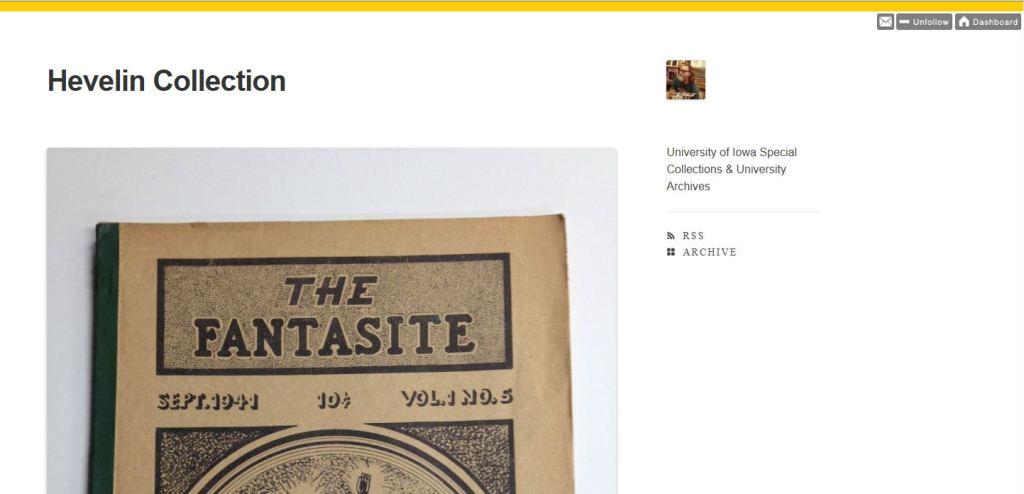
The time has come! The James L. “Rusty” Hevelin Collection of Pulps, Fanzines, and Science Fiction Books is being unboxed and processed.
Special Collections & University Archives is pleased to welcome long-time student worker and avid researcher Peter Balestrieri who is joining our staff as a Processing Librarian and taking on the task of making the collection ready for researchers.
Rusty Hevelin was a science fiction fan, pulp collector, huckster (a dealer at conventions), and voracious reader. In addition, he was one of the founders of Iowa’s two ongoing science fiction conventions, Icon in the Iowa City/Cedar Rapids area, and DemiCon in Des Moines.
Friends and fans now have the opportunity to follow Peter as he explores and unboxes the collection, on our new Tumblr page where he will post photos and updates, box by box, as the mysteries within are revealed.
Please follow along and enjoy the snapshots into the history of science fiction and fantasy literature and fandom in the United States http://hevelincollection.tumblr.com
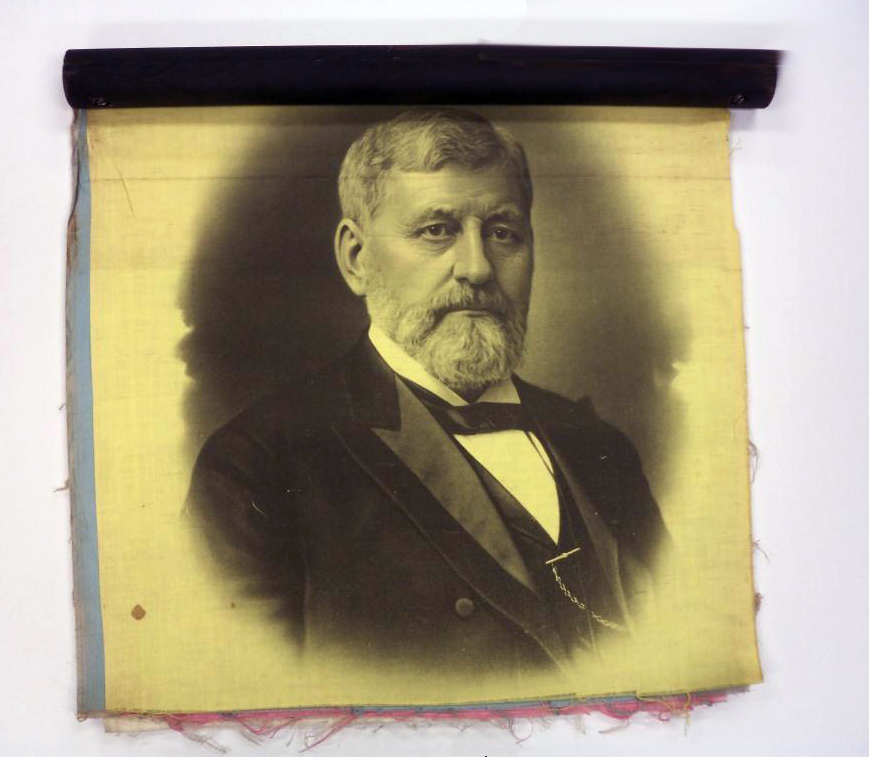
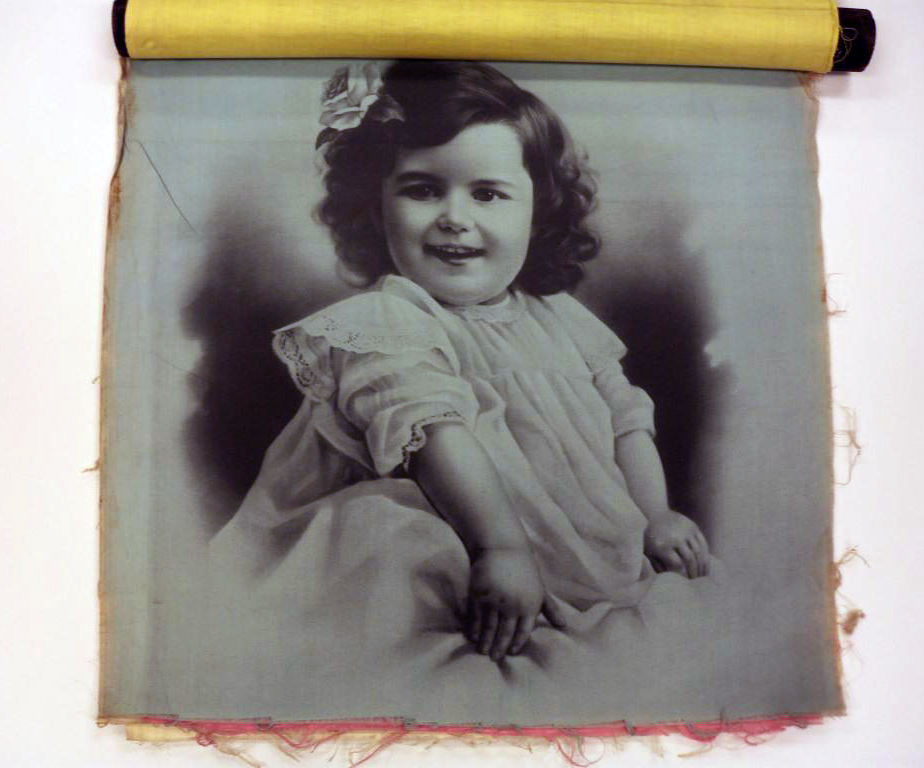
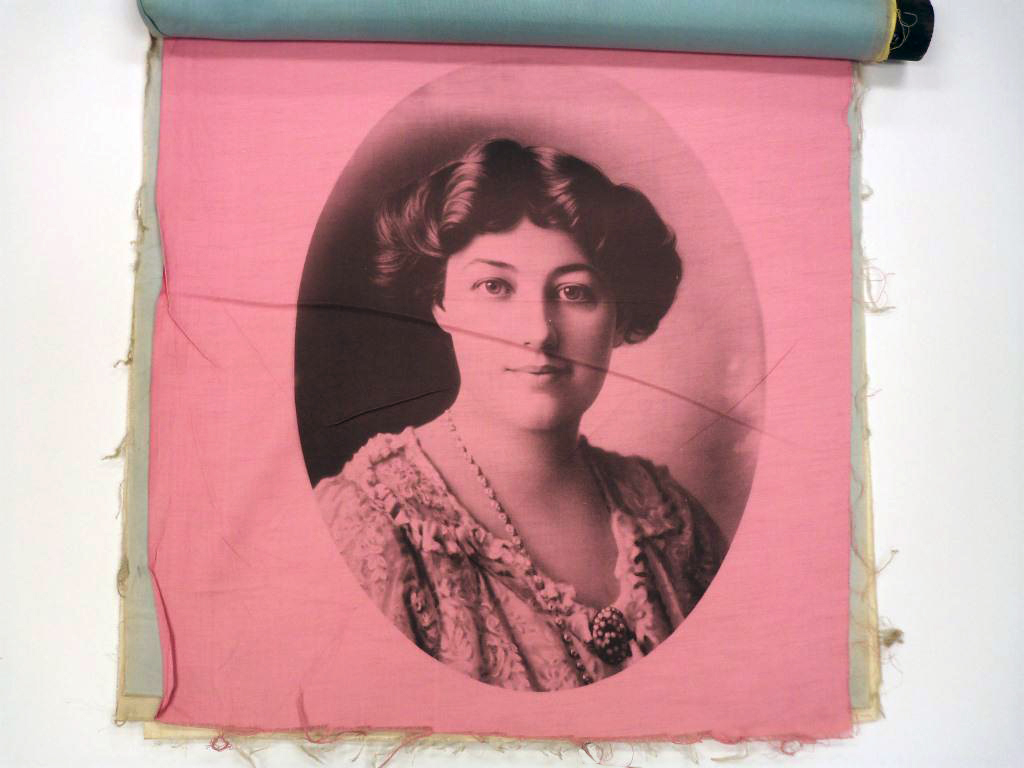
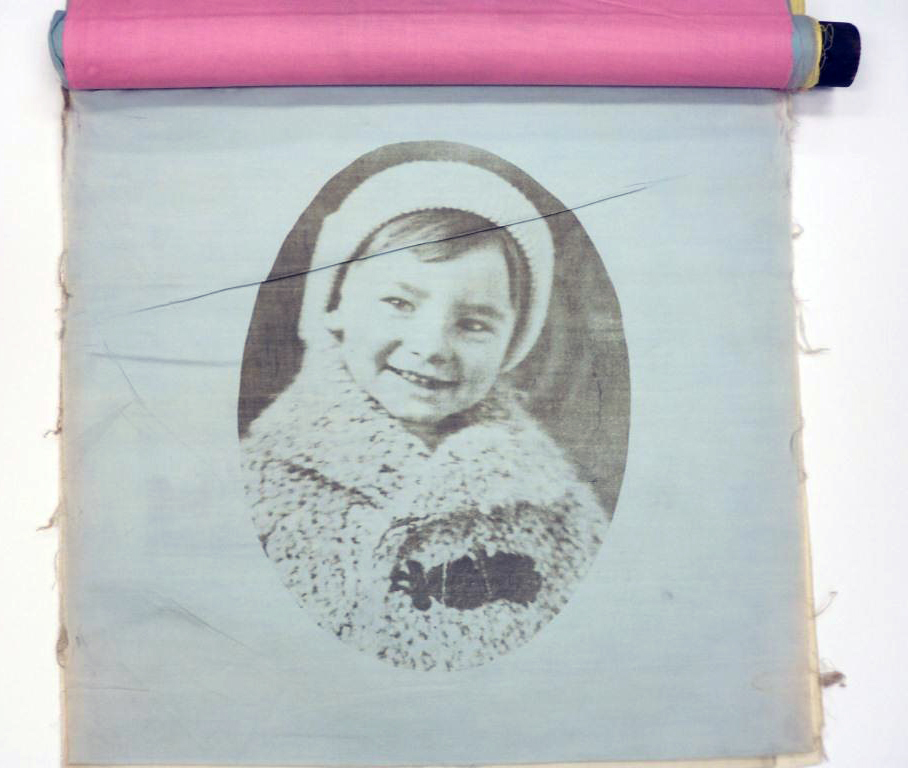
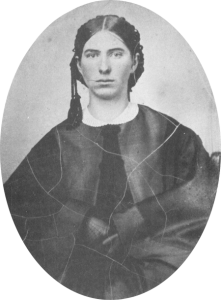
Do you know this man? Or perhaps you know this lovely girl with her bicycle?
This mysterious item has a series of six photographs printed on fabric and bound together on a wooden holder. Based on clothing and hairstyle the photos seem to be from different time periods. Are they all different people? Did one of those children grow into that lovely young lady? Are they all family? Why was this made? When?
This came to us from a woman named Rose Hogan as part of an archive from families named Hogan and Roskopf but nothing is known about this item or the people featured.
The family included teachers and attourneys and has connections to Iowa City, Galva Clearfield, Diagonal, Denison, Teril, Dunlap and Estherville in Iowa, as well as Chambers County in Texas, and Foxhome, Minnesota.
If these faces look familiar, please help us identify them and solve the mystery.
The second edition of our new series, “Voices from the Stacks” comes from English Department graduate student, Miriam Janechek, who is working as a guest curator for an exhibition that will debut this fall:
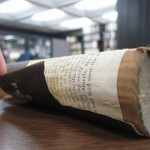
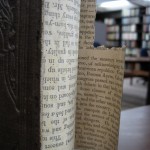
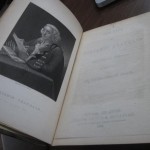
Filler pages from other books used to bind the spine of an 1856 edition of TheLife of Benjamin Franklin demonstrate one of the many benefits of archival research – hands-on work leads to unique discoveries! A keyword search in Google books quickly identified one page, A Manual of the Orinthology of the United States and of Canada, by Thomas Nuttall, published in Cambridge, MA, in 1832, which is seen peeking out of the cracked binding of the University of Iowa Special Collections’ edition of Jefferson’s book. Demonstrating also the limitations of Internet research, Google did not help locate the other filler page, which seems to be from a periodical.
Why was the 24 year-old book on birds used as filler? Did the printer have unsold copies? Did he simply dislike birds? Were there newer, more accurate ornithology books? It’s a mystery…
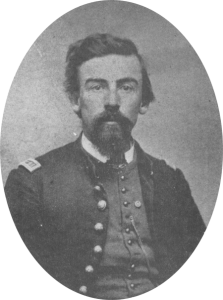
In celebration of the U.S. Civil War Sesquicentennial, The University of Iowa Libraries is bringing to life the compelling story of Civil War soldier Joseph F. Culver and his wife, Mary, featuring letters held in Special Collections in the J.F Culver Papers. Letter by letter their story will unfold over the next three years published on a new blog exactly 150 years to the exact date each letter was written. The blog was launched today with the first letter written 8/14/1862.
Joseph Franklin Culver (1834-1899) was engaged in banking, insurance, and the practice of law in Pontiac, Illinois, before the war. An honorable and religious man he was inspired to leave his pregnant wife of less than a year behind to “walk in the path of duty” as a volunteer to serve with the Illinois 129th Infantry Regiment, Company A (August 1862-June 1865), first as a lieutenant and later as captain. Culver so desired to keep in contact with his new wife that he wrote detailed letters multiple times each week sharing his day, news items, and the stories of the men in his company, also men from Pontiac and Livingston County, IL, for the duration of the three years of his service.
Extensive annotations added by scholar Edwin C. Bearss in the 1970s as J.F. Culver’s letters were turned into a book, Your Affectionate Husband, J.F. Culver, are included to make it possible to follow the dates, names, relationships, and references in the letters. Newly discovered letters and letters from his wife, Mary, will be included in the blog project to make the most complete version of their story to date.
A review of the book from 1979 highly recommended Culver’s letters. “This is a valuable series of letters by an observant and highly literate soldier. In addition, the collection has been edited in impeccably scholarly fashion. The book is thus a revealing as well as useful chronicle of Sherman’s campaigns…The chief value of Culver’s letters is the wide variety of subject matter. Comrades, marches, campaigns, rumors, prices, religion, and general commentaries abound. So do observations on all facets of army life–discipline, conscription, elections, camp life, baggage, shelters, pay, and rations. Added to this are personal opinions on a number of Union leaders.” James I. Robertson, Jr. The Journal of Southern History, Vol. 45, no.4 (Nov. 1979), pp. 612-613.
Though primarily a story of an Illinois man, Iowa readers should note that Joseph and Mary Culver are great-grandparents to John Culver, former Iowa representative to the U.S. House of Representatives and U.S. Senator from Iowa, and great-great-grandparents to Chet Culver, former governor of Iowa.
Here are some featured items that have recently arrived in both Special Collections and in the University Archives. Researchers interested in the history of local radio, advertising, tuberculosis, and artist’s books should particularly take note of our recent arrivals.
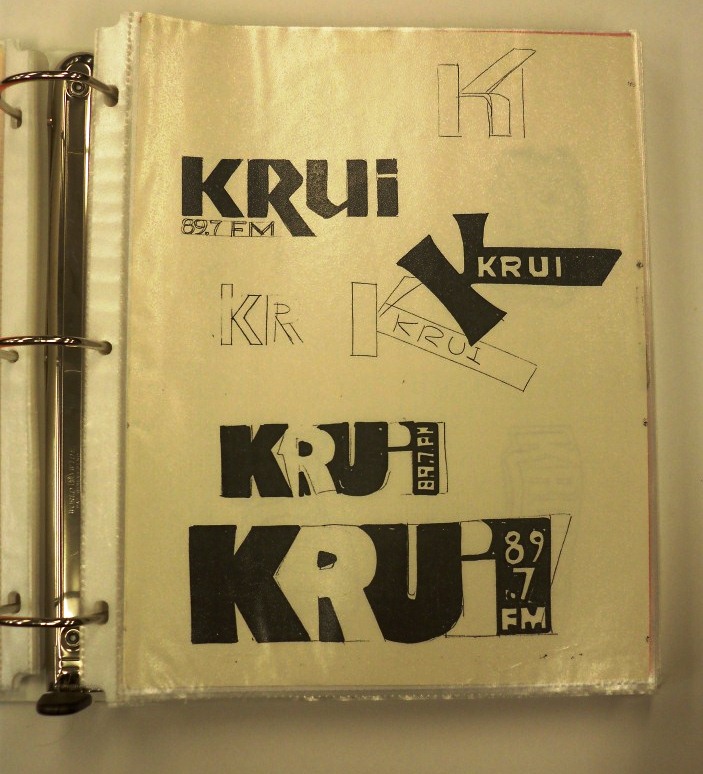
The University Archives now includes additional documents from KRUI. KRUI 89.7, the University of Iowa student radio station, began as a dormitory-only service in the early 1950’s, expanding to FM in 1984. Recently the UI Archives received an additional 14 linear feet of material from the station: Brochures, staff schedules, correspondence, photographs and other documents, to add to the archives existing collection described at http://www.lib.uiowa.edu/spec-coll/archives/guides/RG02.02.08.htm. Dave Long, a member of the KRUI board of directors, helped arrange for transfer of the materials.
Logo design sketches, KRUI, University of Iowa Archives
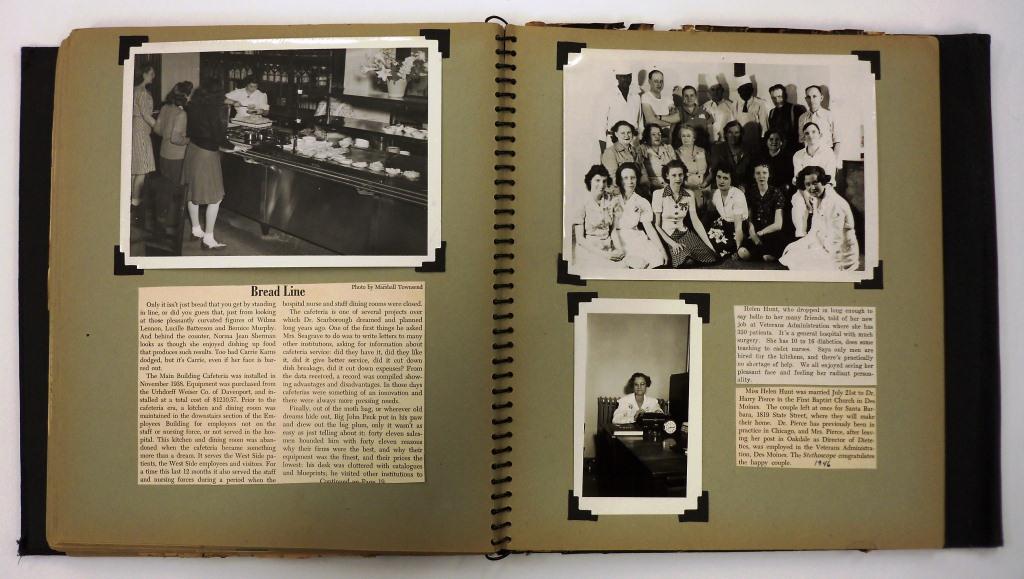
Oakdale Sanatorium was established in Johnson County in 1907 to house and care for patients diagnosed with tuberculosis. Over time, the facility accommodated patients with other needs as well. From 1945 to 1947, Ruth Harris, a dietician from Ames, IA, was employed as Director of Dietetics there. Earlier this year, Ruth Solmonson of St. Paul, MN, a relative of Ms. Harris’, donated a scrapbook to the UI Archives which contains scores of photographs, newspaper clippings, and other items depicting life at the facility. In 2011 Oakdale Hall, the original and largest structure on the campus, was razed to make way for new development, making Ms. Harris’ photographs even more valuable to researchers.
Oakdale Sanatorium Scrapbook, University of Iowa Archives
The newest arrivals in the department of Special Collections include a shipment of eleven impressive artists’ books from Vamp & Tramp Booksellers, LLC. Three of the books are highlighted below.
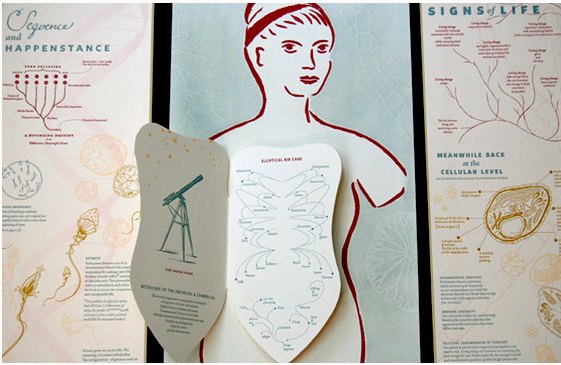
Body of Inquiry is from Casey Gardner and Set in Motion Press. With inspiration drawn from anatomical models and instructional documents this amusing work draws you in to discover a “corporeal codex” with intricately folded organs.
Statement from Set in Motion Press: “This book is a triptych opening to a sewn codex within the subject’s torso. It is a structure of display and intimacy. The scale is large and unfolding and the details are numerous and intricate, accurate and outlandish. The instruments on the outer panels are from the 19th- and 20th-century scientific catalogs. The rest of the images are drawings the artist made and transferred into photopolymer plate for letterpress. The scientific panels explore the miracle of our physicality and are sequenced beginning with atoms, moving to cells, and to genetic structure. The interior codex tells the story of the artist’s anatomical model and investigates the permeable borderline between material and immaterial in our bodies and life.”
Detail from Body of Inquiry, U. of Iowa Special Collections
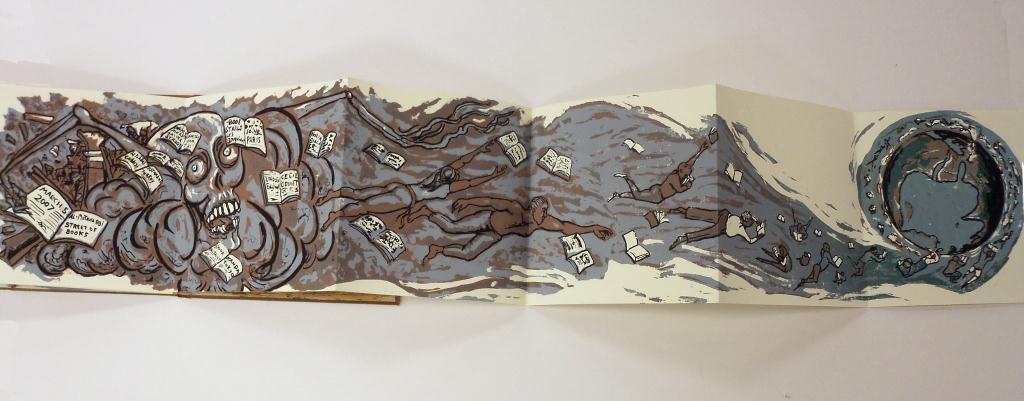
Al Mutanabbi Street, March 5, from Al Hazelwood is one item that is part of a project to “re-assemble” some of the “inventory” of the reading material that was lost in the car bombing of al-Mutanabbi Street on 5th March 2007. Originally the intention was for 130 book artists to join in honouring al-Mutanabbi Street so that one artist’s work would stand in for each of the 30 killed and 100 wounded through creating work that holds both “memory and future,” exactly what was lost that day. However in the end the response was so great that 262 artists participated in the project, soon to be completed.
Stement from artist Al Hazelwood: “This book is based on the car bombing of a street of booksellers in Baghdad. Beau Beausoleil, a bookseller in San Francisco, initiated this project to memorialize this attack on the culture of the book and prevent it from slipping into forgetting among the many atrocities of the Iraq War. He’s asked 130 book artists to contribute — the number of books matching the number of victims that day. This is my contribution. Three from the edition go to the project one of which will be offered to the Iraq National Library in Baghdad. My book, starts with an image of the booksellers street. The next page begins a foldout which begins with the explosion in a death head cloud. Books flying are labeled with different bookseller areas of the world”.
Al Mutanabbi Street, March 5, U. of Iowa Special Collections
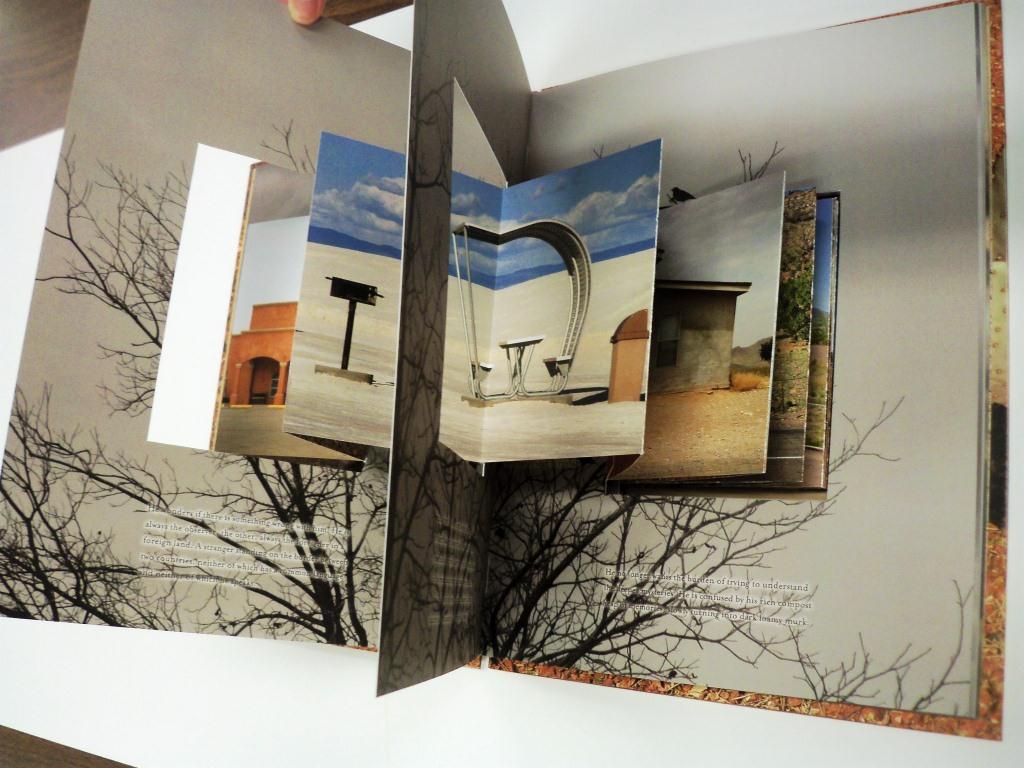
Shelter by Phil Zimmerman of Spaceheater Editions is an intricately constructed floating hinge format book-within-a-book.
Statement from artist Phil Zimmermann: “Shelter came out of an exploration of losing faith and questioning on of its opposites: the process of finding religion. This text came out of watching my dying father, who was never religious when I was growing up, become increasingly interested in faith and salvation as he became sicker from heart disease and cancer. I saw the desert with its unfriendly flora and harsh environment as a metaphor for the difficult world towards the end of many people’s lives. The desert is also used in many religious tracts as a place for contemplation and mortification. In this work roadside shelters and gospel ministries were used as signifiers of ways and places where people look (vainly?) to relive prospects of their approaching death.”
Donated to Special Collections in March 2012 by Linda Yanney, the Beluah Yanney Montgomery Sheet Music Collection has been processed by our outgoing Olson Fellow Gyorgy “George” Toth and is being added to our Sheet Music Collection (http://www.lib.uiowa.edu/spec-coll/msc/ToMsC900/MsC873/MsC873_sheetmusic.html). Covering the late 19th through middle 20th centuries, the Montgomery addendum complements our current collection of sheet music with the major themes of its songs.
Popular Music
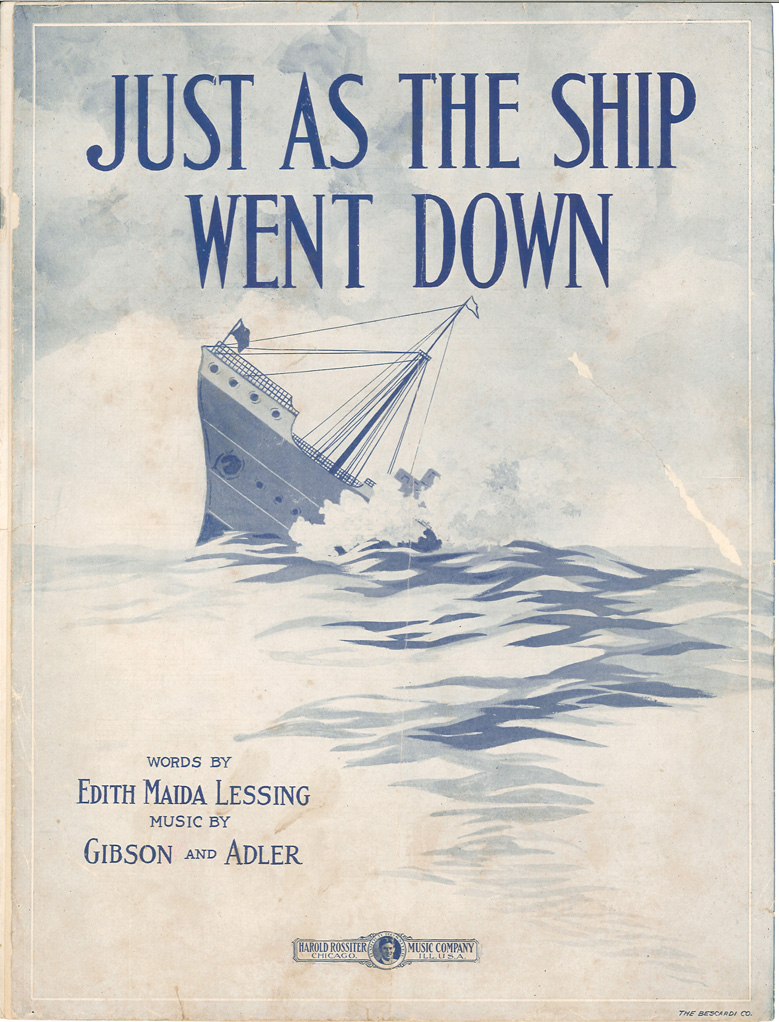
Much of the popular music of the early 20th century was sentimental, and concerned topics like landscape and romance. Not so Edith Maida Lessing’s “Just as the Ship Went Down” from 1912, which remembers the sinking of the Titanic. As we are observing the 100th anniversary of this disaster, we can view this song as an early effort to memorialize the event in U.S. popular culture. Reading, playing and singing songs like this was also part of people’s coming to grips with national and historic events.
“Just as the Ship Went Down.” Edith Maida Lessing, Gibson & Adler. Chicago: Harold Rossiter Music Company, 1912.
Music about the American South
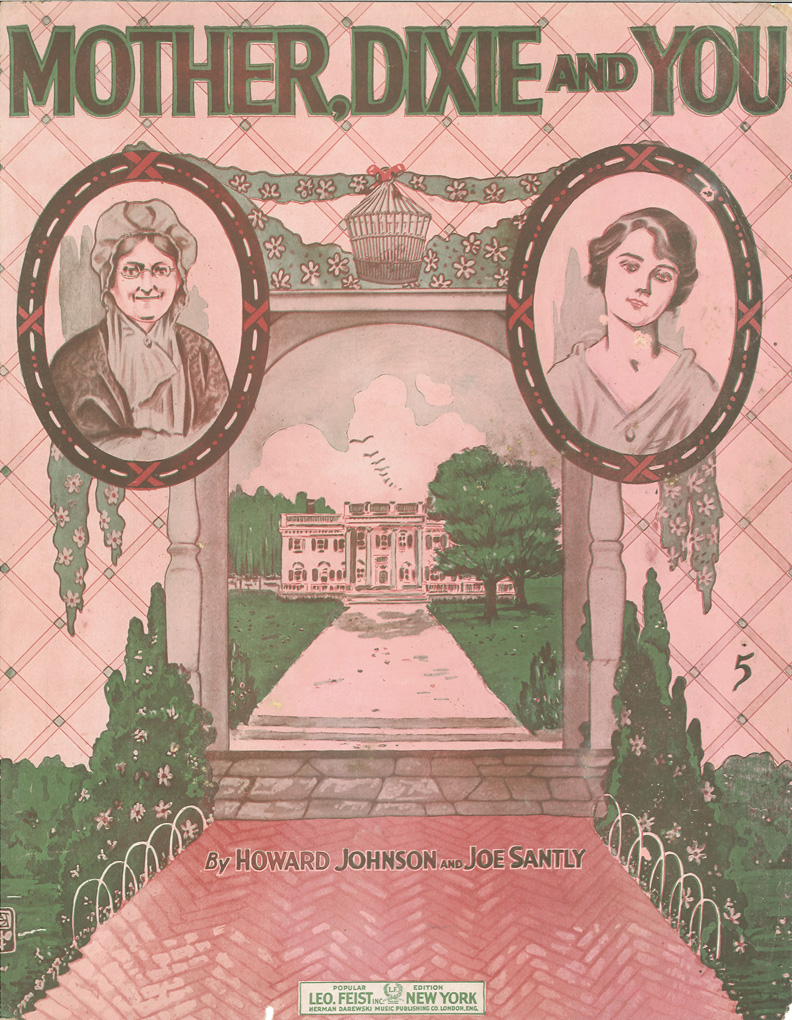
The Montgomery addendum also contains a small group of songs written about the American South. These songs were often introduced by famous singers and actors like Al Jolson on the vaudeville stage and in minstrel shows, where they used African American characters to paint a sentimental picture of antebellum Southern plantations.
Mother, Dixie and You. Howard Johnson, Joe Santly. New York: Leo Feist Inc., 1927.
With today’s standards, these songs were racially charged if not outright racist towards blacks, and they presented a view of the South that culturally attempted to roll back the achievements of the Thirteenth Amendment. Even as some questioned their credibility, many contemporary Americans treated these songs as entertainment, listened to them on the popular stage, and played and sang them in their parlors.
Songs from World War One
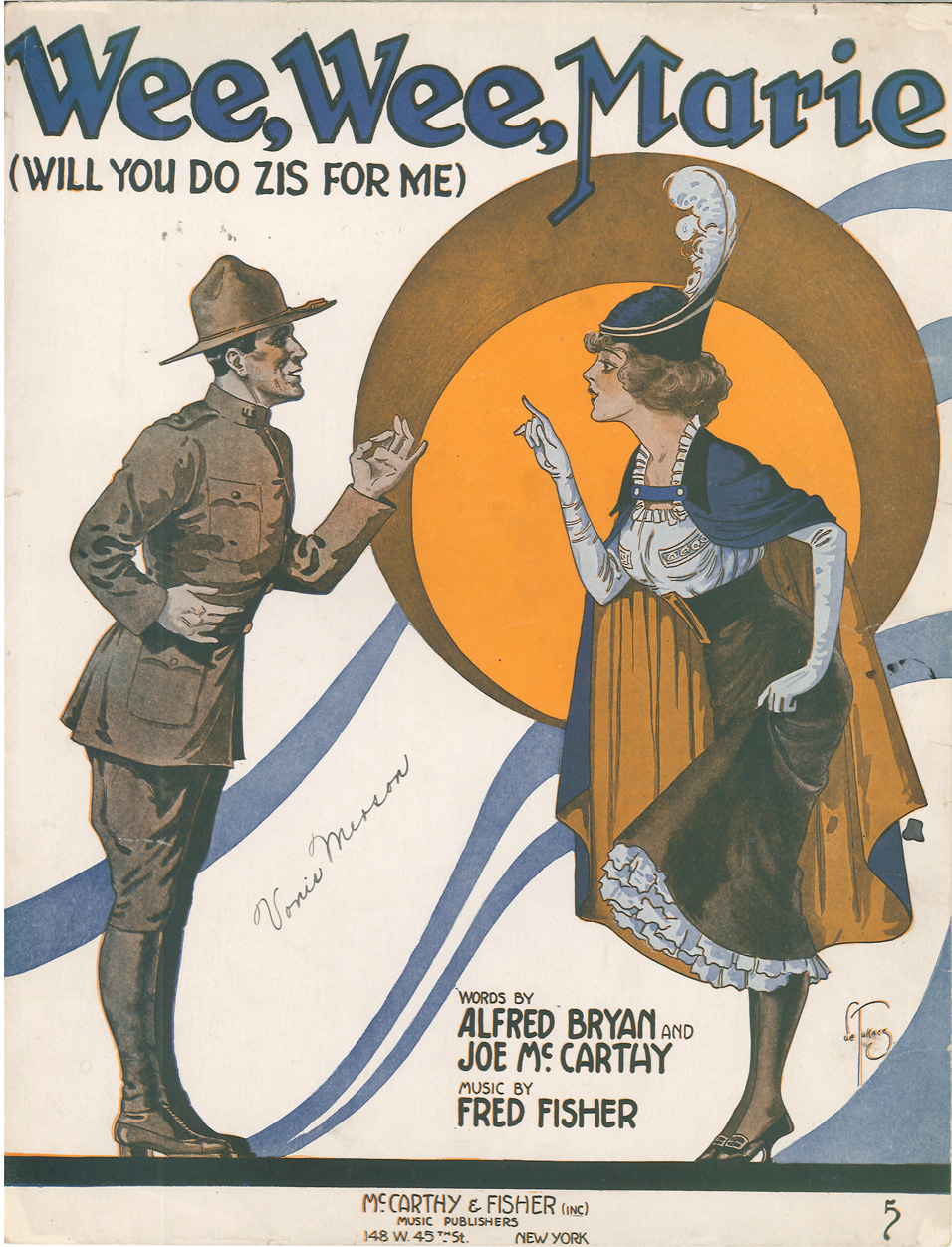
In two years, we will be observing the centenary of World War One. After the entry of the United States, American society changed as it participated in the war effort. Popular songs from this era reflect how Americans engaged with “the Great War” – emotionally, socially, and culturally. In popular culture form these songs answered the question of ‘why we are fighting over there,’ they boosted the morale on the home front, helped American families endure the absence of their fathers, sons, brothers and husbands, and they depicted relationships between American servicemen and -women and the Europeans they encountered during the war. Americans listened to these songs in recorded form, but they also played them on the piano and sang them in their own living rooms and parlors.
Wee, Wee, Marie (Willl You Do Zis for Me). Alfred Bryan, Joe Mc. Carthy, Fred Fisher. New York: McCarthy & Fisher, Inc., 1918.
Theatre Music
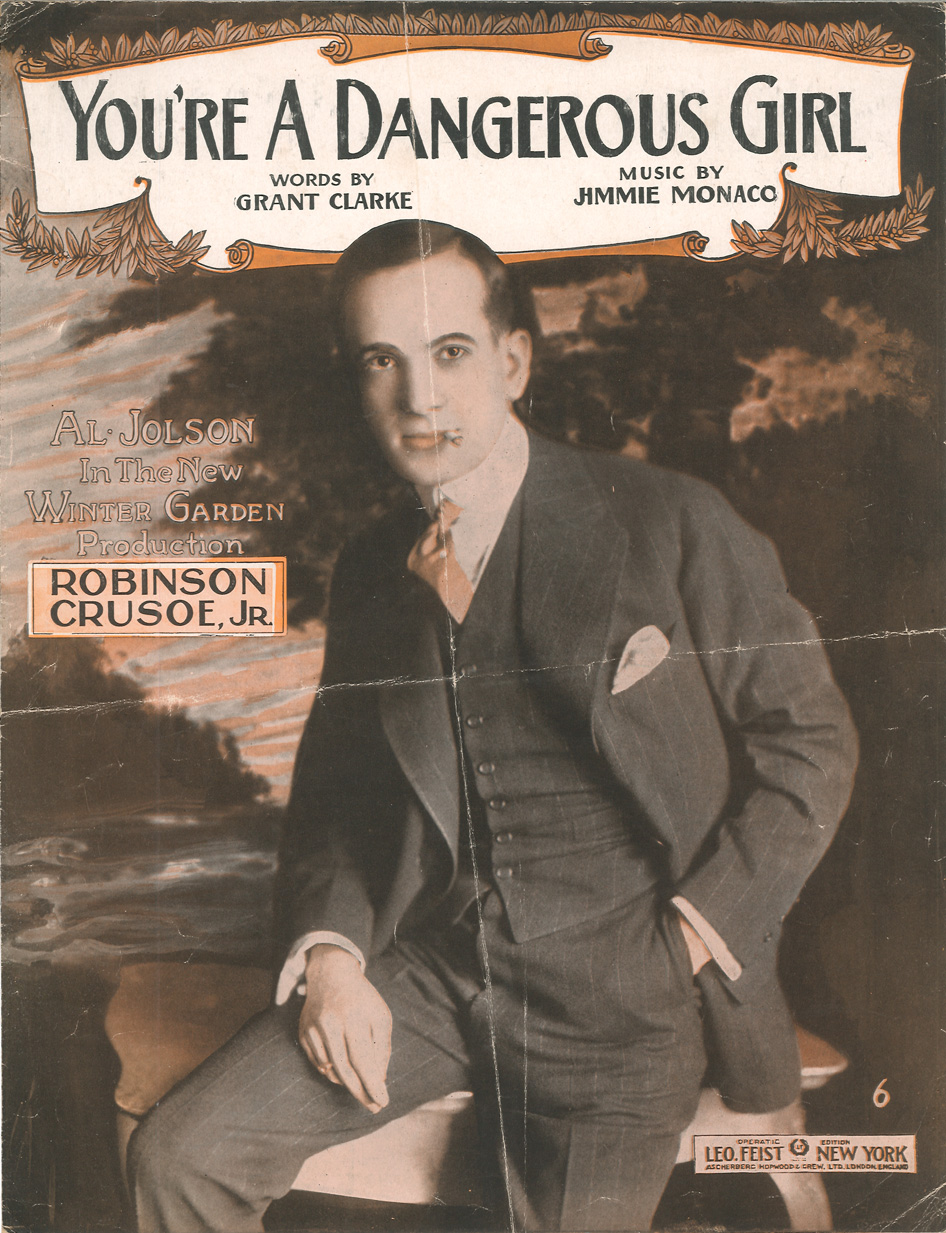
Other songs in the Montgomery addendum were linked to specific stage productions. In the early 20th century, Al Jolson was one of the artists whose name sold musical plays and their sheet music like candy. Another piece, “I’ll Build a Stairway to Paradise” comes from the Broadway production George White’s Scandals, which ran all through the interwar period and launched the career of several major figures in entertainment.
You’re a Dangerous Girl. Grant Clarke, Jimmie Monaco. New York: Leo Feist, 1916.
Film Music
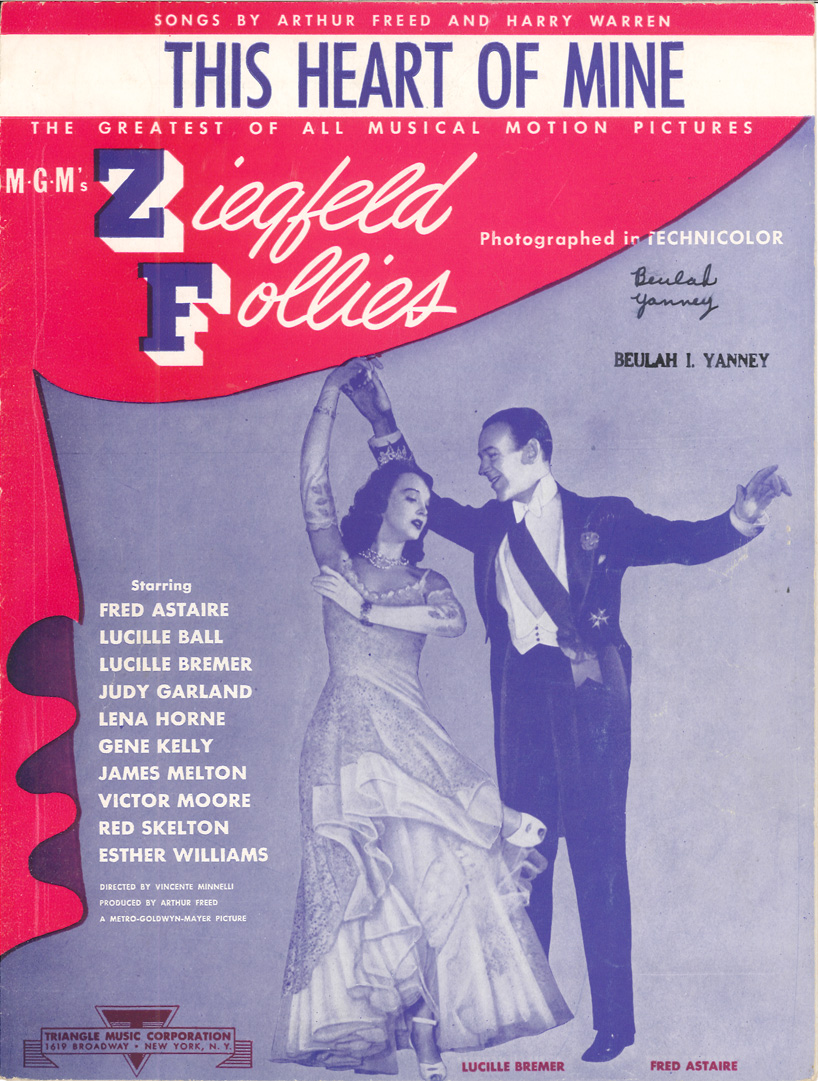
The early 20th century saw the overlapping development of old and new entertainment forms, which included the popular stage, gramophone records, the piano in the parlor, the radio, and film. Depending on their social class and wealth, Americans could enjoy many of these. For example, they could go to see a stage production of the famous Siegfried’s Follies Broadway musical, buy its music on recordings, listen to them on the radio, go to the cinema to see a film remake with Fred Astaire, and purchase its songs to play and sing them in their homes.
This Heart of Mine. Arthur Freed, Harry Warren. New York: Triangle Music Corporation, 1943.
The Beluah Yanney Montgomery Sheet Music Collection will be an important part of our holdings of sheet music from the 19th and 20th centuries. For researchers and fans of U.S. popular culture, these songs say something about the larger American society and the ways people creatively used music for entertainment, social life, education, and emotional expression.
Re-shelving, putting items in folders, boxing, labeling, sorting, shifting, dusting and vacuuming are just a snapshot of what happens behind the scenes everyday in any Special Collections or archives and that means our students and volunteers often have unique opportunities to identify unique items in the collections. From time to time in this space we will feature stories from our student workers or volunteers as they stumble upon items that simply have to be shared in a new series “Voices from the Stacks.”
Our first post comes from Sydney Smith, a senior English major who has been working with us for two years:
Many moons ago, I was a member of what I called the “Vacuuming Project Task Force.” Employees of Special Collections were asked to vacuum all the books in the department after a particularly dusty construction project.
It was not the project we were most fond of, but it did lend itself to exploring the stacks more, and when Karen, a fellow student employee, and I could no longer ignore the dusty books, we liked to play “Find the Book with the Weirdest Cover and (Carefully) Read Out of It.” It was during this game that Karen spotted our prize, a book we come back to for laughs on a regular basis; the crème de la crème of wacky and unexpected books (at least within the call number range from xPN2037.M4 through xPQ4627.L28C6.)
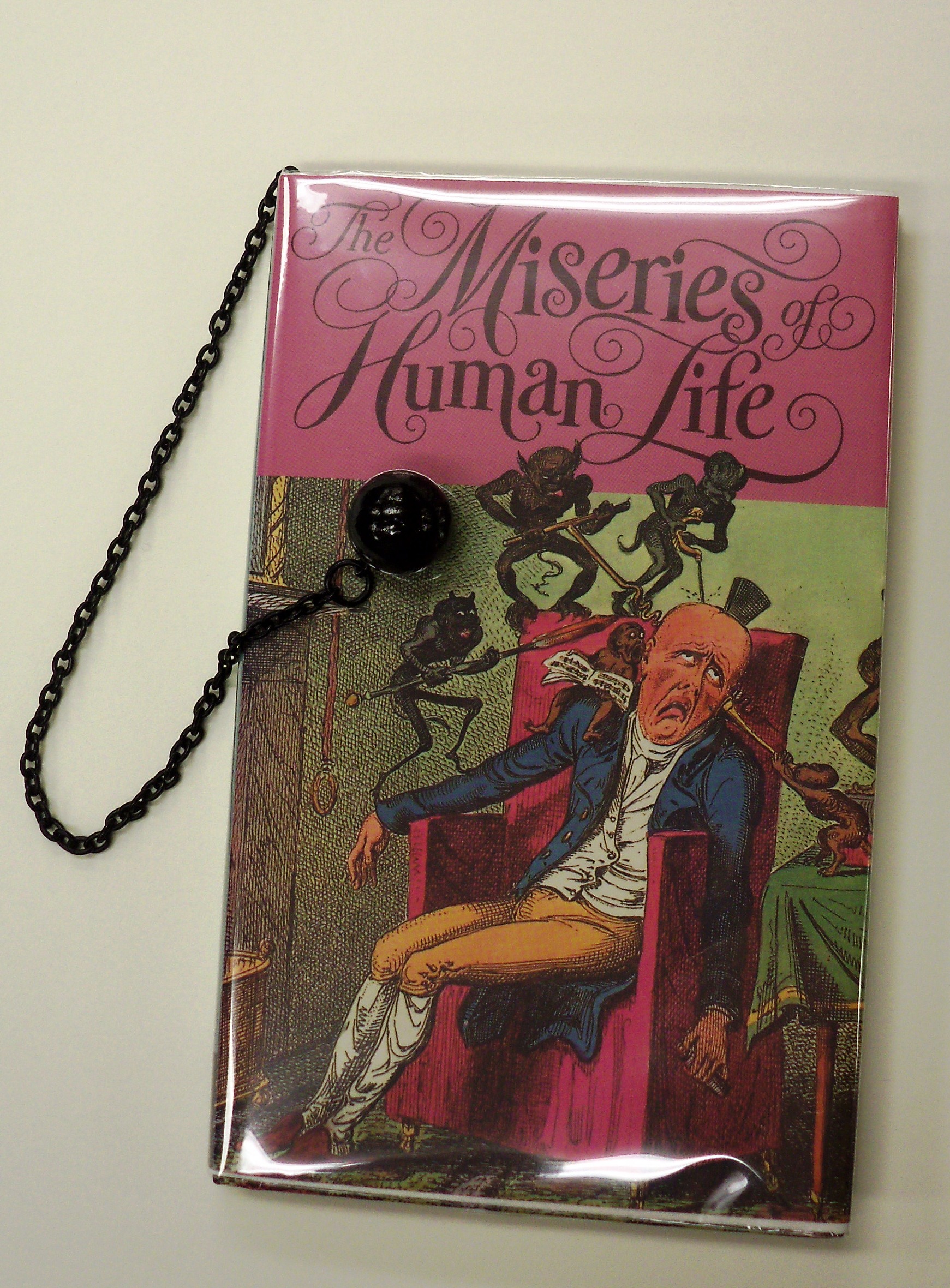
The Miseries of Human Life; or, The Groans of Samuel Sensitive and Timothy Testy. With a Few Supplementary Sighs from Mrs. Testy. In Twelve Dialogues contains all the ridiculous, painfully-detailed, horrible things that author James Beresford noticed in his day-to-day life.
Call number: PN6173.B4 1806
These complaints include but are not limited to:
“Pushing up your shirtsleeves for the purpose of washing your hands – but so ineffectually that, in the midst of the operation, they fall and bag down over your wet, soapy wrists.”
“Straining your eyes over a book in the twilight, at the rate of about five minutes per line, before it occurs to you to obtain some light.”
“Being compelled by a deaf person, in a large and silent company, to repeat some very inane remark three or four times over, at the highest pitch of your voice.”
“Living in chambers under a man who takes private lessons in dancing.”
And, a personal favorite:
“Going, with ardent expectations, to a picnic, and finding that, from some sudden capriccio in the decrees of fashion, there is no nic to pick.”
If I were able to compile my own list of miseries, it would probably sound a bit more like this:
The wifi in my apartment isn’t working again, and I desperately need to check Facebook because I’m bored!
My air conditioner isn’t cooling my home fast enough. I’ve had it on for five whole minutes!
My printer is out of ink. I’ll have to walk all the way to the library to get this printed.
Life’s hard, isn’t it?
Call number: PN6173.B4 1995
There are two editions on hand here in Special Collections, one, an early edition with the original illustrations, published in 1806. The second is an edition abridged by Michelle Lovric and published in 1995. The best part of the abridged edition, and the part that attracted Karen’s attention in the first place is that where it might have had a ribbon bookmark attached to the spine, it has a ball and chain. Thank you, Michelle Lovric!
If the little things are getting you down, please stop by Special Collections and take a look at either edition of Beresford’s Miseries, which is bound to create more laughs than tears any day. In the meanwhile, add a “misery” from your daily life in the comments!
Last weekend at the Iowa City Book Festival, Special Collections & University Archives hosted a Book Tasting event in the Old Capitol. As a closed stack library usually researchers and readers already have an item in mind when they come to see us. “Search” will turn up very different results from “browse” as a strategy and so to make it possible to find an unknown favorite, we created a Book Tasting event. Inspired by wine tasting parties, a “Book Tasting” features a selection of books that the “tasters” have not seen before to browse, add ratings, and perhaps find an unexpected favorite. Then when the ratings are tallied, a crowd favorite will emerge.
The collection of books we put together for the event was inspired by the exhibition across the hall in the Old Capitol Museum, “Insects: A Collection in Multiple Dimensions.” We selected 20 scientific books from the 18th and 19th centuries that have illustrations of collections of things. These collections include everything from an entire four volumes dedicated to every species of antelope to books on butterflies, mollusks, quadrupeds, or flowers. Due to the nature of scientific study at the time these are books that are illustrated in great detail and in the 100+ years represented in the sample, book illustration itself changes dramatically. The books also make it clear how these types of books were used in the 19th century as the University of Iowa got its start. Many bear traces such as singed edges and library bindings that tell the story of their survivial from the 1897 North Hall fire while many others bear the stamps of their former owners, eventual donors to the collections such as Dr. Mark Ranney and D.H. Talbot.
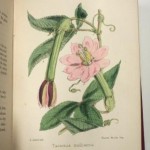
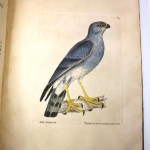
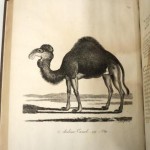
Though our end goal was to find a crowd favorite what emerged from the data collected was a picture of how diverse people’s interests are. 15 of the 20 books were listed as someone’s favorite. Three books tied to be the crowd favorite, #9 Popular Greenhouse Botany, #17 The Birds of Great Britain, and #20 History of Quadrupeds.
#9, Popular greenhouse botany : containing a familiar and technical description of a selection of the exotic plants introduced into the greenhouse / by Agnes Catlow. 1857.
#17 Birds of Great Britain … with descriptions, including the natural history of each bird by William Lewin, 1800.
#20 History of quadrupeds, the 3d ed. by Pennant Thomas, 1793.
If you could not make it to the event please enjoy the gallery of images on Flickr that will give you a “taste” of what was there, including a cover, title page, and image from the book for each item that was featured. The crowd favorites will be featured this week in our “pop-up” exhibit case right inside the door. Find your favorite, and as always, feel free to stop by anytime to enjoy these books in Special Collections.
The University Archives has two announcements: A new acquisition and an ongoing project, both of which have an embedded call to help document student life here at the University of Iowa.
Janet Pease, who earned her undergraduate and graduate degrees (including the Ph.D.) in history from The University of Iowa, donated to the University Archives her scrapbook documenting her first year on campus, a delightful compilation of photographs, keepsakes, and notations highlighting special events of that year. Entering the University in the fall 1962 semester, Ms. Pease distinguished herself as an outstanding student, earning recognition as a member of Phi Beta Kappa honor society. Her career in education spanned some 40 years, all of that time devoted to teaching history at the high school level in Arvada, Colorado. The UI Archives is pleased to add this item to its growing inventory of student life-related collections, and encourages you to contact us if you or a family member may have UI-related items of interest for us to preserve and share with our researchers.
By any measure, Stephen Smith was the all-American boy. The Marion, Iowa, native lettered in high school football, basketball, track and wrestling and was a class officer, honor student and Boys State participant. He entered the University of Iowa in the fall 1963 semester as an ROTC student with hopes of joining the Air Force. He was also moved to protest what he saw as wrongs of the time: Racial segregation and growing U.S. military involvement in Viet Nam. In July 1964, while in Canton, Mississippi, with other Freedom Riders to help blacks register to vote, Mr. Smith was detained by local authorities and brutally beaten while in custody. The following year he was arrested for burning his draft card at the Iowa Memorial Union, only the second person in the nation to do so under a then-new federal law criminalizing such action. He was sentenced to three years’ probation. Mr. Smith died in 2009, several years after suffering a nearly-fatal heart attack. His adult life was, at times, both challenging and rewarding. For 10 years, until his health failed, he was an instructor of computer science at Kirkwood Community College in Cedar Rapids. The UI Archives is now attempting to learn more of Mr. Smith’s life and is in contact with friends and family members to develop a collection to help preserve his memory. If you were on campus at that time and recall the incidents, knew Stephen Smith, or know of somebody who did, please contact David McCartney, UI Archivist (david-mccartney@uiowa.edu). Thank you.
Janet Pease Scrapbook, 1960s
1966 Hawkeye yearbook (RG 02.10), University Archives, Dept. of Special Collections, University of Iowa Libraries.
Sample a selection of vintage illustrated books exploring the natural world pulled from the stacks of Special Collections & University Archives at our Book Tasting event at the Iowa City Book Festival. Browse 19th century botany, gardening, children’s textbooks, animals, herbals and more! “Sample” a book, add some tags to help future browsers identify its “flavor” and finish it off with a rating. The highest rated item will be featured in our “popup” case inside Special Collections and through social media. Stop by, browse, sample, and enjoy!
3:00PM-4:00PM July 14th the Old Capitol Museum Supreme Court.