Skip to content
Skip to main content

New Perspectives as Museum Studies Students Process Archives

Four students pursuing certificates in Museum Studies recently completed internships with The University Archives in the Spring 2012 Semester.  Krystal Rusk processed the records of WSUI/KSUI Broadcasting Services, Elizabeth Blind processed the Macbried Field Campus record, Kirsten Glover processed the record of the UI Early Childhood Education Center and Jessica Wittry processed the Murray (Fiske) Family Papers.  Students in libraries, archives and museum studies programs are increasingly finding value in crossing boundaries to find out how different institutions respond to similar concepts and problems.  We would like to thank them very much for their hard work and assistance and wish them well in the future.

Archives offered a unique perspective to complement the goals for each student.  Elizabeth Blind got caught up in the stories that unfolded as she worked, saying, “It taught me that no matter what collection you are working with it has a story to tell–even one mainly comprised of official proposals and budgets. One of the most enjoyable aspects of working with this collection for me was getting to know the people involved with the campus through their letters and correspondences. I really feel like I know Betty van der Smissen and Richard Holzaepfel, two of the campus directors, and enjoyed reading their letters following the establishment and continued maintenance of the Macbride Field Campus.”   She will pair her Museum Studies Certicate with her recently completed BA in Anthropology and minor in Art History working part-time this summer while volunteering at a local museum and applying to Art History masters programs for the fall of 2013.

Jessica Wittry will be a senior in the fall and is a double major in Anthropology and International Studies. She wanted to process a collection because,  “It seems like a very basic part of managing a museum. So many museums have a backlog of items that haven’t been processed, so no one knows exactly what they have and that is crucial in order to both take care of the artifacts and to create an exhibit from them.”  While she has not decided what kind of cultural heritage institution she’d like to work for, she says she learned a lot that applies to any kind of collection.  “In processing a collection I’ve learned about the basic care of manuscripts as well as how to document the collection through creating finding aids for the collection. I’ve also indirectly learned a little about the managerial work involved with running an archive as I would see others helping students use the collections for different types of research.”  Wittry said that one of the highlights for her was finding a letter that she realized came from president Grover Cleveland.  Though the handwriting is tough to make out it seems to involve a discussion of a Judge Parker and specifically mentions imperialism.  Can you help puzzle out what the letter says?

Handwritten letter from Grover Cleveland.


New Aquisitions from The University Archives

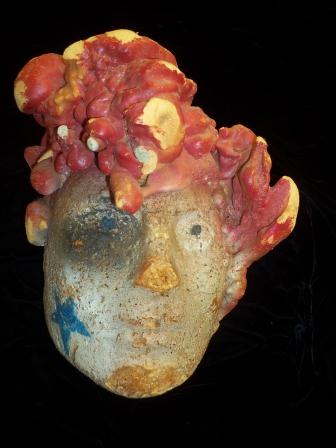
Foam maskThe University Archives recently received an unusual object from donor Emil Rinderspacher, a UI alumnus: A human head-shaped plastic form, created by students in the UI School of Art and Art History as part of an anti-war protest over 40 years ago. Students created hundreds of these “heads,” which were placed on trees on the Pentacrest one spring morning in 1970. This item accompanies papers from Mr. Rinderspacher which document campus activism at the time. The materials are now part of the student life collections of the University Archives.


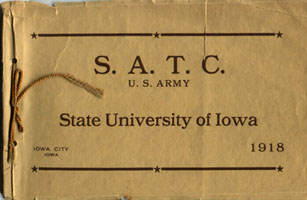
military documentOver two dozen resource guides help University Archives researchers find what they’re looking for. These guides may be found at http://www.lib.uiowa.edu/spec-coll/archives/faq/index.htm. A recent addition is our guide to military and wartime service collections, at http://www.lib.uiowa.edu/spec-coll/archives/faq/faqmilitary.htm. This guide lists such collections as the Records of the Department of Military Science and Records of the Civilian Pilot Training Program, 1942-1944.


Box of Captain Crunch

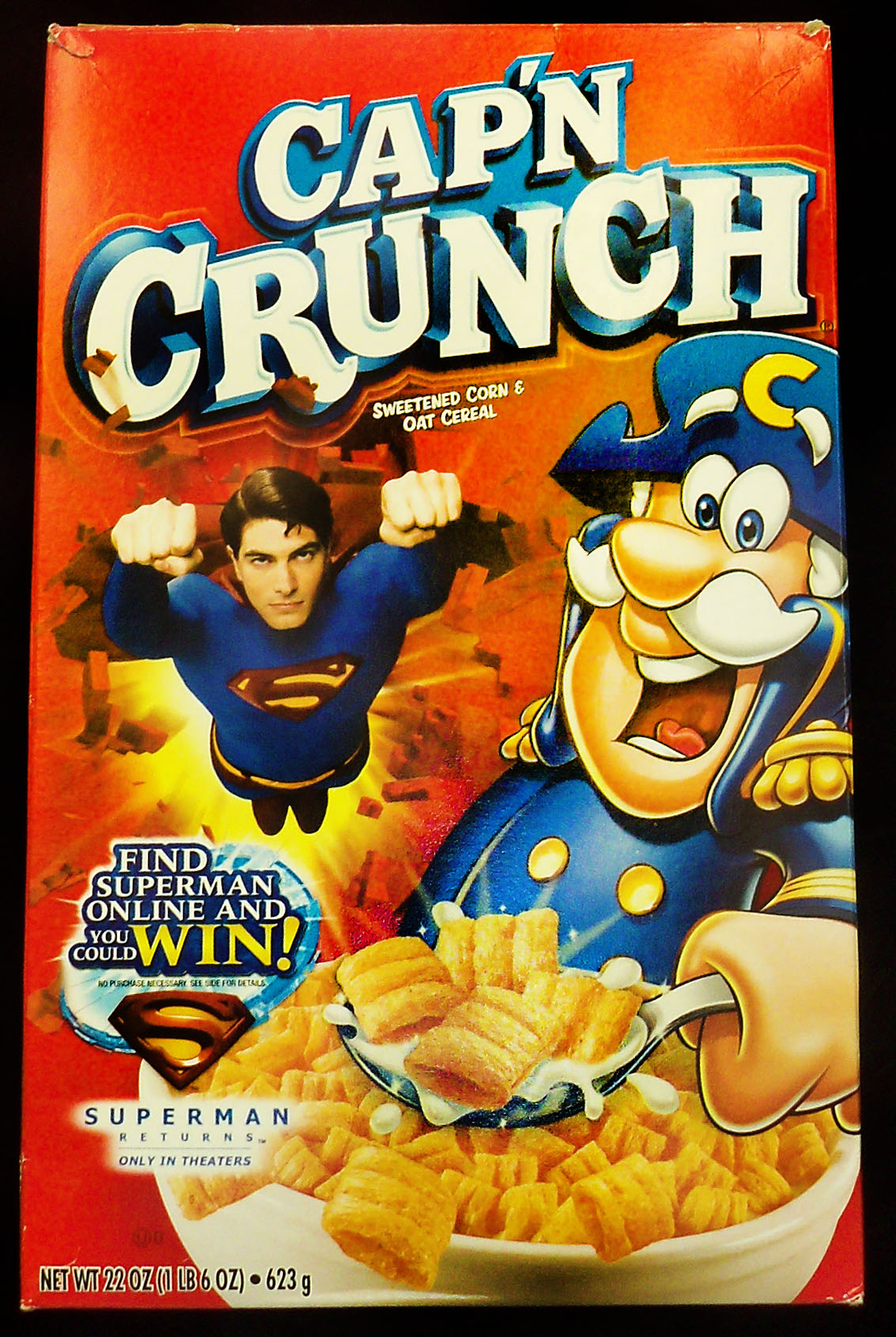
 Once in a while, the University Archivist donates material to the Archives. After chowing down several bowls of Cap’n Crunch cereal, David McCartney donated his empty box featuring former UI student Brandon Routh as Superman in the 2006 blockbuster movie of the same name. Hooray for Hollywood!


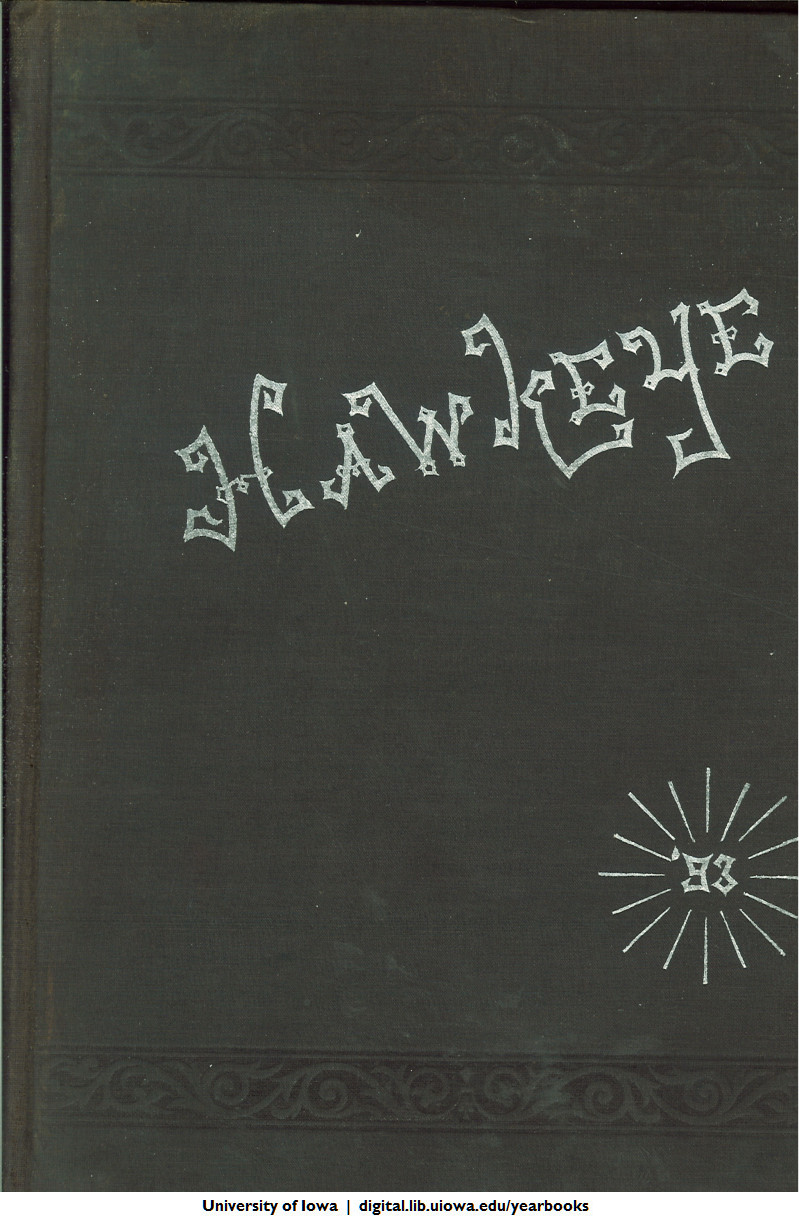
1893 yearbook coverYearbooks and student newspapers are two of the University Archives’ most popular resources. Nearly daily researchers’ questions are answered by consulting one or both of these collections. Now, both are online as part of the Iowa Digital Library. The Hawkeye yearbook, published from 1892 to 1992, is at http://digital.lib.uiowa.edu/yearbooks/. You may browse by decade and year by using the drop-down menu at the left of the screen. The Daily Iowan newspaper (previous names include The Vidette, The University Reporter, and the Vidette-Reporter) collection spans 1868, its first year of operation, to the present. It can be accessed at http://dailyiowan.lib.uiowa.edu/. Both online collections are text-searchable, though the Daily Iowan search feature is still being refined.

“The Defaulter,” or, the Loan Crisis on the American Stage

Did you know that U.S. society lived through major economic crises before the Great Depression? How did American popular theater depict these financial crises?


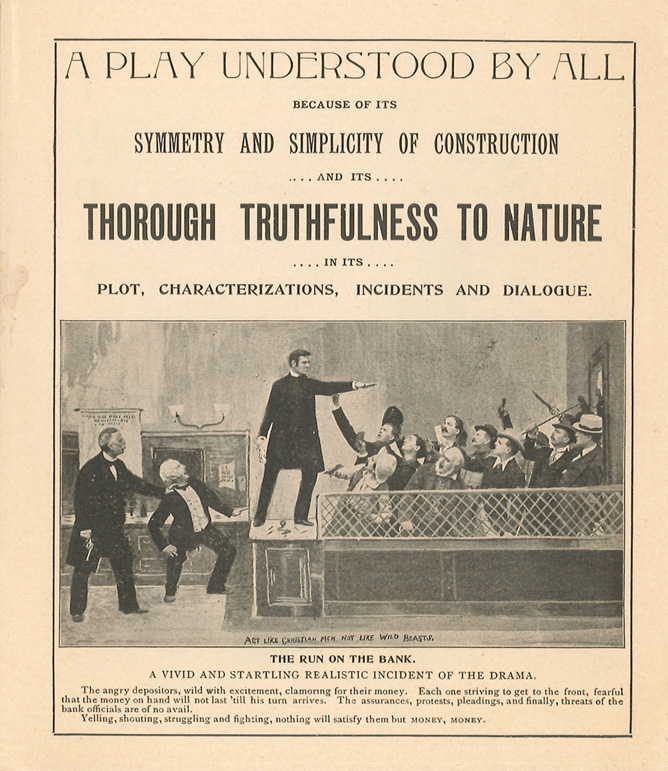
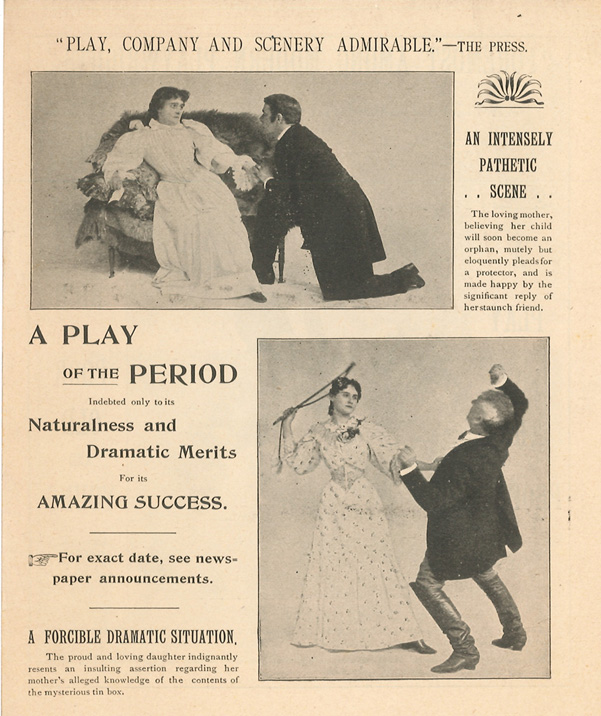
A reference question sent our graduate fellow Gyorgy “George” Toth looking in our John Springer Printed Ephemera Collection, which has some amazing playbills, programs, and advertisements of popular theater from the turn of the 19th and 20th centuries. There he found an advertising booklet for the play “The Defaulter,” which has some arresting imagery, as you can see below.

"The Defaulter" melodramatic stage play, cca. 1890s
"The Defaulter" play advertising booklet page 3


The play is advertised as “A Play of Today – showing Scenes of Today –  of the Life of Today – in the World of Today – with the Aims of Today,” and “a Play Understood by All because of its Thorough Truthfulness to Nature.” What was “the world of today”? And what real events was the play based on?


A quick search by our Instruction and Outreach Librarian Colleen Theisen revealed that the play was advertised (and likely performed) as early as January of 1896. If it was based on real events, this means that the crisis it refers to predates the Great Depression!

"The Defaulter" play advertising booklet page 2


In fact, by 1897 the United States had been in an economic depression for years. Farmers had been losing their land, the unemployed had been traveling the country for work, some people had defaulted on their loans, while others had made a run on the banks for their money. Yet others organized and marched to Washington, D.C. to plead their case with the government. While the play’s humor made the audience laugh, the tears they shed likely came from the viewers’ empathy for those in dire straits, and their fear of their own ruin.

"The Defaulter" play advertising booklet page 5
"The Defaulter" play advertising booklet page 7


Why the wide gestures, the bombastic poses? This play was part of a long tradition of stage acting called the melodramatic mode. Americans in the Victorian era (the second half of the 19th century) watched melodramas as a major pastime. Melodramas were plays for the American popular stage, accompanied by music, featuring stock characters such as a hero, a heroine and a villain, and conveying messages about morality in rather dramatic and overblown, sensational fashion. Setting the economic crisis, a highly complex and scary experience, as a melodrama allowed people to easier understand the situation, to identify with their favorite characters, and to experience a cathartic but happy ending – something most people wanted. In this way, the producers used popular culture not only to make a profit, but also to comfort the spectators and give them hope for the future.


By the late 19th century, melodrama as a stage and literary genre had acquired a reputation for being a lowbrow cultural form consumed by the unsophisticated members of the lower classes. This may be the reason why a reviewer (or promoter?!) assured newspaper readers in 1896 that “It is a drama abounding in strong situations and thrilling climaxes, but there is nothing of a Melodramatic character about it.”


After the turn of the 19th and 20th centuries, the genre of melodrama migrated from novels and the stage to film and pulp literature. In the Victorian era and beyond, melodrama was a major cultural form in which people were both entertained and processed the complex experiences of romantic love, urban life, immigration, and industrial labor relations. Special Collections and University Archives has several major collections about the history of the U.S. stage and popular culture. Please look at their descriptions here: http://www.lib.uiowa.edu/spec-coll/resources/theatrearts.html


Do you know any plays or movies that are trying to give hope to Americans struggling with today’s global recession?

New items in our “pop-up” display case

Two events with deep ties to history take place over the next week, and you can stop in to the Special Collections & University Archives reading room now to see a piece related to each.

 On Sunday, June 3, a celebration of Queen Elizabeth II’s Diamond Jubilee features a procession of over 1,000 boats on the Thames river in London. While infrequent in recent history, processions on the Thames were once a popular way of commemorating public events in London. On view is the first issue of the Illustrated London News. The newspaper’s famous header image features a view of a water procession on the Thames as a part of the Lord Mayor’s Day.

On Tuesday, June 5, observers around the world will witness this century’s last transit of Venus, when the planet Venus is visible crossing the face of the sun. The transit is a rare event—the next will occur in 2117. In centuries past, the transit was an important scientific tool, as observations were gathered from different parts of the globe to determine the distance between the earth and the sun. Governments sponsored elaborate expeditions to gather observations. James Cook was sent by the Royal Academy to Tahiti to record his observations. On display is an engraving from Sydney Parkinson’s A Journal of a Voyage to the South Seas, in His Majesty’s Ship, the Endeavour from 1773, which depicts the fort from which Cook and his scientists observed the 1769 transit.

Thank You!

There is one remaining aspect to highlight in our story of the move from the basement.  That is delivering a big THANK YOU for the help we received from Carney-McNicholas Movers who took care of the last remaining extra-heavy lifting that completed the move!   

The Move Comes to an End

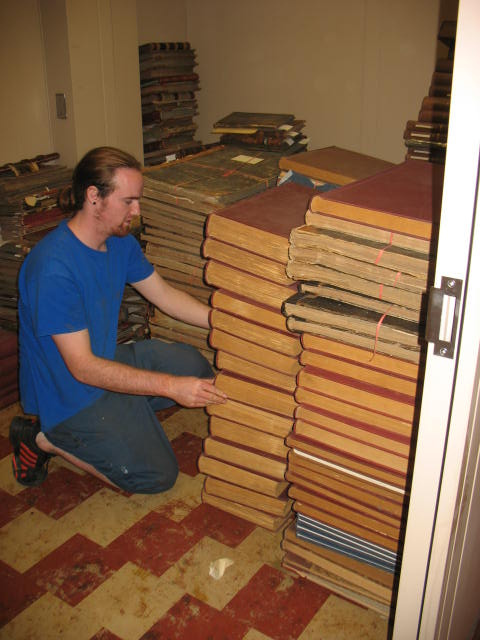
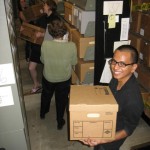
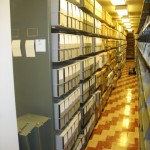
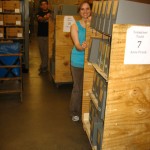
The busy noise of the crowds of students studying for finals has subsided but Special Collections & University Archives is peaceful not because the end of the semester has arrived but because the thunderous parade of carts has ceased. Our dedicated and cheerful crew of student workers finished the monumental task of moving the collections from the basement into newly vacated space on the third floor adjacent to the reading room. Not only are the collections now high and dry but the move united our collections on one floor making it easier and faster to retrieve items.

The students’ impressive work included replacing and dusting 3500 shelves (over 7000 total) and moving over 21,000 linear feet of material. That means that they moved the equivalent of 70 football fields or 4+ miles! Though some of the boxes weighed 40 pounds or more the weight and size of the task did not get them down as the process was filled with jokes and fun conversations.

Our gratitude goes out to everyone involved over the years from the hundreds of volunteers from across campus and the community who helped move materials before the 2008 flood and to our student workers and staff that helped with this move so that those efforts will never be necessary again. Each day as the collections continue to be used and bring joy to researchers, students, and all of us, we can all remember and be thankful for the many hands that came together who made it possible for that opportunity to continue.

Harry Potter and the Quest for Enlightenment

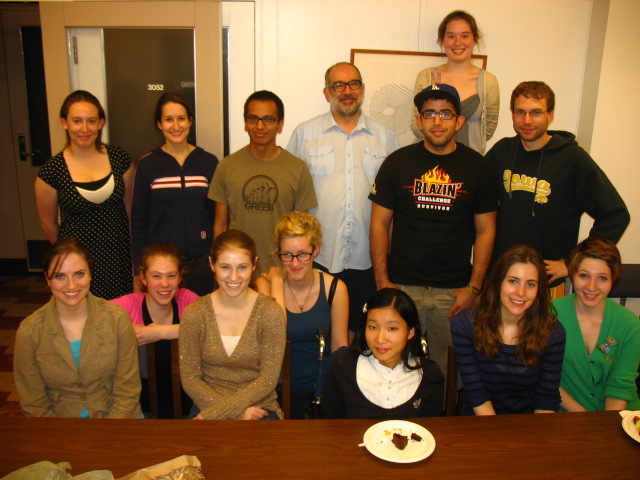
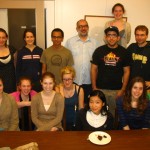
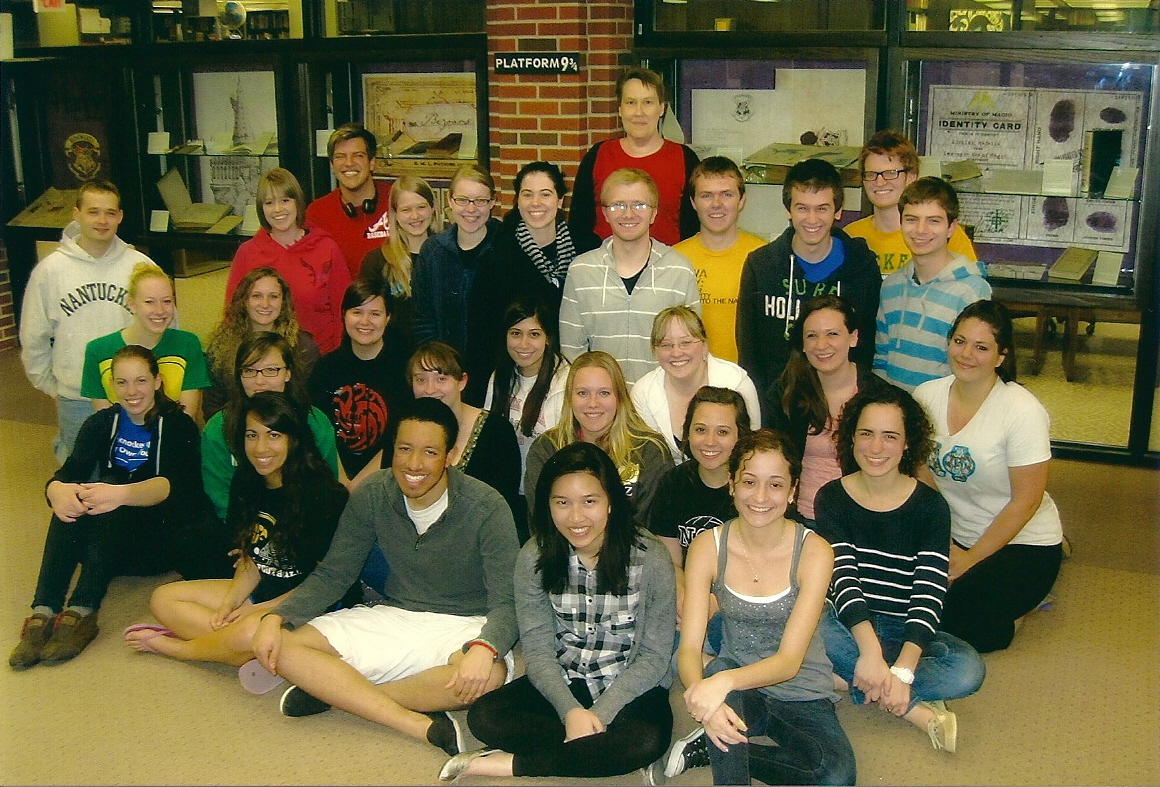
group photo of students

Dragons, mandrakes, and potions have taken over the cases outside Special Collections & University Archives!

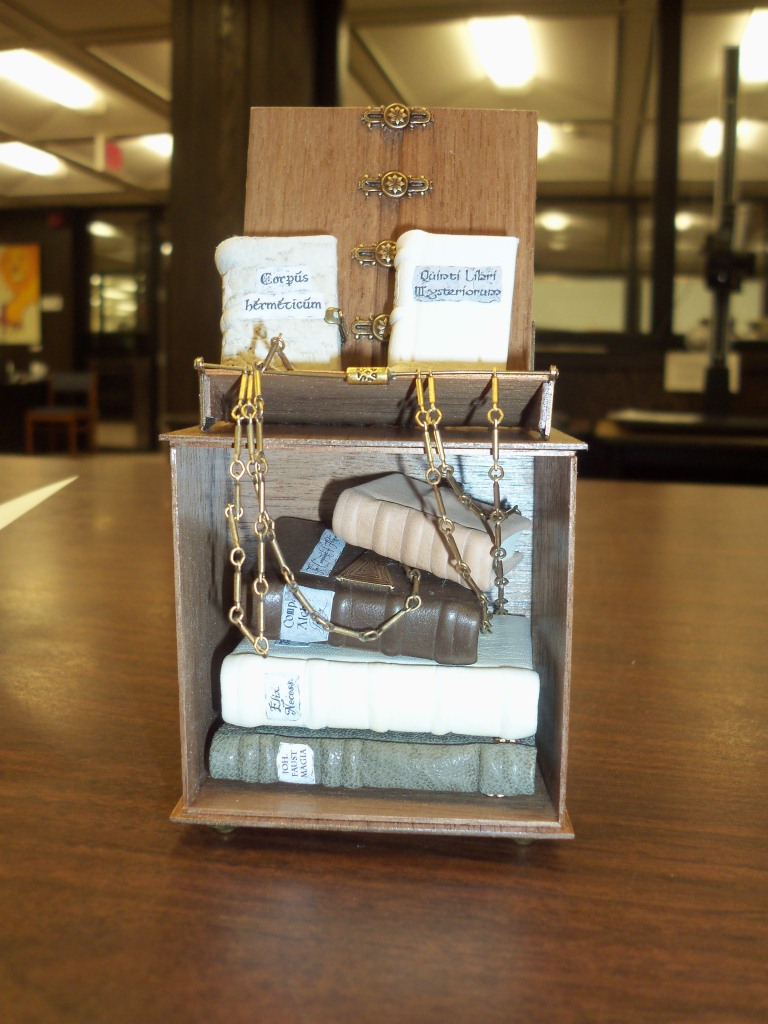
Students in Donna Parsons’ Honors Seminar titled “Harry Potter and the Quest for Enlightenment” have curated an exhibit using materials from Special Collections. The exhibit is one part of a semester long project utilizing Special Collections materials for research.  The students chose one item to represent their research and worked together to fit their items into themes for display. 

Parsons’ seminar has the students closely read the texts and analyze their themes as well as investigate the influences from the literary cannon and the effects on popular culture in the US and Britain.  She envisioned the collaboration with Special Collections as an exciting opportunity to enhance student learning. “The Harry Potter series is filled with extensive references to science, literature, mythology, and history,” Parsons says. “Partnering with Special Collections has supplied my students with the resources needed to trace a specific reference and discuss its relevance to a particular scene, character, or plotline.  The partnership has also provided the context for a deeper understanding of the series and its appeal to a diverse audience.”

Greg Prickman, Head of Special Collections & University Archives,  welcomed the collaboration.  “The idea to have the students create an exhibition was Donna’s, and we quickly agreed to it. Rather than showing or telling, we are giving them the chance to do their own showing and telling, which results in a unique learning opportunity that can only be experienced with access to original historical documents.”

Kelsey Sheets, a student in the seminar, loved finding out how complex the world of Harry Potter really is.  “In the past I have read books about how J.K. Rowling draws inspiration from a wide variety of historical and mythical sources and incorporates them into the series, but my own research [on links between the study of Potions and the muggle study of Chemistry] really solidified this point and made me appreciate the depth of the wizarding world.”

The exhibit will be on display until June 12th on the third floor of the Main Library outside Special Collections & University Archives anytime the library is open.

Cooking Pamphlets as Culture

On April 14th Special Collections & University Archives staff visited the International Students’ Cooking Club. György Tóth, a PhD candidate in American Studies and the senior Olson Fellow, prepared some dishes from his native Hungary. Besides the dinner, the evening also featured an introduction to the Chef Louis Szathmáry II Collection of Culinary Arts, with an assortment of pamphlets on hand to browse and a discussion on culture as seen through cooking ephemera led by Outreach and Instruction Librarian Colleen Theisen. Since many of the international students in attendance were from China, the biggest hit of the evening was “The Art and Secrets of Chinese Cooking,” a pamphlet from the Beatrice Foods Company (including the La Choy line of products) from 1949.

Louis Szathmáry was a Hungarian émigré chef, teacher, writer, philanthrophist, an avid book collector, and is considered by many to be the first “celebrity-chef”. The Szathmáry Collection is made up of his extensive collection of books, pamphlets, and manuscripts relating to cooking. You can see digitized versions of many of the pamphlets from the Szathmáry collection here: http://digital.lib.uiowa.edu/szathmary/ and the finding aid to the entire collection is here: http://www.lib.uiowa.edu/spec-coll/MSC/ToMsc550/MsC533/MsC533.htm

Hevelin Collection

This week the University of Iowa Libraries is pleased to announce the acquisition of the James L. “Rusty” Hevelin Collection of Pulps, Fanzines, and Science Fiction Books. The original press release can be viewed here.

Rusty Hevelin passed away on December 27, 2011 after an illness. He was a science fiction fan, pulp collector, huckster (a dealer at conventions), and voracious reader for most of his 89 years. He hitchhiked to his first science fiction convention in Denver in 1941. The convention was called Denvention, and it was the third World Science Fiction Convention (the cons known as World Cons). He was the Fan Guest of Honor at Denvention 2 in 1981, and was a presenter at the Hugo Awards ceremony at Denvention 3 in 2008 (photo below from Keith Stokes).

Rusty Denvention, Hevelin Collection

To get a sense of what Rusty’s collection is like, it is helpful to get a sense of what Rusty himself was like. Those who knew Rusty were always impressed by his remarkable memory, and his many years as a science fiction fan made him the stereotypical “walking encyclopedia” of fandom. His early years as a fan, convention attendee, and fanzine writer and publisher were spent in the company, and often personal friendship, of great science fiction writers like Robert Heinlein, Ray Bradbury, Isaac Asimov, Frederik Pohl, Lester Del Rey, and many others. He witnessed the evolution of fandom, the adoption of science fiction by mainstream entertainment companies, and many other changes over the course of his lifetime.

There are several sources online for more details on Rusty’s life:

Interview in Transformative Works: link

Obituary at File 770: link

Gay Haldeman’s bio of Rusty for the Demicon 20 program book: link

Rusty’s collection is now here at the University of Iowa, but Rusty’s connections with the state go back much further. He was one of the founders of the state’s two ongoing science fiction conventions, Icon in the Iowa City/Cedar Rapids area, and DemiCon in Des Moines.

We will be highlighting many of the interesting items in the collection in the months (and likely years) to come as we begin to unbox and process the collection. Watch this space for future announcements, and also keep an eye on our Facebook and Twitter pages. You will also soon be able to subscribe to our upcoming email newsletter.