May 6th, 2008 by Mary Cullen
The John Martin Rare Book Room will hold its annual open house on Thursday, May 15 from 4:30 to 7:30.
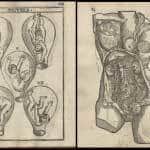
The exhibit, “’No Small Presumption’–Surgical Works From Six Centuries,” will feature rare books from the earliest days of surgery through the twentieth century. Although chloroform and ether were not widely used before the second half of the 19th century, a surprising number of surgical procedures were employed hundreds and even thousands of years ago, including operations for cataracts, bullet removal, hernias, club foot, and bladder stones. The open house will allow visitors to view and page through the early texts and illustrations used by surgeons for instruction and guidance.
Of special interest are the woodcuts and engravings of the elaborate and sometimes quite modern instruments developed over the centuries for specific tasks, including drills, scalpels, and saws designed with speed and efficiency in mind. Important early works in anesthetics and antisepsis will also be featured.
The exhibit is part of a series of public lectures and presentation sponsored by the University of Iowa History of Medicine Society.
The John Martin Rare Book Room is located on the fourth floor of the Hardin Library for the Health Sciences. For additional information, please contact Ed Holtum, Curator at 335-9154.
*This event is open to the public.
Posted in Rare Book Room, Exhibits | Comments Off
April 16th, 2008 by Mary Cullen
Don’t forget to stop by Hardin’s newest exhibit, Simple Medicines, located near the 3rd floor doors of the Hardin Library. The display on herbs and herbal medicinal treatments spotlights the work of French scholar Matthaeus Platearius (d. 1161).
The lustrous images in this exhibit have been copied from a facsimile of a remarkable manuscript published in the last part of the 15th century, Le livre des simples médecines (The book of simple medicines). The original manuscript is housed in the Russian National Library at St. Petersburg [Barcelona: M. Moleiro, 2000].
Beginning around the 11th century, European scholars began translations of ancient Greek works, using as their sources, Arabic translations that were preserved during the Middle Ages by Islamic scholars. One of the most important of these translations (De medicinis simplicibus (“On simple medicines”) was completed in the mid 12th century by Matthaeus Platearius (d. 1161), a physician from Salerno, Italy, an important translation center.
Platearius’ text found its way into numerous manuscripts but none as beautiful as the codex produced for Count Charles of Angoulême and his wife Louise of Savoy. Most of the text is taken from Platearius’ French translation with additional material from later writers. The text includes sections on herbs and flowers, trees, metals & minerals, and animal products. It is followed by a magnificent 116 page atlas depicting “simples” – plants used in treating diseases. The striking artistry was probably the work of Robinet Testard (fl 1475–1523), the French illustrator and illuminator.
Of interest, too, are the written annotations added by two physicians who insert Latin and Greek names for many of the plants and who provide additional commentary.
Posted in Rare Book Room, Exhibits | Comments Off
April 7th, 2008 by Ed Holtum
The University of Iowa History of Medicine Society will host its annual R. Palmer Howard Dinner, Friday, April 25, 2008. The reception will begin at 6:00 pm followed by the dinner at 7:00 on the 8th floor, Roy Carver Pavilion, UIHC.
The after-dinner speaker will be, Walton O. Schalick, III, Md, PhD, Assistant Professor of Medical History, University of Wisconsin-Madison who will speak on ‘Humanizing’ Disability Care: Pediatrics, Policy and Crippled Children in the US and Europe, 1802-1945. The event is open to the public. Please click here for a reservation form.
Dr. Schalick’s research interests include medieval medicine and pharmacology, the history of children with physical disability in 19th and 20th century Europe and the US, and the practical ethics of pediatric emergency research. His is in great demand as a lecturer and has delivered presentations on four continents. Dr. Schalick is also the recipient of numerous honors, including the William b. Bean Award from the American Osler Society. After completing his undergraduate work at Washington University in St. Louis, Dr. Schalick received his PHD and his MD from Johns Hopkins University.
Posted in Lectures and Discussions, Rare Book Room, News | Comments Off
March 24th, 2008 by Ed Holtum
Recently, the John Martin Rare Book Room acquired a rare copy of Edward Tyson’s 1699 book, Orang-outang, sive, Homo sylvestris, or, The anatomy of a pygmie compared with that of a monkey, an ape, and a man… The book constitutes of the most important works in the history of comparative morphology. 
Physician, Edward Tyson, studied at Oxford and Cambridge and was a frequent lecturer on anatomy; he made several important contributions to medicine including the discovery of the sebaceous glands of the corona glandis (“Tyson Glands”). As a hospital administrator, Tyson was responsible for introducing female nurses to Bethlehem Hospital. Tyson’s reputation, however, rests largely with his anatomical studies which, in addition to the present investigation, included the porpoise and the opossum.
The “Orang-Outang” Tyson describes is actually a less than mature male chimpanzee from Angola that died a few months after its arrival in London. Also, his use of the word “Pygmie” denotes a group of small mythical beings whose supposed existence Tyson attributes to sightings of chimpanzees made in antiquity. Tyson’s “Pygmie” is completely unrelated to the name now given to the short-statured groups of people in Central Africa whose existence was unknown to Europeans until the 19th century.
As the first to dissect this species, Tyson noted the great morphological similarity between the animal and humans and termed it “an intermediate link” between ape and man. In doing so, Tyson did not mean to suggest a common lineage or descent but rather was referring to the “links” in the “Great Chain of Being,” the classical conception of a hierarchical universe from the simplest elements through the plants and animals and culminating in humans and finally God.
Tyson writes that the animal is “…of a higher degree above any of [the other apes and monkeys] we yet know, and more resembling a man. But at the same time I take him to be wholly a Brute, tho’ in the formation of the of the Body, and in the sensitive or brutal soul, it may be, more resembling a man, than another other anima; so that in this chain of the creation, as in intermediate link between an ape and a man, I would place our Pygmie.” The remarkable plates are executed in a style very similar to those in Vesalius’ Fabrica further underscoring Tyson’s thesis.
The copy in the John Martin Rare Book Room was once owned by William Musgrave (ca 1655-1721), former secretary of the Royal Society, physician, and noted historian. The skeleton of the chimpanzee dissected by Tyson remains on display at The Natural History Museum of London.
For additional images, click on links.
Musculature
Skeleton
Posted in Notes from the Rare Book Room, New Resources, Rare Book Room, News | Comments Off
March 19th, 2008 by Eric Rumsey
Many of the pictures in Hardin MD are public-domain, meaning that they are not copyrighted. One useful source for pictures that are not copyrighted is classic medical books that are old enough that their copyright has run out. Hardin MD has pictures from three of these books, described below.

Dermochromes, by Jerome Kingsbury, pictures by Eduard Jacobi, 1914.
This book is in the Hardin Library collection, and images were specially scanned for use on Hardin MD pages. Pictures in Hardin MD are on Leprosy, Ringworm, and Lupus (the picture to the left). These realistic pictures were made in Germany using an unusual wax modeling technique.
* * * * * *

Thomas Addison’s book containing the first description of Addison’s Disease, 1855
This book is in the Hardin Library John Martin Rare Book Room, and images were scanned for placement in the University of Iowa Digital Library. They are also on Hardin MD pages.
* * * * * *

Atlas of diseases of the skin, Franz Mracek, 1899
Pictures in Hardin MD are of Psoriasis. These pictures are from the Google Books version, which was scanned at Harvard University
* * * * * *
It has been especially gratifying to make these pages available for Internet users because the pictures from these books are often highly ranked in Google Image search, and get heavy use from this. See for example, Google Image searches on lupus and addison’s disease.
* * * * * *
[medical pictures, medical books pictures, google books, google book search, free ebooks, e books, old books, medical images]
Posted in Hardin MD, Rare Book Room, Electronic Resources | 1 Comment »
March 19th, 2008 by Ed Holtum
The public is invited to a University of Iowa History of Medicine talk on “Elmer L. DeGowin, MD, Blood transfusions in war and peace” at 5:30 p.m. Tuesday, March 25, in Room 401 of the UI Hardin Library for the Health Sciences.
The speaker will be Dr. Ronald Strauss, Professor, DeGowin Blood Center, University of Iowa Hospitals and Clinics.
Light refreshments will be served. The lecture is part of a series of presentations sponsored by the UI History of Medicine Society.
Dr. Strauss will discuss Elmer DeGowin’s many contributions to the understanding of blood storage and transportation and his lifetime efforts to make blood transfusions safe and effective.
Individuals with disabilities are encouraged to attend all UI-sponsored events. If you are a person with a disability who requires an accommodation in order to participate in this program, please contact Ed Holtum at 319-335-9154 or edwin-holtum@uiowa.edu.
For directions to Hardin Library and information on parking, visit http://www.lib.uiowa.edu/hardin/getting.html.
For more information about the UI History of Medicine Society lecture series, visit http://hosted.lib.uiowa.edu/histmed/
Posted in Lectures and Discussions, Rare Book Room | Comments Off
February 22nd, 2008 by Ed Holtum
The public is invited to a University of Iowa History of Medicine talk on “Physicians of the Deaf: Treatment, Prevention and the AMA’s War on Quackery 1910-1940″ at 5:30 p.m. Tuesday, February 26, in Room 401 of the UI Hardin Library for the Health Sciences.
The speaker will be Emily Alden, Student, Interdepartmental Studies Program, UI
Light refreshments will be served. The lecture is part of a series of presentations sponsored by the UI History of Medicine Society.
Shorty after the turn of the 20th century, the American Medical Association began a media campaign to combat nostrums, quackery and patent medicine as part of its efforts to professionalize the practice of medicine, arguing that “unorthodox” medicine was a synonym for ineffective. Alden will focus of the interplay between this campaign and physicians of the deaf during the period between 1910 and 1940
Individuals with disabilities are encouraged to attend all UI-sponsored events. If you are a person with a disability who requires an accommodation in order to participate in this program, please contact Ed Holtum at 319-335-9154 or edwin-holtum@uiowa.edu.
For directions to Hardin Library and information on parking, visit http://www.lib.uiowa.edu/hardin/getting.html.
For more information about the UI History of Medicine Society lecture series, visit http://hosted.lib.uiowa.edu/histmed/
Posted in Lectures and Discussions, Education, Rare Book Room | Comments Off
November 16th, 2007 by Ed Holtum
The public is invited to a University of Iowa History of Medicine talk on “Iowa Leading the Way: Dr. Ralph Waters and the First Ambulatory Surgery Center” at 5:30 p.m. Tuesday, November 27, in Room 401 of the UI Hardin Library for the Health Sciences.
The speaker will be Douglas Merrill, Medical Director, Ambulatory Surgery at the UI Hospitals and Clinics.
Light refreshments will be served. The lecture is part of a series of presentations sponsored by the UI History of Medicine Society.
Merrill will discuss the life and career of Dr. Ralph Waters, who established the world’s first outpatient surgical center in Sioux City, Iowa in 1918. It was the start of a career that would see him invent anesthesia delivery systems whose ilk are still in use today, and to become a founding father of academic anesthesiology in the United States.
While outpatient surgery centers are commonplace today, they were unknown until Waters (“The Wizard of Gilman Terrace”) saw the opportunity to combine his professional qualifications as an anesthesiologist with those of local dentists and surgeons. In doing so, he helped establish anesthesiology as a medical specialty.
Merrill will also speak on the nature of anesthesia and surgery during the early decades of the twentieth century and Water’s later career as the head of the first full-time university department of anesthesia at the University of Wisconsin.
Posted in Lectures and Discussions, Rare Book Room | Comments Off
November 7th, 2007 by Ed Holtum
The next time you visit the Hardin Library, peek into the John Martin Rare Book Room for a glimpse at the antique dark oak desk just inside the entrance. It once belonged to Sir William Osler (1849–1919), unquestionably the most famous English speaking physician of the late 19th and early 20th century. 
Read the rest of this entry »
Posted in Rare Book Room | Comments Off
October 26th, 2007 by Ed Holtum
Fear and dread are no strangers to the Libraries, especially during finals week, as students fight the demons of procrastination, sleep deprivation, and over-caffeination. But this Halloween, we’re kicking it up a notch from fear to terror.
Drop by Main Library on Halloween for our “Ghosts From the Stacks” event, where library staff will draw from Special Collections, Iowa Women’s Archives and the John Martin Rare Book Room to presents artifacts related to grave-robbing, local hauntings, and demon conjuring. Also we will serve cookies.
Ghosts From the Stacks
Main Library, room 2032
Wednesday, Oct. 31, noon - 1:00 pm
Posted in Rare Book Room, Miscellaneous, News | Comments Off