Skip to content
Skip to main content

Comics: Entertainment or Social Critique?

Are comic books a good vehicle for social critique? Is Superman’s romance with Lois Lane trying to tell us something about our own relationships? Can comics promote racial inclusion?

As a spinoff of the recent symposium on graphic language, Special Collections and University Archives presents The Comics Continuum, an exhibit from our collections available for perusal, research and teaching to the university community and beyond. The exhibit is open on the 3rd floor of the Main Library through the end of November 2011. While viewing the exhibit, please see the labels for any collection numbers (MsCs) that you may be interested in browsing. Once you are done with the exhibit, we encourage you to move beyond the glass cases, come in Special Collections, and request to look at some of our comics collections in the Reading Room.

For more on our specific collections of comics and graphic narrative art, see

http://www.lib.uiowa.edu/spec-coll/resources/guides/ComicBookCollections.html


Here are some of the items you can see in our exhibit.


As a genre, comics have the potential to treat political and social issues in ways that promote free and open discussion. The realization of this potential has been shaped by factors such as the contemporary social movements, the vision of the graphic artist, the imperative for business profit, and the expectations of fan communities of entertainment value or social commitment. One of the most important issues of the post-World War Two United States, race relations were treated by comic books with varying degrees of seriousness and sophistication.


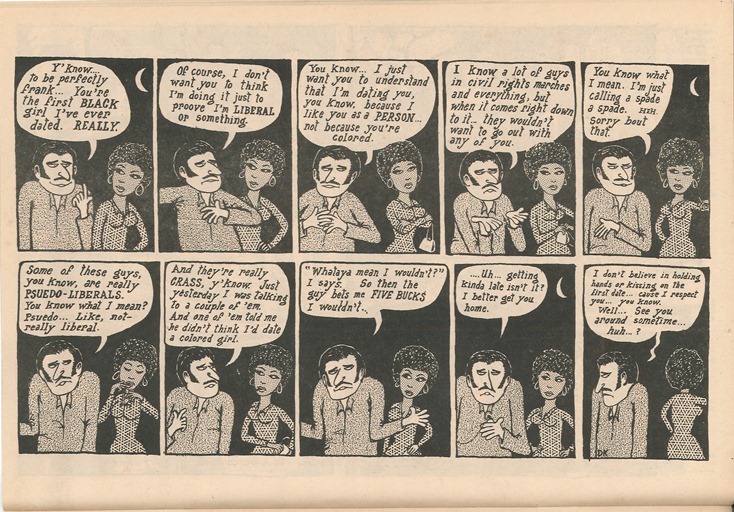
Some, like this 1969 issue of the underground Mom’s Homemade Comics, poked fun at liberals for their ambiguous openness to racial inclusion and relationships.

Moms Homemade Comics 1969Moms Homemade Comics 1969

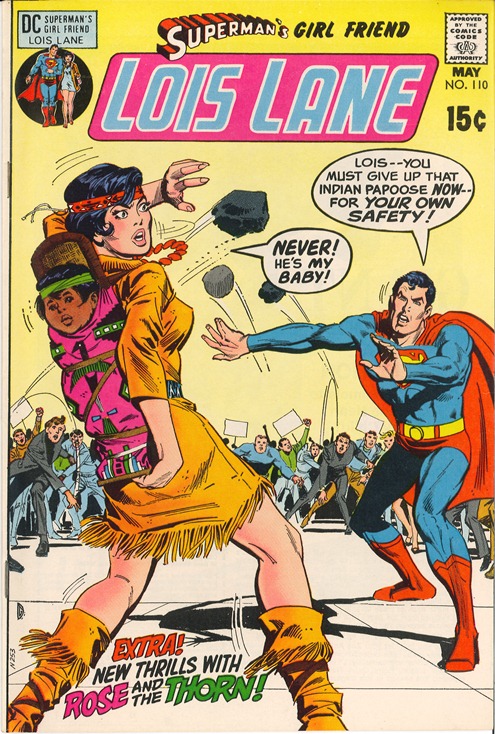
More mainstream comics such as this May 1971 issue of [Lois Lane] Superman’s Girl Friend used the events of the radical American Indian sovereignty movement to explore issues of motherhood and interracial solidarity.

Supermans Girl Friend 1971


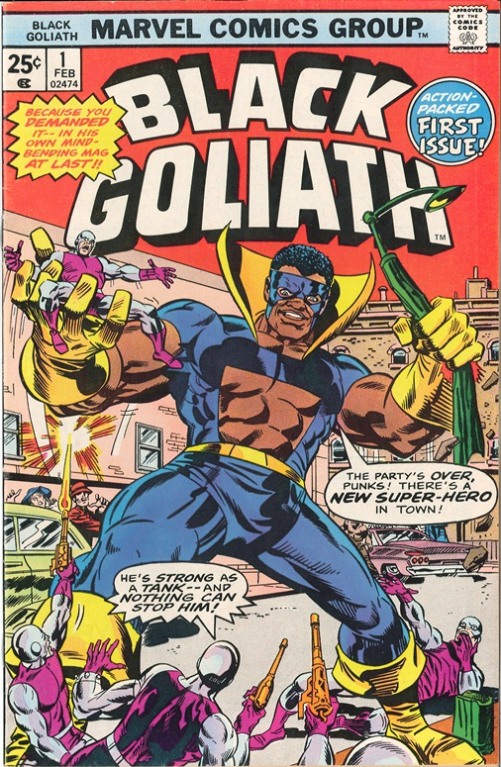
One of the first African American characters to become a superhero was Dr. William Barrett Foster, who, according to his origin blurb, “pulled himself up out of the Los Angeles slums,” to earn several doctorates  and work as director of one of the nation’s most prestigious research labs before becoming a 15-foot tall crime-fighting giant. As in this February 1976 issue of Black Goliath, Dr. Foster’s transformation into a superhero potentially resonated with American anxieties about urban “race riots,” and with the problems of social mobility and the black middle class.


Black Goliath 1976


Mom’s Homemade Comics No. 1, 1969 (ATCA Comics, MsC 780) – http://www.lib.uiowa.edu/spec-coll/MSC/ToMsC800/MsC780/ATCA%20Comics.htm

[Lois Lane] Superman’s Girl Friend No. 110, May 1971 (Comic Books of the Bronze Age, MsC 883, Gift of Ken Friedman) – http://www.lib.uiowa.edu/spec-coll/msc/ToMsC900/MsC883/msc883_comicbooks.html

Black Goliath 16 No. 1, February 1976 (Comic Books of the Bronze Age, MsC 883, Gift of Ken Friedman)

Political Cartoons Exhibit Sampler


How many of the issues of the 2012 presidential elections are new to our society?  What did politicians and the media say about unemployment and social security in the 1930s, the 1970s, or the 1990s? Were the elections of the last century less divisive in their language than those of today? What guidance can the past give for the future? Here is a sampler of our exhibit “A Century of Un/Civil Discourse in Political Cartoons,” on view at the Iowa City Sheraton Hotel during the symposium on political discourse November 9-10, 2011.

Visit the symposium website at http://ppc.uiowa.edu/pages.php?id=278

Browse our  online digital Des Moines Register political cartoons collection at http://digital.lib.uiowa.edu/dmrc/


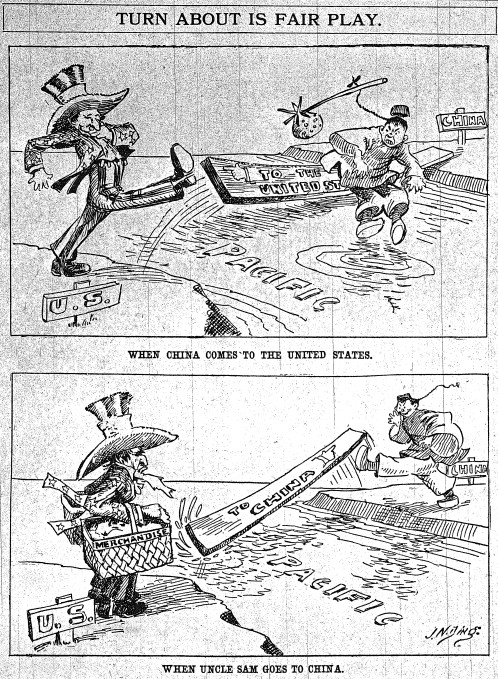
The More Things Change…: Immigration, 1905


“Turn about is fair play.” By J. N. “Ding” Darling, Sioux City Journal, June 28, 1905.

Rendered in the cartooning style of the 19th century, Darling’s observation that the exclusion of Chinese immigrants from the U.S. may ruin trade relations with that country rings true today, when China is seen by Americans as a conniving owner of U.S. debt, but also as a power whose intervention could help the world economy out of the recession.


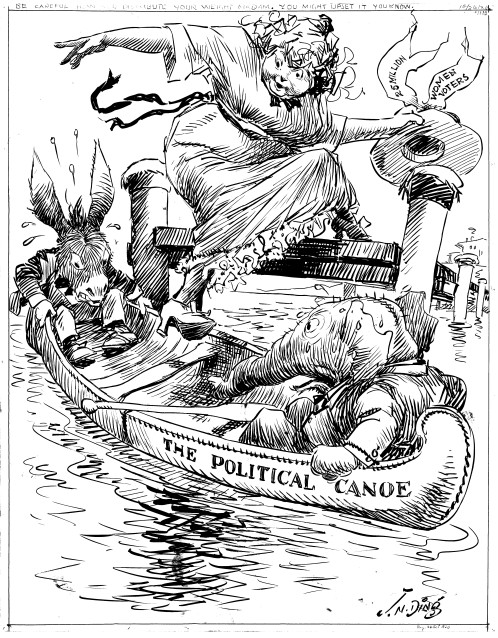
Women and the Political Conversation, 1920

“Be careful how you distribute your weight, Madam. You might upset it, you know.” By J. N. “Ding” Darling, Des Moines Register, October 26, 1920.

Darling’s cartoon masterfully captures the idea held during the culmination of the suffrage movement that women would vote as one bloc in electoral politics, and may fundamentally alter the balance between the major parties. Did this fear come true?


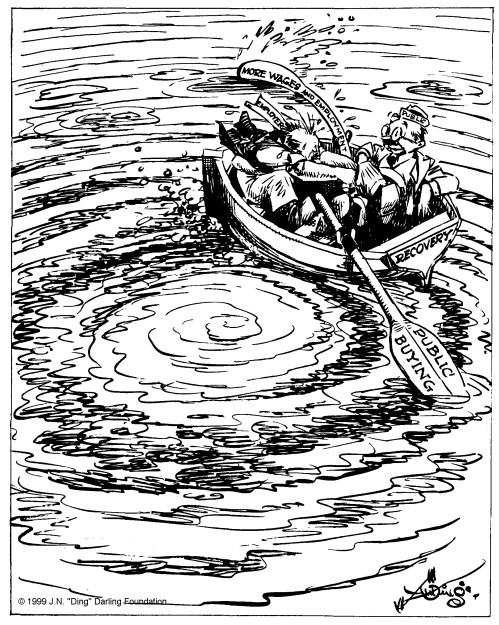
The More Things Change…: Recession, 1933

“If we're going to get anywhere somebody's got to pull that oar.” By J. N. “Ding” Darling, Des Moines Register, August 27, 1933

Historians now explain that the Great Depression was exacerbated by a dramatic drop in people’s willingness to buy goods. Through his cartoon, Darling argued that the road to recovery lay in combining the strikes of the oar of the government’s employment policies with an encouragement of John Q. Public to start buying again with his consumer paddle. This dynamic may be familiar from our own crisis of consumer confidence as a response to the collapse of the credit system.


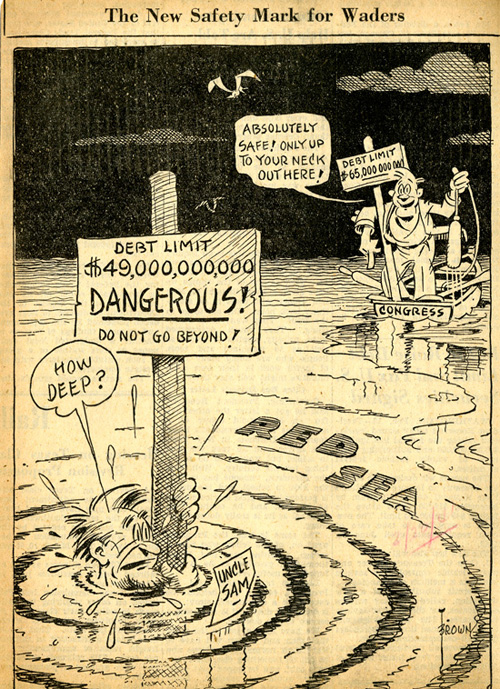
The More Things Change…: Raising the Debt Ceiling, 1941


“The new safety mark for waders.” By T. Brown, Wall Street Journal, February 24, 1941.


Brown’s cartoon cautioning Congress against raising the debt ceiling lest the whole nation submerge anticipated FDR’s fight with Capitol Hill two years later, in which the president had give up his plan of capping personal incomes with a tax in return for Congress raising the debt limit.


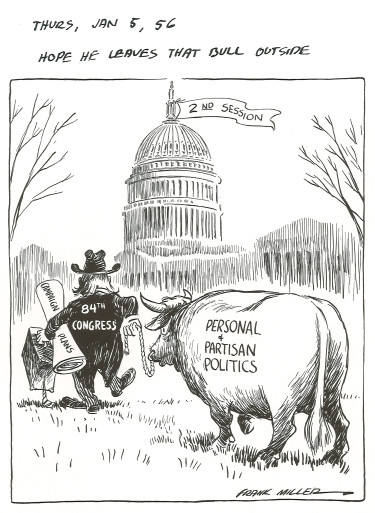
The More Things Change… Government that Governs, 1956

“Hope he leaves that bull outside.” By Frank Miller, Des Moines Register, January 5, 1956.


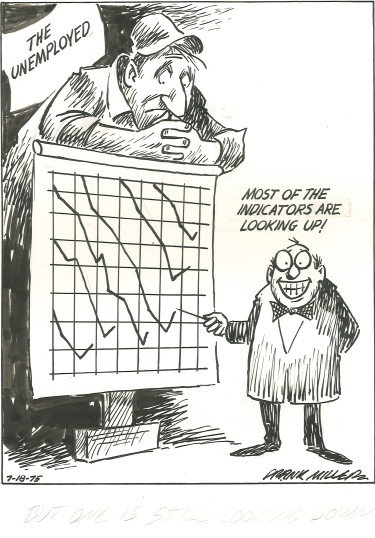
The More Things Change… Jobs, Jobs, Jobs, 1975 

“But one is still looking down.” By Frank Miller, Des Moines Register, July 18, 1975.

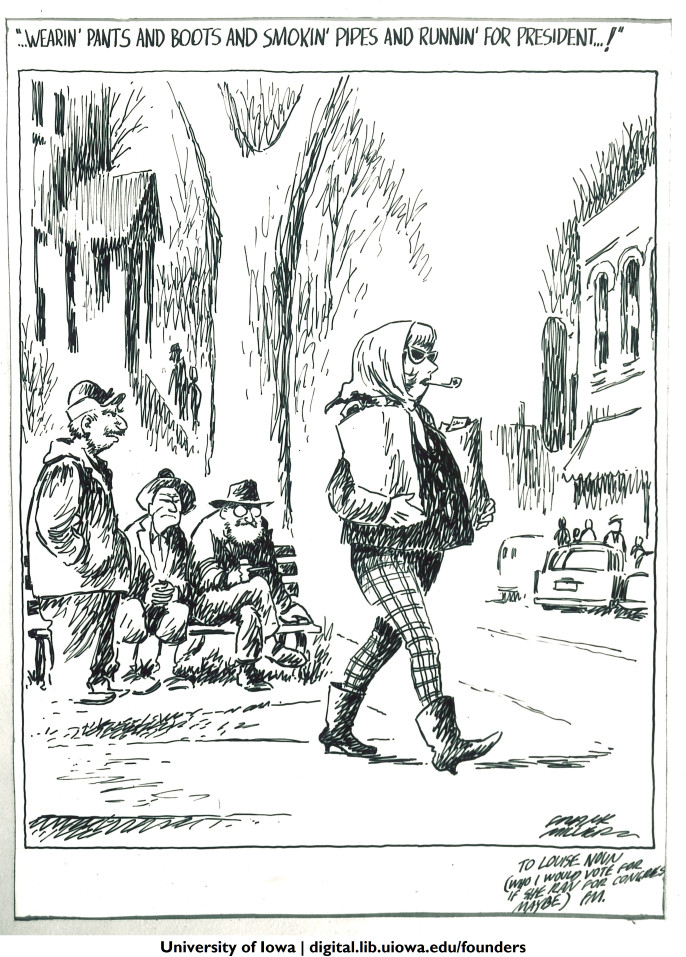
Women and the Political Conversation, 1972

"Wearin' pants and boots and smokin' pipes and runnin' for President!" By Frank Miller, Des Moines Register, 1972


Frank Miller’s cartoon at the same time marked the historic occasion of Shirley Chisholm’s 1972 “Unbought and Unbossed” campaign, a black woman making a bid for the U.S. presidency, and poked fun at those in the Democratic Party and across the U.S. who social progress had passed by. Miller dedicated this copy to Louise Noun, co-founder of the Iowa Women’s Archive, who he considered worthy of voting for if she ever ran for office.


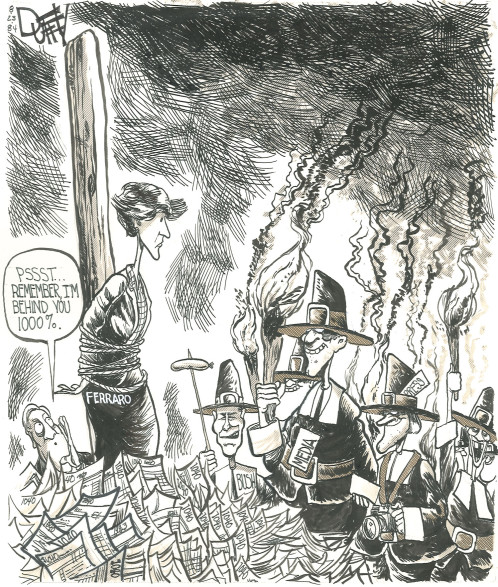
Un/Civil Discourse in U.S. Political Campaigns, 1984

“Pssst ... remember I'm behind you 1000%.” By Brian Duffy, Des Moines Register, August 23, 1984.

In the person of Democratic VP candidate Geraldine Ferraro, the 1984 presidential elections saw the first woman on a major party’s presidential ticket. By late August, Brian Duffy felt that her running mate Walter Mondale had abandoned Ferraro to the attacks of Republican VP candidate George Bush and the feeding frenzy of the media over her past campaign finances and tax filings.


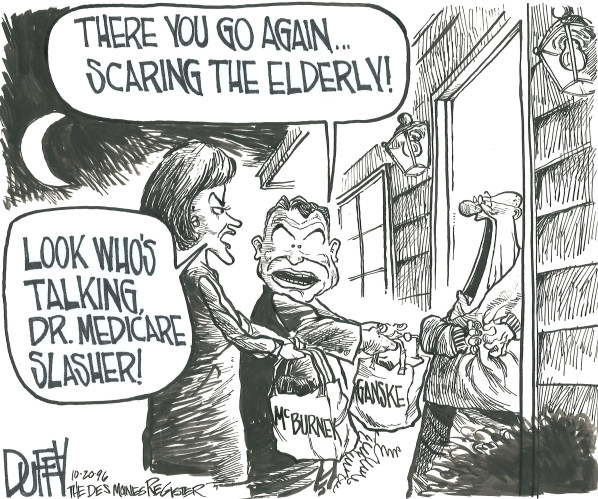
Un/Civil Discourse in U.S. Political Campaigns, 1996


“There you go again ... scaring the elderly!” By Brian Duffy, Des Moines Register, October 20, 1996.

The More Things Change… Political Cartoons Exhibit Highlights Un/Civil Discourse over the Past Century

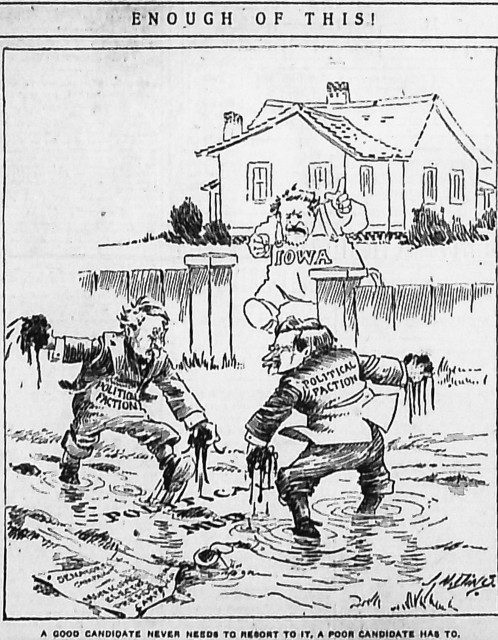
"Enough of this!" By J. N. "Ding" Darling, Des Moines Register, January 25, 1908


How many of the issues of the 2012 presidential elections are new to our society?  What did politicians and the media say about unemployment and social security in the 1930s, the 1970s, or the 1990s? Were the elections of the last century less divisive in their language than those of today? What guidance can the past give for the future?

As part of the University of Iowa Public Policy Center’s “Conflict and Civility in Political Discourse: Where Is the Line?” symposium, Special Collections & Iowa Women’s Archives are teaming up with the Herbert Hoover Presidential Museum & Library to bring you an exhibit of “A Century of Un/Civil Discourse in Political Cartoons.” Assembled from thousands of political cartoons published in the Des Moines Register and other national newspapers over the course of the 20th and early 21st century, the exhibit will show how themes like unemployment, social security, government waste, electoral acrimony, immigration and the position of women were treated by perceptive and provocative cartoonists like J. N. “Ding” Darling, Harold Carlisle, Frank Miller and Brian Duffy. For good measure, the physical exhibit will be accompanied by a screen slideshow with additional cartoons.


The symposium will be held November 9-10 at the Sheraton Hotel of Iowa City. For more information, go to the symposium homepage at http://ppc.uiowa.edu/pages.php?id=278


Would you like to browse more of our political cartoons from home? Please go to our online digital Des Moines Register political cartoons collection at http://digital.lib.uiowa.edu/dmrc/

William Henderson Civil War Diaries

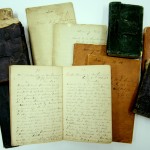
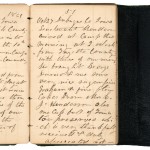
The first of several new Civil War acquisitions arrived yesterday: 11 diaries written by William Henderson, who served as part of the “University Recruits” in Company C, 12th Iowa Regiment. He and his fellow students from Upper Iowa University mustered in Oct. 4, 1861. He went on to serve at Fort Donelson, Corinth, Vicksburg, Jackson, and others.

Henderson’s entry from 150 years ago today, October 26, 1861: “Dubuque Co. Iowa. I was released from Guard duty at 9 o’clock. It reminded me more than anything else of the responsibility of our position and the stern realities of war.”

We will be posting more about this collection in days to come, and all of the diaries will be scanned and added to the Civil War Diaries & Letters digital collection.

Sense and Sensibility

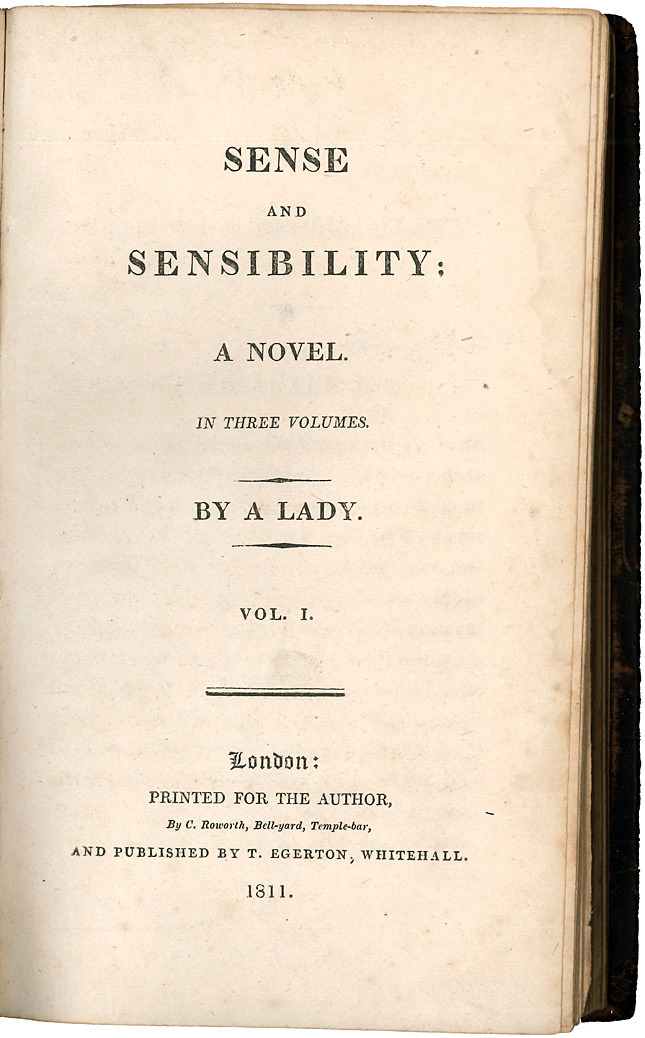
It has been two hundred years since a book was published in England “By a Lady,” entitled Sense and Sensibility. On October 30, 1811, Jane Austen’s first novel was published, creating a literary phenomenon that continues to this day. Join us in the Special Collections reading room on the third floor of the Main Library on Friday, October 28 from 4:00pm to 5:00pm, when we will celebrate this event with an informal gathering. Our copy of the first edition of Sense and Sensibility will be out for viewing, along with a few other Austen pieces. End your week with some good books and good company.

Collaboration in Comics: Tradition and Experimentation

As a virtual supplement to our exhibit The Comics Continuum (on view in the Main Library 3rd floor hallway, now through November) this fall we are featuring items from our comics collections on the Special Collections & University Archives blog. Below we’ve described two examples of collaboration in comics from the exhibition, but please explore our collections on your own! Comic Books in Special Collections is a good place to start online, or come into the reading room and check out the cart of comics material we’ve pulled out of the stacks.

While many comics from idea to finished product are the work of a single artist, collaborative work is an important part of the history of comics, both in the mainstream and experimental realms.

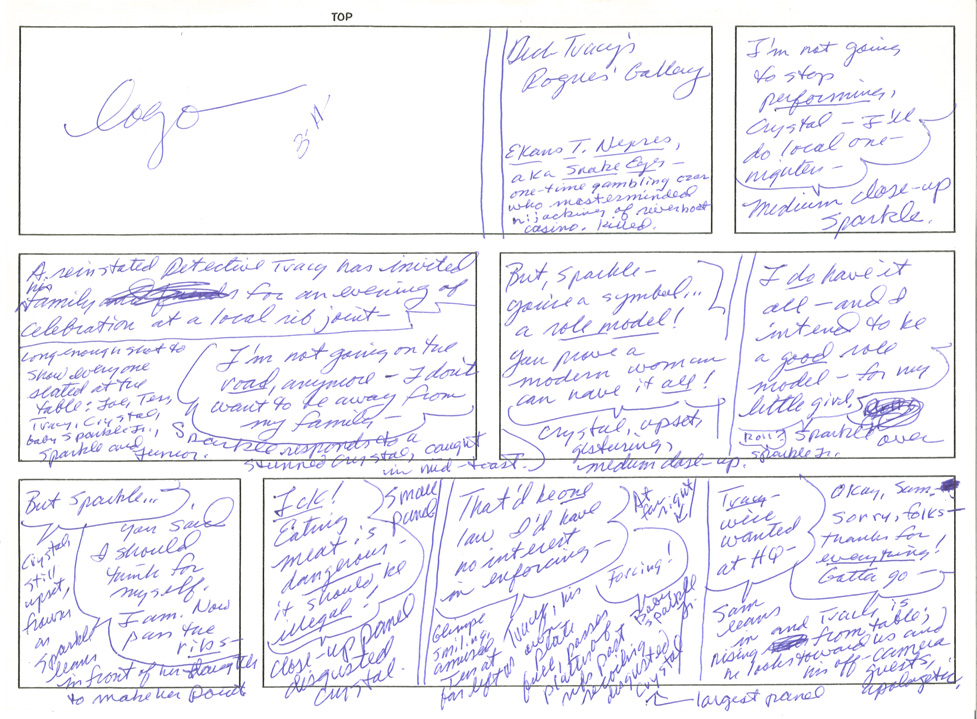
Dick Tracy storyboard
Max Allan Collins’ notes, including dialogue and textual description of the illustrations to come, for a Dick Tracy Sunday comic strip from the 1980s.

The Papers of Max Allan Collins, a UI alumnus, screenwriter, and novelist, contain records of Collins’ correspondence, notes, and writing as he created comics with collaborators who contributed ideas and characters (including Mickey Spillane, for Mickey Spillane’s Mike Danger), art (including Terry Beatty, for Ms. Tree), and lettering.  Collins also has worked to adapt/revive existing comics, as well as the expectations of their fans, in the case of Dick Tracy and Batman.  His papers provide insight into both of these processes, including research and analysis of a comic’s themes and style and creating new stories and sketches that appeal to a contemporary audience and meet the approval of the publisher.

In a letter to the Dick Tracy artist Rick Fletcher from 1980, Collins describes some of the difficulties and compromises inherent in collaborative work:

“Will do my best to describe wardrobe, situations, ‘up front’ – I try to be very specific in my panel descriptions and at the same time not hamstring you; a delicate balance. Occasionally this sort of thing is bound to happen, considering we collaborate largely by mail.”


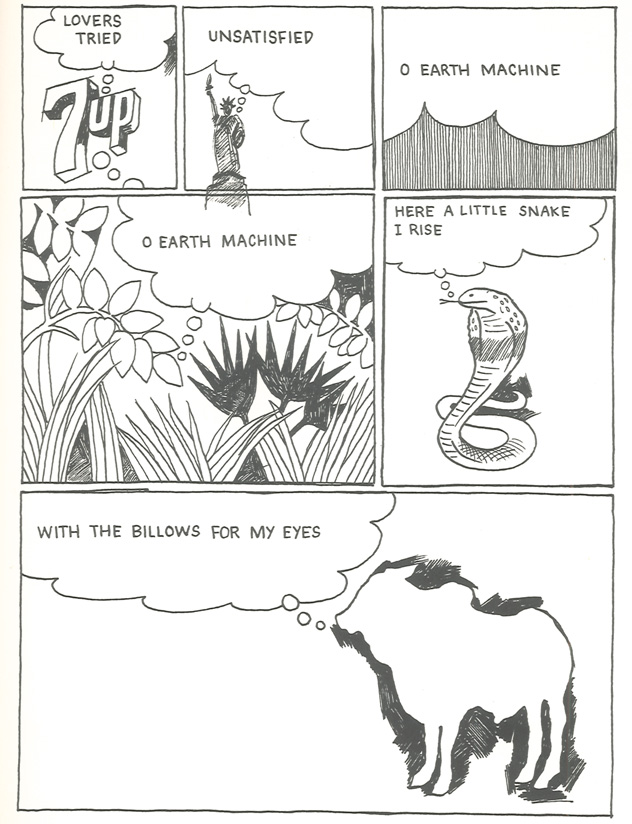
Another item in the exhibition that features collaboration is C Comics No. 2. This 1965 publication is one of only two issues produced as a continuation of C: A Journal of Poetry, which was edited by the poet Ted Berrigan. C Comics is the result of collaborations between visual artist Joe Brainard and a number of poets associated with the New York School including Berrigan, John Ashbery, Frank O’Hara, and Kenneth Koch. Much of Brainard’s other artwork uses comic conventions or existing comic characters like Nancy, and in C Comics the combination of semi-abstract images, re-appropriated characters, unusual layout, and the language of the New York School of Poets creates an innovative form of comics, a precursor to modern experimental and artistic comics of all types.

C Comics "The Earth Machine"
from "The Earth Machine" by Kenneth Koch and Joe Brainard, C Comics No. 2, 1965

Rather than set existing poetry in comic form, as others have done, Brainard drew the graphic parts of the comics (sometimes straightforward, sometimes abstract or absurd) with blank spaces and asked his poet collaborators to fill them in with words. In addition to this issue of C Comics, Special Collections has a number of books on Brainard, including Ron Padgett’s Joe: A Memoir of Joe Brainard, in which he describes a later comics collaboration between artist and poet:

“Knowing that Joe preferred not to do the kind of messy, spontaneous, simultaneous collaborations that we had done [earlier], I wrote a text–a pseudo-professorial statement–that I thought could be adapted to the comic strip form. Then Joe and I set about looking through his … postcard collections, selecting images that jumped out at us. We quickly put them in a sequence, sometimes matching image and text, sometimes going against an overt connection. In light of the images, I made a few final revisions of the text. Joe then redrew everything in black and white, and I lettered in the words” (163).

Civil War transcription – The Winslows

As part of the roll-out of our expanded Civil War transcription project (see the announcement here) we tweeted a letter written by Ferdinand S. Winslow to his four year old son, William Herman. Several of our readers have wondered what became of the Winslows after the war, and the story is actually quite interesting.

Ferdinand Winslow was a Quartermaster during the war, serving at various ranks and taking on progressively greater responsibilities. He also seems to have been a dedicated family man, as the letter to “Herman” demonstrates. During the war Ferdinand and his wife Wilhelmina conceived another child, and Ferdinand was so eager to be with his family when the birth was imminent that he attempted to resign his post multiple times, writing with increasing desperation to Mina in hopes that he would join her soon. Unfortunately, the letters in our collection stop just before we learn if he was successful. The child was born in 1863 while the family was in St. Louis. Two more children came in 1866 and 1868—sadly, all three of these children died before reaching age 10. Ferdinand seems to have lived on for a good many years–there is some evidence he eventually settled in New York City.

William Herman, who received the letter from his father with the ring to kiss, went on to form a company with his brother, Francis, called Winslow Brothers Ornamental Iron Works. They were responsible for much of the decorative iron work that can still be seen around Chicago today, such as the façade to the Carson Pirie Scott building. William Herman Winslow, through his association with Louis Sullivan, befriended a young Frank Lloyd Wright, and commissioned Wright to design his home in River Forest, IL.  Winslow and Wright set up a printing press in the basement and produced several private press books, including the significant piece House Beautiful, designed by Wright. The house is still standing today, a testament to a remarkable family that persevered through the Civil War and took part in the building of Chicago.

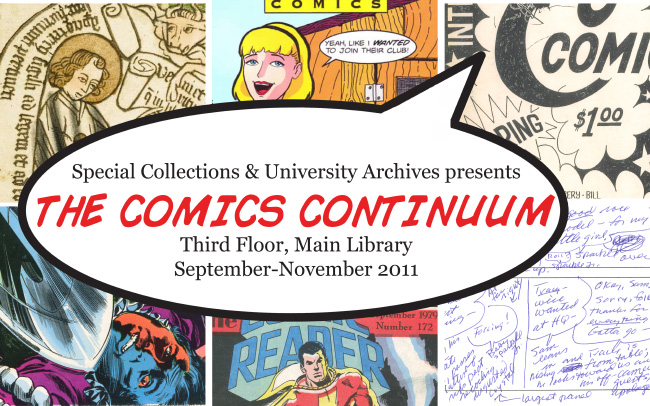
Beyond Superheroes: Exhibit on “The Comics Continuum”

How long have comics been around? Do comics reflect or shape our society? What was the Comics Code Authority? How do comics build community?

 Poster of comics exhibition


As a spinoff of the upcoming symposium on graphic language, Special Collections and University Archives presents The Comics Continuum, an exhibit from our collections available for perusal, research and teaching to the university community and beyond. Our exhibit places comics in a continuum of graphic narrative which encompasses the amateur, commercial, and the artistic, and illustrates their appropriation by countercultures, artists, fans, educators, social movements, and even the U.S. government. Besides placing in their historical context some of the mainstream icons like Wonder Woman and Captain America, the exhibit shows how comics make communities through their production, circulation, consumption and collection.

The exhibit will be open on the 3rd floor of the Main Library from the end of September through November 2011. While viewing the exhibit, please see the labels for any collection numbers (MsCs) that you may be interested in browsing. Once you are done with the exhibit, we encourage you to move beyond the glass cases, come in Special Collections, and request to look at some of our comics collections in the Reading Room.

For more on our specific collections of comics and graphic narrative art, see

http://www.lib.uiowa.edu/spec-coll/resources/guides/ComicBookCollections.html

For our Reading Room policies, see

http://www.lib.uiowa.edu/sc/services/readingroom


‘Now Do Not Let Your Courage Fail’: Voices from the Civil War


An illustration of Civil War camp life from a contemporary magazine

University of Iowa News Release
May 5, 2011
http://news-releases.uiowa.edu/2011/may/050511libraries-civilwar.html


University of Iowa Libraries has launched a new exhibition and digital collection to commemorate the sesquicentennial of the Civil War, and it’s enlisting the help of a few good men and women (well, lots, really) to help make the collection even more accessible and useful.

The exhibition, “‘Now Do Not Let Your Courage Fail’: Voices from the Civil War,” on display at the UI Main Library through July 30, includes letters and diaries from three manuscript collections held by Special Collections & University Archives that offer intriguing perspectives on the war. The experiences of Ferdinand Winslow, an officer in the Union army; Thomas Rescum Sterns, a soldier in the Union army; and Amanda and Mary Shelton, nurses who cared for soldiers through the Christian Commission, bring to life the everyday reality of the conflict.

Accompanying these manuscripts are artifacts from the war, including two Civil War-era quilts from a private collection and a dress worn to a wedding that is on loan from the Kalona Quilt and Textile Museum.

While viewing the exhibition in person, visitors can access digitized versions of the letters and diaries by scanning codes under each piece. This allows viewers to see pages from these collections that are not on display and follow the stories told through the letters.

The digital collection, which was scanned by UI Special Collections & University Archives, is also available online from any computer through the Iowa Digital Library at http://digital.lib.uiowa.edu/cwd.

But the 3,000-plus diaries and letters are digitized images — effectively photographs — that require viewers who want to read them to interpret the handwriting of hundreds of different writers. It also means users cannot search the text for particular words or phrases.

To transcribe that much documentation could take decades and thousands of dollars. But UI Libraries is experimenting with “crowdsourcing,” or collaborative transcription of manuscript materials, in which members of the general public with time and interest conduct the transcription and check one another for accuracy in much the same way contributors to Wikipedia help create a collection of data, information and knowledge.

“Crowdsourcing is revolutionizing the study of the humanities by making available to the public and scholars miles of documents that were previously off-limits, difficult to read or unsearchable,” said Nicole Saylor, head of Digital Library Services.

UI Libraries is inviting volunteers to take a few minutes, hours or days to read and help transcribe some of the pages of a Civil War-era diary, which will not only benefit the library and patrons, but give crowdsourcing participants a glimpse into a more personal side of one of American history’s most significant events. To learn more about this opportunity, visit http://digital.lib.uiowa.edu/cwd/transcripts.html.


To be the first to receive updates  about our programming and holdings, please “like” our University of Iowa Special Collections & University Archives page on Facebook: https://www.facebook.com/uiowaspecialcollections

Being Biblical Through the Ages


How did versions of the Bible reflect the struggles of the European Reformation? How did the Bible “migrate” to America? What is a Cherokee Testament? How did President Lincoln use the Bible in his private and political life? Can the Bible be a comic book?

Editions of the King James Bible around the world are coming out of the woodwork to celebrate the 400th anniversary of the publication of the “Authorized Version.” You may want to keep an eye out for any King James Bible sightings in your neighborhood – all the more so because Special Collections is launching a temporary exhibition on the cultural influence of the Bible and its 1611 King James Version.

Our exhibit  follows a timeline from the 13th through the 21st century, but it also traces certain themes and developments in bibles as well as Bible-related and -inspired materials. Foremost among these is how books made for biblical performances and experiences – in church, meditation, literature, education, and political decision making. As Dr. Blaine Greteman observes, “For hundreds of years the King James Bible provided the script for life – used for weddings and funerals, swearing in presidents, and documenting family histories.”

One example:

Bible Book of Maccabees II Chapters 24 leaf recto

Special Collections call number: xfMMs.Bi3


It wasn’t merely church doctrine and Latin language that kept early Bibles out of the hands of the laity. Manuscript Bibles, produced on vellum (sheep or goat skin) were tremendously expensive to produce.  Often elaborately illuminated, they were both holy writ and objects of desire. This is a leaf of a Bible produced by the workshop of William de Brailes, a 13th Century artist who illuminated the famous “Oxford Bible,” which consists of thirty-four illuminated miniatures depicting biblical events from the fall of the Rebel Angels to the Last Judgment. This page is from Maccabees II, a book that Catholics and Orthodox Christians consider canonical, but most Protestants consider as part of the “Apocrypha.”


Please come visit our Bible exhibit in the corridor on the 3rd floor of the University of Iowa Main Library.