Wednesday, February 10th at 7PM in the Special Collections Reading Room.
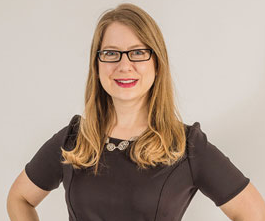
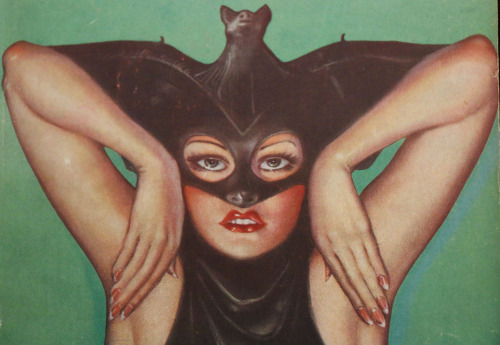
Heather Wacha will be talking about a single Medieval manuscript leaf from Special Collections, Msc 542 xMMs.Pr1 and her process identifying it. She will present her findings about this text in the 13th century manuscript edition, 16th century early printed editions, as well as early 20th century history when Otto Ege broke the manuscript apart, and the early 21st century when digital technologies allow us to start to put it back together again.
Jonas Hunt was first corporal and first sergeant of the Iowa 18th Volunteer Regiment, Company B. His grandson, Leland Hunt, has gifted this collection to the University of Iowa.
From notes from his great-great granddaughter we have this history: “Jonas Hunt was born August 7, 1837. On August 6, 1862 Jonas joined the Eighteenth Regiment Volunteer Infantry. Jonas took part in several battles in southern Missouri and Arkansas before being mustered out the first part of August 1865. They [meaning he and his wife Emeline Twombley] apparently built a log cabin in Lacelle, IA (no longer a town) near Osceola and raised nine children. “
The collection consists of a canteen, a certificate, a roster, a family bible, a military record, and a company sick book. This last item, the sick book, is fairly unique to this collection. It is a record of every illness in the company and where the person was serving during his sickness. It is divided into columns as follows: Name, rank, sick in quarters, in hospital, and duty.
New Acquisition Updates from Margaret Gamm
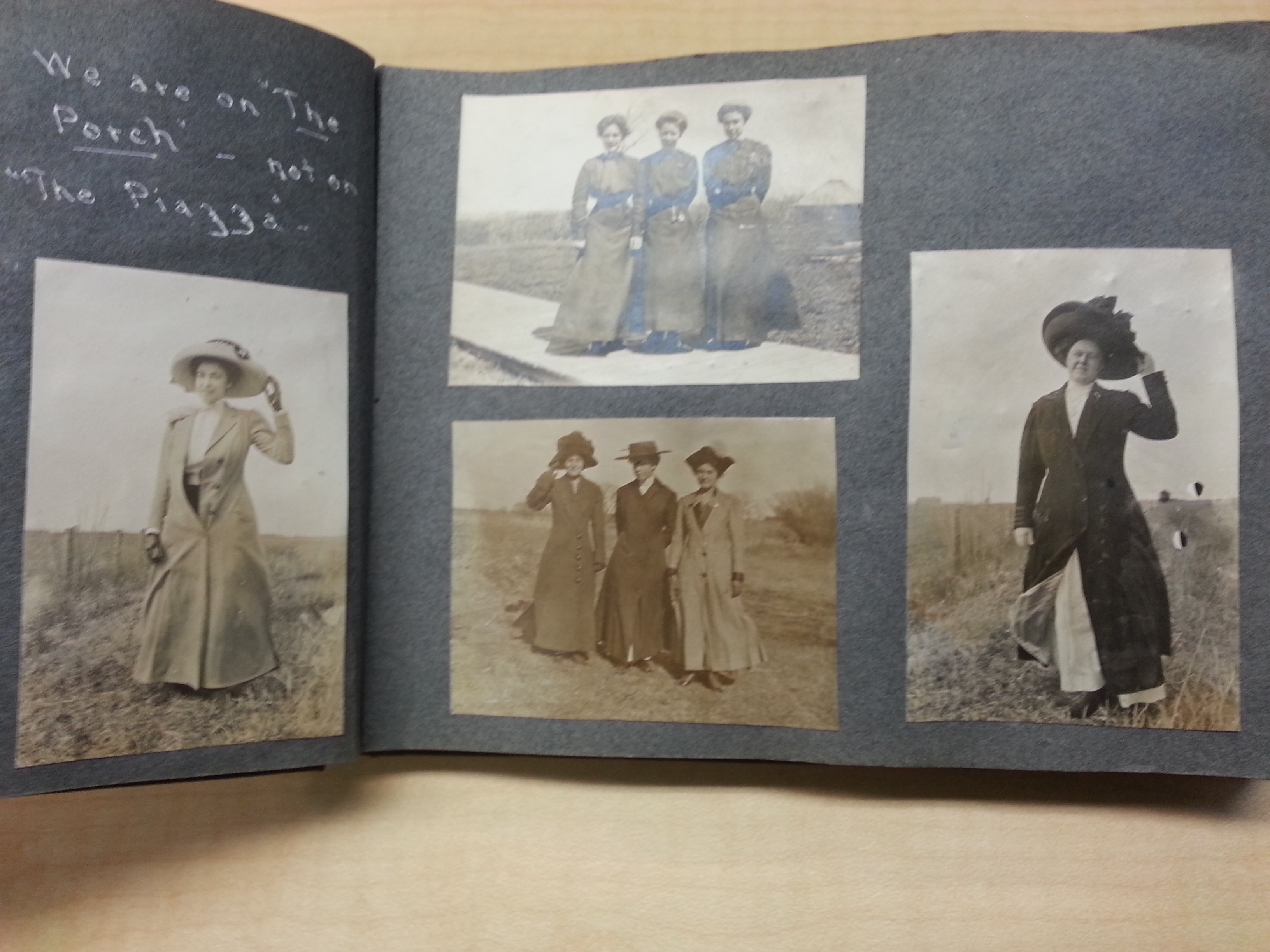
The Glenwood Resource Center in Glenwood, Iowa, was previously named the Iowa Institution for Feeble-Minded Children. This album from around 1910 documents that earlier time period. In some of the first photos, several women show off their Winter attire on a January day declared to be 24 below. Brr! While the creator of the album focused on the teachers at the Institution, the students make many appearances as well.
Event Recap
Photo: Stephen Smith. Photo by Marvin Gatch. Papers of Stephen Lynn Smith (RG 02.0009.032)
University archivist David McCartney gave a presentation about the Historical Iowa Civil Rights Network at St. Ambrose University in Davenport on Thursday, 1/18/2016. HICRN is a project of archivists, librarians, historians, and former civil rights workers from across the state to document the civil rights movement, both at home and elsewhere. David co-founded HICRN in 2012 and, to date, 12 institutions have participated.
Archive Journal, Notes+Queries, “Methods to Use Digital Resources to Teach Primary Sources”: http://goo.gl/wcJuF7
Upcoming Events
The U.Iowa History of Medicine Society and the Iowa Women’s Archives
invite you to hear:
Injections, Itches, and Institutions:
The Experience of Rural Medicine in Iowa, 1910-1950
Jennifer Gunn
History of Medicine Endowed Professor
Director of the Institute for Advanced Study
University of Minnesota
Thursday, January 28, 2016, 5:30-6:30
Medical Education Research Facility (MERF) 2117
Free and Open to the Public
Event Recap
Iowa Women’s Archives staff participated in a Mock Caucus event with other staff from the UI Libraries on Wednesday, January 20, 2016. A mock caucus is a non-partisan educational event to teach about the caucus process and what to expect. Vitalina Nova, Preservation Projects Librarian, led an educational and bilingual guide to caucus.
The event was held at the Center for Worker Justice in Iowa City and was co-sponsored by LULAC and the Center.
New Acquisitions
Update from Acquisitions & Collections Management Librarian Margaret Gamm
These books arrived this week as part of a donation from Nicholas Meyer. His gift, which will be added to his previous gifts to Special Collections, included translations of his works in several languages, as well as Star Trek books and movies and some other fascinating items. The books are about to head over to our cataloging department, where the real language skills live. Kudos to our multi-talented catalogers, and to our generous donor!
Sign Up for Spring Semester Class Sessions
Update from Instruction Librarian Amy Chen
Special Collections librarians can support any aspect of class planning for teaching with rare books and primary source materials.
We had a record-breaking 2015, so sign up early or else our rooms and librarians may already be booked for popular times. Find our classrequest form here.
Special Collections librarians can support any aspect of class planning for teaching with rare books and primary source materials.
We had a record-breaking 2015, so sign up early or else our rooms and librarians may already be booked for popular times. Find our classrequest form here.
New Acquisitions
Update from Acquisitions & Collections Management Librarian Margaret Gamm
Pick Yourself Up From off the Ground by Cuba. One of a kind artist’s book with acrylic graffiti paintings, 2014.
From the University Archives
Update from University Archivist David McCartney
A video paging through a 100+ year old scrapbook from a woman from the class of 1915 who attended the very first Homecoming football game.
Staff Awards
Special Collections Instruction Librarian Amy Chen was selected to be featured as a “Bright Young Librarian” by Fine Books & Collections Magazine. Read the feature here.
From the Web and Social Media
In Case You Missed It: A Compilation of Recent Links & Posts
Blog post reporting on a research trip to Special Collections: Marbled Paper Connections by Emily Pazar. See it here.
Article about the Brinton early film collection: 100 Years Later, New Audiences Discover Legendary Outsider. See it here.
Center for the Book/Special Collections commercial that we filmed last August is finished and will air on the Big Ten Network. Article: here Video below:
Exhibitions
“The Humanity in History”
January 8th-March 1st, 2016
Kelly Grogg, graduate student in the School of Library and Information Science and Special Collections senior Olson Graduate Assistant, has completed her capstone exhibition. It is on display now in the cases outside Special Collections on the 3rd floor.
“Every person featured in this exhibit has contributed to make the world a better place. They may not have ever reached the level of recognition they deserved, but despite their humble beginnings and oncoming obstacles, they contributed to the world in a way that cannot be measured in a ‘neatly packaged, sanitized parable’. These are the people who create history.” – Kelly Grogg
Special Collections Instruction Librarian Amy Hildreth Chen was selected to be featured as a “Bright Young Librarian” by Fine Books & Collections Magazine. Please join us in congratulating her on this recognition from the wider community.
By Tim Shipe, Curator, International Dada Archive, and Arts & Literature Liaison
We are pleased to announce the publication of issue no. 20 of our journal Dada/Surrealism, a special number entitled From Dada to Infra-noir: Dada, Surrealism, and Romania.”http://ir.uiowa.edu/dadasur/vol20/iss1/.
Co-edited by Monique Yaari of the Pennsylvania State University and Timothy Shipe of the University of Iowa, our thematic issue includes eighteen articles by scholars and critics from North America, Europe, and Israel, as well as a selection of primary documents newly translated into English and a substantial bibliography. From Dada to Infra-Noir is the first essay collection in English on the subject of Romanian Dada and surrealism in literature and the visual arts, both within Romania and in the (largely francophone) diaspora.
Dada/Surrealism is the peer-reviewed, free and open-access journal of the Association for the Study of Dada and Surrealism, and is published by the International Dada Archive, Special Collections, University of Iowa Libraries.
Profuse thanks are due to Wendy Robertson for her expertise, patience, and hard work in bringing this project to fruition.
It has only been a few months into my new position as Department Liaison, and one of my major job duties is to supervise the student employees. I did not anticipate that the hardest part of this new job would be watching wonderful students graduate and leave the department.
This Fall 2015 semester, two outstanding students graduated: Zoë Webb and Mallory Price. Both students will be sorely missed, and I think I can speak for the entire department when I say, they will be hard to replace!
Zoë and Mallory reading graduation cards from the Special Collections staff.
Zoë Webb graduated this semester from the University of Iowa School of Art and Art History with a degree in Art, and finalized her undergraduate career with a BFA show titled “Don’t Stray From the Path”. Zoë’s show featured a room not only filled with her original artwork, including some impressive metal works, but it also included artistically placed trees and leaves to give the viewer the sense of walking through an ethereal forest inhabited by faeries.
Zoë began her Special Collections journey in January 2012, where she has completed a wide variety of projects in the department. She’s made spine labels, processed books, including hundreds of science-fiction paperbacks, and helped with some major shifting projects in her many years here. I will definitely miss her shared love of fandom, expert artistic skills, and knack for finding amazing things on accident.
Zoë in front of her art show.
A piece from Zoë’s show.
Mallory began working in the Special Collections department in May 2014, and during her time here has been our primary front desk student. Along with assisting patrons with numerous questions, ranging from helping them to use the scanner, to detailed research questions, Mallory has proved herself to be a huge asset in all things reference! I will miss her expertise in helping others, her positive attitude, and friendly smile!Mallory Price graduated this semester from the University of Iowa School of Music with a Bachelor’s degree in Music, with a focus on Music Therapy. An outstanding violin player, Mallory finalized her undergraduate career with a Senior Recital, playing music from Beethoven, Fritz Kreisler, and Dvořák.
Mallory playing at her Violin recital.
Mallory excited to be finished!
On behalf of the entire Special Collections and University Archives Department, we wish Zoë and Mallory the best of luck in the future!
Preservation Projects Librarian, Vitalina Nova, wrote a blog post about the League of United Latino American Citizens Council 10, both their past records and their current projects for the Iowa Women’s Archives blog.
Image on the left from LULAC Council 10 Records, IWA0733
2016 Rose Bowl a chance to make new memories: UI archivist recalls Iowa’s five previous visits to Pasadena. This month’s Old Gold column by University Archivist David McCartney was posted this week.
This 1959 Rose Bowl decal was sold by Iowa Book and Supply and donated to the university by 1976 alumnus Vernon Lustick, of Cedar Rapids, Iowa.
Notes from the Special Collections Classroom
This week’s news from Amy Chen, Instruction Librarian
Counting up some totals at the end of the semester, Special Collections (not including the Iowa Women’s Archives) taught 119 class sessions total in the Fall 2015 Semester:
4 in August
34 in September
39 in October
28 in November
14 in December
New Acquisitions
Arrival Notifications from Margaret Gamm,
Acquisitions & Collections Management Librarian
The Descent of Mount Gadam is a new acquisition for our Charlotte Smith miniature book collection. Amos Paul Kennedy published the book in 1993 under the imprint of his Jubilee Press, which was later renamed the Jubalee Press. The text is an adaptation of a folktale of the Mensa Bet-Abrehe people of northern Ethiopia.
This week’s news from Instruction Librarian Amy Chen.
Latin Classes
On Monday, four sections of Marcia Lindgren’s Latin I came to Special Collections to learn how Latin circulated in the early modern period with either Acquisition Librarian Margaret Gamm or Instruction Librarian Amy Chen. Students rotated among eight books (or, technically, seven books and one manuscript!) completing worksheets that directed them to find unique features in the texts such as bookplates, guide letters, and worm holes. This curricula is new and represents our shift toward student-centered classes. By all means, it was a success, and we look forward to continuing and refining these sessions in the future.
Student Exhibition
English Department Professor Adam Hooks has been working with the UI Libraries’ Special Collections and Digital Scholarship and Publishing Studio for a project with his students creating a group exhibition utilizing the open source exhibition software Omeka. You can view the students’ online exhibition, “Renaissance Texts as Technology” here: http://rentexts2015.omeka.net/
Event Recap
Lunch with the Chefs
Acquisitions Librarian Margaret Gamm and University Archivist David McCartney created a pop up exhibition for this semester’s Caribbean-themed Lunch with the Chefs event.
Iowa Bibliophiles
Arthur Bonfield spoke about 17th century voyage and travel books from the publisher John Ogilby, and brought stunning examples from his own collection including one of the earliest images of New Amsterdam (New York City) and the first English road atlas. Iowa Bibliophiles is on hiatus through the winter break and will return February 10th.
Join our email list to get meeting reminders: https://t.co/SkUsH1jiIB
By Jacque Roethler, Manuscripts Processing Coordinator
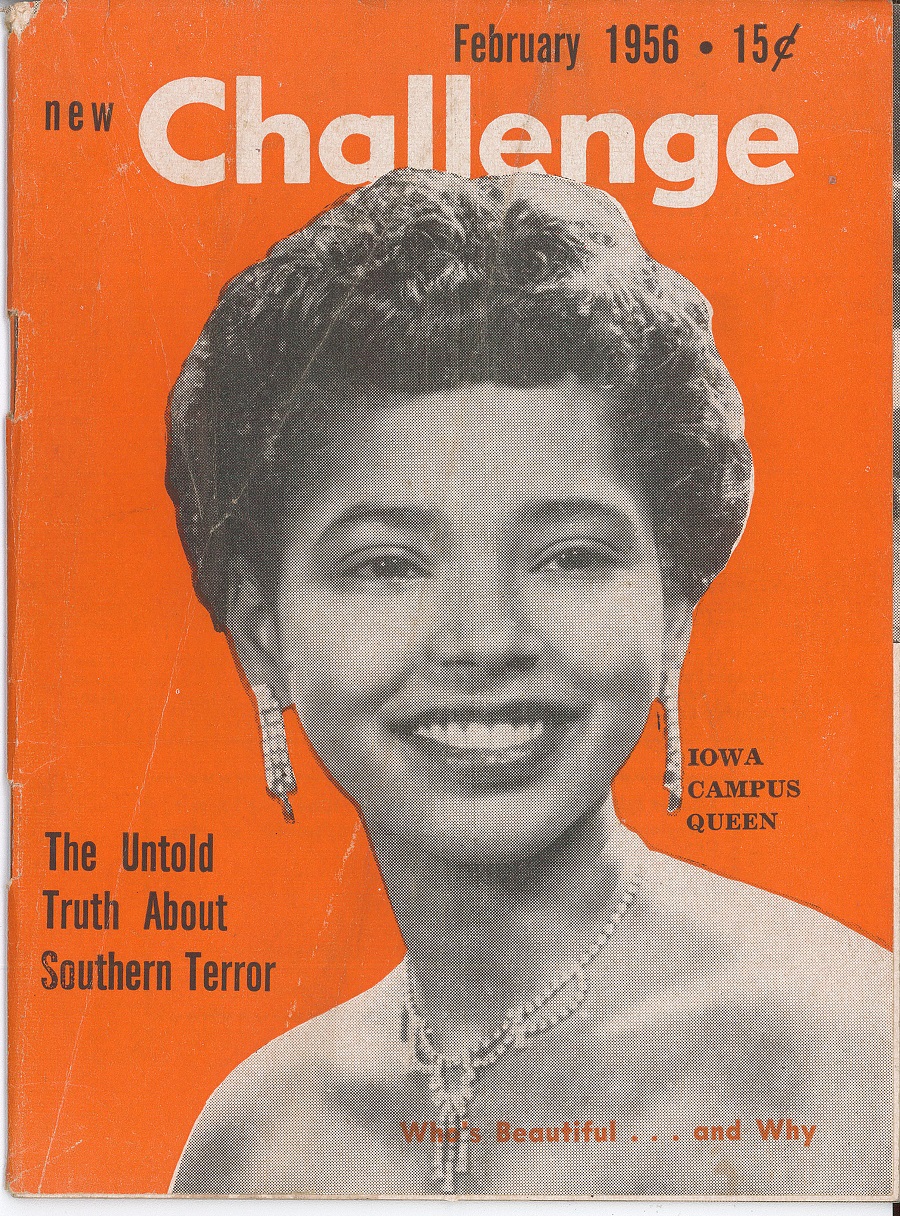
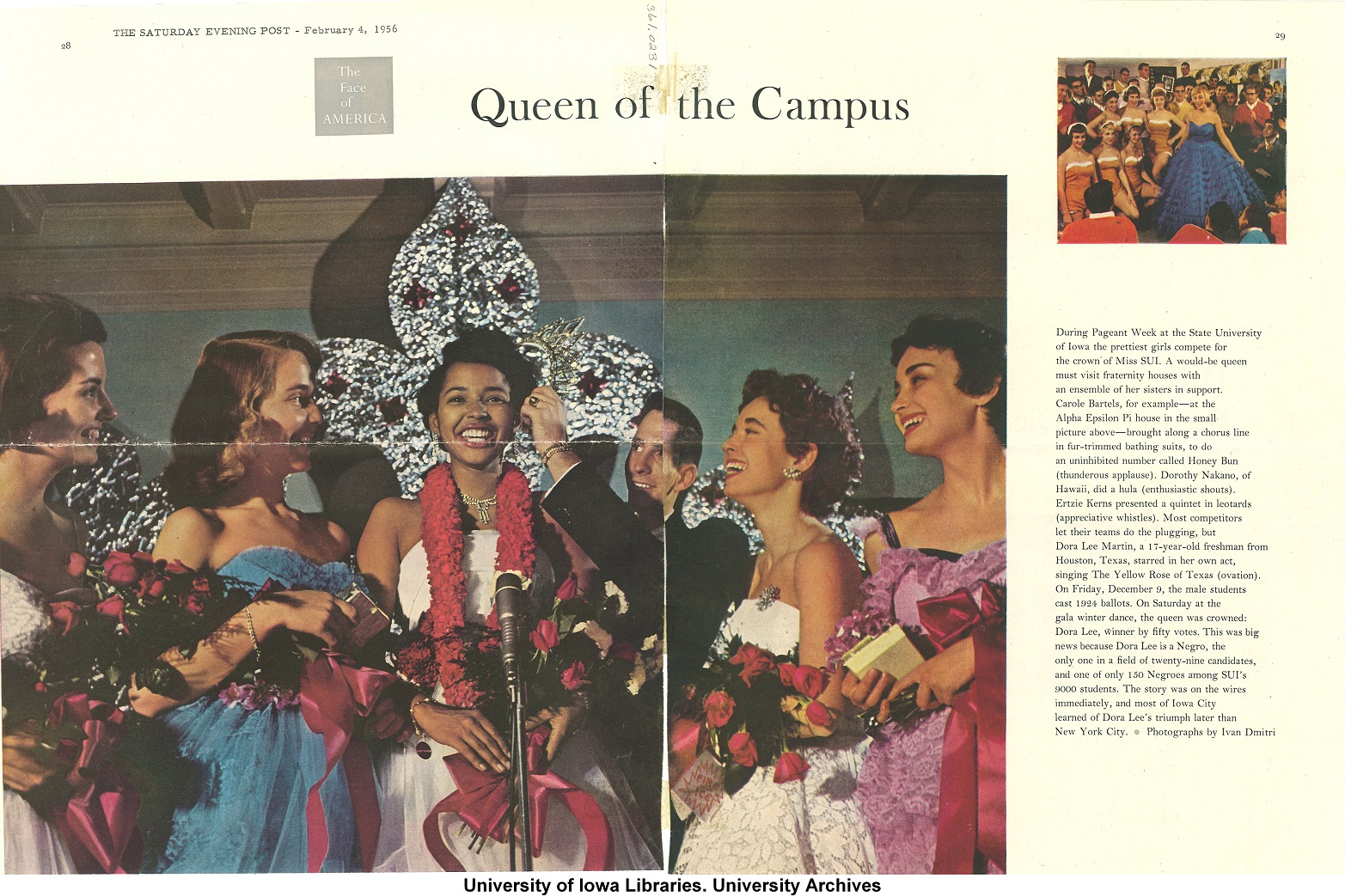
In the firestorm that was the desegregation movement of the nineteen fifties and sixties, the experiences of two women of color makes a nuanced statement about race and its implications. Dora Lee Martin attended the University of Iowa and sixty years ago on December 10, 1955, the seventeen year old freshman from Texas was elected “Miss SUI”. Arthurine Lucy was admitted to the University of Alabama but was denied entry in March of 1956 and suffered many abuses. The two experiences are a telling contrast that was remarked upon in several news clippings from the time.
Dora Lee was raised by her grandmother as only child of a partially paralyzed mother. She had an aunt who had no children, so she was surrounded by relatives as the only child of the entire family. She lived in Loving Canadan, a black enclave in the Third Ward of Houston, where the whole area functioned as an extended family. She rarely left this enclave until she went to Jack Yates High School. There she had a hard time at first because she was coming from a two room schoolhouse to a school that served about a thousand students. Also, she says in her oral history recording that she was fat and they called her “doughbelly”. Between the second and third years, however, she lost weight and in the fall of her third year, she became very active in school. In her senior year she was elected “Miss Jack Yates.”
She came to the University of Iowa on a scholarship and within months she had been elected by her dormitory mates to participate in the Miss State University of Iowa 1955 contest. In an oral history she emphasizes that this was not a beauty pageant, but rather a contest involving performance, poise and popularity. She and her dorm mates and her campaign team worked hard, creating a unified presentation (what would be called a brand today) around “The Yellow Rose of Texas.” She was a singer who sang with a band at parties in Iowa City so, as part of her campaign she went to boys’ dormitories and fraternity houses and sang this song for them. They made paper roses to hand out as favors. Martin said that none of the gowns were hers, but her dorm mates would lend her theirs. She had overwhelming support from the Black community. She has said of this experience:
Never before had I been a part of anything where there was such single-mindedness and such dedication – it really felt special to have all these people working together for the same goal. And there was such harmony and unity. It made me appreciate what it meant to be a proud Black American in 1955. What we could accomplish if we all . . . put our efforts together and work for something.” (IWA0331 Oral history transcription, page 19)
She won the contest by fifty votes. Her election made international news. The University of Iowa Archives has clippings in the vertical files from various towns in Iowa (Oelwein, Humboldt, Mason City, Storm Lake, Sioux City, to mention a few), Kansas City, Des Moines, London, New Delhi. One clipping from Cedar Rapids even states that a woman from Cedar Rapids living in Leopoldville, Belgian Congo reported, “The natives were flocking into the office asking all sorts of questions. Could she speak French, did they think she would adopt them to be a godmother and would she be able to come over here on a trip?” Special Collections even has one publication in Arabic, possibly from Libya.
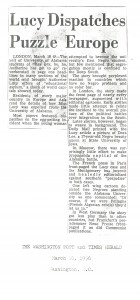
Contrast this to Authurine Lucy’s experience just a few months later. She was born one of ten children born to farmers in Shiloh, Alabama. She graduate from high school in 1947 and attended Selma University, a school for blacks, and then transferred to Miles College, another all black institution. She wanted to be a technical librarian so she applied to, and was accepted, by the University of Alabama in 1952. That is, she was accepted until school administrators discovered she was black. They then told her state law did not allow her to attend. She sued and it took three years for the case to make its way through the courts, but in 1955 the US Supreme Court ruled that she could attend the University of Alabama. However, she was told that she could not stay in the dormitories or eat in the dining hall. She would have to live in Birmingham and make the 51 mile commute each day to Tuscaloosa and faced expulsion and egg peltings. (See Washington Post article below).
On the third day of classes — time enough for word to get out that a black student was taking classes — upon arriving on campus she was met with an angry crowd of about 500 people. She was whisked into an auditorium. Meanwhile the crowd had grown to some 3000 people, some of them not connected with the University. She was pelted with rotten produce and eggs. At the end of the day she was suspended, supposedly for her own safety. The student body protested the suspension, and she sued the University again. Sometime during the intervening time, her lawyers accused the administration of colluding with the anti-desegregation protesters, which would have dire consequences later. The courts decided in Lucy’s favor and ordered the school to accept her again. They used the accusation of collusion to say that Lucy had slandered the school and thus she could not be accepted. Exhausted from all the court battles, Lucy decided not to sue again.
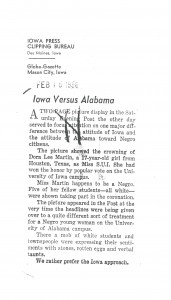
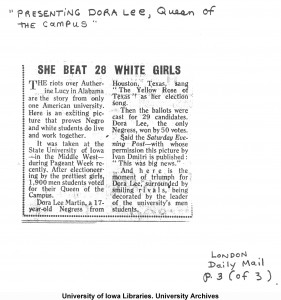
The two women’s experiences were often compared in the news at the time. Below are three clippings from The Washington Post, The London Daily Mail, and from Mason City, Iowa that make the comparison:
Washington Post
Mason City, IA
London Daily Mail
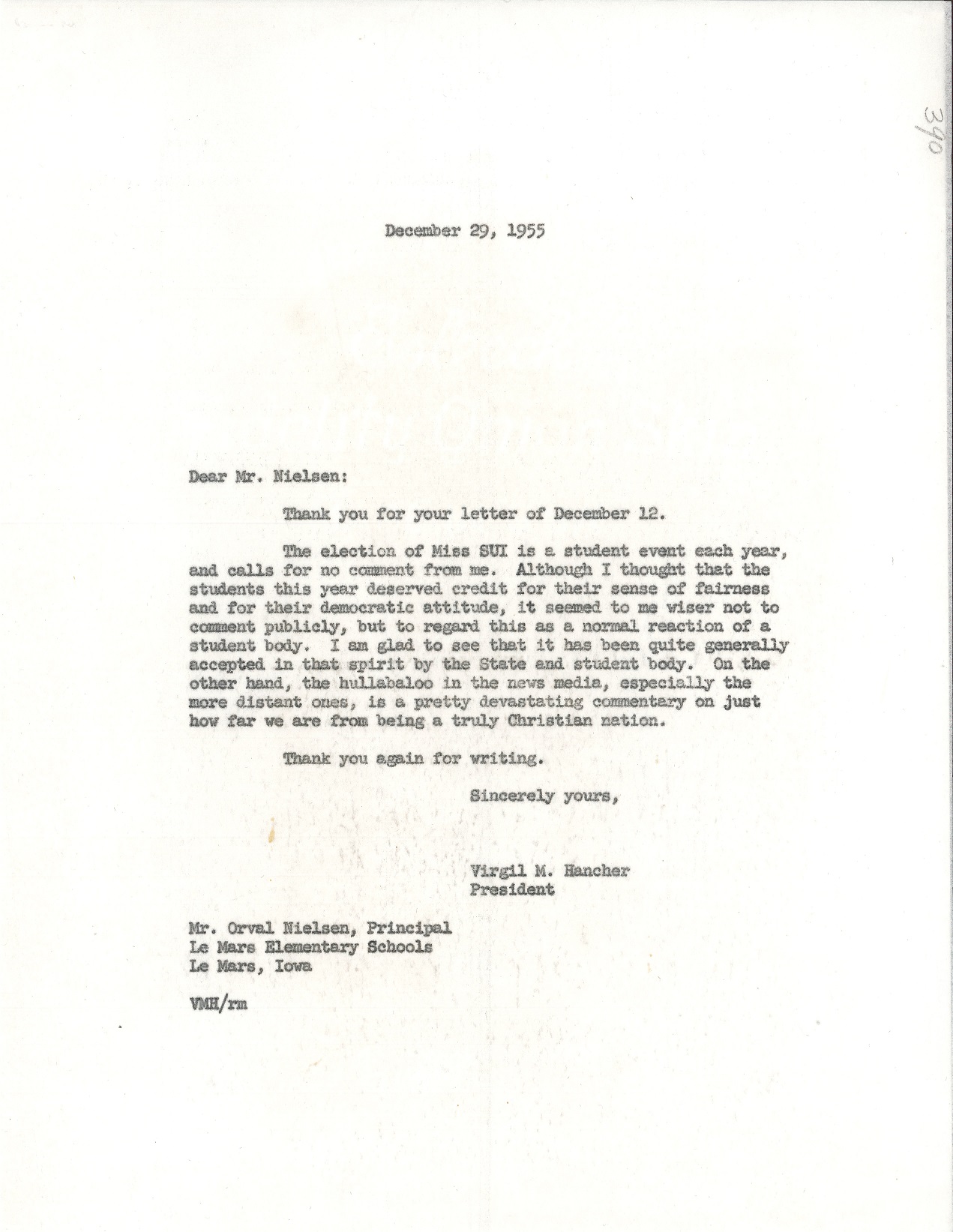
But that’s not the end of these stories. Martin says she never heard anything positive from the administration of the University. This letter from President Hancher may explain some of this silence but Martin says that the events in which previous campus queens had participated were simply silently cancelled. The rules of the pageant were changed so that there was faculty oversight.
Letter from Virgil Hancher
Martin has said in her oral history interview,
“. . . my experience had demonstrated that while laws may be different, people are still the same. The only difference being in the South we knew where things stood. We knew what to expect, while in the North people say one thing, but behave in a very different way. And so we were constantly finding ourselves having to figure out where we were wanted and where we weren’t. . . On the campus at the University it was very, very clear in 1955 that institutional racism was still very prevalent at that University.” (Oral History, page 21)
She got on with her education, but left Iowa before she graduated. She married and followed her husband to Chicago, where she attended Roosevelt University, and finally Rutgers, where she received a Master’s in Social Work in 1969. She worked as a social worker in schools.
Lucy also taught as a profession. In 1988, the University of Alabama reversed her suspension and she returned to the University, and in 1992, she finally received a Master’s degree in Education. The University also named an endowed fellowship after her and unveiled a portrait of her in the student union.
These two scenarios played out during roughly the same time period. They look like different ends of the spectrum. But were they really? A closer look at the situation reveals that there’s more to each one than meets the eye.
References come from these collections in Special Collections:
Clippings from Dora Lee Martin Berry’s file in Alumni and Former Students Vertical File in the University of Iowa Archives, RG01.15.01.
Cover of the New Challenge is in the Progressive Party Papers, 2015 Addendum – The Progressive Party of Massachusetts. MSC0160.
Oral history recording with Dora Lee Martin is part of the Giving Voice to their Memories: Oral Histories of African American Women in Iowa project. IWA0331.


 English Department Professor Adam Hooks has been working with the UI Libraries’ Special Collections and Digital Scholarship and Publishing Studio for a project with his students creating a group exhibition utilizing the open source exhibition software Omeka. You can view the students’ online exhibition, “Renaissance Texts as Technology” here: