I came to town this evening to mail my letter

Joseph Culver Letter, October 6, 1862, Letter 2, Page 1[google-map-v3 width=”400″ height=”300″ zoom=”12″ maptype=”hybrid” mapalign=”right” directionhint=”false” language=”default” poweredby=”false” maptypecontrol=”false” pancontrol=”false” zoomcontrol=”true” scalecontrol=”falso” streetviewcontrol=”false” scrollwheelcontrol=”false”  addmarkermashupbubble=”false” addmarkerlist=”38.21229; -85.224417{}1-default.png” bubbleautopan=”true” showbike=”false” showtraffic=”false” showpanoramio=”false”]

Shelbyville, Ky., Octr. 6th 1862

Dear Mary

I wrote yesterday but having no opportunity to send my letter I came to town this evening to mail it. ((The 129th Illinois, along with other units of Dumont’s division, marched from Louisville on the 3d. A diarist recorded, “The sun was tremendously hot, and as the water in our canteens gave out, no springs or creeks on our way, the knapsacks overloaded and heavy, it may be imagined that this our first day’s tramp was anything but pleasant.” Two days were required to march from Louisville to Shelbyville, a distance of 32 miles. William Grunert, History of the One Hundred and Twenty-Ninth Regiment Illinois Volunteer Infantry. . . (Winchester, 111., 1866) pp. 5-6.)) I am very well. The rebels are leaving the state from every quarter. ((J.F.C. misinterpreted Confederate troop movements. On October 1 General Bragg, leaving Maj. Gen. Leonidas Polk in command of his army at Bardstown, had started for Lexington. Polk was under instructions to slowly retire to Bryantsville. At Lexington, Bragg ordered Kirby Smith with all his forces to Frankfort to assist in the October 4 inauguration of Richard Hawes as Confederate governor of Kentucky. At Lexington on the 2d, Bragg, learning that Buell’s columns were advancing from the Louisville perimeter, ordered Polk to march at once toward Frankfort to strike the Federal army in the flank and rear.)) I see but little prospect of our getting into a fight for some time. The health of the company is generally good. Write soon. Continue reading

Posted in 1862, October | Comments Off on I came to town this evening to mail my letter

I received your letter just before leaving Louisville & did not have time to answer it

Joseph Culver Letter, October 5, 1862, Page 1[google-map-v3 width=”400″ height=”300″ zoom=”12″ maptype=”hybrid” mapalign=”right” directionhint=”false” language=”default” poweredby=”false” maptypecontrol=”false” pancontrol=”false” zoomcontrol=”true” scalecontrol=”falso” streetviewcontrol=”false” scrollwheelcontrol=”false”  addmarkermashupbubble=”false” addmarkerlist=”38.21229; -85.224417{}1-default.png” bubbleautopan=”true” showbike=”false” showtraffic=”false” showpanoramio=”false”]

Head Quarters, Company A, 129th Ills.
Camp near Shelbyville, Ky. Octr. 5th 1862

Dear Mary

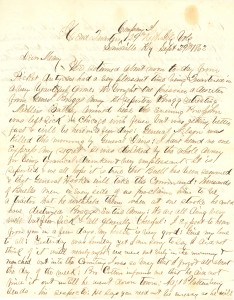
I received your letter just before leaving Louisville & did not have time to answer it. We are about 35 miles from Louisville; left there at 4 o’clock on Friday & marched until 10 o’clock next morning. We camped at Bull Skin run on the field on which the battle was fought last Wednesday morning. We arrived here about 10 o’clock last night & scarcely had lain down until we were ordered out as pickets about 1 1/2 miles. One of us had to remain to take care of those coming in. As Smith & myself could not decide which should remain, both wishing to go with the Company, we cast lots & the lot fell upon me so I am in Camp this Sunday morning while nearly all the Company are on duty. We are all tired & sore, but I am one of the fortunate ones & feel very well. My health is quite good. I have found quite a number of old acquaintances in the Army here from Ohio, Pennsylvania & Illinois. Continue reading

Posted in 1862, October | Comments Off on I received your letter just before leaving Louisville & did not have time to answer it

I thought I should get my trunk started to-morrow

Joseph Culver Letter, October 1, 1862, Page 1[google-map-v3 width=”400″ height=”300″ zoom=”12″ maptype=”hybrid” mapalign=”right” directionhint=”false” language=”default” poweredby=”false” maptypecontrol=”false” pancontrol=”false” zoomcontrol=”true” scalecontrol=”falso” streetviewcontrol=”false” scrollwheelcontrol=”false”  addmarkermashupbubble=”false” addmarkerlist=”38.25486; -85.766404{}1-default.png” bubbleautopan=”true” showbike=”false” showtraffic=”false” showpanoramio=”false”]

Head Quarters, Company A, 129th, Ills. Vols.
Louisville, Ky. Octr. 1st 1862

Dear Mary

I thought I should get my trunk started to-morrow in which I have a note of this date but shall not succeed. I am happy to say my health is quite good. I read a letter from Lou to Allen, reed to-day in which she said you were doing well. It gave me much comfort. ((There were two Allens, both farmers, in Company A, Bartlett and Joseph. Twenty-four-year-old Joseph was mustered in as a private in Company A, 129th Illinois, on Sept. 8, 1862, at Pontiac. On Dec. 5, 1863, Joseph was detailed as a clerk in Maj. Gen. Lovell H. Rousseau’s Nashville headquarters. He served in the Nashville headquarters throughout the remainder of the war and was discharged there on June 5, 1865. Lou Allen was Joseph Allen’s wife. Compiled Service Records of Union Soldiers, NA.)) Continue reading

Posted in 1862, October | Comments Off on I thought I should get my trunk started to-morrow

We returned about noon to-day from Picket duty

Joseph Culver Letter, September 29, 1862, Page 1[google-map-v3 width=”400″ height=”300″ zoom=”12″ maptype=”hybrid” mapalign=”right” directionhint=”false” language=”default” poweredby=”false” maptypecontrol=”false” pancontrol=”false” zoomcontrol=”true” scalecontrol=”falso” streetviewcontrol=”false” scrollwheelcontrol=”false”  addmarkermashupbubble=”false” addmarkerlist=”38.25486; -85.766404{}1-default.png” bubbleautopan=”true” showbike=”false” showtraffic=”false” showpanoramio=”false”]

Head Quarters, Company A, 129th Regt. Ills. Vols.
Louisville, Ky., Sept. 29th 1862

Dear Mary

We returned about noon to-day from Picket duty. We had a very pleasant time being Quartered in a very beautiful grove. We brought one prisoner, a deserter from General Bragg’s Army. He reported Bragg retreating. ((Pvt. A. A. Dunham of Company C reported that some of the men believed the prisoner to be a spy, and he was put in the lockup. The prisoner, in stating that Bragg was retreating, had given misleading information. On September 29 Bragg’s army was at Bardstown, where it had been for the past week, while Kirby Smith’s divisions were camped in and around Lexington. Bragg’s army on the 30th was increased by 8,000, when Maj. Gen. Carter L. Stevenson reached Danville from Cumberland Gap with his “fine” division. O.R., Ser. I, Vol. XVI, pt. II, pp. 889-891; Through the South with a Union Soldier, p. 22.)) Miller’s Battery arrived here this evening. Bro. John [Murphy] was left sick in Chicago with fever but was getting better fast & will be here in a few days. ((Miller’s battery (Company M, 1st Illinois Light Artillery Regiment) had departed from Camp Douglas on September 27. Report of the Adjutant General of the State of Illinois, Containing Reports for the Years 1861 -66 (Springfield, 1886); Vol. VIII, p. 665.)) General Nelson was killed this morning by General Davis. ((On the morning of the 29th, Maj. Gen. William “Bull” Nelson had breakfasted at the Galt House and was standing at the desk, when Governor Oliver P. Morton of Indiana, accompanied by Brig. Gen. Jefferson C. Davis and two other men, entered the lobby. Davis, “a small, sallow, blue-eyed, dyspeptic-looking man, less than five feet nine inches high, and weighing only about one hundred and twenty-five pounds,” accused the powerfully-built, ex-naval officer Nelson of having insulted him at their last meeting.
“Go away”, the six-foot-four, 300-pound Nelson snapped, his manner expressive of his contempt for Davis. Other words followed, and Nelson slapped Davis with the back of his hand. He then turned his back on Davis and walked to the stairway. As he did, Davis secured a pistol from one of his companions and shot Nelson to death. McDowell, City of Conflict, pp. 99-101.)) I have heard no one express any regret. He was disliked by the whole Army for being tyrannical, drunken & very unpleasant. Continue reading

Posted in 1862, September | Comments Off on We returned about noon to-day from Picket duty

This morning I received a letter from you the first since you left us

Joseph Culver Letter, September 28, 1862, Page 1Home Pontiac Ill. Sept 28th /62

My Dear Husband

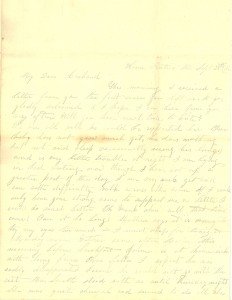
This morning I received a letter from you the first since you left us. It was gladly welcomed & I hope I can hear from you very often. Will you have much time to write? We are all well as could be expected here. Our baby does not grow much yet, he does nothing but eat and sleep (occasionally using his lungs) and is very little trouble at night I am lying in bed writing now though I have sat up a greater part of the day I am very weak yet and can with difficulty walk across the room if I could only have your strong arms to support me a little I could do much better. Oh Frank when will that time come? Can it be long? Mother says it is wrong to try my eyes too much so I must stop for tonight. Continue reading

Posted in 1862, September | Comments Off on This morning I received a letter from you the first since you left us

I cannot take my trunk with me

Joseph Culver Letter, September 27, 1862, Letter 2, Page 1[google-map-v3 width=”400″ height=”300″ zoom=”12″ maptype=”hybrid” mapalign=”right” directionhint=”false” language=”default” poweredby=”false” maptypecontrol=”false” pancontrol=”false” zoomcontrol=”true” scalecontrol=”falso” streetviewcontrol=”false” scrollwheelcontrol=”false”  addmarkermashupbubble=”false” addmarkerlist=”38.25486; -85.766404{}1-default.png” bubbleautopan=”true” showbike=”false” showtraffic=”false” showpanoramio=”false”]

1st Brigade, 4th Division, Western Department
Head Quarters, Company A, 129th Regt. Ills. Vols.
Louisville, Ky., Sept. 27th 1862

Dear Mary

I wrote to you this morning since which time I am informed that I cannot take my trunk with me. I have therefore put all my things in my trunk. I purchased a small valise being all I can carry. Continue reading

Posted in 1862, September | Comments Off on I cannot take my trunk with me

We were marched at a late hour to Louisville

Joseph Culver Letter, September 27, 1862, Page 1[google-map-v3 width=”400″ height=”300″ zoom=”12″ maptype=”hybrid” mapalign=”right” directionhint=”false” language=”default” poweredby=”false” maptypecontrol=”false” pancontrol=”false” zoomcontrol=”true” scalecontrol=”falso” streetviewcontrol=”false” scrollwheelcontrol=”false”  addmarkermashupbubble=”false” addmarkerlist=”38.25486; -85.766404{}1-default.png” bubbleautopan=”true” showbike=”false” showtraffic=”false” showpanoramio=”false”]

Head Quarters Company A, 129th Regt. Ills. Vols.
Near Louisville, Ky., Sept. 27th 1862

Dear Mary

We were marched at a late hour to this place, being about 4 miles from where we first encamped, through clouds of dust. There are about 12,000 in this division command[ed] by General Gilbert. ((Charles C. Gilbert, a graduate of the U.S. Military Academy and Mexican War veteran, had been severely wounded at Wilson’s Creek on Aug. 10, 1861. Recovering, he had been appointed acting major general on September 9, 1862, and placed in command of the Army of Kentucky, the unit to which the 129th Illinois was assigned. When Buell’s Army of the Ohio absorbed the Army of Kentucky on September 29, Gilbert assumed command of the III Provisional Corps. O.R., Ser. I, Vol. XVI, pt. II, pp. 530, 558; Ezra Warner, Generals in Blue: Lives of the Union Commanders (Baton Rouge, 1964), pp. 173-174.)) General Buell’s army are concentrating at this place making in all encamped at this place about 200,000. ((There were on September 27 about 93,000 Union soldiers camped in and around Louisville. Like many people, J.F.C. was unable to estimate crowds. O.R., Ser. I, Vol. XVI, pt. I, p. 19.)) Continue reading

Posted in 1862, September | Comments Off on We were marched at a late hour to Louisville

We arrived near Louisville at about 6 P.M. yesterday

Joseph Culver Letter, September 25, 1862, Page 1[google-map-v3 width=”400″ height=”300″ zoom=”12″ maptype=”hybrid” mapalign=”right” directionhint=”false” language=”default” poweredby=”false” maptypecontrol=”false” pancontrol=”false” zoomcontrol=”true” scalecontrol=”falso” streetviewcontrol=”false” scrollwheelcontrol=”false” draggable=”true” tiltfourtyfive=”false” addmarkermashupbubble=”false” addmarkermashupbubble=”false” addmarkerlist=”38.25486; -85.766404{}1-default.png” bubbleautopan=”true” showbike=”false” showtraffic=”false” showpanoramio=”false”]

Head Quarters Company A, 129th Regt. Ills. Vol.
Camp near Louisville, Ky. Sept. 25th 1862

Dear Mary

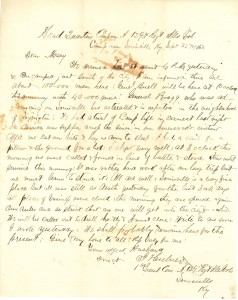
We arrived here at about 6 P.M. yesterday & encamped just south of the city. I am informed there are about 100,000 men here. ((On September 24, Maj. Gen. Thomas L. Crittenden had crossed Salt River with the advance of Buell’s army and entered Louisville. Maj. Gen. Alexander McD. McCook’s division followed Crittenden. By the 27th all of Buell’s army had reached Louisville. The Federals had won the race.
Lieutenant Culver exaggerated the number of Union troops available for defense of Louisville. On the 24th Maj. Gen. William Nelson, the officer responsible for the city’s defense, reported he had 35,000 men; that they were entrenched; and that he believed he could hold the city. With Crittenden came 12,000 men and six batteries, increasing the force camped in and around Louisville to 47,000. O.R., Ser. I, Vol. XVI, pt. II, pp. 540-541; Robert E. McDowell, City of Conflict: Louisville in the Civil War, 1861-1865 (Louisville, 1962), p. 89.)) Genrl. Buell will be here at 10 o’clock this morning with 40,000 more. ((Culver was correct. Buell reached Louisville from Green River on the 25th with several brigades of his Army of the Ohio. It was the 27th before the last of Buell’s troops entered the Louisville perimeter. Buell’s field army numbered about 47,500. O.R., Ser. I, Vol. XVI, pt. I, pp. 14, 111, 616; O.R., Ser. I, Vol. XVI, pt. II, pp. 542-543.)) General Bragg, who was advancing on Louisville, has retreated & is reported in the neighborhood of Lexington. ((General Bragg’s Army of Tennessee had occupied Bardstown, 35 miles southeast of Louisville, on the 22d. The Confederate force at Lexington was the army led by Maj. Gen. Edmund Kirby Smith, which had advanced into Kentucky from East Tennessee. Bypassing Cumberland Gap, Smith’s columns had routed the Federals at Richmond, Ky., on August 30 and had swept into the Bluegrass Region, occupying Lexington and Frankfort, and threatening Cincinnati. O.R., Ser. I, Vol. XVI, pt. II, pp. 864-865.))

We had a trial of Camp life in earnest last night. We carried our supper across the river in our haversacks, without coffee, we eat our bite & lay us down to sleep. I had a rail for a pillow & the ground for a bed. I slept very well. At 3 o’clock this morning we were called & formed in line of battle & stood there until sunrise this morning. It was rather hard work after our long trip, but we must learn to stand it. All are well.

Louisville is a very fine place, but all was still as death yesterday. For the last 3 or 4 days, all places of business were closed; this morning they are opened again. Our rules are so strict that no one will get into the city for a while. We will be called out to drill shortly, & I must close.

Write to me soon. I wrote yesterday. We shall probably remain here for the present. Give my love to all. Kiss baby for me.

Your affect. Husband
J. F. Culver

Posted in 1862, September | Comments Off on We arrived near Louisville at about 6 P.M. yesterday

We arrived in Jeffersonville all safe

Joseph Culver Letter, September 24, 1862, Page 1[google-map-v3 width=”400″ height=”300″ zoom=”12″ maptype=”hybrid” mapalign=”right” directionhint=”false” language=”default” poweredby=”false” maptypecontrol=”false” pancontrol=”false” zoomcontrol=”true” scalecontrol=”falso” streetviewcontrol=”false” scrollwheelcontrol=”false” draggable=”true” tiltfourtyfive=”false” addmarkermashupbubble=”false” addmarkermashupbubble=”false” addmarkerlist=”38.27913; -85.737474{}1-default.png” bubbleautopan=”true” showbike=”false” showtraffic=”false” showpanoramio=”false”]

Jeffersonville, Sept. 24th 1862

Dear Mary

We arrived here all safe at 8 a.m. & are now making arrangements to cross the river to Louisville. ((The regiment left Camp Pontiac on September 22 aboard a troop train. The soldiers breakfasted the next morning at Michigan City and had supper in the evening of the 23d at Indianapolis. Through the South with a Union Soldier, edited by Arthur H. DeRosier, Jr. (Johnson City, 1969), p. 23.)) The Lieut. Colonel [Henry Case] went over this morning but has not returned yet. There has been considerable excitement on account of an expected attack by General Bragg, but it is currently reported this morning that he is retreating. ((Gen. Braxton Bragg’s hard-marching Army of Mississippi had reached Munfordville, where it captured the Union garrison on September 17, ahead of Maj. Gen. Don C. Buell’s army. Bragg, having placed his army between Buell and his Louisville base, took position covering the crossing of Green River. To goad Buell into a rash attack on his chosen position, Bragg advanced one of his divisions. Buell refused the bait, and after four days Bragg, learning that his troops were down to three days’ rations, in a “hostile country, utterly destitute of supplies,” determined to abandon his position astride Buell’s line of communications. Orders were issued for a supply train from the Confederate depot at Lexington to meet the army at Bardstown. On September 20 Bragg yielded the advantage gained and turned northeast. Buell, with the Confederate army out of the way, marched for Louisville, where he arrived on the 25th. The War of the Rebellion: A Compilation of the Official Records of the Union and Confederate Armies (73 vols., 128 parts; Washington, 1880-1901), Ser. I, Vol. XVI, pt. I, pp. 48, 1090-1091; pt. II, p. 542.))

The Louisville papers this morning are urging the citizens to arm themselves. ((Although the crisis had passed, there was great excitement in Louisville on the 24th. “Every able-bodied man” was being impressed to take up arms for defense of the city or to work on fortifications. An attack was momentarily expected. O.R., Ser. I, Vol. XVI, pt. II, p. 542.)) No accidents happened save that a few of the men were left at various places along the road, having wandered off for water &c.

I hope you & the baby are both well. Kiss it for me. Give my love to all. Write soon as you can.

In haste, your affect. Husband
J. F. Culver

Posted in 1862, September | Comments Off on We arrived in Jeffersonville all safe

Needing the money as we do I take the liberty of writing to you again

Joseph Culver Letter, September 18, 1862, Letter 2, Page 1Sue City Iowa Sept 18th /62

Mr Culver

Dear Sir I wrote to you July 1st have not as yet rec’d an ans the mails have been so uncertain I do not know but you might have writen I believe the notes are all due given to the sisters of J H Dart and needing the money as we do I take the liberty of writing to you again hoping you will use your endeavors to collect and send the part belonging to Mary C to Edward Burbeck Racine Wisconsin by Express and oblige

A. H. Burbeck

Posted in 1862, September | Comments Off on Needing the money as we do I take the liberty of writing to you again