From October 24th – 27th Trudy Huskamp Peterson, the former Acting Archivist of the United States, and Jane E. Schultz, Professor of English and Medical Humanities at Indiana University-Purdue University-Indianapolis, will visit the University of Iowa.
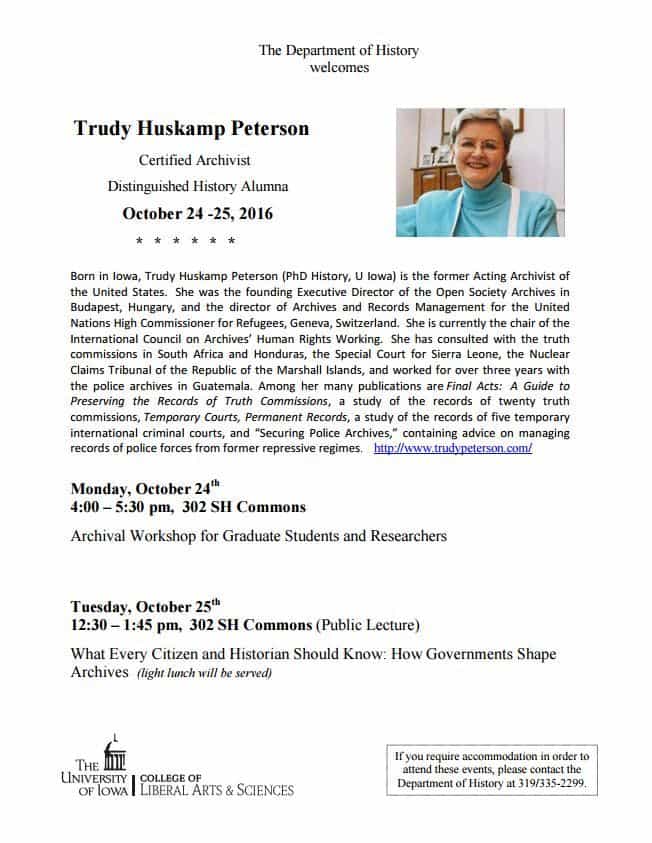
A longtime friend of the Iowa Women’s Archives, Trudy Huskamp Peterson has made an international career of archives and human rights. Besides serving as the United States’ Acting Archivist, Peterson has consulted with truth commissions in South Africa and Honduras and worked for three years with the police archives in Guatemala. She is currently the chair of the International Council on Archives’ Human Rights Working.
On Monday the 24th Peterson will host an archival workshop for graduate students and researchers from 4:00 – 5:30 in 302 SH Commons. She will follow this on Tuesday the 25th with a public lecture entitled “What Every Citizen and Historian Should Know: How Governments Shape Archives.” The lecture will take place in 302 SH Commons from 12:30 – 1:45 and will include a light lunch.
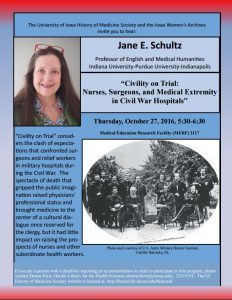
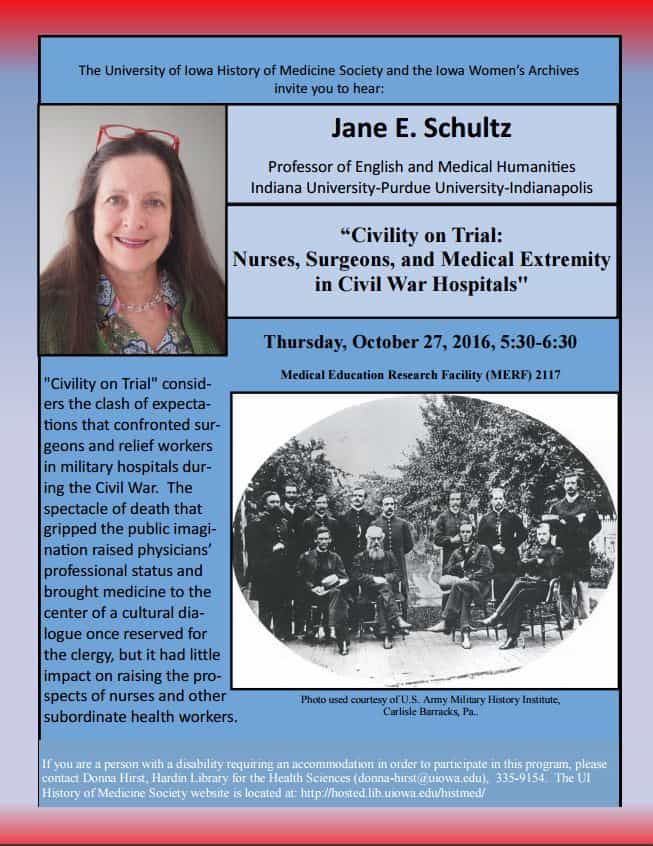
Finally, on Thursday the 27th, the Universty of Iowa History of Medicine Society and the Iowa Women’s Archives will jointly present Jane E. Schultz. Schultz, a professor at Indiana University-Purdue University-Indianapolis, formerly consulted for the PBS miniseries “Mercy Street” and has written extensively about women and the Civil War. Her lecture “Civility on Trial: Nurses, Surgeons, and Medical Extremity in Civil War Hospitals will take place in the Medical Education Research Facility (MERF) 2117 from 5:30 – 6:30.
From October 24th – 27th Trudy Huskamp Peterson, the former Acting Archivist of the United States, and Jane E. Schultz, Professor of English and Medical Humanities at Indiana University-Purdue University-Indianapolis, will visit the University of Iowa.
A longtime friend of the Iowa Women’s Archives, Trudy Huskamp Peterson has made an international career of archives and human rights. Besides serving as the United States’ Acting Archivist, Peterson has consulted with truth commissions in South Africa and Honduras and worked for three years with the police archives in Guatemala. She is currently the chair of the International Council on Archives’ Human Rights Working.
On Monday the 24th Peterson will host an archival workshop for graduate students and researchers from 4:00 – 5:30 in 302 SH Commons. She will follow this on Tuesday the 25th with a public lecture entitled “What Every Citizen and Historian Should Know: How Governments Shape Archives.” The lecture will take place in 302 SH Commons from 12:30 – 1:45 and will include a light lunch.
Finally, on Thursday the 27th, the Universty of Iowa History of Medicine Society and the Iowa Women’s Archives will jointly present Jane E. Schultz. Schultz, a professor at Indiana University-Purdue University-Indianapolis, formerly consulted for the PBS miniseries “Mercy Street” and has written extensively about women and the Civil War. Her lecture “Civility on Trial: Nurses, Surgeons, and Medical Extremity in Civil War Hospitals will take place in the Medical Education Research Facility (MERF) 2117 from 5:30 – 6:30.
Because most plant-based foods are under “plants” instead of “food” in PubMed, articles on chocolate may not be retrieved in a search for Food.
By Eric Rumsey, Janna Lawrence and Xiaomei Gu
As we’ve written, searching for plant-based foods (PBFs) in PubMed is difficult because of the way the MeSH system is organized. This is especially the case because because in most cases PBFs are treated as plants rather than food.
One result of treating plant-based foods as plants is that the MeSH term is usually the botanical plant name; in the case of chocolate it’s Cacao. This is usually not a serious problem when searching for specific substances because the common food name maps to the botanical MeSH term.
A more serious consequence of treating plant-based foods as plants instead of foods is that they are usually not in any food-related explosion, but only in the Plants explosion. So the only occurrence of chocolate (Cacao) is here:
Plants
   Angiosperms
      Sterculiaceae
         Cacao
The reason this is a problem is because articles on chocolate/Cacao will not be retrieved in a search for Food. So, for example, if you do a general search for food-related causes of migraine, you will not retrieve this article:
This is not retrieved by searching for food because Cacao is not in the Food explosion. More broadly, however, it’s also not retrieved by the Diet, Food, and Nutrition explosion.
Here are several other articles on health and medical aspects of chocolate that are not retrieved by the broad Diet, Food, and Nutrition explosion:
Protective effects of flavanol-rich dark chocolate on endothelial function and wave reflection during acute hyperglycemia.
Journal: Hypertension. http://www.ncbi.nlm.nih.gov/pubmed/22851734
If chocolate were the only case of a plant-based food that is not retrieved in a broad PubMed search for food-related topics, it would be a trivial matter. But that’s far from being the case. There are many plant-based foods that have the same problem in PubMed. We have written about a few of these.
[Image above is licensed under Creative Commons, from WikiMedia]
As we’ve written, searching for plant-based foods (PBFs) in PubMed is difficult because of the way the MeSH system is organized. This is especially the case because because in most cases PBFs are treated as plants rather than food.
One result of treating plant-based foods as plants is that the MeSH term is usually the botanical plant name; in the case of chocolate it’s Cacao. This is usually not a serious problem when searching for specific substances because the common food name maps to the botanical MeSH term.
A more serious consequence of treating plant-based foods as plants instead of foods is that they are usually not in any food-related explosion, but only in the Plants explosion. So the only occurrence of chocolate (Cacao) is here:
Plants
   Angiosperms
      Sterculiaceae
         Cacao
The reason this is a problem is because articles on chocolate/Cacao will not be retrieved in a search for Food. So, for example, if you do a general search for food-related causes of migraine, you will not retrieve this article:
This is not retrieved by searching for food because Cacao is not in the Food explosion. More broadly, however, it’s also not retrieved by the Diet, Food, and Nutrition explosion.
Here are several other articles on health and medical aspects of chocolate that are not retrieved by the broad Diet, Food, and Nutrition explosion:
Protective effects of flavanol-rich dark chocolate on endothelial function and wave reflection during acute hyperglycemia.
Journal: Hypertension. http://www.ncbi.nlm.nih.gov/pubmed/22851734
If chocolate were the only case of a plant-based food that is not retrieved in a broad PubMed search for food-related topics, it would be a trivial matter. But that’s far from being the case. There are many plant-based foods that have the same problem in PubMed. We have written about a few of these.
Question: How do I access articles the library subscribes to through Google Scholar?
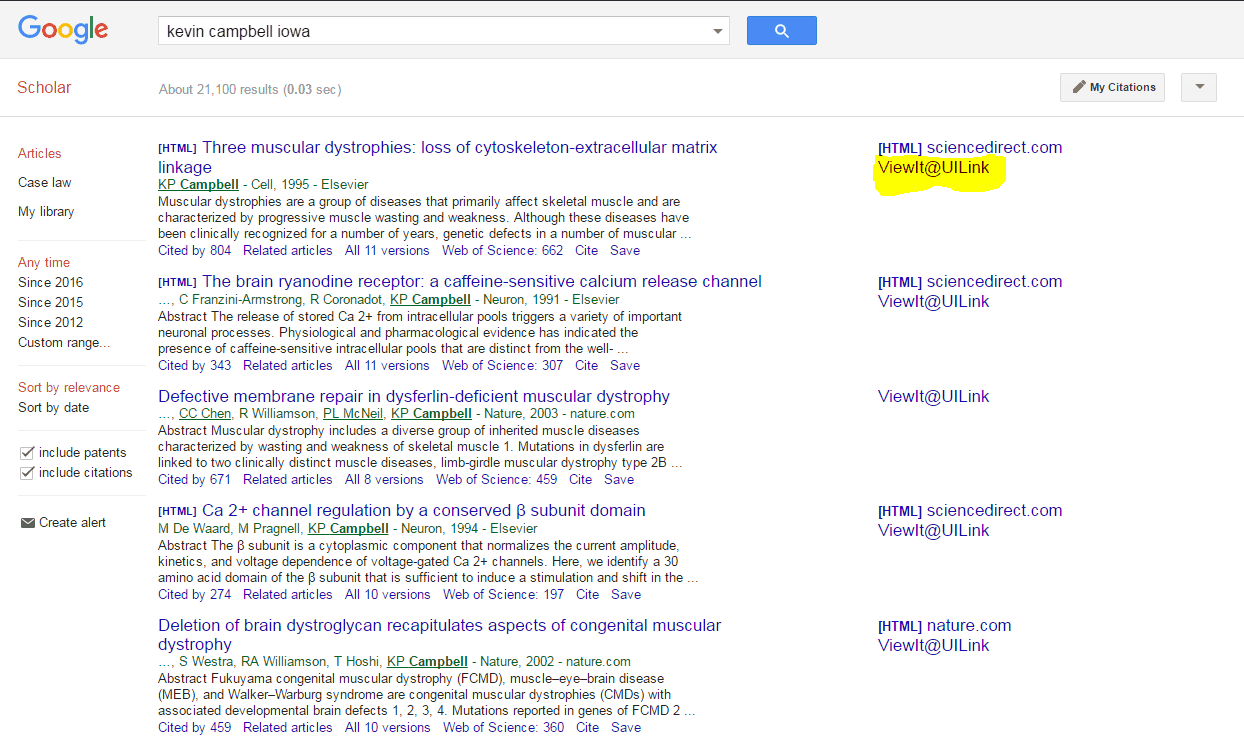
Answer: The answer to this depends upon where you are when searching Google Scholar. If you are using a computer connected to the campus network, Google Scholar automatically detects that and provides a text link to UILink. Follow that link to see if we have access to the article.
If you are searching Google Scholar from off campus, you have two options for getting Google Scholar to recognize that you are affiliated with UI. If you use our link (http://purl.lib.uiowa.edu/GoogleSch) from Databases A-Z, you will be prompted to log in with your Hawk ID and then UILink will appear in Google Scholar results.
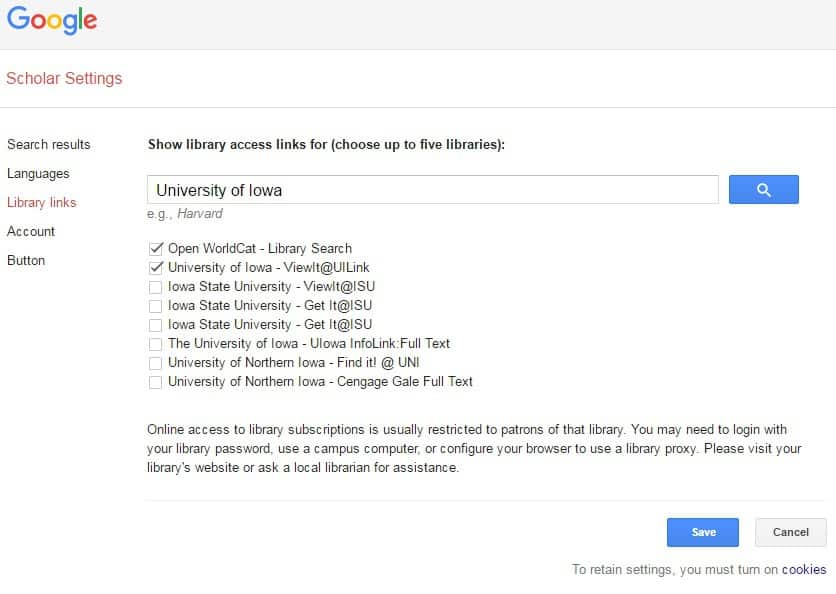
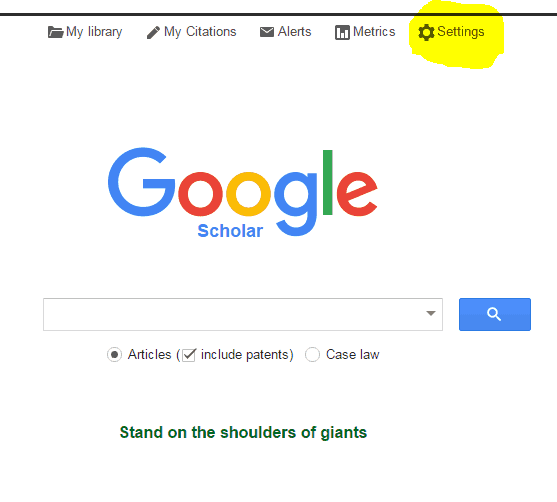
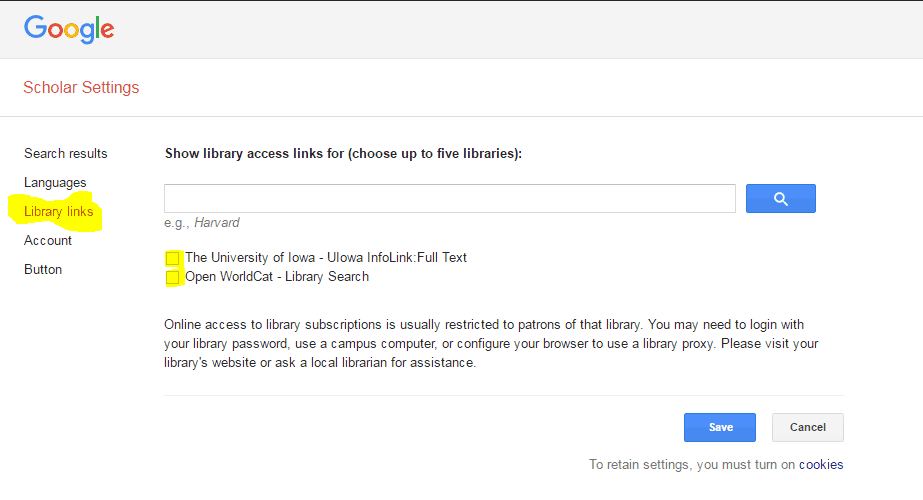
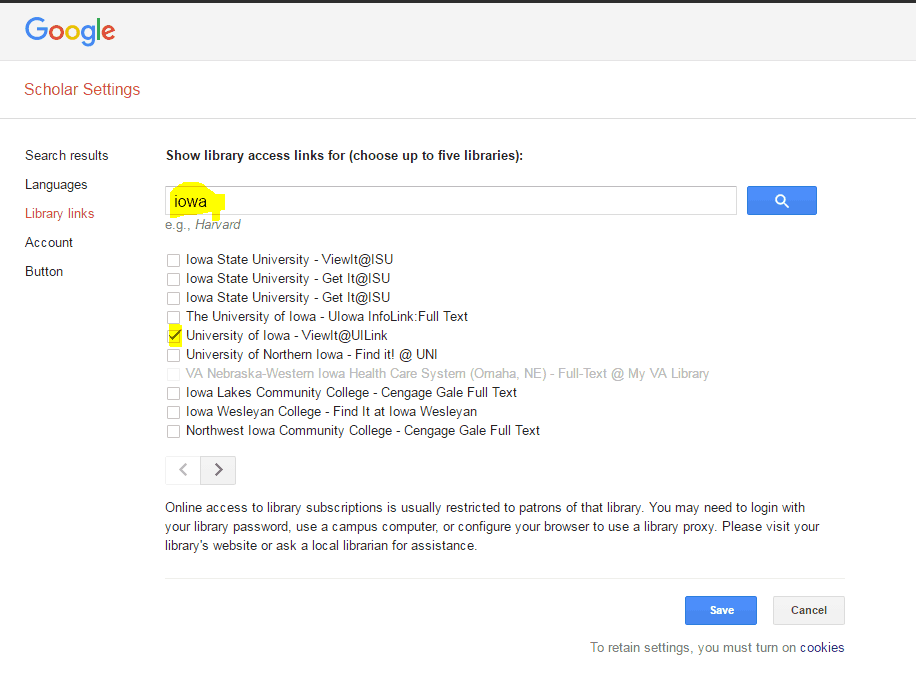
If you are working off campus and prefer to go directly to Google Scholar, you can show it that you are UI-affiliated if you have a Google account. When logged in to your Google account and on the Google Scholar search page, go to Settings in the upper right, then Library links on the left side of the Scholar Settings page. Use the search box to locate University of Iowa, then the check box to turn on University of Iowa – ViewIt@UILink in results.
Note: You may need to uncheck “UIowa InfoLink:Full Text” first. And if you want to retain your settings across devices, you must turn on cookies.
If you have any questions or problems with setting up UILink in Google Scholar, please contact Sara Scheib.
Question: How do I access articles the library subscribes to through Google Scholar?
Answer: The answer to this depends upon where you are when searching Google Scholar. If you are using a computer connected to the campus network, Google Scholar automatically detects that and provides a text link to UILink. Follow that link to see if we have access to the article.
If you are searching Google Scholar from off campus, you have two options for getting Google Scholar to recognize that you are affiliated with UI. If you use our link (http://purl.lib.uiowa.edu/GoogleSch) from Databases A-Z, you will be prompted to log in with your Hawk ID and then UILink will appear in Google Scholar results.
If you are working off campus and prefer to go directly to Google Scholar, you can show it that you are UI-affiliated if you have a Google account. When logged in to your Google account and on the Google Scholar search page, go to Settings in the upper right, then Library links on the left side of the Scholar Settings page. Use the search box to locate University of Iowa, then the check box to turn on University of Iowa – ViewIt@UILink in results.
Note: You may need to uncheck “UIowa InfoLink:Full Text” first. And if you want to retain your settings across devices, you must turn on cookies.
If you have any questions or problems with setting up UILink in Google Scholar, please contact Sara Scheib.
Halloween is getting closer and closer and you are planning that Halloween get-together… Looking for the perfect DIY Halloween decoration projects?
Looking for a classic scary pumpkin? How about one that lights up? Electronic Projects for Dummies will help you create the perfect scary pumpkins! You’ll end up with 2 pumpkins – one transmits an infrared beam and the second one lights up and plays a prerecorded message or sound. When someone walks between the two pumpkins and breaks the plane of the infrared beam, the 2nd pumpkin will light up and emit that evil laugh! The chapter, Scary Pumpkins, takes you through the process, step-by-step, complete with schematics, photos (some in color), parts list and detailed instructions!
What party would be complete without a moving eyeball picture? Haywired: Pointless (yet awesome) Projects for the Electronically Inclined will help you make one! Pick out a picture of your favorite monster, zombie or ghoul – the parts and tool lists, step-by-step photos, schematics and concise directions will help you create your very own moving eyeball picture!! Perhaps you would also like to have one that smiles when someone approaches it? Haywired will show you how to make one! The example they show is of the Mona Lisa, but you can easily adapt it to a ghoul or monster with a toothless grin!
Are you into paper projects? Learn to make a light-up paper cat with Paper Inventions : Machines That Move, Drawings That Light Up, Wearables and Structures You Can Cut, Fold, and Roll. The perfect time of year to make a black cat (or several!) to light up your Halloween party walls! It uses very few materials – construction paper, permanent marker, copper or aluminum foil tape, CR2032 coin battery, LED and a small binder clip! It will also show you how to create blinking and flickering effects for even more eerie decorations!
Interested in coming up with your own spooky decoration ideas? Don’t forget to check out what we have in our Tool Library!! We have Lilypad for making wearable tech (think of the costume you could make!), a MaKey MaKey kit – create a keyboard using a pumpkin and Hersey Kisses! Play around with the littleBits to come up with some fun circuit projects – and there is always the Raspberry Pi Starter Kit, too!
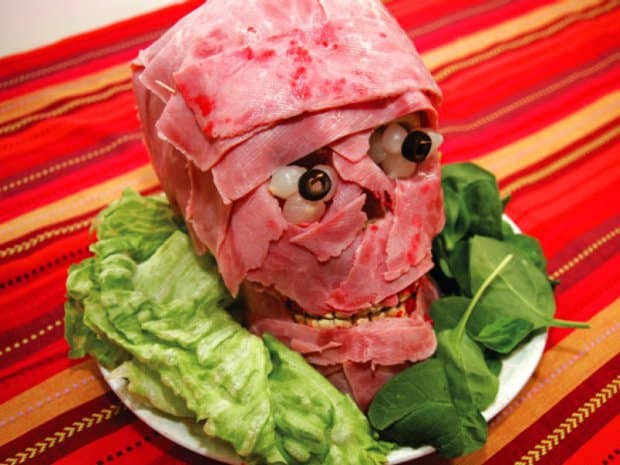
For 10 more last-minute Halloween decorations, check out makezine.com. Spider-web balloons, packing tape ghosts, and a meat head…. Because what’s a Halloween party without an edible head….
With a MaKey MaKey (available in our Tool Library) you can make some small pumpkins (or gourds) scream!
No matter how you plan to spend your Halloween, remember to stop in and explore our resources which can help you make it more eerie!!
Rigsby, Mike. 2009. Haywired : pointless (yet awesome) projects for the electronically inclined. Chicago, ILL : Chicago Review Press. Engineering Library TK99656 .R54 2009
Ceceri, Kathy. 2015. Paper Inventions : Machines That Move, Drawings That Light Up, Wearables and Structures You Can Cut, Fold, and Roll. San Francisco, CA : Maker Media. Engineering Library TT870 .C54 2015
Brown, Casey. Oct. 31, 2012. Hershey Kisses, a pumpkin, and MaKey MaKey create and open source Halloween. Oct. 31, 2012. opensource.com
In order to find full-text articles, please change some settings in Google Scholar. This change is necessary due to the libraries moving to a new electronic management system called UILink.
In order to find full-text articles, please change some settings in Google Scholar. This change is necessary due to the libraries moving to a new electronic management system called UILink.
Overwhelmed by the number of databases that the National Center for Biotechnology Information has to offer on nucleotide sequences, genes and proteins?
Wondering which database you should always start with? Would you like to learn how to set up an NCBI account to link articles in PubMed to records in other databases?
Do you know about PubMed’s Gene Sensor? Are you familiar with the concept of linear navigation? Learn all of these tips and more in this session that is designed for anyone who needs to search the NCBI databases for genetic information.
Date:
Tuesday, October 18, 2016
Time:
2:00pm – 3:00pm
Location:
Hardin Library – Information Commons East, 2nd Floor
Individuals with disabilities are encouraged to attend all University of Iowa-sponsored events. If you are a person with a disability who requires a reasonable accommodation in order to participate in this program please call Janna Lawrence at 319-335-9871.

 apolis, will visit the University of Iowa.
 2:30 – 1:45 and will include a light lunch.







.jpg)