Skip to content
Skip to main content

I hope very soon to be made happy by a letter

Joseph Culver Letter, August 27, 1863, Page 1

Head Quarters, Co. “A” 129th Ills. Vol.
Nashville, Tenn., Aug. 27th 1863

My Dear Wife

I have not had the pleasure of hearing from you since our arrival here, but hope very soon to be made happy by a letter. I am in the enjoyment of excellent health. Our duty thus far has been very pleasant.1 I went out on Picket on Monday [the 24th] & had a very pleasant time. Our post was in a very pleasant grove quite near a house, the ladies of which supplied us with some fine music, both instrumental & vocal.

We made an exchange of Arms yesterday & have all new guns (rifled).2

The last time I wrote to you, I directed my letter to New Hartford, as you requested, but think there must be letters sent that have never reached me. We have recd. two large mails from the North this week but nothing for me. We heard from Mrs. Smith on Sunday. She was much better than when we left & still improving.3

The weather was very cold on Tuesday, so much so that it required an overcoat to be comfortable. It is quite cool & pleasant to-day.

Rumor says Sumpter has fallen & that Charleston is besieged.4 Rosecrans is advancing & Burnside descending through East Tennessee.5 The war is progressing finely, & we may hope for stirring events.

If I could only determine where a letter would find you, there are many things I wish to write, but I will wait until I hear from you. Wherever you are, I hope you are well & happy. Kiss Frankie for me. May God abundantly bless you & keep you from all harm. Write soon & often.

Your Affect. Husband
J. F. Culver

  1. On reaching Nashville, Colonel Case of the 129th Illinois reported to Maj. Gen. Gordon Granger, who was charged with responsibility of protecting the Army of the Cumberland’s depots and lines of communication. General Granger assigned the 129th Illinois to the 2d Brigade of Brig. Gen. Robert S. Granger’s Third Division of the Reserve Corps, and the men were turned to pitching tents, between Fort Negley and the Murfreesboro Pike, near the southeastern outskirts of the city. O.R., Ser. I, Vol. XXX, pt. III, pp. 37, 372; Grunert, History of the 129th Illinois, p. 34.
  2. Col. Case on May 30, 1863 had notified General Paine that the regiment’s caliber .69 muskets were obsolete. These weapons, manufactured more than 30 years before, had been altered from flintlock to percussion, and could not “be relied upon except at close quarters.” While they “would do a great deal of execution at one hundred yards if directed upon troops en masse,” at ranges in excess of 150 yards they were “very uncertain even in the hands of good marksmen, if fired upon an enemy deployed as skirmishers.” At a range of 300 yards, they were practically worthless. If the regiment
    were attacked by “an inferior force” armed with Springfield rifle musket, the “only
    salvation would be to advance rapidly upon the enemy in his own chosen position, and come at close quarters at once.” Case to Paine, May 30, 1863, Regimental Papers, 129th Illinois, NA.
    When no action was taken on this request, Colonel Case on July 27 addressed a communication to General Gordon Granger. Besides repeating his former arguments, he pointed out that the caliber .69 muskets were “constantly getting out of repair,” and he had been “compelled to turn over so many as broken and damaged that we have not enough now to arm our men. ” Case to Granger, July 27, 1863, Regimental Papers, 129th Illinois, NA.
  3. Lieutenant Smith had remained with his wife at Gallatin when the regiment marched to Nashville.
  4. The rumor that Fort Sumter had fallen was false. On August 17, Union batteries emplaced in Morris Island had opened fire on Fort Sumter. Simultaneously, Union monitors and ironclad attacked Battery Wagner. Although Fort Sumter was wrecked by the bombardment and most of its guns dismounted, the Confederates held onto the pile of rubble. Battery Wagner was abandoned by its defenders on the night of September 6, and on the night of the 8th a small boat expedition from the fleet attempted an amphibious assault on Fort Sumter but was repulsed.
    Union land and sea forces on July 10, 1863 had launched a campaign aimed at capturing Charleston. The Confederates, though dislodged from Folly and Morris Islands to the south of Charleston Harbor, fought on, and Charleston and Fort Sumter were not abandoned until the third week of February 1865. Daniel Ammen, The Atlantic Coast (New York, 1883), pp. 125-138.
  5. General Rosecrans’ Army of the Cumberland, having brought up supplies and consolidated its position, resumed the offensive on August 16. The Cumberland Plateau was crossed, and by the 20th Crittenden’s corps on the left had moved through Sequatchie Valley; Thomas’ XIV Corps in the center had reached the Tennessee River on a broad front extending from Battle to Crow Creeks; and McCook’s corps on the right was massed near Stevenson. One of Crittenden’s columns on the 21st made a forced reconnaissance to Harrison’s Landing, and on the 27th Union artillery was unlimbered and opened fire, shelling Chattanooga on the south side of the Tennessee River. Confederate General Bragg withdrew his troops from the city and prepared to defend the commanding ground beyond. O.R., Ser. I, Vol. XXX, pt. III, p. 217; Cist, Army of the Cumberland, p. 178.
    Maj. Gen. Ambrose E. Burnside on August 15 had started his columns south from bases in eastern Kentucky. His goal was to drive the Confederates from East Tennessee. Advancing by way of Stanford, Somerset, and Monticello, Burnside’s troops were in possession of Chitwood’s, 15 miles into Tennessee and 55 miles northwest of Knoxville, by the 27th. O. R., Ser. I, Vol. XXX, pt. HI, pp. 22, 195.

Tool Making for Conservation and Book Arts

Tuesday, August 27, 2013

Raw materials -- elk bone & needles -- (left) shaped into bone folders (right)

Raw materials — elk bone & needles — (left) shaped into bone folders (right)

Last month Conservation Technician Bill Voss served as a Studio Assistant to instructor Shanna Leino, during a two week class at the Penland School of Crafts on Tool Making for Book Arts. Shanna is a well known tool maker and alumna of the UI Center for the Book, whose tools and binding models are featured in the Model Bookbinding Collection housed in the Conservation Lab. Projects covered during the class included making bone folders, awls, punches, leather pairing knives and bamboo tools.

Awl and punch using Ipe wood, steel rod, brass tube

Awl and punch using Ipe wood, steel rod, brass tube

Leather pairing knives from hacksaw blades

Leather pairing knives from hacksaw blades

Heras -- Japanese paper mending tools from bamboo (left)

Heras — Japanese paper mending tools from bamboo (left)

Tweezers from bamboo

Tweezers from bamboo

Wind Farms in the Upper Midwest.

Four New Wind Farms In The Upper Midwest Could Power 750,000 Homes

BY MARI HERNANDEZ, GUEST BLOGGER ON AUGUST 24, 2013 AT 10:00 AM

shutterstock_123206926CREDIT: Shutterstock

Last week, Minneapolis-based utility Xcel Energy proposed its fourth wind farm in the Upper Midwest since mid-July. If approved, the 150-megawatt Border Winds Project would be developed in North Dakota near the U.S.-Canadian border and produce enough electricity to save customers an estimated $45 million over its lifetime while reducing annual carbon dioxide emissions by about 320,000 tons.

In July, Xcel Energy — the nation’s top utility for wind-based power — proposed to add 600 megawatts of wind energy through three wind farms in North Dakota and Minnesota. With the addition of the Border Winds Project, Xcel could save customers more than $220 million and add a total of 750 megawatts of wind power to its existing Midwest portfolio, which would bring its wind capacity total in the region to 2,550 megawatts — or enough power to serve over 750,000 homes.

“These projects will lower our customers’ bills, offer protection from rising fuel costs, and provide significant environmental benefits,” Dave Sparby, CEO of Xcel subsidiary Northern States Power Co., said in a statement last month. “Wind prices are extremely competitive right now, offering lower costs than other possible resources, like natural gas plants.”

Xcel has submitted the four projects to the Minnesota Public Utilities Commission and the North Dakota Public Service Commission for consideration and expects to hear the regulators’ decisions by late fall. If approved, construction will begin immediately in order for the projects to qualify for the federal renewable energy Production Tax Credit (PTC).

The PTC, which was set to expire at the end of 2012, was extended in January to projects that begin construction by the end of 2013. The tax credit provides 2.2 cents per kilowatt-hour for electricity produced over the first ten years of operation.

The Upper Midwest is not the only region that’s benefiting from Xcel’s aggressive push to add more wind power before the PTC expires. In Colorado, Xcel has asked regulators to approve a 200-megawatt wind farm that would save customers more than $142 million in fuel costs over the 20-year contract term.

Xcel also proposed three projects totaling nearly 700 megawatts that would be built in New Mexico, Oklahoma and Texas, citing a lower price per megawatt-hour for wind energy generation than their own natural gas-fueled generation. These projects are expected to save customers $590.4 million in fuel costs over 20 years.

Altogether, Xcel is awaiting approval on about 1,650 megawatts of wind power that could come online before the end of the 2016, which would increase its overall wind capacity by 30 percent.

“We are committed to meeting our customers’ needs in clean and affordable ways,” said Ben Fowke, Xcel Energy’s chairman and CEO. “Wind power is simply the cheapest resource available right now, and we are taking the opportunity afforded by the PTC extension to further shape our systems for the future.”

Mari Hernandez is a Research Associate on the Energy team at the Center for American Progress.

Short on time? Join our PubMed Express workshop on Thursday, August 29th

PubMed is the National Library of Medicine’s index to the  medical literature and includes over 17 million bibliographic citations in life  sciences. This 30-minute session will show you how to find relevant articles fast using some of the basic features in PubMed.

Our next session is

No time for class?  Ask your librarian for a private consult!

graphic of pubmed

Get the information you need about PubMed with a free workshop on Friday

PubMed is the National Library of Medicine’s index to the  medical literature and includes over 17 million bibliographic citations in life  sciences. This one hour session will introduce you to the basics of searching  PubMed and will also cover: using subject headings (MeSH headings), combining  searches, choosing limits, and saving, printing and emailing search results.

Our next session is

No time for class?  Ask your librarian for a private consult!

graphic of pubmed

Learn tips for searching gene, genome & protein information with our free workshop 8/27, 3-4pm

Overwhelmed by the number of databases that the National Center for Biotechnology Information has to offer on nucleotide sequences, genes and proteins?

Wondering which database you should always start with?

Would you like to learn how to set up an NCBI account to link articles in PubMed to records in other databases?

Do you know about PubMed’s Gene Sensor? Are you familiar with the concept of linear navigation?

Learn all of these tips and more in this session that is designed for anyone who needs to search the NCBI databases for genetic information.

Our next session is 

Register for this session online: http://www.lib.uiowa.edu/hardin/workshop/ .  Can’t make it?  We are teaching 5 other sessions this semester, and you can always request a session!

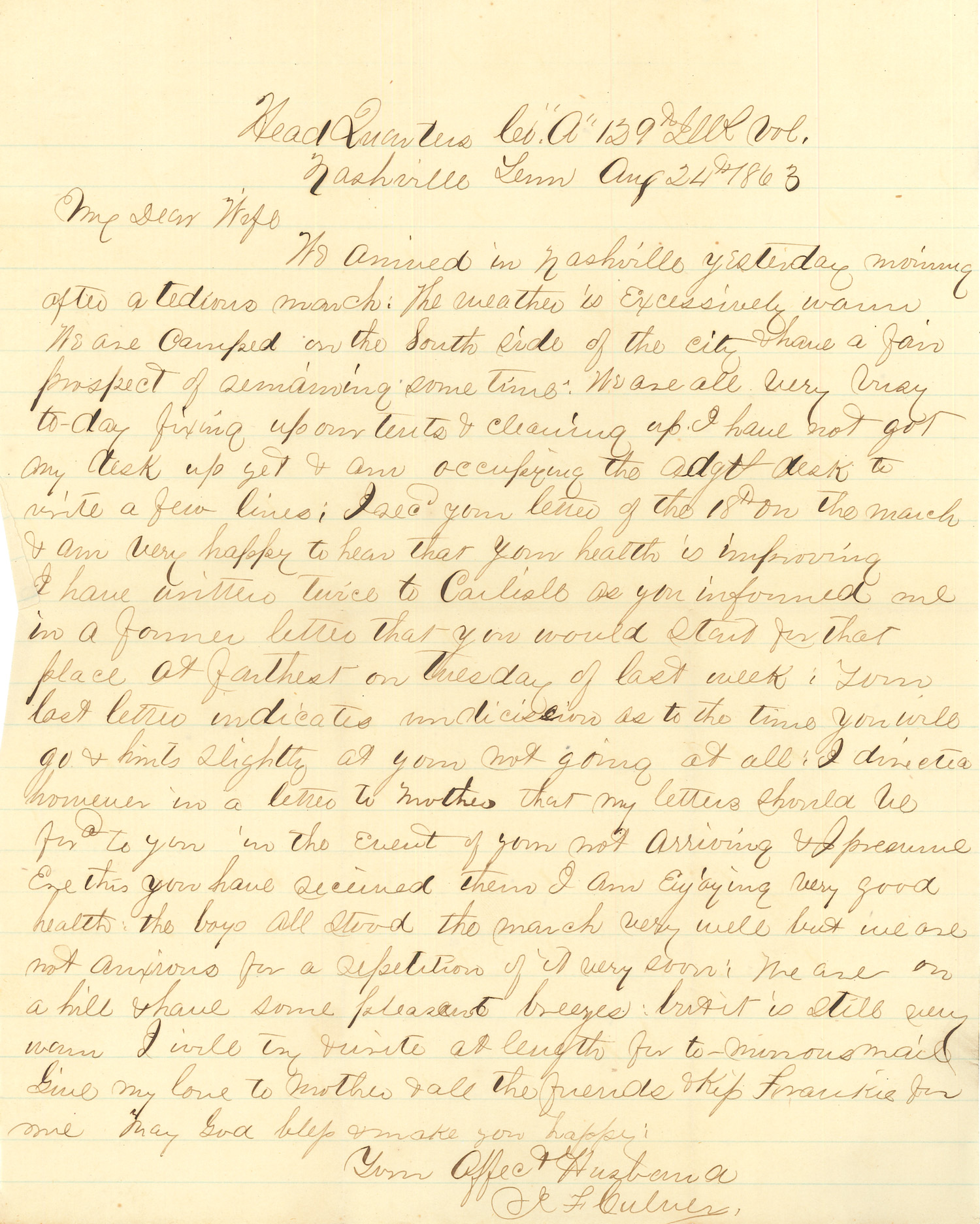
We arrived in Nashville yesterday morning after a tedious march

Joseph Culver Letter, August 24, 1863, Page 1

Head Quarters, Co. “A” 129th Ills. Vol.
Nashville, Term., Aug. 24th 1863

My Dear Wife

We arrived in Nashville yesterday morning [the 23d] after a tedious march.1 The weather is excessively warm. We are camped on the South side of the city & have a fair prospect of remaining some time. We are all very busy to-day fixing up our tents & cleaning up. I have not got my desk up yet & am occupying the adjt’s. [adjutant’s] desk to write a few lines.

I recd. your letter of the 18th on the march & am very happy to hear that your health is improving.2 I have written twice to Carlisle, as you informed me in a former letter that you would start for that place at farthest on Tuesday of last week. Your last letter indicates indecision as to the time you will go, & hints lightly at your not going at all. I directed, however, in a letter to Mother that my letters should be ford. to you in the event of your not arriving,3 & I presume ere this you have received them.

I am enjoying very good health. The boys all stood the march very well, but we are not anxious for a repetition of it very soon. We are on a hill & have some pleasant breezes, but it is still very warm. I will try & write at length for to-morrow’s mail. Give my love to Mother & all the friends & kiss Frankie for me. May God bless & make you happy.

Your Affect. Husband
J. F. Culver

  1. The 129th Illinois left Gallatin at 5 P.M., on August 21, and reached Nashville at 9 A.M., on the 23d. The distance marched was 30 miles. Regimental Papers, 129th Illinois, NA.
  2. Mary Culver’s letter of August 18, 1863, is missing from the Culver Collection.
  3. This letter to J.F.C.’s mother is missing from the Culver Collection.

Back to School with the Sciences Library

Welcome back! Here are six tips from the Sciences Library to help you hit the ground running and start the semester off right.

  1. Textbooks and more – Check the library catalog to see if your textbooks are on reserve at the library or available to check out. This goes for other books, videos, music and articles too.
  2. Study Space – It isn’t always easy to find a place to meet or study. Fortunately, the Sciences Library has new study areas, extended hours and we still have free coffee.
  3. Guides  – Do you have a paper to write, but can’t find the information you need? Check out our Subject Guides. These guides contain links to library funded and librarian recommended research databases and other resources you can use to find what you need.
  4. We deliver, for free –  Need a book from another Library but don’t want to walk all the way across campus? Click the “Request Delivery” link in the library catalog and we’ll send it to your office or a campus library.  If we don’t have it, fill out the Interlibrary Loan Request Form and we’ll get it for you as soon as possible.
  5. Workshops – The Sciences Library offers several workshops during the semester to introduce you to new tools and resources and help you learn how to use them.
  6. Ask Us – We’re here to help you. If you have a question or need some help, please don’t hesitate to contact us. You can call (335-3083), email (lib-sciences@uiowa.edu) or even chat. And of course, you’re always welcome to visit us in person at 120 Iowa Ave., between Phillips Hall and the Biology Building.

For more great tips like these, subscribe to our blog, like us on Facebook or follow us on Twitter. We look forward to working with you!


Extended Fall Semester Hours

We’ve extended the fall semester hours at the Sciences Library. We will now open at 8:30am, Monday through Friday.

Sciences Library Fall Semester Hours
August 26, 2013 – December 22, 2013

Monday – Thursday 8:30 a.m. – 9:00 p.m.
Friday 8:30 a.m. – 5:00 p.m.
Saturday CLOSED
Sunday 1:00 p.m. – 9:00 p.m.

Anna Marie Mitchell Items Get Custom Enclosures

Thursday, August 22, 2013

Take a look at a couple of the newest enclosures our very own “box lady” Linda Lundy has completed.  Linda has been working on some items from the Iowa Womens Archive (IWA).  The latest items come from Anna Marie Mitchell.

Custom enclosure for Mitchell Diorama

Custom enclosure for Mitchell Diorama

Here is some info on Anna Marie Mitchell from  Karen Mason, Curator of the IWA.

Anna Marie Mitchell of Forest City, Iowa, was a missionary for the Lutheran Church in Japan from the 1950s to the 1980s.  In addition to this doll, housed in a wooden box made in Japan, she donated to the Iowa Women’s Archives a diorama of a typical Japanese home that she used when she was on furlough to show Americans what a Japanese home looked like.   Anna Marie Mitchell donated extensive photo albums of her years in Japan, as well as reports of her work, to the Iowa Women’s Archives.

Custom box for Mitchell doll

Custom box for Mitchell doll

Custom box for Mitchell doll

Custom box for Mitchell doll