PubMed is the National Library of Medicine’s index to medical literature and includes over 17 million bibliographic citations in life sciences. This 1-hour session will show you how to improve your search results by using subject headings (MeSH) and advanced keyword searching techniques.
PubMed’s Secret Ingredient: Explosions
By Eric Rumsey, Janna Lawrence, and guest author Chris Shaffer, former Hardin librarian, now University Librarian, Oregon Health & Science Univ
Explosions are a powerful, built-in feature of PubMed that make it easy to search for clusters of related subjects. Because they’re so seamlessly incorporated into PubMed, it’s possible to search the database without having any knowledge of explosions. But to get the best results, it helps to understand how they work.
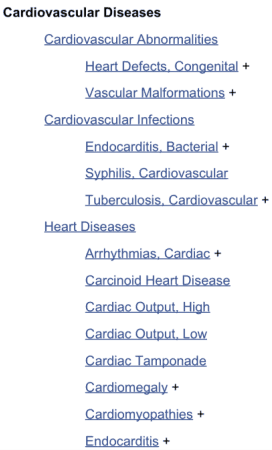
The clip from the MeSH database to the left gives an idea of the hierarchical “tree structure” of explosions. When you search in PubMed for a MeSH term that’s at the top of a category, the search automatically includes all of the terms indented under it. So for instance, if you search in PubMed for Cardiovascular Abnormalities, the two terms indented under it are also included. The “+” sign after these terms indicate that they are explosions that have other terms under them, which are also included.
To see details of specific exploded terms, search the MeSH Database. (To see the page for Cardiovascular Diseases, in the example at left, click the graphic, or click here)
Much of the elegance of explosions is the ability to search large categories, and to move up and down “the tree” to try out more or less specific terms. For example, let’s say you’re interested in the subject of exercise and heart diseases. Combining those concepts in PubMed, you find there are more than 7000 citations. So, how many citations are there about the broader concept of cardiovascular diseases and exercise? With the power of PubMed’s automatic explosions, it’s easy to see that there are about double the number. And, of course, it’s easy to move the other direction in the tree, to do the search with specific terms and explosions anywhere in the hierarchy.
Another key reason explosions are so valuable is that articles are indexed only to the most specific MeSH term. An article on Cardiac Tamponade, for example, will only be assigned that term, and not the broader term Heart Diseases. Without explosions, it would not be found by searching for Heart Diseases. But because it’s in the Heart Diseases explosion, it is found.
Why “Secret Ingredient”?
We call explosions PubMed’s “Secret Ingredient” because they are very powerful but little-known and/or taken for granted. It wasn’t always this way – When the Medline database (which is what you’re searching in PubMed) was in its early days, in the 1980′s, explosions certainly were acknowledged to be a “big deal” – With the relatively low-powered computers of the time, explosions took big chunks of computer time, and were used with caution. With today’s computers, of course, this is only a distant memory, and, fortunately, no one needs to worry about using explosions.
A further reason that explosions have receded into the background is that, with the advent of Google-style simple search interfaces, PubMed has adopted the same sort of simple interface. This has had the effect of making people less aware of what PubMed is doing “under the hood.” With the simple, Google-like interface of PubMed, it’s natural to think that it works “just like Google.” But in fact it’s quite different – With only a bit of oversimplifying, the basic difference is that Google searching is purely computer-based and PubMed is based on human indexing. Humans actually read every article in PubMed, and assign 10-15 MeSH terms, which is what makes explosions possible.
How to search without an explosion
When you search for a subject in PubMed, the default is for it to explode the MeSH term that’s associated with the subject, and this is almost always what you want, since articles are indexed with the most specific term available. For example, an article about cardiac arrhythmias will be indexed as Arrythmias, Cardiac, and not to its broader heading, Heart Diseases. There may be occasions, however, when you only want the MeSH term at the top of the category, without subsidiary terms. The way to do that search, using the example discussed here, is to search for: Heart Diseases [mh:noexp]. Another way to do this is to click the box that says “Do not include MeSH terms found below this term in the MeSH hierarchy” on the MeSH Database display for Heart Diseases.
We are notified to be prepared for marching orders
Head Qrs. Co. “A” 129th Ills. Vol.
Nashville, Tenn., Sept. 19th 1863
My Dear Wife
We are notified to be prepared for marching orders, an indication at least that we will soon leave here, & though we have no definite idea of where we are going, yet, as the whole Brigade is to move, we anticipate being sent to the front.1 As I shall probably be on duty to-morrow & not have another opportunity, I wish to-night to give you a full understanding of our business affairs at home. Our communication will be necessarily less frequent & should we cross the Tennessee River, it will doubtless be very irregular. I have often thought that I should have embraced the opportunity while we were to-gether to make you fully acquainted with all our affairs, yet [I] postponed [it] from time to time until it was entirely neglected.
I regret exceedingly the additional expenditure caused by our removal to this place, & by a late order of Genrl. Rosecrans which compels “a report of the appearance of each officer 4 times a month.” I have spent considerable for clothing.
I have never yet been able to get any definite information of the condition of affairs at Pontiac. [William] Russell promised me he would write, but I have never recd. any word from him. Mrs. Custer, in a letter written some two months ago, informed me that our carpet was almost destroyed & the furniture very much damaged. I may not be wholly excusable for not informing you, but I feared it would mar your pleasure & possibly interfere with your visit. I accordingly wrote to Mr. Remick to attend to it, &, when Russell went home, authorized him to make sale of such articles as were likely to be injured, & if he could effect a good sale to dispose of all of it.
I am wholly unable to determine what amount of money is in Remick’s hands. I had over $40 in Company Records sent to McCleary for sale & $100 sent to him in money. Out of that you have drawn but $25. I ford. by express to-day $25, & ordered him [Remick] to pay $50 to the church, which they tell me will cancel the last of my notes there; & also pay Maples $11 [to] Bond for a pair of boots I ordered; also Fisher amt. due him, which does not exceed $10. So that there should be a balance in his [Remick’s] hands of $30, aside from the Records and whatever has been realized from rent or the sale of furniture.
My liabilities on the house yet is $450 due; $150 which will be due next month & $300 int. due next March. I could, if nothing happens, meet all the liabilities on it, if I was sure Bro. Thomas [Murphy] would not call or want the amount due him next spring which will be $600. In addition to our home, I have paid $50 on those 2 lots in Mott & Collins’ addition.
My matters have become quite seriously damaged since I left. I had sufficient collections well secured, placed in Fleming & Collins’ hands, to have met all my obligations as they became due had I been there to attend to them. I can gather no information from them [Fleming & Collins] & am left to infer that nothing has been done & consequently all has been lost. The interest I had in Tax lands, which promised a good harvest, has all been forfeited in my absence & lost.
We have nothing left then but our share in our home & those lots [in Mott & Collins’ Addition], & yet I could cheerfully resign all were there any prospects of affairs changing for the better. In addition to the other settlements, I placed in Collins’ hands vouchers to complete the payment of my note to McDonald for Spurlock.2 The man by whom the vouchers were payable has left the country, so that there remains $40 & interest to be paid there, which with the amt. lost by Beattie makes the whole of my indebtedness save $25 here [Nashville]. I am very bare, however, & shall probably have to borrow some before next pay day, not exceeding $25, however.
Will you pardon me, my dear Wife, for not informing you more fully on these matters before this? When I left home, my affairs were in a very prosperous condition, & had all been quiet & prosperity continued, all my obligations would have been cancelled before this. Out of the justices’s office I have never heard of any money being paid over, except the little you recd. I do not wish to be unkind, but I do feel that Utley has not done the part of a friend, much less a Brother.
You will perceive that my letter was commenced on the evening of the 19th & this is now the 22nd. Since that time I have been two days & nights on [picket] duty. Great changes have taken place. I am not sure that there is cause for dispondency, but things look somewhat gloomy. The news from our Army informs us of a severe battle & heavy losses,3 & the recognition of the Confederacy by the French.4 I apprehend no serious results finally, but an indefinite prolongation of the war. If the North remains united, we are still safe.
It is with all these things in view that I have written at such length, so that if our communication should be cut off, you might be able possibly to arrange affairs in my absence & in that worse contingency, my death. Do not think I feel any despondency, but I think it wise to provide for any contingency that could possibly happen.
I have a request to make. You recollect I placed in one of the little drawers a sealed package [my will] with the request that it should not be opened during my life time. I wish the document destroyed, but it cannot be done legally except by myself & that in the presence of witnesses. Try & think of it when you go home & send it to me. Should any thing happen to prevent its reaching me; John Wolgamott is witness to it, & this letter shown to him shall be my warrant to him for its destruction. Yet should anything still happen to make all doubly sure, I will make another will revoking all former ones, & retain it until that one is destroyed & then destroy it.
And now, my dear Wife, though misfortune & heavy loss has been the result of my leaving home, yet our country was in danger & is not yet safe. I entered conscientiously upon what I felt to be the discharge of duty, &, if you can yield so great a sacrifice, I shall be perfectly satisfied if it be God’s will to commence the world again. It may not have been most wise to base so much on so Sandy a basis, yet I am confident that with ordinary diligence nearly all my liabilities would to-day have been cancelled. Let us bid farewell to business & talk a little of ourselves.
I recd. your letter of the 13th inst.,5 day before yesterday, while out on [picket] duty, & I am happy to hear that you are so well. You ask me to guess what you gave Bro. Harry [Cheston] for acting as your Post Boy. I should guess a “Kiss.” Am I right?
It is a year ago to-day that we left Pontiac. Yesterday was Frankie’s birthday. I suppose it was celebrated with due solemnity. I hope when his next arrives, I may have the pleasure of joining in the celebration when you may realize your anticipated joys in the knowledge that we are all at home once more to remain. I am happy to hear that Jennie and Harry [Cheston] are so happy. If it be God’s will, we will one day be very happy. I doubt not in the Providence of God, all will be for the best.
There is no Ohio Regt. here. I may possibly meet your Cousin, &, if so, I will try & make his acquaintance.
I set for some Photographs on Saturday but on examining them to-day did not like them. I will sit again to-morrow. The number is 448, &, if you should wish at anytime within a year to get any by sending for the number & this date, you can have them copied. The negative is kept on hand for a year. I will send you one as soon as I can get it.
Enclosed find $10 to be preserved for Frankie as birthday present. If Gold comes down, buy gold as it will be surer. If I get home, I will invest it for him. Kiss him for me. I have been until a late hour writing to-night, being interrupted very often.
Christ Yetter took very sick while on [picket] duty last night [the 21st]. I sent him to Camp, but he is much better this morning & was walking around. The health of the Company is generally good. Quite a number of the men have been drinking too much to-day; they seem to fear that their money will not be spent soon enough. It generally happens after pay day, but is much worse this time, being in the city.6
I came very near losing the package of money I sent to Remick to-day. I put it up, but could not find the Col. to get a pass to go to the express office, & lay down on the bed to wait & fell asleep. Little Mary Nelson came into my tent, as she frequently does, & attracted by the red seals upon it, I presume, took it out of my hands & carried it out & in playing in an adjoining yard with another little girl lost it. [Adjutant] Plattenburg, happening to pass, found it, & returned it to me, after I had concluded it was gone. Had many a one found it, I should doubtless been the loser of $25. She knew she had taken it, but could not tell where she had lost it.
I will try and write to Harry [Cheston], but I am so busy that I find but little time to devote to correspondence. I owe a large number of letters.
We are on duty much more than half the time & but seldom in camp; when here drill consumes nearly all our time or leaves us so tired that it requires considerable effort. I went on duty Sunday morning [the 20th] & was relieved about 9 A.M. to-day, besides [having] 3 hours’ drill this afternoon. I had a little time to go to the express office & that was all.
The papers will give you an account of the Battle [of Chickamauga]. We have but few particulars yet. Our loss in killed & wounded is at least 10,000, & I shall feel glad if in the summing up it does not reach 15,000 or over.7 The Slaughter is terrible. We expect almost every hour to be ordered forward. One division of our Corps [Grangers’s ] was in the battle, either the 1st or 2nd, we have not yet learned which.8 Bro. Johnie is in the 2nd Division & was at last accounts at Chattanooga, & probably not in the battle. I will write to you as soon as I learn. His is Morgan’s division of Granger’s Corps.9
Send me a paper with the account of the French recognition. We are waiting anxiously to learn what England & Russia are doing or intend to do.10 Will the North stand a draft of 600,000 more?11 If so, we are yet safe. I think this interference will have a tendency to arouse & unite them. I hope so at least.
I am sorry to learn of Father’s condition.12 I dare not hope or do I wish for leave of Absence while affairs are in so critical a condition. Let us trust all to God. In his love & protecting care our best interests will be preserved. Do not grieve over past misfortunes but look hopefully to the future. Whatever God directs is for the best.
I have received no letters for some time from any source. My friends seem to be waiting for me to write. Neither Mother [Culver] or Hannah have written since you arrived there. Give my love to all. Believing that God will bless & preserve us, yet committing all to his hands,
I remain, as ever,
Your Affect. Husband
J. F. Culver

- On September 17 General Rosecrans, to strengthen his army at the front, suggested to General Gordon Granger that it would be possible to reduce further the garrisons and posts guarding the supply lines and depots in Middle Tennessee. Rosecrans urged that one infantry regiment be withdrawn from Fort Donelson and Clarksville; one cavalry regiment from Nashville; three battalions of infantry and one of cavalry from the Murfreesboro area; and three infantry regiments from the ten currently posted at Caperton’s, Stevenson, Bridgeport, and Jasper. If Granger knew of any garrisons which could be pared further to provide troops for the army at the front, he was to do so. O. R., Ser. I, Vol. XXX, pt. III, pp. 713-714.
- It has been impossible to further identify MacDonald and Spurlock.
- General Bragg’s Army of Tennessee, reinforced by General Longstreet with two divisions from the Army of Northern Virginia, crossed Chickamauga Creek on September 19 and attacked Rosecrans’ Army of the Cumberland. The Federals more than held their own in the first day’s fighting, but on the 20th several of their generals blundered. As the armies fought and maneuvered through the woods and clearings, a gap opened in the Union front. Through it surged a powerful Confederate column, spearheaded by Longstreet’s veterans. Two of Rosecrans’ four corps (McCook’s and Crittenden’s) collapsed and fled for Chattanooga. Fortunately for the North, Thomas’ XIV Corps and one of Granger’s divisions held their ground. Instead of pursuing the routed corps, Bragg hurled his divisions against Thomas’ and Granger’s bluecoats. A terrible struggle ensued as the Confederates vainly sought to drive Thomas from Snodgrass Hill. Under cover of darkness on the evening of the 20th, Thomas, having won for himself the name “Rock of Chickamauga” and time to enable Rosecrans to rally and re-form McCook’s and Crittenden’s corps, evacuated his position and retired into the Chattanooga defenses.
Chickamauga was the bloodiest two-day battle of the Civil War. Union casualties were 1,657 killed, 9,756 wounded, and 4,757 missing, out of 58,000 engaged. General Bragg listed his losses as 2,312 killed, 14,674 wounded, and 1,468 missing, out of a force of 66,000. The casualty rate for both sides was about 28 percent. E. B. Long, The Civil War Day by Day: An Almanac, 1861-1865. (New York, 1971), p. 412; Cist, Army of the Cumberland, pp. 193-229. - There was no truth to the report that France had recognized the Confederacy. Although Louis Napoleon’s government favored such action, it would not act unilaterally. Napoleon and his ministers would be guided by Great Britain’s actions.
- Mary Culver’s letter of September 13 is missing from the Culver Collection.
- The 129th Illinois was a typical unit in this respect. Public drunkeness has always plagued military units whenever the men receive their pay.
- See note #3 for a brief account of the battle of Chickamauga. Union casualties (dead, wounded, and missing) numbered 16,170.
- General Granger with two brigades of the First Division (Steedman’s) had marched from Rossville to General Thomas’ assistance. He reached Snodgrass Hill at 3 P.M. on the 20th, and employed Steedman’s troops in a counterattack routing the Confederates from a gorge from which they were threatening to turn Thomas’ right. Cist, Army of the Cumberland, pp. 209-210. Brig. Gen. James D. Morgan’s division of Granger’s Reserve Corps guarded the crossings of the Tennessee River and the forward supply depots at Bridgeport and Stevenson. O. R., Ser. I, Vol. XXX, pt. III, pp. 742-743.
- J.F.C. was mistaken. Company M, 1st Illinois Light Artillery, was assigned to Steedman’s, not Morgan’s division, and had participated in the battle on September 20, losing 2 killed and 14 wounded. Adjutant General’s Report, State of Illinois, Vol. III, p. 665.
- In the summer of 1863 the Roebuck resolution urging joint recognition of the Confederacy by Great Britain and France had been debated in Parliament, but, when it failed to elicit sufficient support, it was withdrawn. Napoleon was ready to act but would not do so unilaterally. Randall, Civil War and Reconstruction, pp. 646-647.
- In June President Lincoln had called on the governors of Pennsylvania, Ohio, Maryland, and West Virginia for 100,000 men for six months. Three months before, on March 3, the Congress had enacted a national conscription law, declaring all able-bodied male citizens between 20 and 45 liable to military service. The draft aroused bitter opposition in parts of the North, culminating in the New York City draft riots of July 13-16. Ibid., pp. 410-416.
- Father Culver’s health had continued to deteriorate.
GM’s New Plan. . .
GM’s New Plans to challenge Tesla’s Electric Battery Dominance:
http://thinkprogress.org/climate/2013/09/18/2640141/affordable-electric-vehicle/
Carbon-Free Biologically-Grown Bricks.
Carbon-Free, Biologically=grown Bricks Win Green Business Competition
http://thinkprogress.org/climate/2013/09/17/2631221/biobricks/
I know exactly where you are
Head Qrs. “A” 129th Regt. Ills. Vol. Infty.
Nashville, Tenn., Sept. 18th 1863
My Dear Wife
Yours of the 11th inst. came to hand this morning, also a catalogue & 3 [news]papers for which I am much obliged.1 I recd. the Philad. Ledger a few days ago.
I know exactly where you are, as I boarded nearly a year at Mrs. McGary’s in that same house.2 Please remember me to them kindly; I am indebted to them for many favors. Are the girls married yet? I have not seen or heard of any of them for years.
I shall take great pleasure in sending you long letters whenever I have opportunity; it is no tax upon me to write to YOU.3 I try to imagine myself talking with you, telling you all I know that I think would be interesting, and then waiting patiently for your reply. We often talk about you here & Alf Huetson invariably, whenever he sees me do or hears me say anything out of the way, reminds me that it is not consistent with my wife’s views. I have, therefore, a good monitor, & it has become a fixed rule to comply with your wishes in all matters. It is a happy thought to be in possession of a loving, true & noble hearted Wife. It alleviates our sufferings, gives strength in trial and temptation, & joy & happiness in all the walks of life. My heart is filled with gratitude to God for his abundant mercy & so great a blessing.
I am sorry to hear of Father’s declining health. I am much afraid that before my opportunity for getting home arrives, he will have passed away. I am sorry Bro. Wes. does not exercise more energy in securing so good a position,4 but inactivity is his characteristic. I was in hopes that his accumulating a family would be an incentive to energy; if that fails, I fear nothing will arouse him. Allen Fellows recd a letter from his Wife this morning. She is quite well.
I am well acquainted with Mary Moore & Annie Brady, but they were only little girls when I was home & went to Sabbath School.5 Annie Brady was a very bright scholar & won many honors in the public schools in Carlisle.
How do you like Mrs. Proff. Johnson?6 You will find her very intelligent. I hope your acquaintance with the family may prove pleasant. I am not acquainted with Proff. Boswell’s family.7 Annie (Van Horn) Davis has been quite successful, or rather prolific.8 Give Lizzie Zug a kiss for me, she is an especial favorite of mine.
I believe I could guess in three times who made the remark to her about Frankie. It was either Mary Rheem, Em. Ensiminger, or Ell., the last named lives on the corner of the Alley west of Sister Jennie, at the lumber yard.9 I have forgotten her last name though it is very familiar. I recollect it now, it is Ell. Armstrong. The language is very like either of them. It is not very singular that either of them should recognize him [Frankie].
[Lt.] Smith has not heard from his wife since his return [from furlough] & feels quite uneasy. The weather is so cool this morning that my fingers are quite numb. Every body is wearing overcoats. I presume it will last until after the 21st, [equinox]: If it should continue long, we will be compelled to get a stove. The changes in the weather are full as severe and sudden as in Illinois.
Frank Long has just been here requesting a recommendation for a position in a negro Regiment, & it has broken into my thoughts considerably.10 I must finish my letter now, or it will miss to-morrow’s mail.
I had thought of a number of things I wished to write, but fear they have gone out of my mind entirely. I have received no letters since I last wrote to you from any source, but have been expecting to hear from Pontiac daily. Henry Greenebaum [a friend and Pontiac dry goods merchant] sent me another package of Collars, so that I am well provided. I am much in need of my boots & hope they will not forget to send them by McIntyre.11
I am sorry to say that I have not answered either Maggie [Utley’s] or Sarah Williams’ letters yet, though I am strongly impressed that I wrote to Maggie last. If there was no drill this afternoon, I would write to both of them; as it is, I fear I shall not be able.
The health of the men is generally good. I sent you a Nashville paper yesterday containing an undeserved compliment. The troops were from the different companies & not all of Co. “A”, & we had no idea of eliciting any encomium.12 I shall in all probability be on duty on Sunday again, it seems to be my misfortune.
The boys are crying at some Provost Guards passing, “White Gloves.” They have a holy horror of all style. I fear it would require a great effort for us to comply with the regulations of the “Army of the Potomac.” The men complain now of being too much of a band-box Regt, yet our style falls far short of the requirements of some portions of the Army.13
I have not heard from Bro. Johnie yet. I presume he is quite busy. There has been some hard fighting at the front for the last four days, but we have not learned the result though the papers report Rosecrans driven back this morning.14 Yet it is not generally believed. We shall hear definitely in a few days, I presume.
Give my love to all the family. I should like very much to hear from Mother & the rest of my Bros. & Sisters, but they apparently expect you to do their writing. Kiss Frankie for me. I am happy to hear that you both enjoy such good health. I shall look anxiously for the music, we need something of the kind very much.
We have not yet been paid off but are promised to-morrow. I do not know why it is delayed. Write as often, your letters are not less interesting to me than mine are to you. Though I should be far happier to communicate more directly with you, yet I rejoice at this opportunity still left for communication & earnestly hope though distant to hear very often.
Remember me kindly to all our friends in Carlisle. Tell me all you hear & see, for rest assured that everything and almost every person are familiar to memory.
May Our Father in Heaven bless you & preserve you in health and happiness. I remain, Dear Mary,
Your Affect. Husband
J. F. Culver
- Mary Culver’s letter of Sept. 11 is missing from the Culver Collection.
- Mary Culver evidently had written J.F.C., describing a visit to Mrs. McGary’s.
- Mary Culver had expressed appreciation for the long letters her husband frequently wrote, contrasting them to her briefer ones.
- In an earlier letter, dated September 2, Mary Culver had written, “Wes and Little Willie was up this afternoon. Wes expects to report to Washington soon. He is quite lame yet and Mother thinks he never will entirely recover the use of his ankle.” Mary Culver to J.F.C., Sept. 2, 1863, Culver Collection. Wes Culver had fractured a small ankle bone by falling out of a tree the previous autumn.
- Anna Brady was the 19-year-old daughter of Ernest and Margaret Brady. The father was an agent for a Bible society. Mary Moore was the 17-year-old daughter of Robert and Ann Moore. The father was a Carlisle Township farmer. Eighth Census, Cumberland County, State of Pennsylvania, NA.
- Lucena Johnson, to whom Mary Culver had been introduced, was the wife of Professor Herman M. Johnson of Dickinson College. Ibid.
- W. A. Boswell was a 35-year-old professor of mathematics at Dickinson College. In 1860 he was living with his wife, Frances, and their three children. Ibid.
- It has been impossible to identify Annie Van Dorn Davis.
- Mary Rheem was the 25-year-old daughter of Jacob and Susan Rheem. The father was a wealthy Cumberland County speculator. Elizabeth Ensiminger was the 24-year-old daughter of Samuel and Frances Ensiminger. Her father was a Carlisle saddler. Ellen Armstrong was the 21-year-old daughter of Mrs. Mary Armstrong. She and her mother lived in Carlisle with her brother, a well-to-do lumber merchant. Ibid.
- Frank M. Long, a 20-year-old Pontiac blacksmith, had been mustered into the army on Sept. 8, 1862, as corporal in Company A, 129th Illinois. Long was promoted to sergeant on Jan. 20, 1863, and reduced to private on May 20, 1864, for repeated misbehavior in face of the enemy. On June 20, 1864, at Kennesaw Mountain, Ga., he deserted. He was arrested at Gallatin, rejoined the regiment near Vining’s Station, Ga., on Sept. 15, 1864, and placed in arrest. Compiled Service Records of Union Soldiers, NA. The black regiments being organized by the United States were officered by whites.
- There were two McIntyre brothers in Company G, 129th Illinois, both of whom had been tinsmiths in civil life. Eighteen-year-old Charles and 24-year-old Robert M. Mclntyre were mustered into service as privates on Sept. 8, 1862. Charles, while posted at Chattanooga, on April 19, 1864, was ordered to report to General Steedman for transfer to naval service. Robert, on June 17, 1863, was detailed as a provost clerk at Gallatin, Tenn., and on December 7, 1863, was detailed for duty at the Nashville Quartermaster Depot. On April 28, 1864, Private Mclntyre was ordered to report to General Steedman at Chattanooga for transfer to naval service. Compiled Service Records of Union Soldiers, NA.
- The Nashville Union for September 17 carried this article. “I witnessed an incident while attending a funeral today, that made a deep impression on me. “Company A, 129th Illinois, on picket duty under command of a lieutenant, presented arms as a funeral cortege passed. The little girl who was going to her long home could not know it, but it thrilled the hearts of her parents that strangers thus saluted their darling.”Such instinctive courtesy notes this gentleman eyewitness; and courtesy and valor have ever gone together. Those men will not be found wanting wherever they may be. In camp and field, in life and death may God bless them.”
- The 129th Illinois was not a “spit and polish” unit. On July 27, 1863, Lt. G. W.
Morris of the Inspector General’s Department had directed Colonel Case to have his
adjutant inspect the guard detail before marching it to the parade ground. He would see
that the muskets were loaded, and that they were “free from dirt, rust, grease, pieces of
tape, string or other unnecessary appendages,” and that their “equipments are in good
order and properly adjusted.” No clothing other than that prescribed by regulations would
be worn. Trouser legs would not be stuffed into boots; coats and blouses were to be
buttoned up to the chin; blankets compactly rolled and slung across the right shoulder.
Sergeants were to fall out with their muskets and sidearms. Inspector General to Case,
July 27, 1863, Regimental Papers, 129th Illinois, NA.
On August 3 Lieutenant Morris had reported that the 129th, “although well commanded did not come up to the standard even of volunteers. There is that lack of pride or interest that should exist, and which is necessary to the maintenance of Good Order and Military Discipline. All of which may be attributed to the fact that the officers are both negligent as to their own personal appearance and to the enforcement of the regulations among the men.” Granger to Case, Aug. 5, 1863, Regimental Papers, 129th Illinois, NA.
These complaints caused Colonel Case to take corrective measures, and General Gordon Granger soon observed a “decided improvement” in the military appearance, discipline, and drill (both company and battalion). Granger was especially pleased to see the company officers were stimulating that “feeling of pride so necessary to advancement in everything pertaining to the soldier.” Morris to Case, Aug. 6, 1863, Regimental Papers, 129th Illinois, NA. - General Thomas’ XIV Corps in the period September 13-16 had held its ground in
McLemore’s Cove, awaiting arrival of McCook’s XX Corps on its right. Forced
reconnaissances were made to Catlett’s Gap and toward Blue Bird and Dug Gaps, and on
the 17th Thomas put his corps in motion and closed up on Crittenden’s right along
Chickamauga Creek. McCook by nightfall was in position on Thomas’ right at Pond
Spring, and Rosecrans had massed his army along a 12-mile front.
General Bragg in the meantime had marshaled his Army of Tennessee east of the Chickamauga, with its right near Reed’s Bridge and its left under Lt. Gen. D. H. Hill south of Lee and Gordon’s Mills. Wheeler’s cavalry guarded Bragg’s left and Forrest’s horse-soldiers his right. Cist, Army of the Cumberland, pp. 188-190.
Voyager 1 as seen from Earth!
An unprecedented glimpse of Voyager 1 as seen from Earth:
http://io9.com/an-unprecedented-glimpse-of-voyager-1-as-seen-from-eart-1332889148
NASA Spacecraft Embarks on Historic Journey!
NASA Spacecraft Embarks on Historic Journey into interstellar space:
http://www.nasa.gov/mission_pages/voyager/voyager20130912.html#.Ujib3NKsiG5
The Actual New Flux Year Box – in action
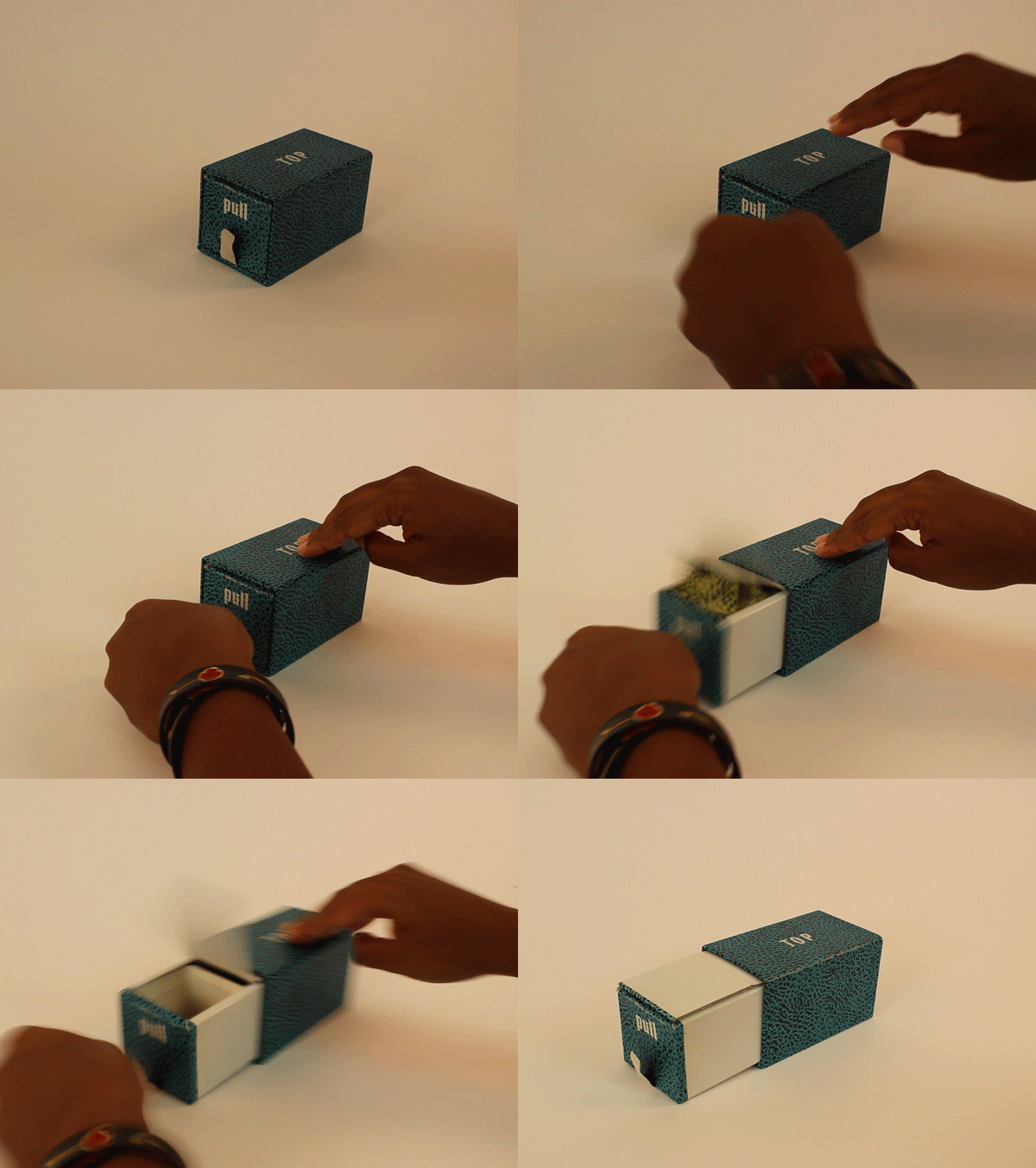
It seemed appropriate, since you can interact with a version of the 3D model of the New Flux Year box, to provide you with a clip of the people who are interacting with the objects. Here, we have a digitizer who recorded herself as she pulls the pull-tab of the New Flux Year box.
Even though this is not her first time interacting with the box, I had to delete the audio of the squealing/screaming sound the yellow snake emits because it is interjected by a rather strong word of surprise. Rest assured, the snake did come down, it is back in the box where it belongs though you cannot see it from the animation.
The Actual New Flux Year Box – in action
It seemed appropriate, since you can interact with a version of the 3D model of the New Flux Year box, to provide you with a clip of the people who are interacting with the objects. Here, we have a digitizer who recorded herself as she pulls the pull-tab of the New Flux Year box.
Even though this is not her first time interacting with the box, I had to delete the audio of the squealing/screaming sound the yellow snake emits because it is interjected by a rather strong word of surprise. Rest assured, the snake did come down, it is back in the box where it belongs though you cannot see it from the animation.