Skip to content
Skip to main content

Black Hawkeyes: The History of Black Students at the University of Iowa

Drawing on collections in the Iowa Women’s Archives, curator Kären Mason will discuss the history of African American women students at the University of Iowa on Tuesday, February 25th at the Iowa Memorial Union.

If you can’t make it to the talk, check out this wonderful resource: African American Women Students at the University of Iowa, 1910-1960.

black hawkeyes

Black Hawkeyes: The History of Black Students at the University of Iowa
Featuring Dr. Kären M. Mason, Curator of Iowa Women’s Archives
Tuesday, February 25, 12:30-2 PM
Penn State Room, Iowa Memorial Union
Presented by the Society of Black Graduate and Professional Students

Find protein sequences and more with our new NCBI workshop

This session provides an overview of the National Center for Biotechnology Information (NCBI) databases that contain protein related information. Learn how to search for protein sequences, conserved protein domains, sequence similarity-based protein clusters and experimentally-determined bimolecular structures.

This workshop is hands-on and there will be time for questions at the end. All HOW sessions are free to UI students and affiliates.

Our next session is:

Monday, February 24 from 2-3 pm

Location: Hardin Library Info Commons EAST

Register online here. Questions? Call us at 335-9151 or email lib-hardin@uiowa.edu to learn more.

[image accessed via NCBI’s Molecular Modeling Database]

A Mecca Tradition: The Blarney Stone

What did engineering and law students have in common during MECCA, the former incarnation of E-week? The search for the Blarney Stone, of course. It is named for the Blarney Stone in Ireland which, when kissed by leaning backward from a parapet in Blarney Castle, is said to give the “gift of eloquence.”

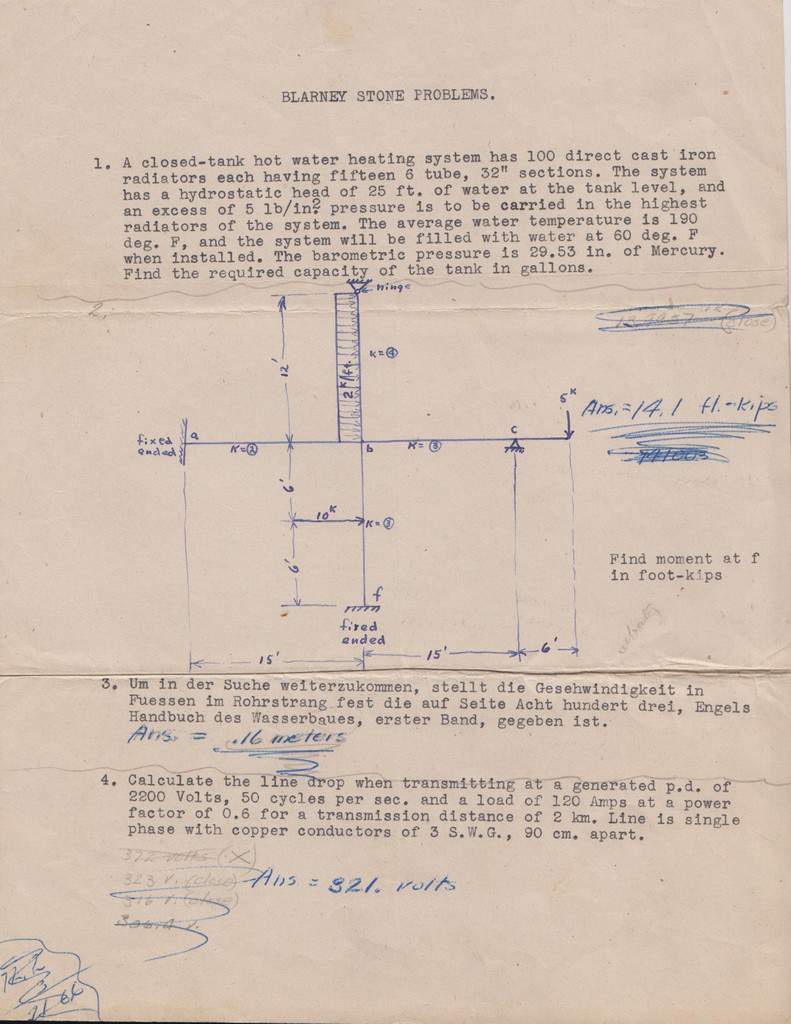
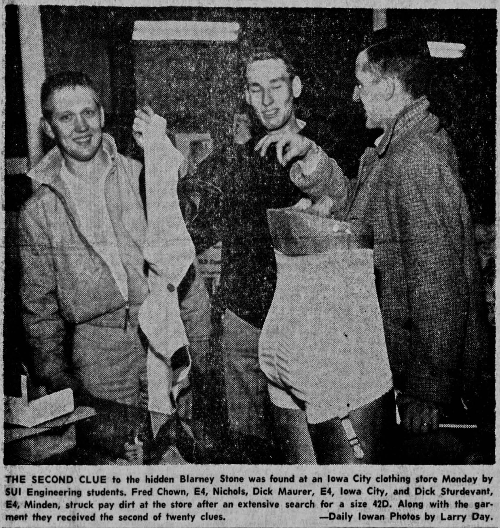
During MECCA week, the students of the engineering college would compete in order to find the Blarney Stone, a 13”x11”x6” piece of granite that is supposed to come from Ireland, a tradition which began in 1910. The stone would be hidden by the graduating class, and they would then give the underclassmen clues in the form of engineering problems to solve. Eventually, this tradition was turned into a competition between the law students and the engineering students to see who could find the Stone first. If the law students found it before the engineers, the engineers would be “in disgrace” for the entire year. MECCA week was the peak of the rivalry between the engineering students and the law students, with creative pranks abounding.

Blarney Stone Found

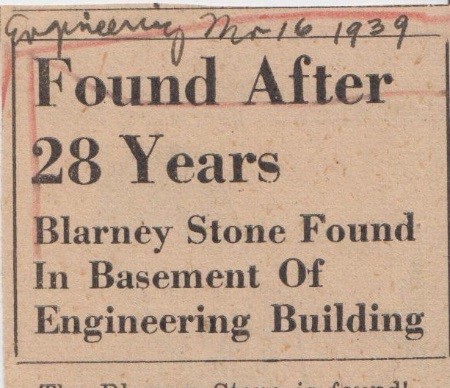
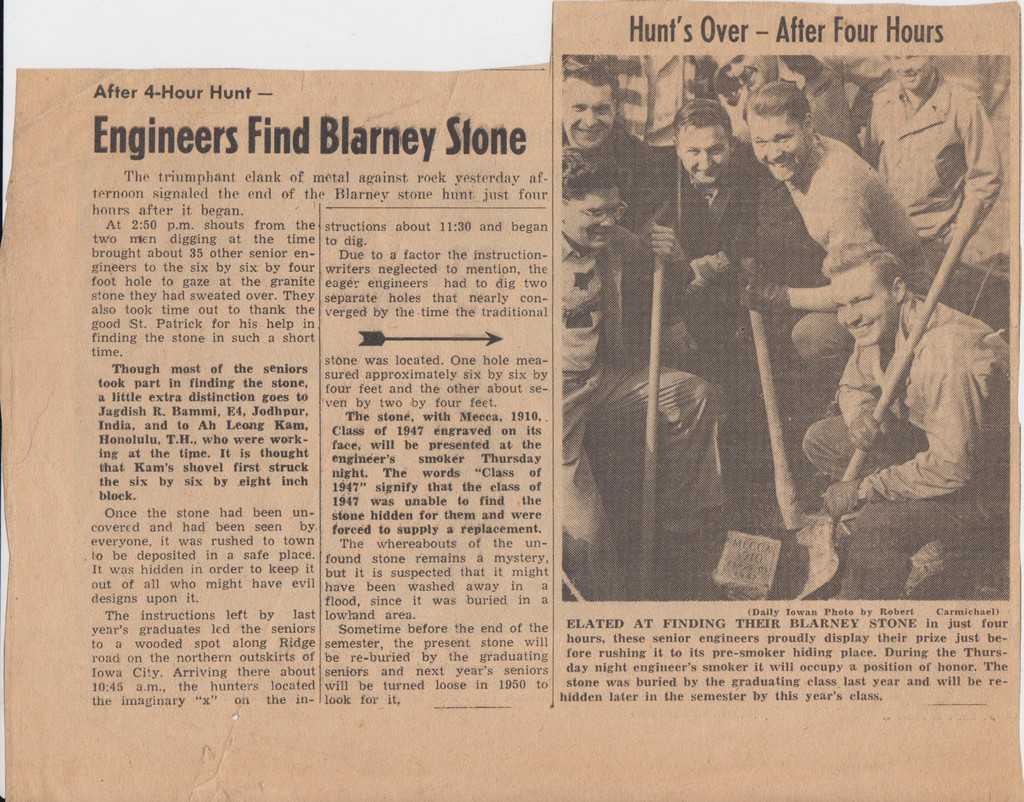
The search for the Blarney Stone was not easy, however. In 1912, the instructions for locating the stone were lost, and the Stone was not found until 27 years later when they finally resurfaced. Ironically, the Blarney Stone was found hidden in the basement of the Engineering Building. The stone was not found in 1947, either, necessitating the purchase of a new Blarney Stone by the class who had failed. Further complicating the search was the enormous area in which it could be hidden—anywhere within a 25 mile radius of Iowa City.


Can you solve these problems to find the stone? How about the one written in German?

problem 2


Here are some articles written in the Daily Iowa about the search for the Blarney Stone:

new 2

news 1
From The Daily Iowan. 17 Mar. 1959.


Further Reading:


References

I feel rather certain that I shall get home this Spring

Joseph Culver Letter, February 21, 1864, Page 1

Head Qrs., 1st Brig., 1st Div., 11th A. C.
Nashville, Febry. 21st 1864
My Dear Wife

I recd. two letters from you yesterday evening, both mailed on the 12th, but one written on the 6th & 7th & the other on the 12th.1 I am happy to learn that you enjoy such good health. I will not undertake to answer the questions you have asked, for I feel rather certain that I shall get home this Spring. If not, I will telegraph for you.

If you get an opportunity to see Thomas Hill, ask him what he can do to assist me.2 The money of Tom Smith’s & Joe Shellebarger’s that I expected to borrow is in his hands.3

Mrs. Harrison will be here this evening; the Col. recd. a dispatch from her to-day. My going home will be delayed on Mitchel’s account.4 He has sent in an application for leave to go home & get married. I will cheerfully wait on him. I think he is more nervous about it than I was. He will probably bring his bride here.

I was at church to-day & heard a very good sermon. It was late when we got back, & now it is mail time & my letter very brief. I have been almost tempted to telegraph for you & give up the idea of getting home. I am afraid by the time Jim returns, which will be full one month, we will have marching orders. If I succeed in being sent for the instruments, it will not interfere with my getting a leave of absence next fall, but to get a leave of absence now would prevent it.

If I do not get home, I will write in full about the matters of which you write. Hoskins will be home next week; I will send by him. He is ordered to Chicago to appear against C. J. Beattie.5

You want me to tell you the next prettiest name to Mary. For dark eyes & dark hair, brunnette, I like Ellen, & for light hair & complexion, Jennie.6 Give my love to all. I must close. I hope to get home. May God bless you.

Your Affect. Husband
J. F. Culver

  1. Mary Culver’s letters of February 7 & 12 are missing from the Culver Collection.
  2. Thomas Hill was a 43-year-old Pontiac Township farmer. In 1860 he valued his real estate at $13,000, his personal estate at $1,400, and lived with his wife, Mary, and four children. One of his four farm hands had been Chris Yetter. Eighth Census, Livingston County, State of Illinois, NA.
  3. Joseph Shellenbarger, a 19-year-old fruit tree agent, was mustered into service on Sept. 8, 1862, as a private in Company A, 129th Illinois. Private Shellenbarger died in the brigade hospital on March 31, 1864, at Wauhatchie of pneumonia. Thomas R. Smith, a 23-year-old farmer, was mustered into service on Sept. 8, 1862, as a private in Company A, 129th Illinois. Private Smith was hospitalized at Quincy, Ill., with wounds to the left arm received at New Hope Church, Ga., May 27. 1864. He received a medical discharge on May 18, 1865. Compiled Service Records of Union Soldiers, NA.
  4. Adjutant Mitchell of Harrison’s staff was granted a 10-day leave on February 19, 1864, “to attend to personal business” in Bloomington, Ind. Ibid.
  5. Charles J. Beattie, a Livingston County lawyer, had been indicted for forgery in the U.S. District Court for the Northern District of Illinois. Ibid.
  6. Mary Culver had written J.F.C. of her hope that their next child would be a girl and had asked his preference for a name.

We are very glad to hear that you have not been sent to the front

Joseph Culver Letter, February 20, 1864, Page 1Carlisle Feb. 20th 1864
Dear Bro. Frank,

Yours of the 14th has been received, and we are very glad too hear that you have not been sent to the front, that is the place of honor, but also of danger, and we feel anxious that you may be as little exposed as possible, and be spared to Mary. I wonder not that you often recall the scenes of the past, when you & Mary were comfortably fixed in your own home, where joy reigned supreme; for there is no place like home, where love prompts every act, and perfumes the very air where our little ones in anticipation of reality nestle in our arms or play at our feet. May God grant unto you soon a return of those joys, for He has blessed you with a wife who is eminently qualified to make your home a happy one.

Mother received your letter also one from Mary and will foreward Mary’s clothes &c. on Monday or Tuesday she has written to Mary to that effect. Jennie sent a letter to Mary this afternoon. Mary endeared her self to us very much while here, and we feel very deeply for her in her affliction and her separation from you, and would fain throw a ray of joy around her to cheer her in her loneliness. I hope she may be privileged to return and spend the Spring and Summer with you. I was at our babes & Frankie’s graves last Sabbath the sprigs of green which Mary placed at the head of the graves are still there, the flowers have faded fit emblem of their lives beautiful but fleeting, their immortal spirits now bloom in perpetual youth. Death has again entered my family a sister mourns the death of her youngest child aged 6 or 8 months. My father is worse I scarcely expect to see him again alive, but hope to meet him again on the bright shores of our Heavenly Home. We heard from Hanna this evening she seems to be much pleased with the School she is right well. Mother seems more cheerful and contented than she did before Hanna left. I saw Gustie & John Miller to day their families were well. I saw Lizzie a week ago all were well then. Jennie and Marvin are pretty well, they both have colds. My health is better than it has been for some weeks. Dr. Johnson is engaged in an effort to increase the College Endowment $100.000 his prospects are very good.

“May angels guard thee”
Your Brother
H.C. Cheston

It is just one week since your last letter arrived

Joseph Culver Letter, February 19, 1864, Page 1

Head Qrs., 1st Brig., 1st Div., 11th A.C.
Nashville Febry. 19th 1864
My Dear Wife

I recd. no letter to-day; it is just one week since your last arrived. I cannot divine the reason. [Pvt. Joseph] Allen recd. a letter from Lou, dated the 14th, in which she says you are well.1

You wrote in one of your letters for me to send a [black] servant for Mrs. Remick and one for Maggie [Utley]. I would be happy to comply if it were possible, but every negro captured in Kentucky is sold into Slavery.2 None are allowed to cross the Ohio River. The only way is to get a permit to take your servants home with you, as Dr. Johns did, & then go up the river to Cairo.3 I cannot take time to go by water, & therefore will not be able to take them with me.

I am unable to tell how soon I may be ready to start home, or whether it is certain or not. I have succeeded well in my own Regt., but some of the others are slow.4

My health is good. If I could only hear from you, but I feel fearful that your health may not be good. I have recd. no letter from any source since I last wrote. I wrote to Bro. Charlie [Culver], Johnie [Murphy], & Scott McDowell last night. I have not been able to sleep for the cold for several nights.5 Mrs. Harrison will be here to-morrow. How I wish you were here, but wishing is in vain. Give my love to Mother & Maggie. May God bless & keep you. Good night.

  1. Lou Allen was the wife of Pvt. Joseph Allen of Company A, 129th Illinois Infantry. Eighth Census, Livingston County, State of Illinois, NA.
  2. Thousands of blacks freed by President Lincoln’s Emancipation Proclamation, dated January 1, 1863, had refugeed to the Nashville area and were living in camps in and around the city. According to terms of the Emancipation, Union slave states—including Kentucky, all of Tennessee, and sections of Virginia and Louisiana—had been excluded from its provisions. Slave owners, legal residents of these states or regions, could identify and claim the return of their blacks. Randall, Civil War & Reconstruction, pp. 490-498.
  3. Dr. Harvey S. Johns’ resignation as surgeon of the 129th Illinois had been accepted January 19, 1864. Compiled Service Records of Union Soldiers, NA.
  4. J.F.C.’s reference is to the collection of funds from the troops to purchase instruments for the brigade band.
  5. Private Grunert noted in his diary for February 18, “intensely cold weather today.” On February 17, Private Dunham had written his mother, “We are having splendid wether heare now but rather cool. People are plowing.” Grunert, History of the 129th Illinois, p. 44; Through the South with a Union Soldier, p. 104.

Database of the Week: Mintel Oxygen

Each week we will highlight one of the many databases we have here at the Pomerantz Business Library.

The database: Mintel Oxygen Mintel

Where to find it: You can find it here, and under M in the databases A-Z list. You do need to agree to the Terms of Use and create an individual profile with your @uiowa.edu email address before you can gain access.

Use it to find:

  • Industry reports
  • Market research
  • Consumer reports
  • Product information
  • International information, but strongest in US and UK coverage

Tips for searching:

  • Scroll over “Category overview” at the top to see sectors, themes, and demographics that are covered
  • Use the search box at the top and type in an industry, or even a company
  • Use the sidebar on the left to limit your results by content (reports), sector, or demographics

Demos: The following demo on searching Mintel can be viewed on youtube

You can also view a video from Mintel that tells you about their coverage

Want help using Mintel? Contact Willow or Kim and set up an appointment.

I was somewhat surprised to hear of Sammy’s enlisting

Joseph Culver Letter, February 19, 1864, Page 1In Camp at Loudon Tenn.
19 February 1864
Brother Frank:

Your favor of 1st inst containing letters from mother, Sammy, Brucker and Grunbaum was received three days ago. It was a very interesting package. I had not heard from home in a longtime. I was somewhat surprised to hear of Sammy’s enlisting. I knew he wanted to come into the army – he has often told me so, but I never gave him any encouragement. Once, when asked by him what he had better do with regard to entering the service, I told him to go to school two or three years, and then if necesity required it, to go into the army. I had hoped that he would be spared the evil influence incident to camp life. But it may do him good. I shall be very glad to see him. Since the receipt of your letters, I have learned that the order for you to march to Bridgeport, was countermanded: you may still be in Nashville. My valise has reached Chattanooga, and I shall get it in a few days. If you see Sammy, as he comes to the Battery, tell him that some of our men are still in Chattanooga in charge of some ordnance stores left there, and that he can find them by following the railroad from fort Negley to fort Wood. They are midway between.

I am disappointed not to see Mary before she went home. One section of our Battery moved out night before last with a Brigade of infantry. I have not yet learned where they went. I am very busy now: this is the first letter I have written in more than a week. I must write to mother tonight. How do you like your new position as A.D.C.? I think it will suit you better than a line office. I hope you will rise still higher in position, and that you may continue to fill every position with honor to the country and credit to yourself.

How is it with your soul, Frank? Are you prospering spiritually? I am not doing very well now. The circumstances with which I am surrounded are very untoward. I would much like to see you tonight. But can not write more.

Write me soon and often.

Affectionately
Your Brother W J Murphy
Battery M 1st Ill. Artillery
3 Brig. 2 Div. H. A. C.
Louden Tenn.

Celebrating Engineers

The College of Engineering celebrates E-Week in conjunction with National Engineers Week, February 16 – 22, 2014. During E-Week, a variety of student-organized activities help celebrate and recognize engineers and their contributions to society.

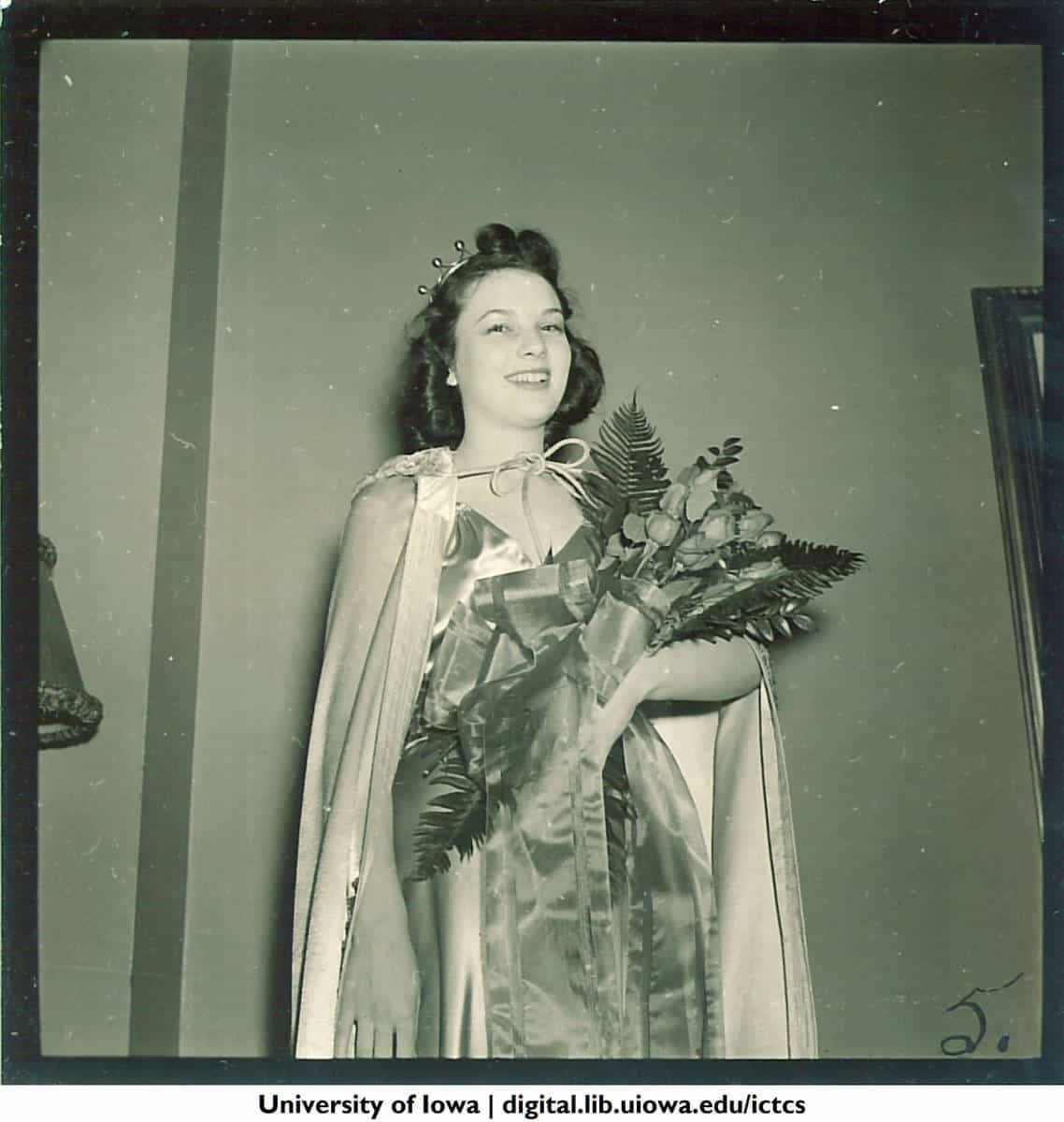
However, did you know that the College of Engineering founded a similar event more than 100 years ago? On March 17, 1910, the Associated Students of Applied Sciences organized a parade and a vaudeville show to honor St. Patrick, the patron saint and founder of engineering. Three years later, the event was renamed MECCA. The letters represented the five divisions of engineering (Mechanical, Electrical, Civil, Chemical, and Architectural) and spelled a word which denotes a place to which pilgrimages are made. For sixty years, MECCA Day was a lively annual homecoming for The College of Engineering students and alumni.

Blarney Stone

The Blarney Stone was the symbol of the MECCA celebration.

The Blarney Stone was the symbol of MECCA. The graduating class would hide a greenish colored rock, no larger than a baseball, for the underclassmen to find. Elaborate, mathematical calculations provided clues for locating the stone. In 1912, the Blarney Stone was hidden as usual but the directions were missing. Twenty-eight years later, the stone was recovered when the instructions were found.


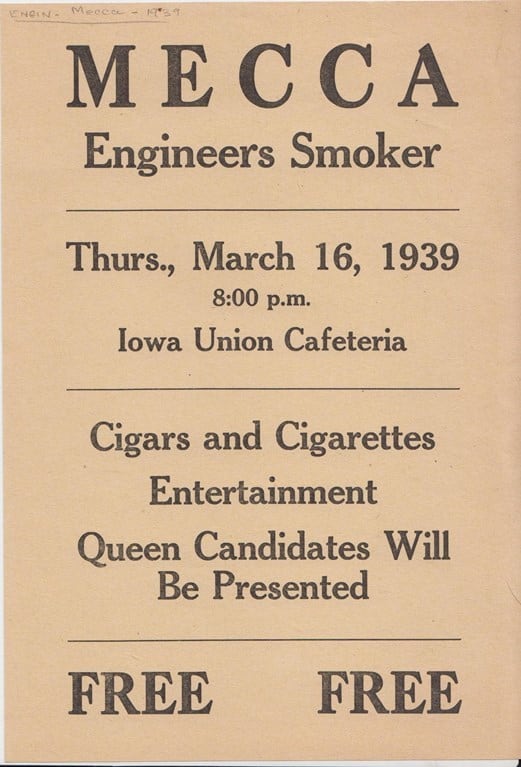
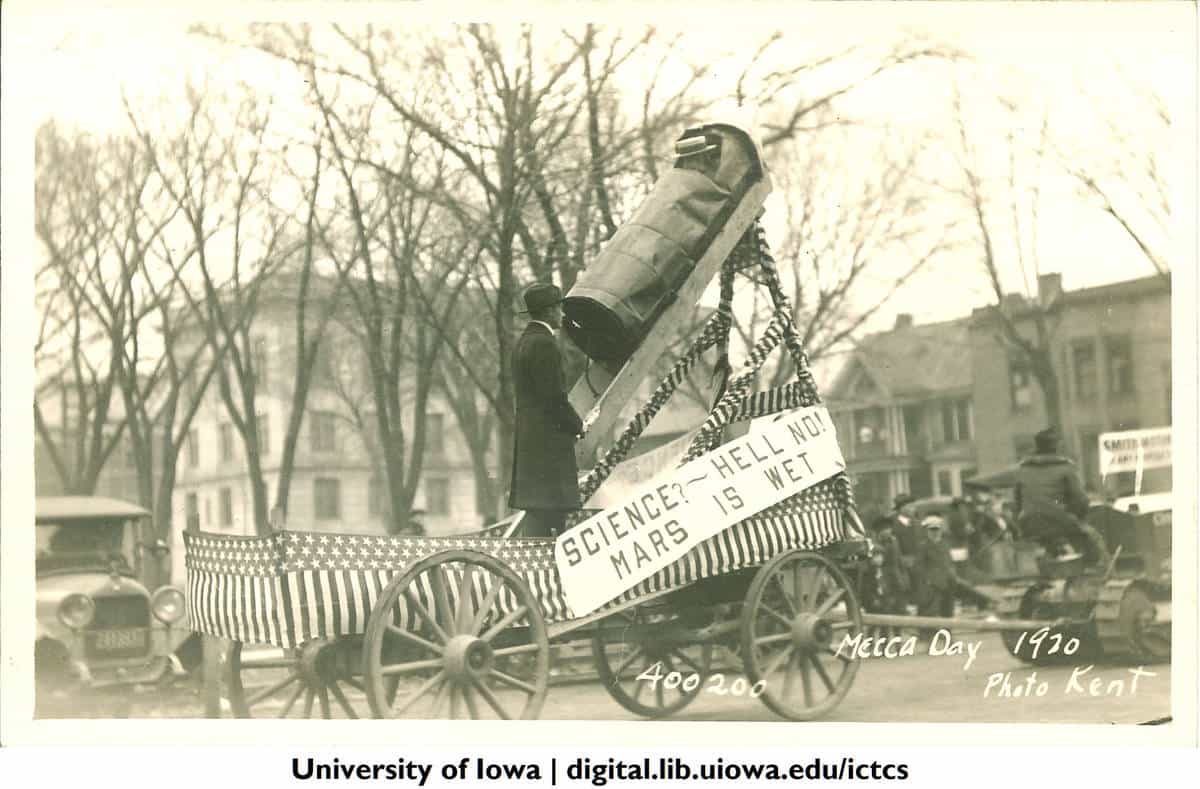
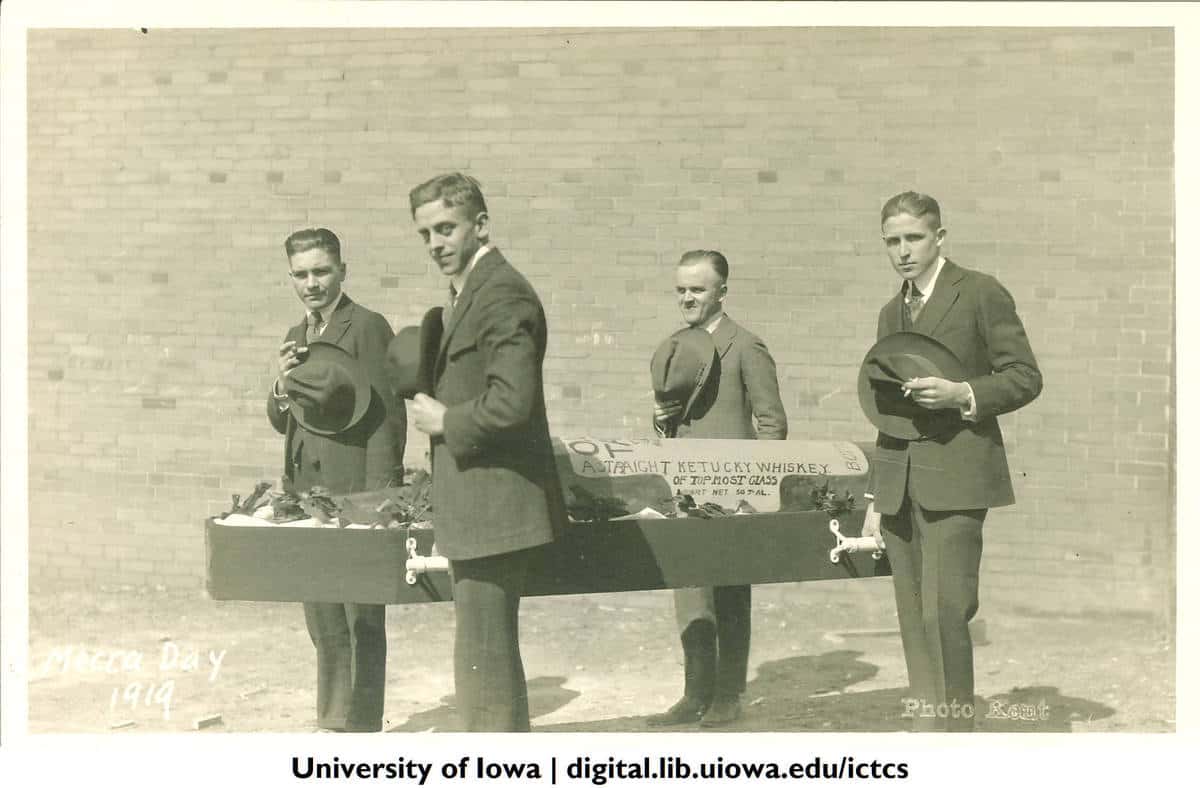
Other traditions included parades, formal banquets and balls, satirical plays, beard contests and “Smokers.”

MECCA Queen, circa 1940

Crowning of the MECCA Queen, circa 1940

MECCA Smoker, 1939

A rocket on top of a MECCA Parade float

MECCA Parade Float, 1920

MECCA Parade Pallbearers, 1919

“Pallbearers” burying a bottle of whiskey during prohibition. MECCA Day Parade, 1919

REFERENCES

“The Ninth Annual Engineers’ Banquet,” The Transit, Volume 16 (1911), p.85

“The MECCA Celebration – 1915,” The Transit, Volume 19 (1915), p. 63

“MECCA,” The Transit, Volume 25 (1921), p. 26

Iowa City Town and Campus Scenes, The University of Iowa Libraries Iowa Digital Library