BLANCO, MANUEL (1779–1845). Flora de filipinas. Printed in Manila at the Santo Tomas press, 1837. 21 cm tall.
Manuel María Blanco Ramos was born on Nov. 24, 1779, in Navianos de Alba, a small village in the province of Zamora, Spain. Blanco grew up in Spain, influenced by King Charles III’s commitment to humanism and scientific progress. Despite the turbulence of the 19th century, Blanco emerged as a prodigious figure driven by a desire to serve his parishioners and explore the natural world.
At the age of 10, Blanco entered the College-Seminary in Valladolid, where he studied Latin and philosophy. His thirst for knowledge extended beyond theology; he immersed himself in various scientific disciplines, including chemistry, physics, natural history, mathematics, geography, and astronomy.
After completing his Augustinian training in 1804, Blanco left for the Philippines. Arriving in Manila in 1805, the local Catholic parish assigned him to a monastery in the town of Angat in the province of Bulacan. His primary task was to learn the Tagalog language under the guidance of Brother Joaquín Calvo, who shared Blanco’s passion for plants.
In 1822, he translated Tissot’s Treatise on Domestic Medicine from French to Tagalog. His goal was to incorporate locally available remedies, bypassing those inaccessible to the indigenous population. Given the abundance of local vegetation, he focused on indigenous plants with healing properties.
Blanco meticulously observed the country’s vegetation. He collected plant specimens, took notes, and documented his findings. He lacked formal training as a professional botanist and had no mentors or herbaria for reference. Armed only with Carl Linnaeus’s System Vegetabilium and later Jussieu’s Genera Plantarum, he embarked on a quest to catalog every plant in the Philippines.
His work culminated in the monumental work Flora de Filipinas, según el sistema sexual de Linneo [Flora of the Philippines according to Linnaeus’s system]. This comprehensive work cataloged over 900 plant species, providing valuable insights into Philippine botany.
Father Blanco included common names in Tagalog, Bicol, Visayan, Ilocano, and Pampango alongside scientific nomenclature. Observations included medicinal and practical applications.
Although initially reluctant to publish his work, his fellow friars eventually convinced him that his book would significantly contribute to the scientific understanding of the Philippines. The book proved very popular and Blanco soon started work on a slightly expanded and improved second edition. Unfortunately, he would not finish the book before his death.
Blanco spent the final years of his life in poor health due to a prolonged bout of dysentery. He died on April 1, 1845, at the age of 66.
Although Blanco’s herbarium collection no longer exists, Flora de Filipinas remains a testament to his passion for botany and for providing useful medical information to the people of the Philippines.
The John Martin Rare Book Room’s copy of Flora is covered in limp vellum, with the title handwritten on the spine. It is, in modern parlance, chonky—it stands only 21 centimeters tall but is almost 900 pages long! Most of the paper is good quality and sturdy, and although it appears the book may have been resewn and the pages possibly washed, the cover is contemporary with the printed text.
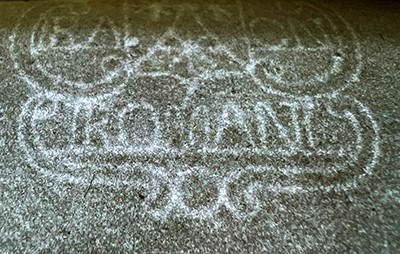
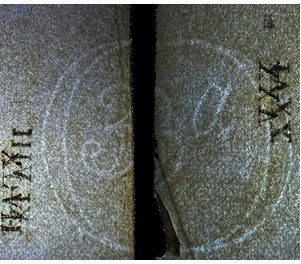
The pages also contain many watermarks possibly from as many as nine separate papermakers. Identifying watermarks can be a bit tricky. Some are well-documented and we know exactly who they belong to. Thanks to the Filigranas Hispánicas watermark database and other watermark databases, I could identify the following watermark as Roman Romani, an 18th-century family of papermakers in Málaga, Spain.
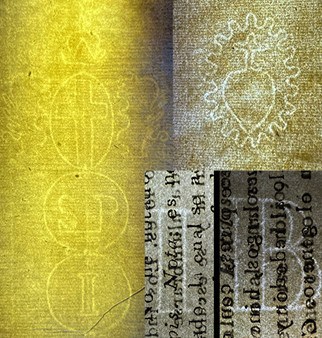
I got lucky, though, because the Romani’s signed their work with their full name. Many watermarks are not so straightforward. The heart you see below is cataloged in a few different places, but I could not find who it belongs to.
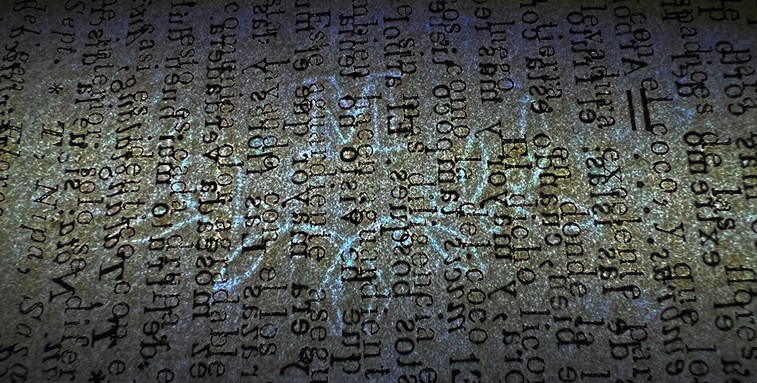
Unfortunately, I haven’t yet identified which mill the initials SP correspond to. Same with the M with the vine beneath it and the 3a and IB watermarks. But the search is the fun part!
Hardin Library has an enrichment collection to stimulate the mind and expand perspectives. The collection, which includes both print and electronic books, contains an assortment of health sciences biographies, histories, narratives, works of fiction, and graphic novels.
Mark Onken, administrative library assistant I just finished Lucky Jim, by Kingsley Amis, which is a funny novel about a post-WWII British academic who is seeking tenure for a position as a lecturer at a provincial university and keeps sabotaging his own prospects with his own reckless behavior (pro tip: no matter how nervous you may be before giving a lecture, soothing your nerves with Scotch is probably not a good idea).
A few weeks ago, I started an ambitious project. Both from watching HBO’s Rome, and from reading my daughter’s Percy Jackson series, I have been on a bit of a Roman history kick, and I have started to read Plutarch’s Lives of the Noble Grecians and Romans. I have read the first 200 pages (out of 1200), although I think I will give myself a break and read something a little less serious for a week.
Kathleen Halbach, interlibrary loan supervisor
I usually have multiple books going at one time.
Remember the First Ladies: The Legacies of America’s History-Making Women by Diana Carlin, Anita McBride, and Nancy Kegan Smith (who I saw in person discussing this book)
100 Things iTo Do In Iowa Before You Die by Sara Broers
Lost Book of Bonn by Brianna Labuskes
Ready or Not by Cara Bastone
Over the weekend I finished For the Love of Summer by Susan Mallery.
Matt Regan, clinical education librarian
I’m currently reading Shakespeare: The World as Stage by Bill Bryson and the Vlad Taltos series by Steven Brust.
Jennifer DeBerg, user services librarian
I just read Akhil Sharma’s “A Life of Adventure and Delight” and am going to start on Lorrie Moore’s “A Gate at the Stairs” soon.
I’m currently listening to The Dictionary of Lost Words by Pip Williams. Next up is No One Goes Alone by Erik Larson.
Damien Ihrig, curator, John Martin Rare Book Room
I am reading Wolf Hall by Hilary Mantel.
Cassie Reed Thureson, health sciences reference and research librarian
I am reading the second book of the Einburgh Nights series, Our Lady of Mysterious Ailments, by T.L. Huchu.
Sarah Andrews, program coordinator
I like to read mystery series. I am currently reading Miss Aldridge Regrets by Louise Hare, and the Aimee Leduc Investigations series by Cara Black. I just finished Pay Dirt by Sara Paretsky. I also started Babylon Berlin by Volker Kutscher in preparation for watching the tv series.
Congratulations to Jennifer DeBerg, user services librarian at Hardin Library for the Health Sciences, on co-authoring a new article that helps update processes for evidence-based nursing.
Evidence-based practice in nursing involves providing holistic, quality care based on the most up-to-date research and knowledge rather than traditional methods, advice from colleagues, or personal beliefs.
Currently, a pyramid hierarchy is typically used when reviewing evidence for a patient’s care. In their article, DeBerg and her co-authors suggest weighing all types of evidence similarly and not categorizing evidence according to an unhelpful evidence hierarchy.
Edmonds, S. W., Cullen, L., & DeBerg, J. (2024). The problem with the pyramid for grading evidence: The evidence funnel solution. Journal of PeriAnesthesia Nursing, 39(3), 484–488. https://doi.org/10.1016/j.jopan.2023.10.015
You can find more academic publications affiliated with the University of Iowa anytime using Iowa Research Online.
The Medical Library Association (MLA) held a hybrid meeting in Portland, Oregon from May 18 to May 21, 2024. Many of Hardin’s librarians participated in the meeting.
This year’s meeting marked the end of Hardin Director Janna Lawrence’s three-year term on the MLA Board.
MLA Fellows luncheon attendees Jon Eldredge (University of New Mexico), Shannon Jones (Medical University of South Carolina), and Julie Esparza (LSU-Shreveport) and Janna Lawrence (University of Iowa)
Hardin librarian Mary M. Thomas presented a program overview of the UI Libraries’ mental health first aid model. As part of the implementation, Thomas created mental health toolkits for faculty and staff and students.
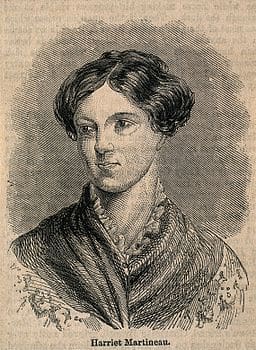
MARTINEAU, HARRIETT (1802-1876). Life in the sick-room: Essays. Printed in Boston by L.C. Bowles and W. Crosby, 1844. 20 cm tall.
Martineau was born in 1802 into a progressive Unitarian family in Norwich. Despite the societal expectations that confined her to domestic roles, Harriet’s intellect and determination were undeniable. In 1823, she challenged gender norms by anonymously publishing On female education, advocating for women’s rights to education and intellectual pursuits.
Her literary breakthrough came with the publication of Illustrations of political economy in 1832, a series of short stories that deftly wove economic theories into narratives about everyday people. This work not only brought her fame and financial security but also highlighted her as a significant intellectual force.
From 1834 to 1836, Martineau traveled across the United States. A staunch abolitionist and advocate for women’s rights, she wrote extensively against slavery and the lack of opportunities for women, eventually writing Society in America. Her extensive travels also led to insightful writings on the Middle East, India, and Ireland, further establishing her as a versatile and influential journalist and author.
Martineau began experiencing a series of symptoms while on her travels and, in 1839, returned to England for treatment. For someone experiencing a debilitating illness but not necessarily dying, being confined to a “sick room” was common at this time. It allowed the room to be set to the orders of the physician and made it easier for the family to care for their ill relative.
Although confined to her own sick room for five years, Martineau was financially secure and had a progressive, independent spirit. She oversaw her medical care and constructed an environment that best suited her needs. She even restricted access from her family, who she felt could be more emotionally draining than helpful. While resting and recuperating, Martineau remained very productive, writing a novel for children and the essays eventually published in Life in the sick-room.
Already considered an irritation in the medical community, she really caused a stir by claiming that Mesmerism, a pseudo-science medical treatment, cured her. Franz Anton Mesmer (1734-1815), a German physician, maintained that an “animal magnetism” pervades the universe and exists in every living thing.
He believed that its transmission from one person to another could cure various nervous disorders through its healing properties. Mesmer at first used magnets, electrodes, and other devices to effect his cures, but after arousing suspicion among his fellow physicians, he preferred to utilize his hands.
Considered quackery by many in the medical establishment, even in 1844—including by her physician brother-in-law who oversaw her care—physicians publicly attacked Martineau’s claims about Mesmerism. Her brother-in-law eventually published a detailed account of her illness. Although he promised it would anonymously appear in a medical journal, he instead created a public pamphlet and made little effort to disguise who he was talking about.
After ten years of good health, Martineau once again fell ill in 1855 and returned to her sick room. She remained there until her death in 1876. She continued to write during this time, completing, among other things, her autobiography, works promoting women’s suffrage, and critiques of the Contagious Diseases Acts, which targeted women in the name of preventing sexually transmitted illnesses.
After her death, the medical establishment, again including her brother-in-law, who publicly published the results of an unauthorized autopsy, went out of their way to discredit Martineau and her work. Without evidence, they claimed her illness led her to behave in unconventional and “unfeminine” ways. Martineau remained an inspiration to many, though, and her works live on as a testament to her resilience and rejection of the status quo.
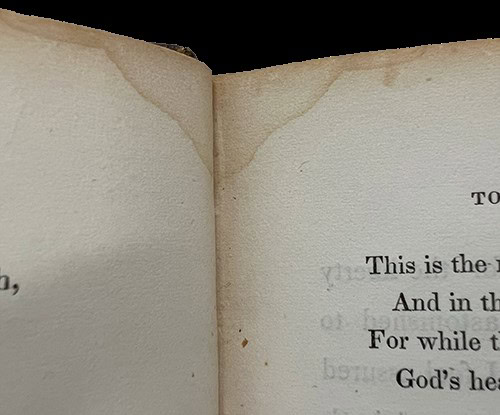
Our copy of the first American edition of Life in the sick-room is quite unassuming. It features a standard 19th-century burgundy cloth cover that has faded over time. Since it was a book in the library’s circulating collection for most of its life, it features a “library cloth” rebacked spine with the label maker-printed call number and title easily visible. Inside, the paper is in good condition, with evidence of damage from a long-ago liquid spill. Much like Martineau herself, though, this little book has shown great resilience in the face of adversity!
Contact the JMRBR Curator Damien Ihrig: damien-ihrig@uiowa.edu or 319-335-9154 to take a look at this book.