Skip to content
Skip to main content

Great but Hidden: PubMed’s New Diet, Food, and Nutrition Explosion

By Eric Rumsey, Janna Lawrence and Xiaomei Gu

As we have written, NLM made a great improvement in introducing the new explosion for Diet, Food, and Nutrition. Before that was introduced this year, each of the three elements in the explosion had to be searched separately because they were not in the same explosion. So we strongly endorse the new explosion!

Although it is less difficult to search for nutrition articles now, there is still a problem. The term mapping feature of PubMed does not work for the word “nutrition,” which is certainly a common way to search for the broad subject comprised by the new explosion.

Hardin0511b2-300x247
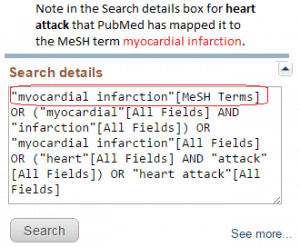
Image 1. Search Details for Heart Attack.

In most cases in PubMed, if the user searches a word or term that’s synonymous with the appropriate MeSH term, the system will automatically include the MeSH term in the search. An example of this is searching for the term heart attack (without quotes).

As shown in Image 1, PubMed automatically maps the word to the appropriate MeSH term – “myocardial infarction” [MeSH Terms]. (To see Search details, on the PubMed search results screen, scroll down to the “Search details” box, in the right side-bar). Another example of PubMed’s automatic mapping is cancer, which maps to neoplasms [MeSH Terms].

Hardin0511c2-300x279
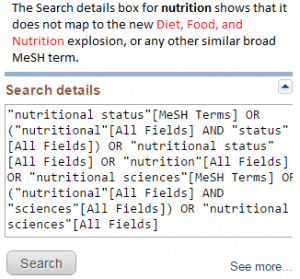
Image 2. Search Details for Nutrition.

A search for the word nutrition retrieves several phrases and MeSH terms, seen in the Search details in Image 2. But this does not include the new explosion Diet, Food, and Nutrition, which would retrieve many more relevant articles than these terms do.

There are two conceivable ways that NLM could address this problem. The first is to change the name of the explosion to Nutrition, so that mapping the word would not be necessary. The second solution is to make the word nutrition map to the new explosion. We encourage NLM to consider these options, so that the full power of the new explosion can be released!

Plant-Based Foods – An Inclusive PubMed Search – Revised 2016

Hardin0318c

By Eric Rumsey, Janna Lawrence and Xiaomei Gu

Searching for nutrition topics in PubMed is tricky. It’s especially difficult to search for plant-based foods (PBF’s). In 2014, we published an article that addresses this problem that contained a hedge for searching for PBF’s. A few months ago, the National Library of Medicine introduced a new explosion that makes it a lot easier to search for nutrition topics in PubMed, which we discussed here.

In this article we are revising our 2014 PBF hedge to incorporate the new PubMed explosion. While there may still be a few occasions when our previous hedge for PBF’s would be appropriate, in almost all cases we do not recommend using the old hedge. Instead, we recommend using the hedge below:

((Plants[mesh] OR Plant Preparations[mesh]) AND Diet, Food, and Nutrition [mesh]) OR (Vegetables[mesh] OR Fruit[mesh] OR Plants, Edible [mesh] OR Dietary Fiber[mesh] OR Flour[mesh] OR Bread[mesh] OR Diet, Vegetarian[mesh] OR Nuts[mesh] OR Condiments[mesh] OR Vegetable Proteins[mesh] OR Tea[mesh] OR Coffee[mesh] OR Wine[mesh] OR Vegetable Products[mesh])

The big change in this PBF hedge from the previous PBF hedge is, of course, replacing the food-diet-nutrition hedge that was part of the previous PBF hedge with the the new Diet, Food, and Nutrition explosion. Otherwise, the main change is the addition of the new MeSH term Vegetable Products.

Advanced techniques for plant-based food searching

In most cases, you’ll probably want to start with the hedge above. But if that doesn’t find what you want, try the ideas below.

If you combine your subject (a particular disease for example) with the hedge above and it misses articles that you think exist, consider broadening the search by combining your subject with Plants. The Plants explosion in MeSH is very large, containing hundreds of plant species. It’s organized by taxonomic relationships, which makes it hard for a non-botanist to browse. But it’s useful to combine with other subjects in searching, because it’s so comprehensive. The main drawback in searching it is that in addition to plant-based foods, it also has many plant-based drugs, which you’ll have to sift out from the food articles.

If you combine your subject with the hedge above and it misses articles on particular plant-based foods, search specifically for those. If you do a search for food and migraine, for example, and your search doesn’t pick up specific foods that you know have been associated with migraine (e.g. chocolate), combine those foods specifically with migraine.

A caveat: There is an exploded MeSH term Plants, Edible, which might seem to be a good place to search for plant-based foods. Unfortunately, however, it’s of limited usefulness – The explosion contains only grain plants and Vegetables, which is mainly soy-based foods. The term Plants, Edible itself is mostly used to index articles that are on the general concept rather than articles on specific types of edible plants.

If you’re interested in reading some background explaining why it’s so difficult to search for PBFs in PubMed, see our companion article.

Diet, Food, and Nutrition – How To Search in PubMed

hardin0318a

By Eric Rumsey, Janna Lawrence and Xiaomei Gu

Searching for Food, Diet & Nutrition has long been one of the most difficult subjects to search in PubMed. We were happy to report earlier this year that the National Library of Medicine has gone a long way toward fixing this problem, with a new explosion for Diet, Food, and Nutrition.

Before the new explosion came out, searching for the subject was very tricky because diet, food and nutrition were all in different places in the MeSH tree structure, and so they had to be searched separately. To help with this problem, we created a detailed search strategy, or hedge, that would bring together all of the components in one search. We no longer recommend using this hedge. We have examined the new explosion, and find that it covers the field very adequately.

We strongly recommend the new explosion for most nutrition searches. But there are some aspects of the field that are not covered in the new explosion that were part of our hedge, in particular obesity and vitamins. Both of these terms are closely connected to the subject of food, diet & nutrition. But we understand why NLM has not included them in the new explosion, since they will not always be wanted. Both of these subjects are somewhat complicated to search in PubMed. In both cases, however, a simple one-word text word search will retrieve almost all of the relevant citations. So in cases when you want to include these subjects in your nutrition searching, you can do these searches:

Diet, Food, and Nutrition [mh] OR vitamins
Diet, Food, and Nutrition [mh] OR obesity
Diet, Food, and Nutrition [mh] OR vitamins OR obesity

“Good job, NLM!”

In conclusion, good words for the National Library of Medicine – Thank you for fixing the long-standing problem in searching for nutrition! With the surging interest in the subject, you’ve made things a lot easier for the many people searching for it.

Searching Nutrition In PubMed & Embase: The Winner Is…

By Eric Rumsey and Janna Lawrence

As we’ve discussed, the big problem in searching for food-diet-nutrition subjects in PubMed is that the subjects are not together in a convenient bundle, as most subject groupings are in PubMed. To get a list of articles that includes food, diet and nutrition, it’s necessary to search each of these areas separately and then bundle them together into one search set.

When we first wrote about the difficulty of searching food-diet-nutrition in PubMed in 2013, we stated clearly that much of problem is caused by the fragmentation of the the relevant MeSH terms. So, jump forward a year. About two months ago, our library got institutional access to Embase.com, sometimes called the “European MEDLINE.” Embase includes all of the articles in MEDLINE, as well as many other articles, and uses its own subject heading system. Because we’ve long been aware that food-diet-nutrition subjects are generally given more attention in Europe than in the US, we thought that the subject might get better treatment in Embase than it does in PubMed. We weren’t disappointed…

A Nutrition explosion that includes Food and Diet

Embase uses explosions to bundle related subjects together, much like PubMed, and, as we were hoping, it does indeed bring food, diet and nutrition subjects together in a convenient bundle – Nutrition. So in the search box, just type in Nutrition/exp to get the nutrition explosion, that will retrieve everything on food and diet as well as nutrition. This is a great advance over PubMed. It becomes easy to combine a subject of interest with food-diet-nutrition, in one simple step. For example, using Embase.com format:

‘Heart disease’/exp AND Nutrition/exp
Neoplasm/exp AND Nutrition/exp
‘Mental function’/exp AND Nutrition/exp

To do equivalent searches in PubMed, it’s necessary to do a hedge/filter search, such we have developed, or to search food-diet-nutrition terms separately and combine these with the subject of interest.

Better treatment of “Food” in Embase

Certainly having the inclusive food-diet-nutrition explosion is the biggest advantage in Embase. But there are other problems in PubMed, especially in the way the Food explosion is treated. In both Embase and PubMed, Food is the largest food-diet-nutrition explosion. There are several difficulties with this explosion in PubMed. An overall complication is that Food and Beverages have a confusing relationship. They are together in one explosion Food and beverages, which is made up of two separate explosions, one for each of the terms. If the user knows enough to search Food and beverages, he/she will get both terms. But if the user searches “Food,” the search will not include beverages. In Embase, beverage is an explosion that’s included in the food explosion, so searching “food” will retrieve articles on beverages.

Several other problems with the Food explosion in PubMed are caused by a lack of detail, in comparison with Embase. Some examples:

  • In PubMed, Fruit is not an explosion, although there are individual fruits included in the Plants explosion, usually under their Latin plant name. In Embase, the fruit explosion has 43 terms under it, 6 of which are themselves explosions.
  • In PubMed, Spices is an explosion with one term under it – Black Pepper. In Embase, the spice explosion has 31 terms listed under it, 4 of which are themselves explosions.
  • In PubMed, specific kinds of red meat, e.g. beef and pork, do not have their own MeSH terms; instead, they’re indexed under the general term Meat. In Embase, the meat explosion contains a red meat explosion, which has 7 terms, including beef and pork.

Related to the lack of detail in the Food explosion in PubMed is that many foods, especially plant-based foods, are not retrieved in a search for “food” because they don’t have specific terms in the Food explosion. We have written some “case studies” of this on chocolate, cranberries, and olive oil, all of which are in the Food explosion in Embase, but not in PubMed. We have also written an article on red meat being difficult to search in PubMed because there is no MeSH term for it; as mentioned above, Embase does have a term for it.

Looking at articles in Embase and PubMed that mention specific foods in the article abstract, it’s almost always the case that Embase’s detailed indexing will include descriptor terms for the specific foods, and PubMed usually will not. Comparison of article indexing is easy to do because Embase provides a “Source” filter, that makes it possible to limit to articles that are included in both Embase and PubMed. Each of the articles retrieved using this filter has a direct link to the citation in PubMed.

PubMed Advantages

The biggest advantage of PubMed, of course, is that it’s free to world. Embase, on the other hand, is an Elsevier product and is only available at institutions that have a subscription.

Another PubMed advantage is its simple Google-like interface, which is certainly more comfortable to most people. Embase uses an older style of interface that may appeal to librarians more than to most users. For anyone with a serious interest in food-diet-nutrition, though, we would say it’s definitely worth learning.

Plant-Based Foods – An Inclusive PubMed Search

This article has been superseded by the following:
Plant-Based Foods – An Inclusive PubMed Search – Revised 2016

**********************

By Eric Rumsey and Janna Lawrence

In our earlier article on searching for plant-based foods (PBF) in PubMed, we suggested that a quick way to search the subject is to combine MeSH plant-related explosions AND our Food-Diet-Nutrition (FDN) hedge. This works quite well, especially for citations after 2002. In that year the Plants explosion was greatly expanded by the addition of several hundred new MeSH plant names. Before that, articles on specific plants were indexed inconsistently. Sometimes they were put under the plant family name, in which case they were included in the Plants explosion, and in other cases they were indexed under other terms like Vegetables, Fruit, or Plants, Edible, that are not in the Plants explosion.

In order to do the most inclusive search for plant-based foods, including citations before 2002, we have created two hedges, to be used for all the years in PubMed. These hedges include other MeSH terms and text-words, to supplement the plant-related MeSH term search strategy that works well after 2002. We have done fairly thorough testing of the two hedges, and we recommend the first hedge for most searches. It uses MeSH terms, and it emphasizes precision, which means that it gets somewhat fewer citations, but the citations are more likely to be on target. For both of the hedges, we’ve combined them in an OR search with the “Plants AND FDN” hedge search mentioned above.

Here’s the first hedge – Recommended for most searches – Emphasizes Precision:

((Plants [mesh] OR Plant Preparations [mesh]) AND (food OR foods OR beverages OR diet OR dietary OR vitamin OR vitamins OR nutrition OR nutritional OR nutrition disorders OR food industry OR nutritional physiological phenomena OR dietary fats OR dietary proteins OR feeding behavior)) OR (Vegetables [mesh] OR Fruit [mesh] OR Cereals [mesh] OR Plants, Edible [mesh] OR Soybeans [mesh] OR Dietary Fiber [mesh] OR Flour [mesh] OR Bread [mesh] OR Diet, Vegetarian [mesh] OR Nuts [mesh] OR Condiments [mesh] OR Vegetable Proteins [mesh] OR Tea [mesh] OR Coffee [mesh] OR Wine [mesh])

[9.5.14. Hedge revised – Number of citations: 294,149]

To use this search, click this link. You can also copy the text above and paste it into the PubMed search box. If you have a personal “My NCBI” account in PubMed, the hedge search can be saved for later use, or it can be made into a search filter. For information on setting up and using saved searches, see here; for more information on filters, see here. Commentary on terms in this hedge (If the “Year introduced” is not given, the term has been in MeSH since its launch in 1966):

  • Vegetables [mesh] Citations: 84411 An explosion that includes about 25 specific vegetables, including Onions, Soybeans, Daucus carota, and Solanum tuberosum. This is a relatively small proportion of all vegetables, which are indexed with their species or family name, in the Plants explosion.
  • Fruit [mesh] Citations: 57179 Notably, this is NOT an explosion. All particular fruit types are indexed with their species or family name, in the Plants explosion.
  • Cereals [mesh] Citations: 73516 An explosion that includes 8 cereals, including Avena sativa, Triticum and Zea mays. This is an important group, since it includes the world’s staple foods–wheat, rice, and corn.
  • Plants, Edible [mesh] Citations: 38945 An explosion that includes several terms elsewhere in this hedge that get more citations when they’re searched separately. The term Plants, Edible by itself gets 5402 citations.
  • Soybeans [mesh] Year introduced: 1986 Citations: 19284 An explosion that includes Soy Foods, Soy Milk, and Soybean Proteins.
  • Dietary Fiber [mesh] Year introduced: 1982(1977) Citations: 13468
  • Flour [mesh] Citations: 3570
  • Bread [mesh] Citations: 3115
  • Diet, Vegetarian [mesh] Year introduced: 2003(1963) Citations: 2537
  • Nuts [mesh] Citations: 2074
  • Condiments [mesh] Citations: 1945 An explosion that includes Spices.
  • Vegetable Proteins [mesh] Year introduced: 1975 Citations: 1515
  • Tea [mesh] Citations: 6904
  • Coffee [mesh] Citations: 4751
  • Wine [mesh] Citations: 7256

Here’s the second hedge – Emphasizes Recall:

((Plants [mesh] OR Plant Preparations [mesh]) AND (food OR foods OR beverages OR diet OR dietary OR vitamin OR vitamins OR nutrition OR nutritional OR nutrition disorders OR food industry OR nutritional physiological phenomena OR dietary fats OR dietary proteins OR feeding behavior)) OR (vegetable OR vegetables OR fruit OR fruits OR cereal OR cereals OR spices OR condiments OR flour OR nut OR nuts OR vegetarian OR soy OR soybean OR soybeans OR bread OR Tea OR Coffee OR Wine)

[9.5.14. Hedge revised – Number of citations: 380,361]

To use this search, click this link, or see instructions above with first hedge. Most of the words used in this hedge are text-word versions of the MeSH terms used in the first hedge. Since this emphasizes “recall” instead of “precision,” it gets more citations than the first hedge. But the citations are less likely to be relevant. We looked closely at citations using the two hedges, and it was easy to see the lesser relevancy of the citations in the second hedge. Most of these, of course, are retrieved because they mention words that are in the abstract (e.g. fruit, vegetables) but which are not assigned as MeSH terms.

A word about searching for older citations

When we first realized that most of the plant name MeSH terms were only introduced in 2002, it seemed like a serious problem. However, as we’ve looked back retrospectively, we’ve come to see that there really wasn’t much research attention given to the subject in the earlier days of MEDLINE, especially before about 1990.

We’ve done detailed work to study this, but in this article we’ll just give a couple of anecdotal examples of what we’ve found. We looked at the number of citations that contain the word “fruit” since 1968, and found that this stayed flat, at about 400 mentions per year, until about 1990. It’s grown fast since then, and in 2013, the word is in about 8000 citations. In another example, we found that there are 70 articles in all of PubMed that have “sweet potato” in the title, and are on human subjects. All but three of these are after 1992; zero citations from 1980-1992 contain the words in the title. So, if it seems like the hedges in this article aren’t finding many citations before 1990, it’s probably because there just aren’t many to be found.

Things improve in the 1990s. It appears, from our retrospective examination of citations on FDN, that as the volume of research on the subject increased, NLM gradually improved the quality of MeSH indexing to accommodate it. The coverage of more prominent plant families improved, and the application of existing FDN MeSH terms became more consistent. So in the 1990s, even before the mass introduction of new MeSH plant terms in 2002, FDN indexing and retrieval was improving.
PubMed Food Problem: Red Meat

By Eric Rumsey and Janna Lawrence

As we’ve discussed before, searching for “red meat” in PubMed is difficult because the subject is poorly covered in the MeSH vocabulary. Not only is there not a term for “red meat,” but there are also no MeSH terms for specific kinds of red meat (beef, pork, etc.). There is only the one all-inclusive MeSH term Meat, which includes all kinds of meat, as well as fish and poultry. So this is a rare case in PubMed in which MeSH is essentially useless. The only way to do a thorough search is to use text words that include the phrase “red meat” or that contain specific types of red meat – e.g. “red meat” OR beef OR pork… [etc]

The problem of searching for red meat has returned to our attention recently for two reasons. One is that the subject continues to be in the news. Last winter when we wrote, it was getting attention because red-meat nutrient carnitine was reported to be linked to heart disease. And recently red meat has been back in the news because it’s been reported that tick bites can trigger an allergy to red meats.

The other reason we’ve been thinking about red meat is that, coincidentally, our library has recently gotten a subscription to Embase, which a European-based medical literature database that’s the main alternative to PubMed/MEDLINE. Of course, the first thing we did with new access was to compare the indexing, and especially the explosions, in Embase to PubMed for Food-Diet-Nutrition subjects. We have found several cases in which Embase is better. One case in which it’s clearly better is red meat.

Here’s the explosion in Embase:

Red Meat
… Beef
… Lamb Meat
… Mutton
… Pork
… Rabbit Meat
… Veal
… Venison

This can’t be used directly in PubMed, of course, but at least it gives an idea of specific meats to search in PubMed as text words.

PubMed Food Problem: Cranberry & Cranberries

By Eric Rumsey and Janna Lawrence

Part of the problem in searching for food in PubMed is that it’s often the case that there’s a fuzzy border between between food and medicine.   A food that is enjoyed for its taste and general nutritional benefits may have properties that make it therapeutic for specific health conditions. A good example of this is cranberries, and cranberry juice, which may have benefits for prevention of urinary tract infections.

As with most plant-based foods, in MeSH indexing, cranberry is in the Plants explosion, and it’s not in any food, diet or nutrition (FDN) explosion. Fortunately, most articles on cranberries and cranberry juice are assigned some FDN indexing terms so that they are retrieved in broad FDN searches. Articles on cranberry juice are often under Beverages, and some articles on cranberries are under Fruit or Dietary supplements.

To show how this works in PubMed, we searched for cranberry or cranberries in the article title, limited to human, and retrieved 322 articles. We then combined this with our broad hedge search to get all articles that contain food, diet or nutrition MeSH terms or text words. This retrieved 255 articles — 79% of the cranberry/cranberries articles, which is a fairly good retrieval. But still, it’s certainly notable that there are 67 articles that are not retrieved, many of which appear to be very much on target, that don’t contain any FDN MeSH terms or text words. Here are some examples:

As we mentioned above, plant-based foods are tricky to search in PubMed because the name of the food plant is usually only in Plants, and not in any FDN explosion. The five articles above are all indexed under Vaccinium macrocarpon, the taxonomic name of cranberry, which is in the Plants explosion. So if you were searching for articles on urinary tract infections and plant-based foods, a strategy that would retrieve these articles would be to combine Urinary Tract Infections AND Plants.

Is Chocolate A Food? A Problem In PubMed

By Eric Rumsey and Janna Lawrence

[Check out additional articles on PubMed & Plant-Based Foods]

As we’ve written, searching for food-related subjects in PubMed is difficult because of the way the MeSH system is organized. Plant-based foods are especially difficult because in most cases they are treated mainly as plants rather than food.

One result of treating plant-based foods as plants is that the MeSH term is usually the botanical plant name; in the case of chocolate it’s Cacao. This is usually not a serious problem when searching for specific substances because the common food name maps to the botanical MeSH term.

A more serious consequence of treating plant-based foods as plants instead of foods is that they are usually not in any food-related explosion, but only in the Plants explosion. So the only occurrence of chocolate (Cacao) is here:

Plants
   Angiosperms
      Sterculiaceae
         Cacao

The reason this is a problem is because articles on chocolate/Cacao will not be retrieved in a search for Food. So, for example, if you do a general search for food-related causes of migraine, you will not retrieve this article:

Chocolate is a migraine-provoking agent
Journal: Cephalalgia
http://www.ncbi.nlm.nih.gov/pubmed/1860135

This is not retrieved by searching for food because Cacao is not in the Food explosion. More broadly, however, it’s also not retrieved with the comprehensive Food-Diet-Nutrition hedge that we’ve discussed previously, which includes text-words as well MeSH terms and explosions.

Here are several other articles on health and medical aspects of chocolate that are not retrieved by our broad Food-Diet-Nutrition hedge:

If chocolate were the only case of a plant-based food that is not retrieved in a broad PubMed search for food-related topics, it would be a trivial matter. But that’s far from being the case. There are many plant-based foods that have the same problem in PubMed. We will be writing on several of these foods in the next few months, so keep an eye on this space!


ClinicalKey Now Available!

(We originally announced that ClinicalKey was available yesterday, but discovered some issues with it.  It seems to be running fine now, both on-campus and off, but if you have any problems, do not hesitate to contact us at 319-335-9151.)

Elsevier’s ClinicalKey is now available through the Health Sciences Resources A-Z list, as well as through the All Databases A-Z list.  ClinicalKey will replace MDConsult in mid-January 2014, and includes most of the content currently in that resource, plus more.  All content can be searched through a single search box, or specific types of information can be selected from the top of the screen.

Clinical Key includes:

  • Over 1100 Elsevier biomedical books*
  • More than 500 journal titles*
  • Clinical monographs from First Consult
  • Procedures Consult content and videos
  • Practice guidelines
  • Clinical Pharmacology drug monographs
  • Patient education information

Although ClinicalKey can be used without individual registration, creating an account allows users to use special features, such as accessing PDFs of most book chapters (all books have HTML chapters), saving searches, and creating presentations using ClinicalKey content.

A ClinicalKey user guide is available at http://www.elsevier-data.de/ClinicalKey/ClinicalKey_user_guide.pdf.  ClinicalKey is available off-campus to UI students, faculty, and staff by logging in with your HawkID and password.  Questions?  Contact your liaison or the Hardin Library reference staff at 319-335-9151 or lib-hardin@uiowa.edu.

*Records for books and journals will be available soon in the InfoHawk catalog and the Electronic Journals list.