Hardin Library has different hours for the Labor Day holiday weekend. The 24-hour study is available at all times with a current UIHC Badge or Iowa One Card.
Saturday, September 3
CLOSED. Home Iowa football game.
Sunday, September 4
Library open regular hours: Noon-9pm
Monday, September 5
CLOSED. Labor Day holiday. University of Iowa holiday.
Tuesday, September 6
Regular hours resume. Library open regular hours: 7:30am-9pm
Labor Day traditionally signals the end of the Summer in the United States. History of Labor Day
I like to say we left at first light
with Chairman Mao himself chasing us in a police car,
my father fighting him off with firecrackers,
even though Mao was already over a decade
dead, & my mother says all my father did
during the Cultural Revolution was teach math,
she says & it’s the first time the word doesn’t hurt. I respond by citing something age-inappropriate from Aristotle, drawing mostly from his idea that hands are what make us
It is essential that Summer be grafted
to bones marrow earth clouds blood the eyes of our ancestors. It is essential to smell the beginning words where Washington, Madison,
Hamilton, Adams, Jefferson assembled amid cries
of:
“The people lack of
information” “We grow more and
more skeptical” “This Constitution is a
triple-headed monster” “Blacks are property”
It is essential to remember how cold
the sun how warm the snow snapping around the ragged feet of soldiers and
slaves. It is essential to string the sky with the saliva of Slavs and Germans and Anglos and French and Italians and Scandinavians, and Spaniards and Mexicans and Poles and Africans and Native Americans. It is essential that we always repeat: we the people, we the people, we the people.
Taped to the wall of my cell are 47 pictures: 47 black faces: my father, mother, grandmothers (1 dead), grand- fathers (both dead), brothers, sisters, uncles, aunts, cousins (1st and 2nd), nieces, and nephews. They stare across the space at me sprawling on my bunk. I know their dark eyes, they know mine. I know their style, they know mine. I am all of them, they are all of me; they are farmers, I am a thief, I am me, they are thee.
I have at one time or another been in love with my mother, 1 grandmother, 2 sisters, 2 aunts (1 went to the asylum), and 5 cousins. I am now in love with a 7-yr-old niece (she sends me letters in large block print, and her picture is the only one that smiles at me).
I have the same name as 1 grandfather, 3 cousins, 3 nephews, and 1 uncle. The uncle disappeared when he was 15, just took off and caught a freight (they say). He’s discussed each year when the family has a reunion, he causes uneasiness in the clan, he is an empty space. My father’s mother, who is 93 and who keeps the Family Bible with everbody’s birth dates (and death dates) in it, always mentions him. There is no place in her Bible for “whereabouts unknown.”
my father is a retired magician which accounts for my irregular
behavior everythin comes outta magic hats or bottles wit no bottoms & parakeets are as easy to get as a couple a rabbits or 3 fifty cent pieces/ 1958
once, while on a coke binge, and away from my mother, my father drove his car across the sand and into the pacific ocean. before he had done that, he had given away all of his possessions, and eaten a steak dinner. he survived.
Selections by Bushra Moghram
This Bridge Across by Christopher Gilbert (entire poem) A moment comes to me and it’s a lot like the dead who get in the way sometimes hanging around, with their ranks growing bigger by the second and the game of tag they play claiming whoever happens by.
The world is a beautiful place
                                                           to be born into
if you don’t mind happiness
                                             not always being
                                                                        so very much fun
       if you don’t mind a touch of hell
                                                       now and then
                just when everything is fine
                                                             because even in heaven
                                they don’t sing
                                                        all the time
Comparison by Paul Laurence Dunbar (entire poem) The sky of brightest gray seems dark To one whose sky was ever white. To one who never knew a spark, Thro’ all his life, of love or light, The grayest cloud seems over-bright.
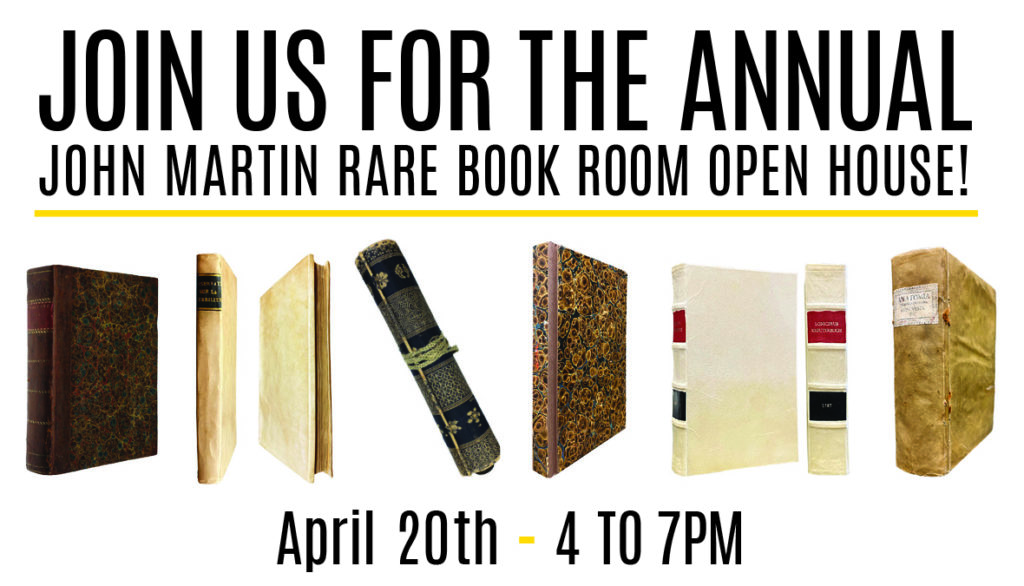
Visit the John Martin Rare Book Room at Hardin Library for the annual open house,
Wednesday, April 20, from 4pm-7pm.
All are welcome/family friendly! Masks encouraged. This is an in-person event.
The following books will be on display:
BLEULAND, JAN (1756-1838). Otium academicum. Trajecti ad Rhenum: Ex Officina Joh. Altheer, academiae typographi, 1828.
SABUCO de NANTES y BARRERA, OLIVA (1562-1646) Nueva filosofia de la naturaleza del hombre, no conocida, ni alcanzada de los grandes filosofos antiguos, la qual mejora la vida y salud humana, con las adicciones de la segunda impression. Madrid: Printed by Domingo Fernandez for Francisco Lopez Fernandez, 1728.
de PORRAS, MANUEL. Anatomia Galenico-moderna / Compuesta Por El Doctor Don Manuel De Porras, Cirujano De Su Magestad, Y De Los Reales Hospitales De La Corte, Y Examinador Del Real Protomedicato. En Madrid : En la Imprenta de Musica, por Bernardo Peralta, 1716.
SCHWANN, THEODOR (1810-1882). Mikroskopische Untersuchungen über die Uebereinstimmung in der Struktur und dem Wachsthum der Thiere und Pflanzen. [Microscopical researches into the accordance in the structure and growth of animals and plants]. Berlin : Verlag der Sander’schen Buchhandlung G.E. Reimer, 1839.
Medicinal Plants Scroll from Japan’s Mid-Edo Period. Japan, 1727.
PARACELSUS (ca. 1493-1541). Des hochgelerten vn[d] hocherfarnen Herren Theophrasti Paracelsi von Hohenheim, beider Artzney Doctoris, etliche Tractaten vor in Truck nie ausskommen. [From the highly educated and high ranking Theophrastus Paracelsus of Hohenheim, doctor of both medicines, a number of never before seen tracts] Printed by Arnold Birckmann’s print shop (the “Heirs of Arnold Birckmann”) in Cologne in 1564.
Aristotle (pseudo). Aristotle’s Compleat Master-piece : In Three Parts : Displaying the Secrets of Nature in the Generation of Man … To Which Is Added, A Treasure of Health ; Or, The Family Physician : Being Choice and Approved Remedies for All the Several Distempers Incident to Humane Bodies. The Fifteenth ed. London: Printed and Sold by the Booksellers, 1723. **note**this book is currently being conserved and may not be available for the open house but is in our permanent collection
NIGHTINGALE, FLORENCE (1820-1910). Notes on nursing: what it is, and what it is not. Printed by Harrison, 1860.
NICANDER, OF COLOPHON (flourished 138-130 BCE) Theriaka; Tou autou Alexipharmaka [Greek title transliterated]. Theriaca; Eiusdem Alexipharmaca. Printed by John Soteris in 1530.
TAGLIACOZZI, GASPARE(1545-1599). De curtorum chirurgia per insitionem. Apud Gasparem Bindonum iuniorem, 1597.
BOURGEOIS BOURSIER, LOUISE (1563-1636) Obseruations diuerses sur la sterilité, perte de fruict, fœcondité, accouchements, et maladies des femmes, et enfants nouueaux naiz / amplement traictees et heureusement praticquees par L. Bourgeois, dite Boursier, sage femme de la Roine; œuure vtil et necessaire a toutes personnes. [Diverse Observations on Sterility, Miscarriage, Fertility, Childbirth, and Diseases of Women and Newborn Children. Discussed in Detail and Successfully Practiced by L. Bourgeois, called Boursier, Midwife to the Queen. A Work Useful and Necessary for All]. Printed by Chez A. Saugrain. 1609.
LONICER, ADAM (1528-1586) Kreuterbuch, kunstliche Conterfeytunge der Bäume, Stauden, Hecken, Kreuter, Getreyde, Gewürtze. Bey Christian Egenolffs seligen Erben, 1587.
MOTONORI, TAKI (1732-1801) Kokei saikyuho [Emergency remedies for the benefit of the people], 1789.
WILLIAM COWPER (1666-1709) The anatomy of humane bodies : with figures drawn after the life by some of the best masters in Europe, and curiously engraven in one hundred and fourteen copper plates, illustrated with large explications, containing many new anatomical discoveries, and chirurgical observations : to which is added an introduction explaining the animal oeconomy, with a copious index. Oxford: Printed at the Theater, for Sam. Smith and Benj. Walford…, 1698.
SCHEDEL, HARTMANN (1440-1514). [Nuremberg Chronicle] Liber chronicarum. 1493.
GALVANI, LUIGI. De viribus electricitatis in motu musculari commentarius cum Joannis Aldini dissertatione et notis. Accesserunt epistolae ad animalis electricitatis theoriam pertinentes. Modena: apud Societatem Typographicam, 1792.
Individuals with disabilities are encouraged to attend all University of Iowa–sponsored events. If you are a person with a disability who requires a reasonable accommodation in order to participate in this program, please contact Damien Ihrig in advance at 319-335-9154 or damien-ihrig@uiowa.edu.
By Beth Stone, MFA Collections Conservator, University of Iowa Libraries
When volumes arrive in conservation, the first step is a quick assessment. Often this entails physical inspection of a cart of 30-80 items, ticking off from a checklist of the most common repairs or housings we provide. When an individual item is shuffled to a technician’s bench, a more thorough assessment can be completed. At first pass, I had put this item into a queue needing more intensive repair. The binding had become disengaged from the textblock, and though it looked otherwise sound, I set it aside to tackle at a future date.
It’s always delightful when an Italian paper binding comes into the lab for some treatment. They are a pleasure to hold and often have some quirks. Paper bindings were common in Italy from the early sixteenth century through the early nineteenth century. This Morgagni is an example of one of the two main types: a laced-case binding. For non-binders, this means the textblock was sewn onto alum taw (a white leather) supports, which were then laced through the single-piece heavy paper cover.
Paper bindings served two purposes; they were either placed on a textblock for temporary protection, assuming that the owner would eventually pay to have a more distinguished binding, or intended to be a less expensive final binding. It can be difficult to tell what the intention was. In this particular volume, the pages were never trimmed, and the rippling edges are the result of the deckle (wooden frame) of the paper mould (screen). These edges would have been trimmed to be flush and perhaps decorated in a different binding.
Additionally, the single-layer paper cover has no reinforcement. It remains very flexible on a book of this size while very thin and still protective. However, I think this may have originally been intended as a temporary measure rather than a final binding. The large size of the volume (10.25 in x 16.14 in) would likely require more substantial binding for handling, which would have cost a hefty sum. Additionally, the printing style seems to demand a more decorative binding.
Upon closer inspection, I noticed that the taw thongs were cleanly cut at the textblock. The thongs also remained intact on the rear cover and under the paste down. Though removing a portion of the textblock resulted in a spine that was now too wide for the text that remained, no damage was present on the paper cover. Since it was paper, the cover had been able to naturally refold itself and conform to the smaller size of the spine.
There were a handful of documents stuck in the text. Among them was a note from the purchase by Dr. Martin. It indicated that the item had been received by him, and then later by the library, in this condition.
Ultimately, this item will get custom housing [storage box] and return to the collection without any intensive treatment. I will clean the cover – using specialized sponges and perhaps a gel for the stained corner – but the sewing will remain broken, and the textblock will remain disengaged.
Your role at Hardin: I am a Library Assistant IV working in Collections, Access Services, and just recently, returned to help in Interlibrary Loan.
Years you’ve worked in a library and years you’ve worked at Hardin: My library career started in high school in the late ’70s as a volunteer at my hometown library in Allison, Iowa, under the direction of librarian Mabel Bauman. I started working at UI Libraries in 1983 and have worked at Hardin on and off as a student and staff since 1983. I’ve also worked at the UI Law Library, VA Library, Math Library, and the Iowa City Public Library (24 years).
One thing you enjoy about working at Hardin: I’ve worn many hats during my library career. Anything from dealing with the bomb-sniffing dog in 2007 during an active bomb threat at Hardin, working at the storage facility (lovingly referred to as the “barn”), to working on the lighting/HVAC project at Hardin. The best experience during my library career has been working with the many students and other individuals that have crossed my path and continue to keep in touch with me decades later.
A fun fact about yourself: I have no peripheral vision, so if you don’t like the answer I give and you roll your eyes at me as you stand next to me, I most likely won’t see it. My door is always open at Hardin, so stop in and say hello.
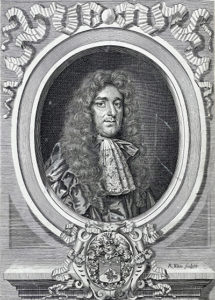
John Browne(1642-1700) was a 17th-century English surgeon and anatomist. He was royal surgeon to Charles II, James II, and William III. Under Charles II, Browne first came to observe the “King’s Evil,” or scrofula (cervical lymphadenitis), a disease related to tuberculosis that inflames and swells lymph nodes in the neck. Some thought that the touch of royalty could heal the disease, and Charles II performed many of these ceremonies. Browne vividly described the disease and ceremonies in his Adenochoiradelogia, printed in 1684.
With a recommendation from the King, Browne was appointed a surgeon at St. Thomas’s Hospital in 1683, where he trained. The Governors who oversaw the hospital, led by the Whig politician Sir Robert Clayton, disliked the freewheeling behavior of its surgical staff. The surgeons at St. Thomas felt unburdened by hospital policy because of their support by the King. However, Clayton and the Governors saw it differently and in 1691 dismissed the entire surgical staff, including Browne.
In response, in 1697, Browne put together this book, a work that exemplified his approach to writing and selling books: he made a few tweaks to A compleat treatise… and released it under a new title.
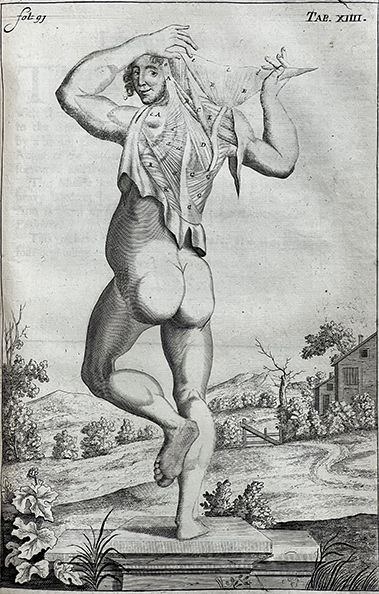
Browne tweaked a few things in Mygraphia nova in an attempt to distance himself from accusations of plagiarizing the works of Giulio Casseri and William Molins, most notably in the illustrations. Many of Casseri’s illustrations are somewhat whimsical, with lounging poses or those with movement, with the subject of the dissection often helpfully holding back layers of skin or muscle on their own bodies.
The illustrations shown here demonstrate such a pose and the kinds of small changes Browne made from A compleat treatise… to Mygraphia nova. Browne’s defenders wished to credit him with the innovation of directly labeling tissues, rather than with a letter or number referenced in the text. This too, however, was a technique lifted from others, including Casseri and Molins.
Interestingly, he added a very short section on the heart as a muscle in the 1697 edition but directed the reader to an appendix that contained the well-known work of Richard Lower. He gave Lower full credit in the title, perhaps artfully exploiting Lower’s name recognition. Browne’s works were relatively popular and printed in several editions, including after his death.
Cover
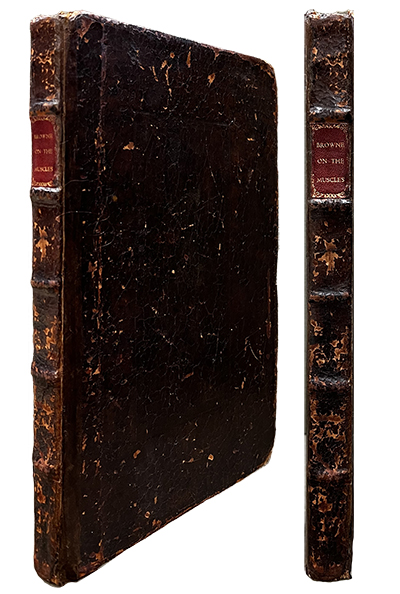
The binding consists of contemporary leather with a deep brown color and a blind tooled (no color or gilt added) design on the front and back boards. It has raised spine bands with “Browne on the muscles” stamped in gilt over a red compartment on spine. The leather is quite cracked and the front and back hinges are loose, but it has been treated by our master conservation team and is stable for use.
Other than some browning at the front and back, more than likely due to exposure to the elements and the glue on the boards, the paper is in great condition. There are a few editorial marginalia as well.
Contact curator Damien Ihrig or any others from this or other treasures: damien-ihrig@uiowa.edu or 319-335-9154 to arrange a visit in person or over Zoom.
Our copy of Mygraphia nova was generously donated by Helen Hislop, an influential physical therapist who trained and practiced at the University of Iowa.
Professional development (usually a virtual webinar)
Working with a researcher interested in JMRBR materials
Consulting with a clinical researcher about their project
Working on a systematic or other review
A reference desk shift
Damien Ihrig
Interested in visiting the John Martin Rare Book room for research or fun? In-person or Zoom appointments are available. Want to host a class here? Need help with your historical medical research? Contact Damien by email or phone (319-335-9154).
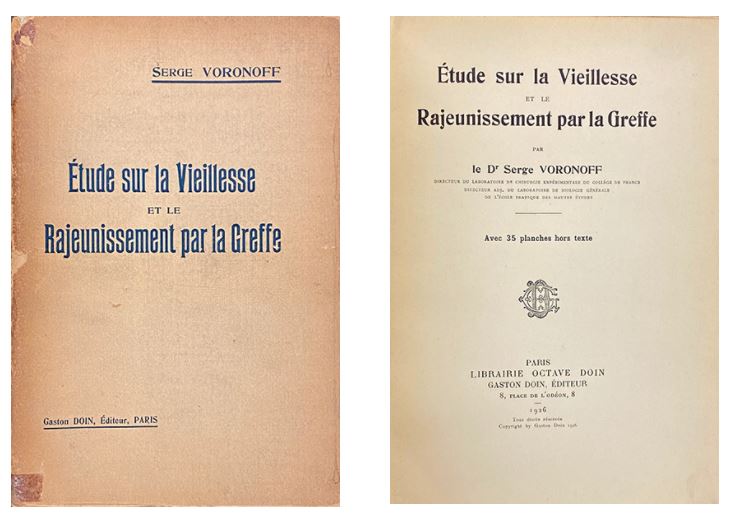
VORONOFF, SERGE (1866-1951). Étude sur la vieillesse et la rajeunissement par la greffe. [Research on aging and rejuvenation by transplantation] Printed in Paris by Octave and Gaston Doin in 1926. 23 cm tall. Signed copy.
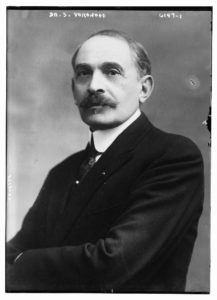
Voronoff was born in Russia and studied medicine in France. He studied with the transplant pioneer, Alexis Carell, eventually becoming a French citizen and setting up his own research and surgical practice. While practicing in Cairo for a time, he reflected on the accelerated aging experienced by eunuchs.
Believing aging and a whole host of associated health conditions could be reversed with testicular transplantation, he set about studying the effects in farm animals. Not unexpectedly, few young men were willing to donate one of their testicles for human transplantation. He began by using the testicles of executed prisoners (he was neither the first nor the last to misuse prisoners in this way), but the demand for his services was too high. He eventually settled on monkeys and apes as the best animal substitute, setting up a “monkey farm” to ensure a steady supply.
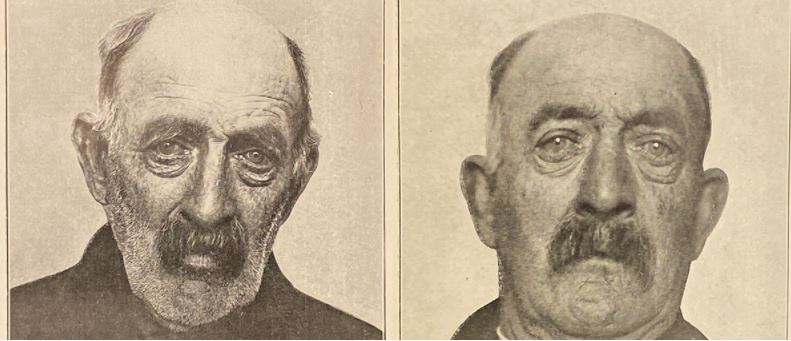
To demonstrate the validity of his procedure, Voronoff often published patient testimonials with “before and after” photographs of his patients, a technique used throughout the 20th Century and now by those peddling “too good to be true” cures. His technique inspired many other surgeons and veterinarians around the world. Thousands of animal-to-human and animal-to-animal sexual organ transplants were performed.
Before and after patient photographs by Voronoff
Voronoff was convinced he would eventually be able to create long-lived superhumans and animals. He performed at least one human ovary transplantation into a monkey, including an attempt to impregnate the monkey with human sperm. Most of Voronoff’s patients were wealthy men seeking increased sexual vigor. An increasing lack of evidence and Voronoff’s critics, both in science and the media, finally overwhelmed the work, the discovery of hormones associated with sexual organs in the 1930’s rendered transplantation completely unnecessary.
This book is Voronoff’s major work and has his signature on the flyleaf. It is in good condition, with the cover mostly detached but the text block is intact and in excellent condition. The simple paper covers have darkened somewhat over time due to handling and higher acid levels present in most papers of the time. Contact Curator Damien-Ihrig (phone 319-335-9154) to view this book or any others from this fascinating (and disturbing!) period of medical experimentation and discovery. In person and Zoom appointments available.
by Damien Ihrig, MA, MALIS, Curator, John Martin Rare Book Room
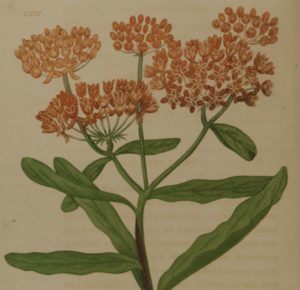
Image of butterfly milkweed (asclepias tuberosa) from the book American Medical Botany, from the John Martin Rare Book Room collection
The University of Iowa University of Iowa College of Pharmacy building has a garden that contains plants that were used for healing. The Roots of Medicine garden was a collaboration of Hardin Library staff, the John Martin Rare Book Room, the College of Pharmacy, a horticulture expert from Iowa State University, and local gardeners. The garden contains signs that identify the plants and QR codes to pull up more information.
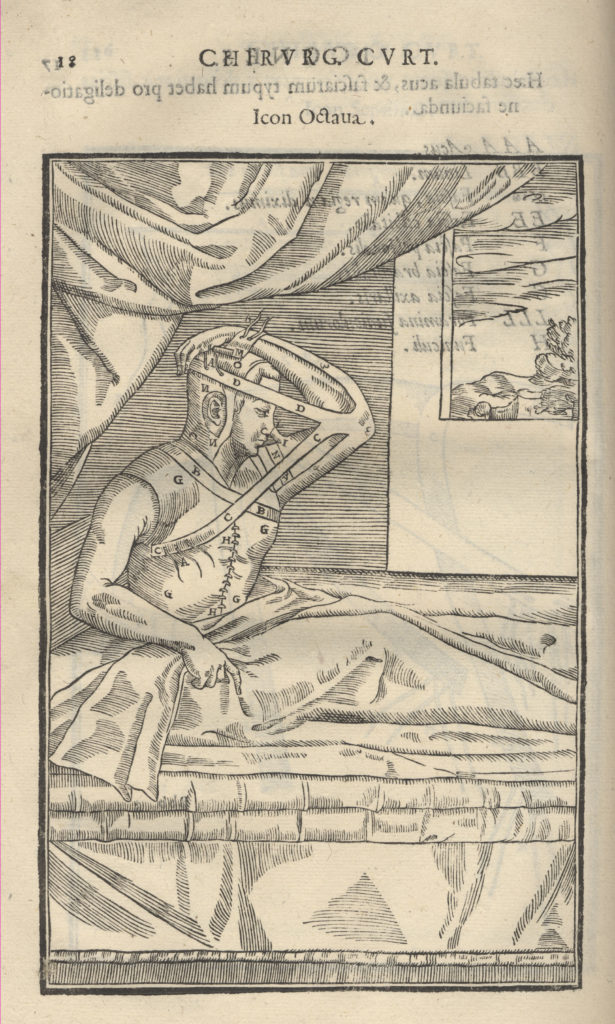
Tagliacozzi studied under Girolamo Cardano at the University of Bologna. After graduating, he became a professor of surgery and anatomy at Bologna. This work, “Concerning the surgery of the mutilated by grafting,” is a classic in the history of plastic surgery and is especially noteworthy for its description of rhinoplasty.
Some form of rhinoplasty had been practiced in ancient India and, in the thirteenth century, by a family of itinerant Sicilian surgeons (the Brancas) who kept the operation a family secret. This became known as the “Italian Method.” This method was included in works by Vesalius, but he described it incorrectly. Tagliacozzi learned of it, modified it, and published De curtorum chirurgia per insitionem, describing his successes and failures of his own method in detail.
The volume is divided into two parts: the first, “Theory of the art of plastic surgery,” is about the structure, function, and physiology of the nose; and the second part, “Practice of the art,” describes and illustrates the instruments and operative procedures for restoration of the nose, lip, and ear. Tagliacozzi also fully discussed the complications, such as hemorrhage and gangrene, that often occurred during these operations.
It has 22 full-page woodcut illustrations showing Tagliacozzi’s method and surgical instruments. They are well-executed and illustrate many of the techniques described in the text. The immediate popularity of the work caused it to be pirated by another Venetian printer, Roberto Meietti, who issued it under the same date. This only touches on the interesting life and work of Tagliacozzi. Read more about him here.
The book is in great condition. One leaf is stained and a few others have browned a bit over time, but it is otherwise in excellent shape. The binding consists of a modern vellum pasted over paper boards. And the full-page illustrations are crisp and jump off the page with their detail and fun flourishes. This book was purchased by Dr. John Martin in 1977 and donated to the collection.
If you are interested in seeing this or other items in the collection, please contact Damien Ihrig at damien-ihrig@uiowa.edu or 319-335-9154 to arrange a visit in person or over Zoom.

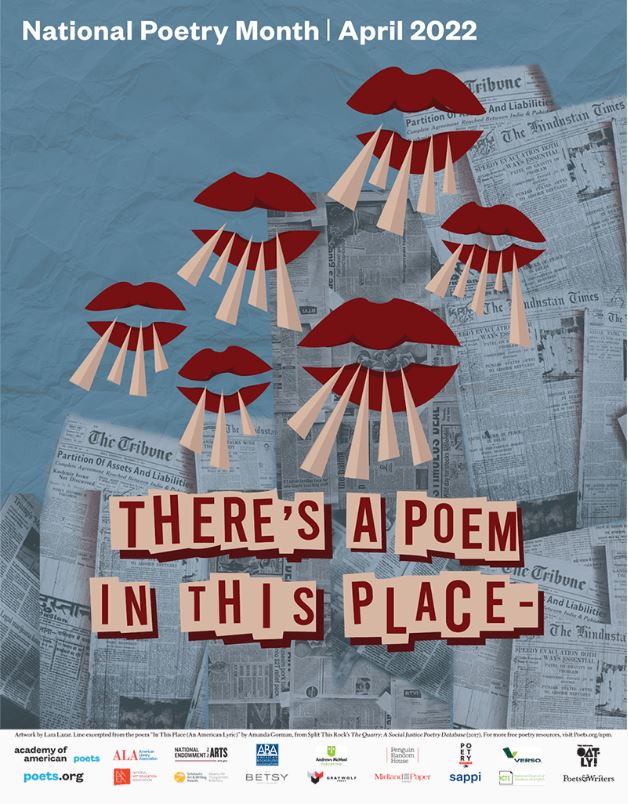
 Selections by Josh Hart



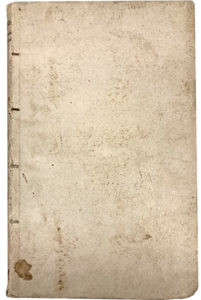 It’s always delightful when an Italian paper binding comes into the lab for some treatment. They are a pleasure to hold and often have some quirks. Paper bindings were common in Italy from the early sixteenth century through the early nineteenth century. This Morgagni is an example of one of the two main types: a laced-case binding. For non-binders, this means the textblock was sewn onto alum taw (a white leather) supports, which were then laced through the single-piece heavy paper cover.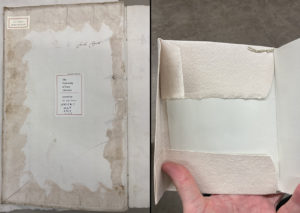
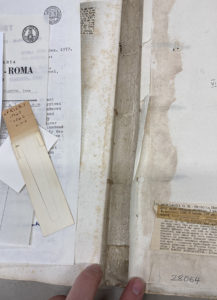 There were a handful of documents stuck in the text. Among them was a note from the purchase by Dr. Martin. It indicated that the item had been received by him, and then later by the library, in this condition.




 Tagliacozzi studied under