Skip to content
Skip to main content

I hope Howard will become more manageable

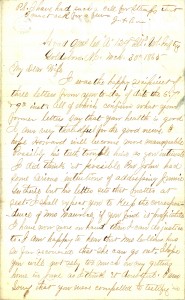
Joseph Culver Letter, March 30, 1865, Page 1

Head Qurs. Co. “A”, 129th Ills. Vol. Inftry.
Goldsboro, N.C., Mch. 30th 1865
My Dear Wife

I was the happy recipient of three letters from you to-day, of date of 6th, 7th & 9th inst., all of which confirm what your former letters say that your health is good. I am very thankful for the good news. I hope Howard will become more manageable, possibly his teeth trouble him as you intimate.

I did think it possible Bro. John [Murphy] had some serious intentions of addressing Jennie Gutherie, but his letter sets that matter at rest.1 I shall expect you to keep the correspondence of Mrs. Maurice if you find it profitable. I have now more on hand than I can do justice to. I am happy to hear that Mrs. Collins has so far recovered that she can go out. I hope you will not rely too much on my getting home in June, as I think it doubtful.

I am sorry that you were compelled to testify in that horse suit. I would much rather pay for her myself. As it is probable Bro. Utley lost the suit, do you try & find out quietly what he values the mare at, and I will pay for her as soon as I can.2 I am surprised at Mathis’ conduct and will write to W. B. Lyon about it. Do not settle it again. I have an acct. at Lyon’s of things I brought for the boys & forgot to set down the amount.3 If you have an opportunity, I wish you would please get it for me, & I will send the amt. when we are paid. We expect pay in a few days.

Send for the bolt of muslin if you have sufficient funds to spare. I wrote in one of my letters a request for you to keep an account of the time you stay at Utleys with the time I spent there. Possibly that letter may not have reached you.4

The band of the 2d Brigade has been playing for an hour some very sweet airs. They were playing “Home Sweet Home” when I sat down to write; they have just ceased. We have a great deal of good music as there are six bands within a few hundred yards of us. We are quite well fortified here, but I have not heard of any enemy in our immediate front for several days.5 There was a rumor in camp to-day that Grant has taken Richmond at a loss of 25,000 men, but it lacks confirmation.6 The Rail Road is opened up with Wilmington, & trains arrive and depart regularly to & from both Wilmington & Morehead City.7

We recd letters to-day from Pontiac as late as the 20th March which is only 10 days. The men begin to count the days now for the 8th Sept. to come round.8 They talk a great deal about home & the prospects there.

Christ. [Yetter] went on duty (picket) in my place this morning to give me an opportunity to complete the muster rolls. It rained so much this forenoon, however, that I did not get through. Nate [Hill] is out visiting & has not come in yet.

You asked me in one of your letters what I used to cure the Inflamatory Rheumatism. I used nothing but cold water in the shape of baths three or four times a day at first — decreasing in number gradually. It is a never failing cure. I had the water poured from a water pot in a stream of 1/2 inch in size upon the affected parts, gradually increasing the height to 10 or 15 feet. It will certainly scatter the swelling & drive away the pain. I hope Bro. Harrington will try it & keep it up all summer.9 Harry McDowell spent an hour here early in the evening. He is very anxious for the expiration of his term of service so that he may enjoy the pleasures of home with a wife; he is devoted as ever. Jim Morrow & I had quite a chat last night; he had a great many questions to ask about his lady friends in Pontiac. Nate is just coming home, he has spent the evening with Charlie Peck.10 Charlie is acting Commissary of the Regt. John Wilson has not yet returned.11 Weiser (the bugler) has just heard of the death of his wife.12 She has been sick for several months; but, as he had no opportunity to hear from her, he did not learn that she was sick until the mail reached him here. She leaves 3 small children.

Saml. McGooden is not with the Army. He went home from Atlanta to have an operation performed on his eyes, & they have not heard from him since. I saw [William] McCartney yesterday, he is well & has stood the march very well.

There is a band about a quarter of a mile off, & the music comes this way carried by the breeze. It sounds so very sweet that it reminds me of those times at home when we could hear the band in the court yard. “When shall we meet again?” I like the song very much but hardly think it conducive to happiness to dwell on it too often. God, who has thus far shown us only love and mercy, will perform all his promises in His own good time. I stood out in front of my tent awhile to-night watching the stars & listening to the music & found myself at home directly. So for fear of the blues, I hastened into my tent & commenced writing.

There is quite a circle of the boys around the fire talking of their marches through Georgia & South Carolina. I can only be a listener & have but a faint idea of all their exploits as they take occasion to tell me many times each day.

I had a long letter from Saul yesterday.13 He says if this campaign does not end the war, he is coming into the service and California will put forth her strength.

The “Sentinel” has not reached the Company since I left. I spoke to Decker about it when I was home, & he promised to see to it.14 If you have an opportunity, please remind him of it. Send me the No. containing my Charleston letter. I have not had time to write to him or the paper since my arrival here. It is 20 minutes of ten, & I must close if I would write any other letters to-night. I hope Our Father will still preserve you in good health & make you happy. Remember me kindly to all. Kiss Howard for me. Tell our Friends to write. Accept much love, Good Night.

Your affect. Husband
J. F. Culver

P.S. I have had such a call for stamps that I must ask for a few.
J.F.C.

  1. On February 28 John Murphy, who was stationed in Nashville, had written his sister, “Of course I’ll take your advice kindly, and not only that but I prize it very highly. But I have no notion of making overtures for the hand of Jennie Gutherie, and I think she does not understand it otherwise. I do not think I have been the cause even indirectly of a rupture between her and Kelly. Mollie, don’t you know that I can never marry a woman that can’t sing?” John Murphy to Mary Culver, February 28, 1865, Culver Collection.
  2. A suit had been brought against Leander Utley by certain parties for a mare in which J.F.C. had an interest.
  3. W. B. Lyon owned and operated Wm. H. Lyon & Son, a prosperous Pontiac dry goods store. History of Livingston County, Illinois, p. 640.
  4. The letter referred to is missing from the Culver Collection. Apparently, Mary Culver and Howard were staying with the Utleys, as had J.F.C. during his Pontiac leave.
  5. Upon going into camp, soldiers of the 129th Illinois, like those of other XX Corps units, began erecting cabins. On the 28th orders were issued by General Williams for his division commanders to “pay particular attention to the establishment of their picket-lines, having them so placed and with such connections right and left as will enable them to entirely prevent any person from passing them.” O. R., Ser. I, Vol. XLVII, pt. III, p. 47; Grunert, History of the 129th Illinois, pp. 224-25.
  6. There was no truth to this rumor. But on March 29 General Grant sent two corps and Maj. Gen. Philip H. Sheridan’s cavalry sweeping westward across Hatcher Run in an effort to reach the Southside Railroad and force General Lee’s Army of Northern Virginia to evacuate Petersburg.
  7. J.F.C. was mistaken about the resumption of through rail traffic between Goldsboro and Wilmington. It was April 4 before the bridge across the Northeast Branch of the Cape Fear was rebuilt, and the 5th before through trains again made the run between these two cities. O. R., Ser. I, Vol. XLVII, pt. III, pp. 65, 91, 96.
  8. As a three-year-regiment, soldiers of the 129th, unless they chose to reenlist as veteran volunteers, would be mustered out on September 8, 1865.
  9. Robert Harrington, running on the Union ticket, had been elected county clerk of Livingston County in the autumn of 1861, and was reelected four years later. After leaving office in 1869, he moved to Mississippi and from there to Beatrice, Nebraska. History of Livingston County, Illinois, p. 266.
  10. It has been impossible to further identify Charles Peck, unless he was Darius R. Peck, a 32-year-old engineer, who had been mustered into service on September 8, 1862, as a private in Company A, 129th Illinois. Compiled Service Records of Union Soldiers, NA.
  11. John T. Wilson, a 24-year-old farmer, was mustered into service on Sept. 8, 1862, as a private in Company H, 129th Illinois Infantry. He was detailed as quartermaster clerk on Oct. 1, 1862, and on Nov. 1, 1863, he was promoted to commissary sergeant. Wounded on Aug. 19, 1864, before Atlanta, Sergeant Wilson was hospitalized and did not rejoin the regiment, being discharged at Camp Butler, Ill., Jan. 24, 1864. Ibid.
  12. Joseph C. Weiser, a 31-year-old jeweller, was mustered into service on Sept. 8, 1862, as a private in Company H, 129th Illinois Infantry, and was mustered out near Washington, D.C., on June 8, 1865. Ibid.
  13. S. S. Saul moved to Pontiac from Pennsylvania in 1854 and taught school for several years. In 1857 he was elected county clerk, a position he held until 1861. Saul had been instrumental in prevailing on J.F.C. to settle in Livingston County. They had been partners before J.F.C. was mustered into service in September 1862. History of Livingston County, Illnois, p. 324.
  14. Henry S. Decker and James Stout were owners of the Sentinel, having acquired it from M. E. Collins in 1863. Decker, the editor, had moved to Livingston County from Chicago, while Stout was an “abolitionist of the most ultra character, at a time when it was anything but popular to promulgate the doctrine.” Ibid., p. 318.
Get the Lead Out

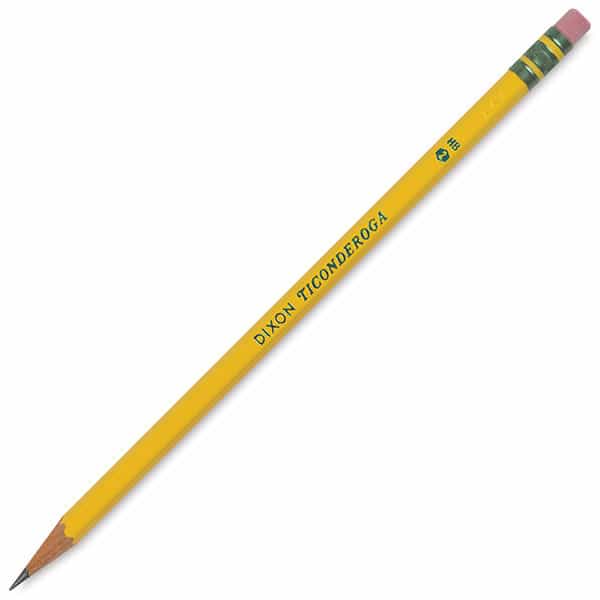
Ticonderoga pencilEeyore was saying to himself, “This writing business. Pencils and what-not. Over-rated, if you ask me. Silly stuff. Nothing in it.” — Winnie the Pooh.

A long time ago, in a far away place, before apps and texts and even typewriters, pencils were used to convey the written word. As you purchase a new box of Ticonderogas to mark your bubble answer sheet, consider the invention of the pencil.

History

Pencils are made with graphite. Therefore, graphite mining had to exist before the pencil was created. The first graphite was mined at Seathwaite Fell in Cumbria, England in 1564. Since graphite has similar properties to lead, it was first called, “plumbago,” derived from the Latin word for lead ore. The first pencils were produced by sawing the graphite into sheets, shaping the graphite sheets into square rods, and inserting the graphite rods into a wood casement. However, the first pencils were fragile because the graphite broke easily.

Patent

H.L. Linman Pencil & Eraser PatentTo prevent the graphite from breaking, French chemist, Nicolas-Jacques Conté, discovered the process of mixing the graphite with clay. The soft material was pressed into sticks and kiln-fired. At which point, the dry graphite & clay rod was inserted into a wooden case. By varying the ratio of graphite to clay, Conté discovered that he could manufacture a pencil for a specific hardness to differentiate the marks on paper. For example, No.2 pencils are popular because of its midrange hardness which leaves dark marks without smudging. No.1 is the softest graphite and leaves a darker, smudgier mark , and No.3 pencils leave a fainter mark. Conté’s 1795 patent is the basic process for manufacturing pencils today.

To learn more about the manufacturing of pencils, watch this video by the Science Channel, How Its Made : Pencils.

Trivia

Try answering these questions:

A. What chemical is graphite composed of?

B. What television personality regularly played with specially made pencils with erasers at both ends?

C. Which inventor had his pencils specially designed to be three inches long with abnormally soft graphite?

D. Who received the first patent for attaching an eraser to the end of a pencil?

E. The majority of pencils manufactured in the United States are what color?

F. How long is the Guinness Book of Work Records largest pencil?

References & Resources

New Carbons book

Inagaki, Michio. New Carbons: Control of Structure and Functions. New York : Elsevier Science, 2000. Engineering Library TA455.C3 I53 2000

Graphite Graphene and Their Polymer Nanocomposites book cover

Mukhopadhyay, Prithu and Gupta, Rakesh K., editors. Graphite, graphene, and their polymer nanocomposites. Boca Raton, FL : CRC Press, 2013. Engineering Library TA455 .G7 G73 2013

National Day Calendar: National Pencil Day, March 30. 2015.

Wikipedia: Pencil. March 26, 2015.

Cumberland Pencil Museum.2011. Southey Works. Date accessed March 2015

Trivia Answers:

A. It is made almost entirely of carbon atoms.
B. Johnny Carson
C. Thomas Edison
D. Hymen Lipman, U.S. Patent 19,783, March 30, 1858
E. Yellow
F. 65 feet tall

Your letters may have been delayed

Joseph Culver Letter, March 29, 1865, Page 1

Head Qurs. Co. “A” 129th Ills. Vols.
Goldsboro, N.C., March 29th 1865
My Dear Wife

By to-day-s mail I recd. letters from Bro. Sammy [Murphy], Chattanooga, Tenn. of Mch. 2, & from Springfield, Ills. of the 2nd also, but none from you. Yesterday I recd. yours of the 29th Feb., being the latest. We have news from Pontiac of the 8th & 10th inst. I hope, however, you are not ill. Your letters may have been delayed.

It is quite cloudy & threatens rain. Yetter went on a visit this morning to the 17th Corps & has not yet returned. John Lee just came into my tent; he is quite well. His last letter is dated the 1st March & came by Major Hoskins.

I read a number of your letters over just before dinner. I find some of them as old as October & one from Maggie [Utley] of Oct. 14/64.1 I thought of all the changes that have taken place since they were written; and, though the ways of Providence are past finding out, yet God has been very good to us. I think of Dear Mother very often.2 I felt very happy last night after I lay down, & I thought she was near me though I could not see her.

We have not yet heard when the Army is expected to be put in motion. Genl. Sherman has gone to Washington & will doubtless return with his plans for the coming Campaign completed.3 Unless the Rebel Army should retreat from our front, we anticipate a campaign similar to last summer, only doubly severe. I think it probable they will contest every inch of the ground stubbornly.

I recd. a letter from Saul to-day of Jan. 31st. He says if the war does not terminate with this Campaign, he will be in the Army. A few weeks may make a vast change in the aspect of affairs in this Country.

Jim Morrow was up at my tent last evening, he is in good health. Harry McDowell was here until a late hour last night, he is very well.

I heard yesterday of Thad. Keyser’s marriage. Rumor says Abbie Remick has returned, & she & Milt [Lyon] are to be married very shortly.4 Is it true? Has Ed. Cook returned yet?

Remember me to all our friends. Kiss Howard for me. Love to Maggie & children. Hoping Our Father will bless you, I remain, with love,

Your affect. Husband
J. F. Culver

  1. The October letters were written before J.F.C. received the orders detaching him from the regiment and sending him to Chicago as a witness in the Beatty trial.
  2. Mrs. Nancy Murphy, J.F.C.’s mother-in-law, had died under the wheels of a railroad train on November 10, 1864. Mary Culver, from that day forward, was unable to mention her mother’s name. Culver, “Robert Murphy and Some of His Descendants,” p. 40.
  3. General Sherman on March 26, leaving General Schofield in command of the armies, boarded a train at Goldsboro for the trip to New Bern. There he embarked on the steamer Russia and landed at Old Point Comfort, Virginia, from where, on the afternoon of the 27th, he telegraphed General Grant and Secretary of War Stanton. Next day found General Sherman at Grant’s City Point headquarters. There they discussed with President Lincoln plans for defeating the armies of Generals Lee and Johnston and ending the war. When he returned to New Bern by boat on the 30th, Sherman was accompanied by his brother John, United States senator from Ohio. O. R., Ser. I, Vol. XLVI1, pt. III, pp. 32-3, 42-3, 59-60.
  4. Abbie J. Remick on October 25, 1865, married D. Milton Lyon, son of William M. Lyon.

I must spare a few minutes from my papers to write to you

Joseph Culver Letter, March 28, 1865, Page 1

Head Quarters Co. “A” 129th Ills.
Goldsboro, N.C., March 28th 1865
My Dear Wife

The mail leaves at 4 P.M., & I must spare a few minutes from my papers to write to you. I recd. 4 letters from you yesterday, one from Hannah [Culver] and one from Cousin Electa Wallace, Mansfield, Ohio, with Photograph enclosed.1 I dare not take the time to answer your letters in full; they were very interesting, indeed. The latest bears date Febr. 29th. I hope you are enjoying yourself. I should have enjoyed the Communion Season very much. I earnestly hope all the converts may prove faithful.

You were not more surprised at Nannie Barrett’s joining our Church than I was when she told me her intention. She spoke to me just before I left the church the last evening; I advised her to study the discipline & then do as she thought best. I hope Charlie Murphy may not suffer from the dog’s having bitten him, yet I have very little faith in a mad stone.2

I am sorry to say that I kept no diary, but I will try & write up one the first leisure time I have. I cannot imagine wherein your “married life has been a failure” except in the realization of that enjoyment you anticipated.3 The pleasures of a home & its comforts we have known but a few weeks during our married life. It is hardly fair to conclude that all is a failure. I trust God will spare us for the enjoyment of many years of peace and prosperity when we may forget past sorrows in present enjoyments. Your married life has been experienced by very few in this country, so much of sorrow and so little of comfort.

I am glad to hear that the church has secured a new cabinet organ. I agreed to give $10 if necessary.

The boys are all well as usual. We are drawing new clothing, & the men will soon be comfortably clad. Quite a number have been barefoot, some for a couple of weeks, & must have suffered greatly.4 The wounded are getting along finely. We have learned nothing of Henry Polk yet; I will write to his father to-day.

Mother’s health is much improved. Hannah says she wrote to you. Green is flourishing & would like to see you & the baby.

I cannot tell what our prospects may be for getting home in June; it is doubtful. Tell J. W. Smith that I could not get to Savannah, Ga.; therefore I did not attend to his business. There are a great many things that I wish to write about & will in a few days if we are not hurried off. I hope Howard is entirely well. Kiss him for me. Remember me kindly to all our friends. Accept much love & may God bless & keep you.

Your affect. Husband
J. F. Culver

  1. Electa Wallace of Mansfield, Ohio, was a relative of the Dunmires’.
  2. Charlie Murphy was the 8-year-old son of William and Adaline Murphy, whose farm adjoined Mrs. Culver’s father’s property in Pontiac Township. Eighth Census, Livingston County, State of Illinois, NA.
  3. Mary Culver in one of her letters had complained that her “married life has been a failure,” which elicited these reassurances from her devoted husband.
  4. The regimental historian wrote, “New clothes arrived this evening and were distributed, and it seems as though General Sherman did not intend to remain long, as the rumor of an advance was current.” Grunert, History of the 129th Illinois, p. 224. General Sherman on April 1 reported that the “suffering of the troops for want of shoes” could not be blamed on a want of foresight on the part of his chief quartermaster, but could be attributed to “mud banks, storms at sea, difficulties of navigation, &c.” O. R., Ser. I, Vol.XLVII, pt. III, p. 29.

March Winds

A field of wind turbines located west of Williams, Iowa Source: Wikimedia Commons

A field of wind turbines located west of Williams, Iowa Source: Wikimedia Commons

It is the proverbially windy month of March, when the weather is widely variable, blowing in warmer temperatures and creating spring storms.

If you want to see how windy Iowa (or the entire country) is, check out the Wind Map.

How can Mother Natures’s ferocious power be harnessed and tamed?

Driving along Interstate 80, acres of wind turbines rise majestically over the corn fields and blink in the midnight sky making the wind industry a vital economic resource. The state of Iowa has more than 80 wind installations with over 2,500 turbines capable of producing 3,670 megawatts of power. The turbines generated nearly 27% of Iowa’s total electricity in 2013,2 and more than 50 companies are responsible for employing 3,626 people3 whose jobs are to manufacture, transport, or assemble the giant blades and towers, rotors and generators. Even farmers are compensated for leasing their land, furthering the benefits to the Iowa economy.

With towers standing over 200 feet tall and spinning two or three 116-feet propeller-like blades, how do these behemoth, industrial-sized wind turbines generate electricity? Simply stated, the energy in the wind turns the blades around a rotor. The rotor is connected to a shaft which spins a generator to create electricity. However, to learn more, see how a wind turbine works.4 Be sure to hover over the different parts for more information.

As you are out in the last few days of the blustery month of March, consider all the power and energy those winds produce.

Xu, Xuegen, Yu, Kai, and He, Guorong. Downwind Variable Pitch Wind Turbine Generator. U.S. Patent 20130011262. Filed May 22, 2011. Assigned January 10, 2013. Source: http://www.google.com/patents/US20130011262

Xu, Xuegen, Yu, Kai, and He, Guorong. Downwind Variable Pitch Wind Turbine Generator. U.S. Patent 20130011262. Filed May 22, 2011. Assigned January 10, 2013. Source: http://www.google.com/patents/US20130011262

References & Resources

1 Craig, Ashely, et al. The Wind Energy Supply Chain in Iowa. Chicago, IL: The Environmental Law & Policy Center, November 2010

2 U.S. Energy Information Administration. Iowa. Quick Facts

3 “Iowa projected to add 1,330 energy jobs in 2015.” The Des Moines Register, December 15, 2014

4 How Does a Wind Turbine Work? Source: U.S. Department of Energy. Office of Energy Efficiency & Renewable Energy

5 Iowa Wind Energy Association

6 American Wind Energy Association (AWEA) TC 88 Wind turbine systems

Books & Standards

Newton, David E. Wind energy: a reference handbook. Santa Barbara, CA: ABC-CLIO, 2015. Engineering Library On order

Edited by Panos M. Pardalos, et al. Handbook of wind power systems. Berlin: Spring, 2014. Engineering Library TJ820 .H36 2014

Harvest the Wind book cover

Engineering Library TK1541 .W36 2012

Warburg, Philip. Harvest the wind: America’s journey to jobs, energy independence, and climate stability. Boston: Beacon Press, 2012. Engineering Library TK1541 .W36 2012

Edited by Charalambos C. Baniotopoulos et al. Environmental wind engineering and design of wind energy structures. New York: Springer Verlag, 2011. Engineering Library QC931 .E58 2011

Burthchen, Marco, et al. Material Qualification of Main Bearings for Large Wind Energy Turbines. November 21, 2014. STP 1580, 2014. http://www.astm.org

Index of Wind turbine standards. Source: International Electrotechnical Commission (IEC)

I recd. 12 letters brought through from Atlanta and 10 more by to-days mail

Joseph Culver Letter, March 26, 1865, Page 1

Head Qurs. Co. “A”, 129th Ills.
Goldsboro, N.C., Mch. 26th 1865
Sunday Eve
My Dear Wife

I rode from Kinston to this place yesterday on horseback, 37 miles, & arrive[d] just before dark. I recd. 12 letters brought through from Atlanta & 10 more by to-days mail, the last from you bearing date Feb. 20th. I am very happy indeed to learn that you are well & Howard also.

I am at home again; I found all the boys present in good health & most of them glad to see me. I wrote to you just before I left Kinston of the result of the battle on the 19th inst.1 J. M. Pemberton killed. Mark Stevens2 & F. M. Van Doren slightly wounded. Henry Polk was captured on the 15th inst. while out foraging. The boys have fears that he was killed, but I hope he will turn up soon all right.3 Green [the freedman] was the happiest boy I seen. Christ [Yetter] has been getting along finely. Nate [Hill] is flourishing. All of them are fat & hearty. David Jones died on the march from Savannah up; Mark Stevens is in the Hospital but Van Doren is with the Company.

7-1/2 P.M.: I quit writing to go to Supper, & after Supper the Chaplain came after me to preach. I preached from Romans, 6 Chap, 23rd verse. It was so cold that there was not a great many out though all the fires in the neighborhood were surrounded.

I saw Bro. [James H.] Gaff & [John S.] Lee this evening, both are well. Allen Fellows was also here to-day & is well.

We have just recd. orders to prepare immediately for another campaign.4 50 men of our 1st Div. were captured to-day while out Foraging.5 The Band of the 3rd Brig. is playing a beautiful air. It is very cool to-night, & I should not be surprised if there is a frost.

I will not undertake to answer your letters to-night. I have read all of them once over but have been busy making estimates of clothing, camp, & Garrison equipage for the Company, & there are very many reports to make & things to look after at the close of so long a campaign, so you must excuse me if I am not so punctual for a few days. I thought of very many things I wished to write about this afternoon, but my tent is constantly full, & I am interrupted so often.

Mat Harber is here from the Hospital.6 He says Mark Stephens is getting along very well. Col. Case commands the Brigade. We ate part of the fruit cake for supper this evening, & I gave its history. Our Regt. lays about two miles North West of Goldsboro. I have not been to the Town yet.

I would have been pleased to have seen Howard playing in the water. Kiss him for me. I have letters from Carlisle of the 14th Feb. Mother was better at that time. I will close for this time. The mail leaves at 5 A.M. to-morrow.

Remember me in love to all our friends. Let us thank God for his mercies & take courage. Do not give way to despondency; God will care for us. I hope you will be happy. Accept the love of your

affect. Husband
J. F. Culver

  1. The battle to which Captain Culver referred is Averysboro, fought on March 16, not Bentonville which raged on the 19th and 20th.
  2. Mark Stephens, a 24-year-old farmer, was mustered into service on Sept. 8, 1862, as a private in Company A, 129th Illinois Infantry. Wounded at New Hope Church on May 27, 1864, Private Stephens was hospitalized at New Albany, Ind. He rejoined the company in the autumn of 1864 and was wounded at Averysboro, March 16, 1865. Rejoining the unit, Private Stephens was mustered out near Washington, June 8, 1865. Compiled Service Records of Union Soldiers, NA.
  3. Henry M. Polk, a 21-year-old farmer, was mustered into service on Sept. 8, 1862, as a private in Company A, 129th Illinois Infantry. Private Polk was captured foraging at Blackwater, N.C., on March 15, 1865, and was paroled at Aikins Landing, Virginia, March 26. He was furloughed at Benton Barracks, Mo., on April 7, 1865. Ibid.
  4. On the 25th General Williams alerted the division commanders of the XX Corps to “at once have estimates and requisitions prepared and forwarded for a full supply of all articles needed to thoroughly equip their commands. The Corps must be put in condition for another campaign. A full supply of all needed articles can be obtained and full requisitions should be made.” O. R., Ser. I, Vol. XLVII, pt. Ill, p. 2.
  5. A failure to file “after action reports” by the officers involved limits details of this affair.
  6. James Mat Harber, a 21-year-old farmer, was mustered into service on Sept. 8, 1862, as a drummer in Company A, 129th Illinois Infantry. Drummer Harber was detailed on Sept. 13, 1864, as a nurse in the Third Division Hospital, and was mustered out with the regiment on June 8, 1865, near Washington, D.C. Compiled Service Records of Union Soldiers, NA.

Endnote Basic Xpress Class Today, March 26!!

This class is an introduction to an online citation management system that is free for everyone at the University of Iowa. It helps you to manage all your references for a paper (or many papers) as well as create the incite citations and bibliographies in a wide variety of formatting styles.

The web version of Endnote Basic will be taught: not the full client version!

Today, 2:30 p.m., 2001C Seamans Center Library Computer Classroom, 30 minute class.

Taught by Liz Kiscaden, Head of Hardin Library Services, Hardin Library for the Health Sciences.

LIB_March_26_Endnote


Corridor Collaboration: Preserving Cedar Rapids’ History

Flood1-1The flood of 2008 threatened to destroy many of Cedar Rapids’ treasured artifacts. Since then, the University of Iowa Libraries’ Conservation Lab treated over 7,500 items, 100 boxes of manuscripts, and 11,000 single sheets affected by the disaster.

On April 23 the UI Alumni Association will co-host a Lifelong Learning event at the National Czech & Slovak Museum & Library to celebrate the near-completion of the UI Libraries’ restoration efforts.

Find out how the UI Libraries partnered with National Czech & Slovak Museum & Library and the African American Museum of Iowa to rescue the city’s valuable relics. Panelists will display and discuss the restored items while detailing how these organizations united to preserve these pieces of Cedar Rapids history.

Panelists:
Jeff Kueter – President and CEO, UIAA (moderator)
Dave Muhlena – Library Director, National Czech & Slovak Museum & Library
Brianna Wright – Curator, African American Museum of Iowa
Nancy E. Kraft – Head, Preservation and Conservation, UI Libraries

WHEN: Thursday, April 23, 2015, 6:30 p.m. (reception), 7 p.m. (discussion)

WHERE: National Czech & Slovak Museum & Library, Cedar Rapids, IA

The program is FREE and open to the public. Refreshments will be served and a cash bar will be available. Register by Tuesday, April 21, at: http://www.iowalum.com/lifelonglearning/czech/

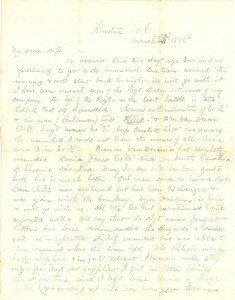
We arrived here two days ago but had no opportunity to get to the command

Joseph Culver Letter, March 24, 1865, Page 1

Kinston, N.C. March 24th 1865
My Dear Wife

We arrived here two days’ ago but had no opportunity to get to the command.1 Our train arrived this morning & will start back to-night; we will go with it. I have seen several men of the Regt. to-day, but none of my company. The loss of the Regt. in the last battle [Averysboro] is two killed and 14 wounded. James M. Pemberton of Co. “A”, & one man (Bullman) Co. “H”, Killed; & F. M. Van Doren, Co. “A”, Sergt. Mason, Co. “E”, Corp. Onstott, Co. “H” are among the wounded.2 I could not learn the names of all. There were three in Co. “K”. Francis Van Doren is but slightly wounded. David Jones, Co. “A”, died in South Carolina of Chronic Diarrhea.3 Henry Snyder, Co. “A”, has been quite sick but is much better.4 One man said he heard that Sam Hill was captured but had been exchanged & was again with the Company.5 Major Hoskins is here & will go with us. All the Co. not mentioned are reported well.

All say that the Regt. never fought better. Col. Case commanded the Brigade & did well. He is reported slightly wounded but was able to run around when the train left.6 The Rebels were badly whipped & in full retreat.7 Sherman will stop only a few days for supplies. I feel in better spirits than at any time since I left home. There is a large mail (100 sacks), & I will hear from you soon.

It is very windy and dusty. My health is excellent. The boys represent the trip from Savannah as very severe, yet they lived well. The country has been very Swampy. The train brought several hundred families of refugees, & they sit in groups all around the field. It looks terrible. Both young & old without any one to protect or provide for them, surrounded with soldiers & doubtless often insulted by reckless men.

Remember me in love to all. Tell [John] Smith the result of the battle as soon as you can so that he can inform Pemberton’s family. He was a brave & noble soldier. May God bless & protect you & make you happy. I will write as soon after my arrival at the command as possible.

Good Bye.
Your affect. Husband
J. F. Culver

  1. Captain Culver had traveled the 32 miles from New Bern to Kinston by rail. Goldsboro, where Sherman had rendezvoused with Schofield, was 24 miles west of Kinston. At 2 A.M. on the 24th the 129th Illinois had been turned out by an alarm, and five hours later the regiment broke camp at Waynesboro, on the final leg of its 55-day march from Hardeeville. At noon, the regiment entered Goldsboro, their route passing Sherman’s headquarters. Sherman stood bareheaded as the troops marched by with bands playing. The regiment, along with other units of the Third Division, camped two miles north of Goldsboro. Grunert, History of the 129th Illinois, p. 223.
  2. According to the regimental returns, two men were killed and 17 wounded at Averysboro on March 16. Two of the wounded subsequently died. The three wounded in Company K were: Corp. Andrew Salgman, and Pvts. Joseph Caley and Philip Wilderwood. O. R., Ser. I, Vol. XLVII, pt. I, p. 799; Regimental Papers, 129th Illinois, NA, RG 94. James M. Pemberton, a 23-year-old farmer, was mustered into service on Sept. 8, 1862, as a private in Company A, 129th Illinois Infantry. He was killed in action at Averysboro, March 16, 1865, Edwin P. Bulmer, a 32-year-old shoemaker, was mustered into service on Sept. 8, 1862, as a private in Company H, 129th Illinois Infantry. Private Bulmer was mortally wounded in the chest at Averysboro and died the next day in a field hospital. Francis M. Vandoren, a 24-year-old farmer, was mustered into service on Sept. 8, 1862, as a private in Company A, 129th Illinois Infantry. From April 27, 1864, until autumn, he was detailed as a teamster in the supply train, Third Division, XX Corps. Wounded at Averysboro, Private Vandoren was mustered out with the regiment on June 8, 1865, near Washington, D.C. Otis S. Mason, a 30-year-old blacksmith, was mustered into service on Sept. 8, 1862, as a sergeant in Company E, 129th Illinois Infantry. Sergeant Mason was wounded at Averysboro, and was hospitalized at Quincy, Ill., where he was medically discharged on March 25, 1865. John H. Onstot, a 35-year-old clerk, was mustered into service on Sept. 8, 1862, as a corporal in Company H, 129th Illinois Infantry. Onstot was promoted to sergeant on May 16, 1864, and was wounded at Averysboro. He was given a medical discharge while hospitalized at Madison, Indiana, on May 25, 1865. Compiled Service Records of Union Troops, NA.
  3. David Jones, a 37-year-old miner, was mustered into service on Sept. 8, 1862, as a private in Company A, 129th Illinois Infantry. Private Jones died on March 3, 1865, at Chesterfield, S.C., of a “congestive chill.” Ibid.
  4. Henry E. Synder, a 20-year-old farmer, was mustered into service on Sept. 8, 1862, as a private in Company A, 129th Illinois Infantry. He was mustered out near Washington, D.C. on June 8, 1865. Ibid.
  5. Nathan W. Hill, a 24-year-old farmer, was mustered into service on Sept. 8, 1862, as a private in Company A, 129th Illinois Infantry. He was promoted to corporal on Dec. 30, 1862, and to sergeant on May 9, 1863. Sergeant Hill was discharged on June 8, 1865, near Washington, D.C. Ibid.
  6. General Ward reported that at Averysboro, he “directed Colonel Case to move with the First Brigade well around to the left and feel for the rebel flank, at the same time directing Colonel Dustin and General Cogswell to press the enemy in their front. I cannot speak too highly of the manner in which Colonel Case executed this movement.” The 1st Brigade led by Colonel Case closed on the Confederate flank, just as Dustin’s men swept over their earthworks. The Southerners took to their heels, leaving three cannon and 100 prisoners, not counting 68 wounded, in the Federal’s hands. O. R., Ser. I, Vol. XLVII, pt. I, p. 784.
  7. Following the battle of Bentonville and the occupation of Goldsboro by Schofield’s army, General Johnston retired northward to the Smithfield area. Here astride the North Carolina Railroad, he would be in a position to cover Raleigh, if, as expected, it proved to be Sherman’s next goal on his march through North Carolina. O. R., Ser. I, Vol. XLVII, pt. II, pp. 1453-54.

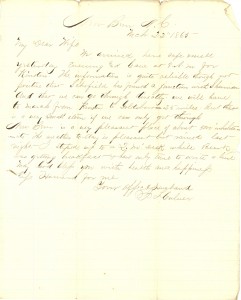
We arrived here safe and well yesterday evening

Joseph Culver Letter, March 22, 1865, Page 1

New Bern, N.C. Mch. 22nd 1865
My Dear Wife

We arrived here safe & well yesterday evening, and leave at 8 A.M. for Kinston.1 The information is quite reliable, though not positive, that Schofield has formed a junction with Sherman, and that we can go through directly.2 We will have to march from Kinston to Goldsboro — 25 miles, but that is a very small item if we can only get through.

New Bern is a very pleasant place of about 5000 inhabitants. The weather to-day is pleasant but rained last night. I stepped up to a Q. M.’s Desk, while Burk was getting breakfast, and have only time to write a line. May God bless you with health and happiness. Kiss Howard for me.

Your affect. Husband
J. F. Culver

  1. The trip of 33 miles from Morehead City to New Bern was made by rail.
  2. On March 19, as Sherman’s columns marched east toward Goldsboro and a rendezvous with Schofield, General Johnston attacked Slocum’s wing, near Bentonville. The Confederates gained ground at the expense of the XIV Corps. Reinforced by the XX Corps, the Federals stiffened and held. Next day Sherman arrived on the field with Howard’s wing, and orders were sent by courier for Schofield to march at once from Kinston upon Goldsboro. On the 20th Sherman’s troops felt their way forward, and during the night Johnston’s army abandoned its position. The next day, the 22d, Sherman put his columns in motion for Goldsboro, which had been occupied by Schofield’s troops the preceding day. Sherman entered Goldsboro on the 23d, at the head of Howard’s wing. Cox, March to the Sea, pp. 186-96.