 To improve findability for the journals held in the Main Library, the math collection journals are being moved from the 2nd floor to the 3rd floor and will be located adjacent to the other journals. Bookstacks staff are beginning to move these materials upstairs and in a few months you will be able to find the math collection journals in the northeast corner of the third floor. In the meantime, if you have problems locating a title, please contact the Service Desk staff on the 1st floor.
New Online Tool for Iowa Flood Information!
As rainy as it has been lately, you may want to learn more about flooding and how to check the flood conditions in your area.
Almost everyone knows that floodplains are the lowlands and relatively flat areas adjoining waterways that are subject to flooding. Floodplains are, in fact, an extension of the water system. Their natural function is to help move high water volumes downstream or to store the water until flooding subsides. They provide a variety of functions including flood water storage, filtration and removal of water pollutants, channel stability and erosion control, wildlife habitat, beauty and recreational opportunities and stream baseflow. Building and developing on flood plains disrupts the ability of floodplains to perform these vital functions. Not to mention the danger that flooding causes to property, homes, and lives.
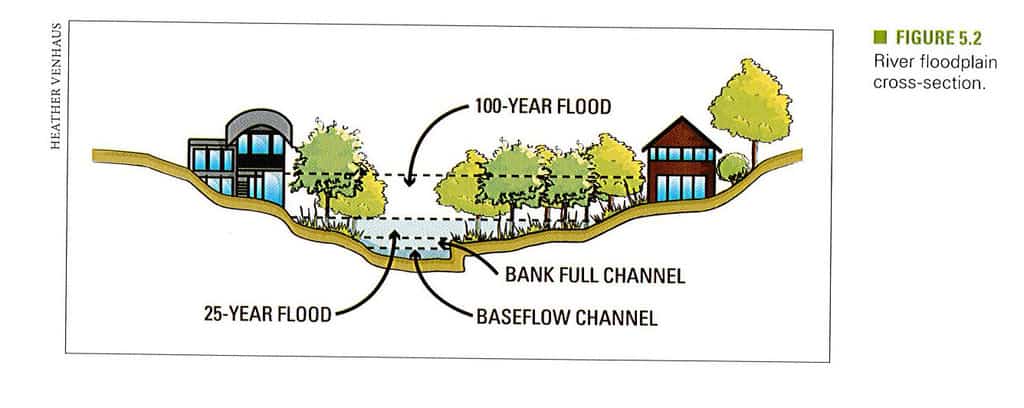
Designing the Sustainable Site. Heather Venhaus. Graphic page 121. Engineering Library NA9051 .V46 2012
We’ve heard of the 100-year-floodplain, but perhaps don’t know that it doesn’t mean that a flood will only occur every hundred years. Floodplains are classified by the likelihood of flooding in a given year. An elevation that has a 1% chance of being flooded each year is designated as a 100-year-floodplain. In fact, 100-year-floods (and floods of any designation) can occur in a relatively short period of time. Since floods are not consistent in their timing, it can be easy to downplay or ignore the risks until it is too late to prevent damage. Floods are the most frequent of natural disasters and destructive floods occur world-wide.
We here in southeast Iowa know about floods first-hand. To help residents understand localized flooding, the University of Iowa Flood Center (IFC) has developed a new interactive, online tool to access local flood information. The IFC is part of Hydroscience & Engineering (IIHR), a research institute at the UI College of Engineering. It is the nation’s first academic center devoted solely to the study of floods.
The Iowa Flood Information System (IFIS) includes access to current stream and river level data from 19 stream-stage sensors in Johnson County. IFIS provides information that can help Johnson County residents make more informed decisions for flood planning and mitigation. It will also alert community members in advance so they are better able to stay safe and minimize potential flood damage.
The user-friendly, online application displays up-to-the-minute community specific information on rainfall, stream levels, and more, including:
- Iowa River flood inundation maps for Iowa City/Cedar Rapids
- Real-time and historical data on water levels, gauge heights, and rainfall conditions
- 2D and 3D interactive visualizations
- Discharge levels at the Coralville Lake Reservoir
It is “a one-stop web-platform to access community-based flood conditions, forecasts, visualizations, inundation maps, flood-related data, information and applications.” The website has an informative video tutorial which will walk you through the many features available.
Be aware of the flood conditions near you – and stay safe!
RESOURCES:
Venhaus, Heather. 2012. Designing the sustainable site : integrated design strategies for small-scale sites and residential landscapes. Hoboken, N.J : John Wiley & Sons.
Jha, Abhas Kumar. 2012. Cities and flooding : a guide to integrated urban flood risk management for the 21st century. Washington, D.C. : World Bank.
Iowa Flood Center. 2015. University of Iowa.
Iowa Flood Information System. Iowa Flood Center. University of Iowa. Date accessed: June, 2015.
OTHER RESOURCES:
Price, Roland K. 2011. Urban hydroinformatics : data models, and decision support for integrated urban water management. London : IWA Publishing.
Brody, Samuel David. 2011. Rising waters : the causes and consequences of flooding in the United States. Cambridge, New York : Cambridge University Press.
Mambretti, S., editor. 2012. Flood risk assessment and management. Southampton ; Boston : WIT Press.
FloodSmart.gov. June 17, 2015. FEMA.
Search for biomedical and pharmaceutical information using Embase – free workshop Tuesday, July 7, 10-11am
EMBASE is a biomedical and pharmaceutical database containing bibliographic records with abstracts. Although there is overlap with records from PubMed, there are also many unique records. This hands-on session will show you how to conduct basic searches using EMBASE’s quick search box, how to conduct searches using EMTREE subject headings, and how to use subheadings for drug and disease topics.
Our next session:
If you can’t attend this workshop, you can sign up for a personal session.
Math Journals Moving Location in Main Library
To improve findability for the journals held in the Main Library, the math collection journals are being moved from the 2nd floor to the 3rd floor and will be located adjacent to the other journals. Bookstacks staff are beginning to move these materials upstairs and in a few months you will be able to find the math collection journals in the northeast corner of the third floor. In the meantime, if you have problems locating a title, please contact the Service Desk staff on the 1st floor.
University of Iowa Libraries Open Access Policy Statement
On June 18, 2015 the University of Iowa Libraries adopted an Open Access Statement. Library staff will make their publications freely available and ensure long-term preservation and findability. This policy complements the Libraries’ support of open access to scholarship.
For more information about scholarly publishing, open access and author’s rights, please see our guide.
4th of July Holiday hours @Hardin
| Thursday, July 2 | 7:30am-6pm |
| Friday, July 3 | Closed for holiday |
| Saturday, July 4 | Closed for holiday |
| Sunday, July 5 | 12pm-9pm regular hours resume |
24-hour study will be open when the library is closed.
24-hour study requires an access card.

photo by liz west @Flickr
Lucy Hartmann
After working in Special Collections for a while, we meet many people who leave a lasting impression on us—collectors, donors of papers, students, and researchers, among others, who devote countless hours to their work in these collections. In the midst of comings and goings, some individuals stand out, and one of them deserves special recognition.
It is with heavy hearts, but also fond memories, that we remember the time we spent with Lucy Hartmann, who passed away on June 22. We got to know Lucy during the time she spent working in Special Collections through the UI REACH program. Lucy was dedicated to her tasks in Special Collections, helping us with filing, sorting, cleaning books, and other duties that helped us to tackle some things that we may not have otherwise been able to resolve. Her contributions to our activities were real and meaningful, and the focus she applied to her work impressed us all. We were able to share some of our favorite items in the collections with her, and were delighted to be able to throw a party for her to commemorate her graduation from UI REACH.
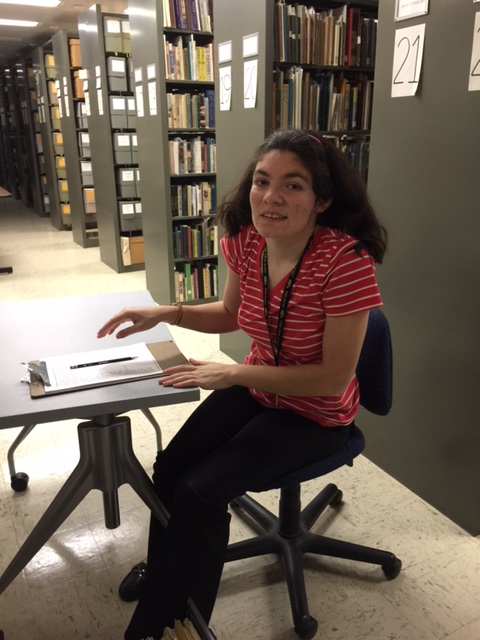
Lucy Hartmann at work in Special Collections.
I speak on behalf of the entire staff of Special Collections when I say that she will be missed, that her time with us will not be forgotten, and that her efforts are truly appreciated as we continue to go about our daily business. Her time in our department may have been relatively brief, but the impression she made on us is something that will endure with us for a long time to come.
Over the years that we have been involved with UI REACH, thanks to the efforts of our Department Manager Kathy Hodson, we have been fortunate to be able to work with, and learn from, people such as Lucy and former students Alex and Jeff. We look forward to continuing this relationship, and to remembering Lucy by extending opportunities to more students in the future.
Lighting Being Upgraded in the Information Commons
The Information Commons East is closed through Friday, July 10 for the installation of new lighting, as well as heating and cooling work. The East Commons will reopen from Saturday, July 11 through Sunday, August 9, but will close again August 10-August 14. The West Commons remains open during construction in the East Commons.
The West Commons will receive similar upgrades this summer and will be closed from July 13-July 31. The East Commons will be open during this time.
Lighting Being Upgraded in the Information Commons
The Information Commons East is closed through Friday, July 10 for the installation of new lighting, as well as heating and cooling work. The East Commons will reopen from Saturday, July 11 through Sunday, August 9, but will close again August 10-August 14. The West Commons remains open during construction in the East Commons.
The West Commons will receive similar upgrades this summer and will be closed from July 13-July 31. The East Commons will be open during this time.
June Notes from the John Martin Rare Book Room @Hardin Library
 GREGOR REISCH (ca. 1467-1525). Margarita philosophica. 2nd ed. [Freiburg?: Johannes Schottus, 1504].
Reisch was a Carthusian prior at Freiburg and confessor to Emperor Maximilian I, as well as assistant to Erasmus. Margarita philosophica, might be called the first modern encyclopedia. Its twelve divisions cover the trivium, the quadrivium, and the natural and moral sciences.
The illustrations are fine examples of wood-block cutting, and include music, a large folding map of the Eurasian continent and parts of Africa, and astronomical, astrological, and zoological figures. The book so popular sixteen editions were made in the 17th century. This edition, the second edition, was preceded by the first edition of 1503.

wood block prints from Margarita philosophica by Reich
You may view this work in the John Martin Rare Book Room, Hardin Library for the Health Sciences. Make a gift to the Hardin Library for the Health Sciences by donating online or setting up a recurring gift with The University of Iowa Foundation.