Skip to content
Skip to main content

Omeka Workshop Review

Last Saturday we hosted the first of four digital scholarship workshops here at the Studio.  This workshop covered Omeka, an open source collections management platforms designed to let scholars curate collections and create narrative displays for the public.  It’s a perfect tool for supporting a balance of rigorous scholarship with a public-friendly face.  We use Omeka here at Iowa for projects ranging from DIY History and History Corps to individual course assignments in undergraduate classrooms in a variety of departments.

Despite only having a week of registration, I was thrilled to have eighteen attendees! The class included faculty, staff, and both graduate and undergraduate students at all levels of technical experience.  We blasted through a lot of material in a little over three hours, from the basics of the site structure, adding items and exhibits, and administering the site; to more advanced concepts, such as creating custom item types, exporting between installations, and mapping with Neatline. Some attendees already had some basic knowledge of Omeka, and were generous in helping their fellow attendees who had questions.  The hands-on structure of the workshop, in which every attendee was tinkering in their own website, also gave people who were more comfortable with the technology the chance to work ahead and try features out for themselves.

This model of people going at their own pace but tuning in when they needed to and communicating with each other was made much easier by the TILE classroom.  Attendees were able to work in small groups where they could feel comfortable asking their neighbor a question, but everyone could still see what I was doing as I walked them through various parts of the site on the screens around the room.

I was glad to see that everyone’s enthusiasm carried over to lunch!  We adjourned to the Studio for sandwiches and chatting, and a lot of interesting conversations were going on about various research projects.  People had a chance to reflect on the basics that we had covered before lunch, and bounce around ideas for how Omeka might be used in classrooms.

For me, one of the most important parts of any technical workshop is explaining the overall structure and main concepts of a platform, not just the step-by-step motions of doing things with it.  This has often been a difficulty for me when researching new tools, that often the documentation assumes you already understand what you might want to do with it.  We had great questions about the differences between different versions of Omeka and how to decide which is best for a specific purpose, and also about how much of how a site is used and set up depends on decisions specific to a project versus field standards.  It’s important to me for people to understand that there’s often not one right way to “do digital”, but that digital resources can be used differently to express what we really want to get at with our research.

Registration is still open for our upcoming workshops on text encoding, 3d modeling, and mapping, so come join us!
SEEKING NOMINATIONS: Arthur Benton University Librarian’s Award for Excellence

The University Libraries is seeking nominations for the Arthur Benton University Librarian’s Award for Excellence. Funded by a generous endowment, this prestigious award acknowledges a library staff member’s professional contributions in the practice of librarianship, service to the profession, scholarship, or leadership which has had a significant impact or innovation to the operations of the Libraries or the University of Iowa. The library staff member will receive $1,500 to be used for professional development activities.

Criteria for the award and the nomination form are available at:   http://www.lib.uiowa.edu/admin/bentonaward/

Nominations are due by Friday, October 16.

Many graduate students and faculty work closely with our librarians to locate and procure curriculum and research resources. The Benton Award is a great opportunity to recognize that collaborative relationship.

*The University Libraries includes the Main Library, Hardin Library for the Health Sciences, and the Art, Sciences, Business, Engineering, and Music libraries. (Professional staff in the Law Library and other campus departmental library staff are not eligible.)

Open Access is the way that new knowledge is made easier | Faculty guest post

By Willow Fuchs

During the month of Open Access Week (October 19-25) we will be highlighting a number of guest posts from University of Iowa Faculty and Staff who have personal experience making their work Open Access.  We appreciate their contributions.

Professor Williams

Professor Williams

The first guest post is by Associate Professor, Rachel Marie-Crane Williams, Ph.D. University of Iowa,  Departmental Executive Officer of the Department of Gender, Women’s and Sexuality Studies, Faculty member of the School of Art and Art History/Media, Social Practice, and Design.

Open Access is the way that new knowledge is made…easier

October 19-25 is International Open Access Week all across the world. As a scholar I have directly benefited from participating in the Iowa Research Online open access platform. One of my articles has been downloaded over 12,000 times. The ripple effects of this can be seen easily on Google Scholar. That particular article is cited numerous times by other people who are pursuing similar questions in countries like Albania and Spain. If not for open access and my participation in the Iowa Research Online program I doubt those scholars would have found my work.

As a public servant at a public university I feel that an open access system for all of the scholarship that we produce is important. Print journals are expensive to produce, subscriptions are costly for individuals and libraries, and people without access to the journal can’t use the information. Ultimately as researchers we want to engage in conversations with other people about our work and trends or ideas in our field. My own research often appeals to people who are not directly connected with a university. It gives me great pleasure to know that they can still find and read my scholarship even if they can’t afford a subscription to a journal, they live in a place where the journal is not available, or they are not aware of what journals to consult in order to find information about a particular topic.

We are always standing on the shoulders of giants. Climbing up to those places in order to survey the world stretched out before us should be easy, free, and independent of our connections in academia. It is important to find what came before us with regard to a history of ideas. I wrote my dissertation at a time when printed journals were still the way that scholarship was disseminated. Google was still five years away from launching Google Scholar. As a doctoral student I traveled to university libraries all over the country to browse stacks, read journals, and find information. It was a slow, expensive, and arduous process. Now, I can simply use the internet to find information from the comfort of my own couch. With open access I can still read that information even if my university does not subscribe to the journal or I don’t have funding to purchase the articles. Having easy and free access to the ideas of others can spark our creativity, help us formulate new ideas and approaches, keep us from being redundant, and make collaboration easier, thus creating new knowledge.

Open access also levels the playing field. As an educator I care deeply about equality. Students from schools with small budgets or in developing countries can access the work of others without barriers As a teacher, it broadens the possibilities of ideas and research that I can share with students. Nothing is more frustrating than finding an abstract that seems relevant to your lecture only to discover you can’t access it without paying for it. This has real relevance for my colleagues in medicine where people’s lives might depend on access to the latest research about procedures or pharmaceuticals.

If we are committed to making new knowledge and advancing the act of discovery we must all commit ourselves to open access and to the possibilities it offers to everyone who has the technological ability to surf the web.

Guest Post: Open Access is the way that new knowledge is made…easier

During the month of Open Access week (October 19-25) we will be highlighting a number of guest posts from University of Iowa Faculty and Staff who have personal experience making their work Open Access.  We appreciate their contributions.

The first guest post is by Associate Professor, Rachel Marie-Crane Williams, Ph.D. University of Iowa,  Departmental Executive Officer of the Department of Gender, Women’s and Sexuality Studies, Faculty member of the School of Art and Art History/Media, Social Practice, and Design

Open Access is the way that new knowledge is made…easier

October 19-25 is International Open Access Week all across the world. As a scholar I have directly benefited from participating in the Iowa Research Online open access platform. One of my articles has been downloaded over 12,000 times. The ripple effects of this can be seen easily on Google Scholar. That particular article is cited numerous times by other people who are pursuing similar questions in countries like Albania and Spain. If not for open access and my participation in the Iowa Research Online program I doubt those scholars would have found my work.

As a public servant at a public university I feel that an open access system for all of the scholarship that we produce is important. Print journals are expensive to produce, subscriptions are costly for individuals and libraries, and people without access to the journal can’t use the information. Ultimately as researchers we want to engage in conversations with other people about our work and trends or ideas in our field. My own research often appeals to people who are not directly connected with a university. It gives me great pleasure to know that they can still find and read my scholarship even if they can’t afford a subscription to a journal, they live in a place where the journal is not available, or they are not aware of what journals to consult in order to find information about a particular topic.

We are always standing on the shoulders of giants. Climbing up to those places in order to survey the world stretched out before us should be easy, free, and independent of our connections in academia. It is important to find what came before us with regard to a history of ideas. I wrote my dissertation at a time when printed journals were still the way that scholarship was disseminated. Google was still five years away from launching Google Scholar. As a doctoral student I traveled to university libraries all over the country to browse stacks, read journals, and find information. It was a slow, expensive, and arduous process. Now, I can simply use the internet to find information from the comfort of my own couch. With open access I can still read that information even if my university does not subscribe to the journal or I don’t have funding to purchase the articles. Having easy and free access to the ideas of others can spark our creativity, help us formulate new ideas and approaches, keep us from being redundant, and make collaboration easier, thus creating new knowledge.

Open access also levels the playing field. As an educator I care deeply about equality. Students from schools with small budgets or in developing countries can access the work of others without barriers As a teacher, it broadens the possibilities of ideas and research that I can share with students. Nothing is more frustrating than finding

an abstract that seems relevant to your lecture only to discover you can’t access it without paying for it. This has real relevance for my colleagues in medicine where people’s lives might depend on access to the latest research about procedures or pharmaceuticals.

If we are committed to making new knowledge and advancing the act of discovery we must all commit ourselves to open access and to the possibilities it offers to everyone who has the technological ability to surf the web.

African American Communities – Trial ends 4 November 2015

African American Communities presents multiple aspects of the African American community — focusing predominantly on Atlanta, Chicago, St. Louis, New York, and towns and cities in North Carolina — through pamphlets, newspapers and periodicals, correspondence, official records, reports and in-depth oral histories, revealing the prevalent challenges of racism, discrimination and integration, and a unique African American culture and identity.

Please send additional comments to Carmelita Pickett.

Standards Xpress Class TOMORROW at 2:30 p.m.!

We are offering 30 minute Xpress classes Thursdays at 2:30 p.m. They will take place in the Library Multipurpose Room (2001C SC).


XpressClasses_Standards_forweek

This class is an introduction to Standards and specifications. You’ll learn how to access a wide variety of standards including ASTM, ISO, ADA, NFPA (Fluid), and the U.S. code of Federal Regulations. It features a new database, TechStreet, to gain electronic access to these standards and more.

This class is taught by Kari Kozak, Head, Lichtenberger Engineering Library. Kari will be available after class to answer any further questions.

Stop in and learn more about standards!


William Anthony Lecture

The University of Iowa Libraries’ Preservation and Conservation presents:

The William Anthony Conservation Lecture
Thursday, October 8, 2015, 6:00 p.m.-8:00 p.m.
Adler Journalism Building, E105
Gary Frost, guest lecturer
“Great Legacy, Great Prospects — The Historical Bookbinding Model Collection at Iowa”

A reception will follow. All UI students, faculty, staff  and Iowa City area community members are invited to attend.

At this event, you can expect to learn about the art and craft of bookbinding over the centuries. Discover the University of Iowa Libraries’ unique role in helping to document and teach these techniques.

We look forward to seeing you there.

Download PDF poster to print Anthony Lecture flier 8.5 x 10-FINAL-1.

Berliner Philharmoniker’s Digital Concert Hall – Trial ends 31 January 2016

The Berliner Philharmoniker’s Digital Concert Hall video streams classical music concerts, current and historic, to your tablet, smartphone, smartTV or PC.  Features the orchestra under the baton of famed conductors such as Sir Simon Rattle, Claudio Abbado, and Herbert Karajan. Includes interviews with conductors & soloists and program notes.

The first time you use Digital Concert Hall you must register, then log in to subsequent sessions.

Please send additional comments to Katie Buehner.

Explore our Library! We Have Lots of Study Spaces!

Midterms are here….. (yes, already!)

What kind of study space do you need to ace those tests and projects?

Group Study Space? We have that!

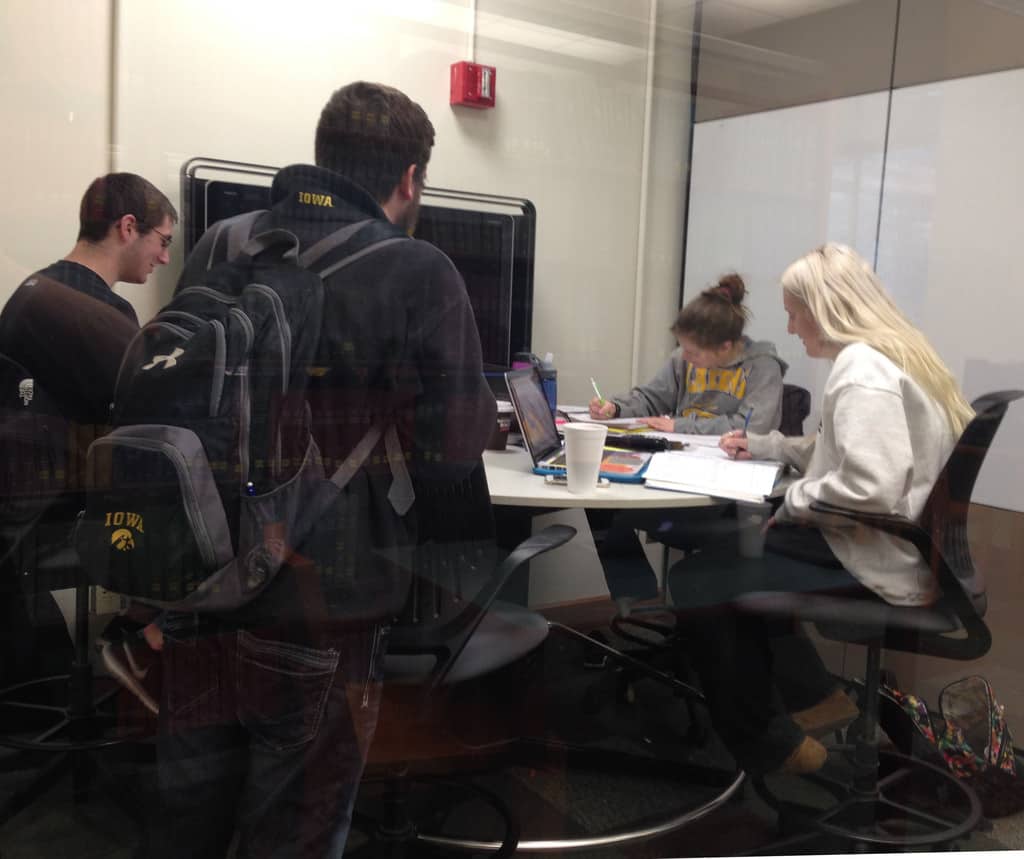
Group Study Pod 1

Group Study Pod 1

Working on a group project and need that space to spread out and maybe even have a white board? We have 2 study pods – one of which has a Media:Scape. Both the Media:Scape cable ports and adapters and white board markers are available for check out at the circulation desk.  There is a sign-up sheet on the door of each pod. It is a 2-2-2- policy: 2 or more students, 2 hour time slots, and you may reserve your spot up to 2 days in advance. Besides the 2 group study pods we have four group tables which are another option for working together on a group project.

Quiet Study Space? We have that!

Need a quiet space away from roommates and other distractions? We have the perfect area! Our lower level is a dedicated quiet space. There are over 30 individual study carrels. If you are tired of sitting at a desk, we’ve got several easy chairs where you can sit back and relax while you cram for that midterm.

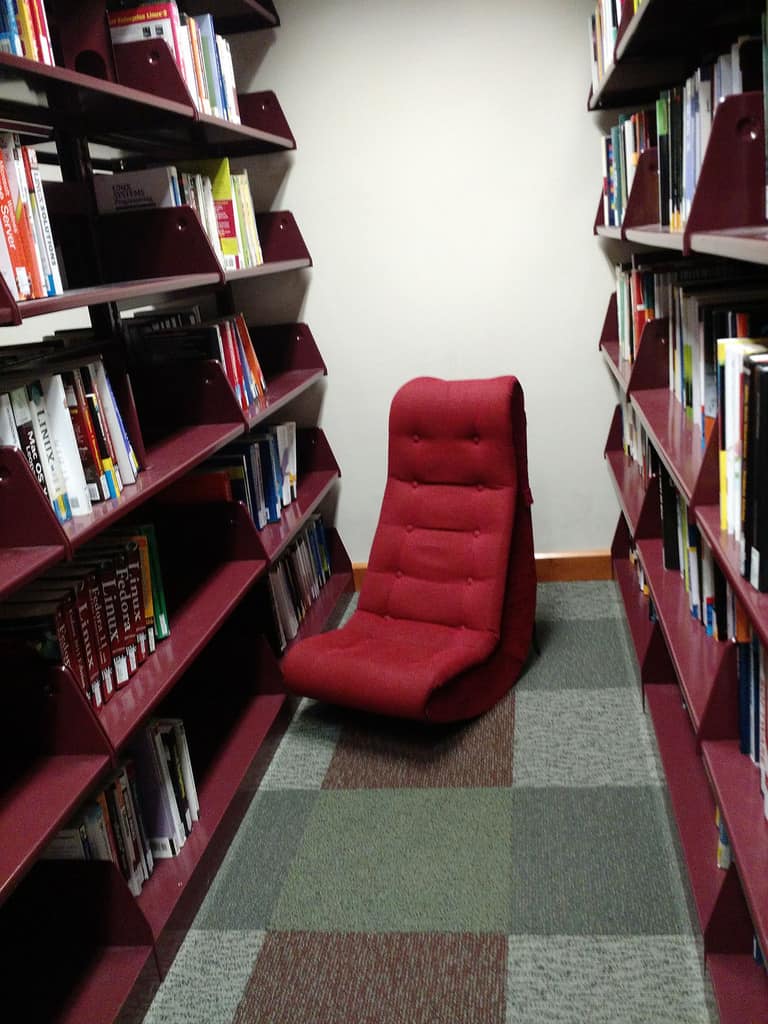
Gamer Chair in the Lower Level Quiet Study Space

Gamer Chair in the Lower Level Quiet Study Space

Bean Bag Chairs? Gamer Chairs? Yup, we have them!

Also in the lower level, we have comfortable bean bag chairs and gamer chairs. They are the perfect spot to catch up on that required reading you haven’t done yet….

Study Carrels? We have them!

Besides the study carrels in the lower level, there are 4 on the main level, too.  The upstairs study carrels are close to the printers and scanners so they are easily accessible.

Need an ITC computer? We have those!

We have 20 computers (plus new computers tables and chairs) on the main level, and 12 more in the multipurpose room.  Plenty of spaces where you can come to study!

Printers & Scanners? We have those, too!

All our computers and your laptops will print to the 2 print stations. We also have 2 scanners – so it is easy to scan documents and save to a thumb drive or email them – easy way to share information to project partners and keep an electronic copy!

Whenever you need a change of scenery from your dorm or apartment, come study with us! And good luck on those midterms!