Skip to content
Skip to main content

Guest Post: The Janus Faces of Open Access Publishing

Two-faced image of the god Janus.

During the month of Open Access week (October 19-25) we will be highlighting a number of guest posts from University of Iowa Faculty and Staff who have personal experience making their work Open Access.  We appreciate their contributions.

The second guest post is by Frederick Domann, PhD; Director, Molecular & Cellular Biology Graduate Program; Co-director, Radiation and Antioxidant Enzyme Core Service; Co-director, Free Radical Cancer Biology Program; Professor of Radiation Oncology; Professor of Pathology, Surgery

@RickDomann

The Janus Faces of Open Access Publishing

Two-faced image of the god Janus.There is little doubt that the open access (OA) model for publishing scientific literature has revolutionized the academic approach to publishing and the publication industry itself. Since the advent of OA publishing there has been an exponential proliferation of OA journals which currently number greater than 10,000 (https://doaj.org). I personally receive countless requests to serve on the editorial boards of these journals which I typically ignore and promptly delete. Academic institutions have embraced the OA model since traditional journals can cost as much as $20,000 per year for an institutional subscription. Indeed, universities such as the University of Iowa offer incentives in the form of payment of publication fees for their faculty to publish in OA journals. Indeed my trainees and I have benefitted from these incentives and have published several papers in OA journals within the last several years. One of these (http://www.ncbi.nlm.nih.gov/pubmed/24672806), published two years ago in the reputable Dove Press journal Hypoxia is currently the most viewed and downloaded paper since the journal’s inception. Clearly this has provided a brilliant showcase for our work and we have benefitted from the university’s OA policy. Open access allows free and ready access to its readers, while passing the costs of production and publication off to the contributors of literary content. And while this “pay to publish” approach opens opportunities for investigators to quickly and broadly disseminate their findings, OA publishing also has a dark side. This dark side is manifest in the proliferation of “predatory” journals that accept work that may be of questionable quality and significance. Such journals should be actively avoided and are identified on Beall’s list of predatory journals which can be found at http://scholarlyoa.com/publishers/. One of the perils of the pay to publish model are the presentation of opportunities for blatant conflicts of interest in the publication process http://www.nejm.org/doi/full/10.1056/NEJMc1307577). For example, pharma businesses might take advantage of the lower rejection rates and relaxed journal standards in OA journals to publish prematurely or incompletely to promote the interests of their company.  Another troubling aspect of the proliferating OA model is the pressure to provide qualified competent reviewers from a limited pool of knowledgeable experts, the demands on whose time are typically already overextended, to review the avalanche of submitted manuscripts. Since the material in OA journals is disseminated digitally there are essentially no page limits and so the numbers of papers and rate of papers published is astronomical. Already more than 2 million papers are published in the greater than 10,000 OA journals mentioned above. Almost certainly the rigor of review that is afforded these papers is on average substantially below that of traditional journals. These acknowledgements appear to have led to an improved perception of the value of publications in traditional journals for the communication of highly reliable and reproducible results. Other digital resources such as ArXiv (http://arxiv.org/) enable investigators to disseminate their own findings before they are peer-reviewed in pre-print form known as e-prints, so the information can be distributed to interested parties without delays or compromising the quality of the finally published work. And while ArXiv may have downsides of its own (http://mathoverflow.net/questions/65090/downsides-of-using-the-arxiv) it may present a viable alternative to OA publishing, and at minimal or no expense. Hopefully this discussion highlighting the two-faced nature of OA publishing will leave the reader with a better sense of risks and benefits of both publishing in and reading from OA journals.
 

Guest Post: The Janus Faces of Open Access Publishing

During the month of Open Access week (October 19-25) we will be highlighting a number of guest posts from University of Iowa Faculty and Staff who have personal experience making their work Open Access.  We appreciate their contributions.

The second guest post is by Frederick Domann, PhD; Director, Molecular & Cellular Biology Graduate Program; Co-director, Radiation and Antioxidant Enzyme Core Service; Co-director, Free Radical Cancer Biology Program; Professor of Radiation Oncology; Professor of Pathology, Surgery

@RickDomann

The Janus Faces of Open Access Publishing

There is little doubt that the open access (OA) model for publishing scientific literature has revolutionized the academic approach to publishing and the publication industry itself. Since the advent of OA publishing there has been an exponential proliferation of OA journals which currently number greater than 10,000 (https://doaj.org). I personally receive countless requests to serve on the editorial boards of these journals which I typically ignore and promptly delete. Academic institutions have embraced the OA model since traditional journals can cost as much as $20,000 per year for an institutional subscription. Indeed, universities such as the University of Iowa offer incentives in the form of payment of publication fees for their faculty to publish in OA journals. Indeed my trainees and I have benefitted from these incentives and have published several papers in OA journals within the last several years. One of these (http://www.ncbi.nlm.nih.gov/pubmed/24672806), published two years ago in the reputable Dove Press journal Hypoxia is currently the most viewed and downloaded paper since the journal’s inception. Clearly this has provided a brilliant showcase for our work and we have benefitted from the university’s OA policy. Open access allows free and ready access to its readers, while passing the costs of production and publication off to the contributors of literary content. And while this “pay to publish” approach opens opportunities for investigators to quickly and broadly disseminate their findings, OA publishing also has a dark side. This dark side is manifest in the proliferation of “predatory” journals that accept work that may be of questionable quality and significance. Such journals should be actively avoided and are identified on Beall’s list of predatory journals which can be found at http://scholarlyoa.com/publishers/. One of the perils of the pay to publish model are the presentation of opportunities for blatant conflicts of interest in the publication process http://www.nejm.org/doi/full/10.1056/NEJMc1307577). For example, pharma businesses might take advantage of the lower rejection rates and relaxed journal standards in OA journals to publish prematurely or incompletely to promote the interests of their company.  Another troubling aspect of the proliferating OA model is the pressure to provide qualified competent reviewers from a limited pool of knowledgeable experts, the demands on whose time are typically already overextended, to review the avalanche of submitted manuscripts. Since the material in OA journals is disseminated digitally there are essentially no page limits and so the numbers of papers and rate of papers published is astronomical. Already more than 2 million papers are published in the greater than 10,000 OA journals mentioned above. Almost certainly the rigor of review that is afforded these papers is on average substantially below that of traditional journals. These acknowledgements appear to have led to an improved perception of the value of publications in traditional journals for the communication of highly reliable and reproducible results. Other digital resources such as ArXiv (http://arxiv.org/) enable investigators to disseminate their own findings before they are peer-reviewed in pre-print form known as e-prints, so the information can be distributed to interested parties without delays or compromising the quality of the finally published work. And while ArXiv may have downsides of its own (http://mathoverflow.net/questions/65090/downsides-of-using-the-arxiv) it may present a viable alternative to OA publishing, and at minimal or no expense. Hopefully this discussion highlighting the two-faced nature of OA publishing will leave the reader with a better sense of risks and benefits of both publishing in and reading from OA journals.


Find biomedical and pharmaceutical publication information using EMBASE | workshop Tues., October 13

EMBASE is a biomedical and pharmaceutical database containing bibliographic records with abstracts. Although there is overlap with records from PubMed, there are also many unique records. EMBASE is useful when conducting systematic reviews or to search topics on food/diet/nutrition, medical devices, or drugs.
This hands-on session will show you how to conduct basic searches using EMBASE’s quick search box, how to conduct searches using EMTREE subject headings, and how to use subheadings for drug and disease topics.
Our next session is:

Register online or by calling 319-335-9151.  We also have a help sheet.

Learn to use NCBI databases for genetic information at our workshop

Overwhelmed by the number of databases that the National Center for Biotechnology Information has to offer on nucleotide sequences, genes and proteins?
Wondering which database you should always start with?
Would you like to learn how to set up an NCBI account to link articles in PubMed to records in other databases?
Do you know about PubMed’s Gene Sensor?
Are you familiar with the concept of linear navigation?
Learn all of these tips and more in this session that is designed for anyone who needs to search the NCBI databases for genetic information.
Our sessions this semester:

Sign up online or by calling 319-335-9151.

Database of the Week: RMA Annual Statement Studies

Each week we will highlight one of the many databases we have here at the Pomerantz Business Library.

The database: RMA Annual Statement Studies/eStatements Online RMA

Where to find it: You can find it here, and under R in the databases A-Z list.
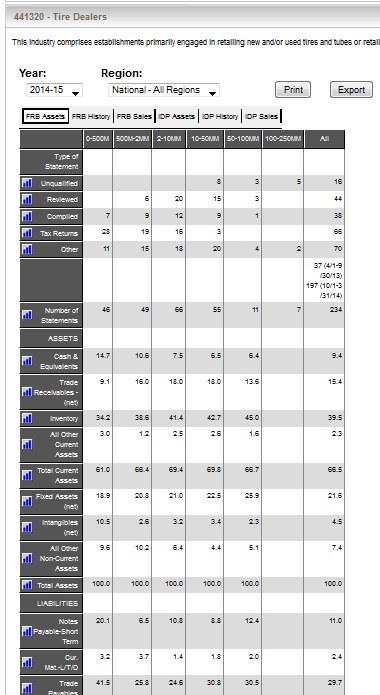
For over 95 years, RMA’s Annual Statement Studies® has been the industry standard for comparison financial data. Material contained in today’s Annual Statement Studies was first published in the March 1919 issue of the Federal Reserve Bulletin. In the days before computers, the Annual Statement Studies data was recorded in pencil on yellow ledger paper! Today, it features data for over 778 industries.

Use it to find:

  • Industry Financial Ratio Benchmarks
  • Industry Default Probabilities
  • Cash Flow Measures
  • Data definitions

Tips for searching:

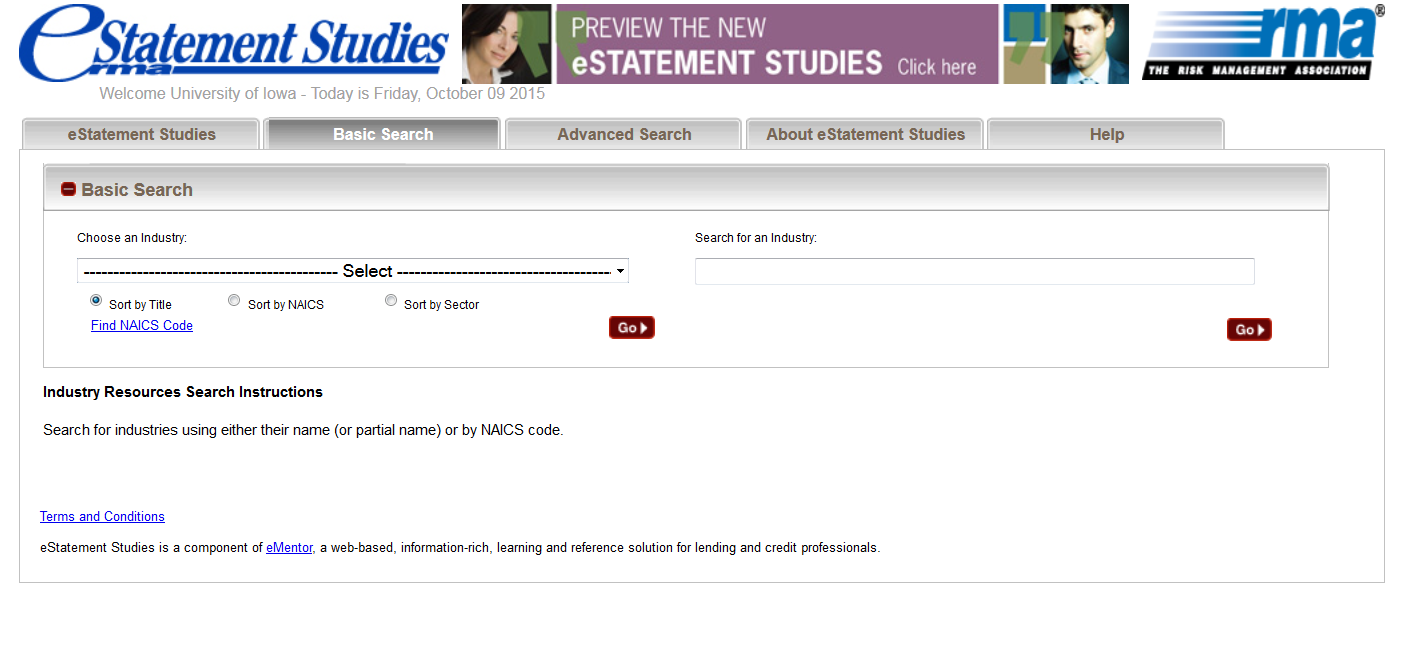
  • Use the Basic Search
    • Browse by industry title (alphabetical)
    • Browse by NAICS
    • Browse by sector
    • Search for an industry by keyword or NAICS
  • Use the Advanced Search to specify: data group, year, region, range, and type of data.
  • Export data into Excel RMA_data

Want help using RMA Statement Studies? Contact Willow or Kim and set up an appointment.

DIY for the Weekend! Learn Game Development Programming!

Looking for a fun project for the weekend? How about learning Minecraft® mod development in 24 hours?

typing_hands

Sams Teach Yourself Minecraft Mod Development in 24 Hours will help you do just that! Each chapter is an “hour” and explains the entire process from “Setting up the Minecraft® development environment” to “What’s Next?” and all you need in between. At the end of each hour is a hands-on, try-it-yourself activity, workshops, and exercises which will help you hone your new skills writing mods. Java programming basics are explained as you move through each hour, making it a great way to learn to program.

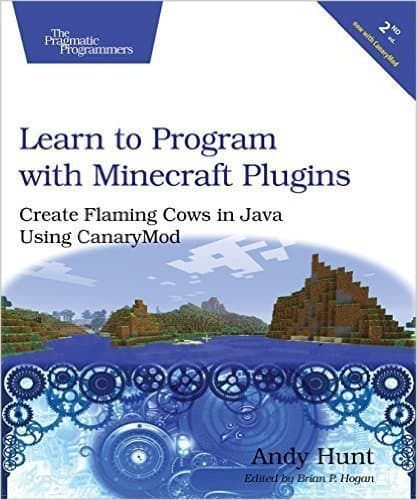
Want to learn to make flaming cows, flying creepers or teleportation in Minecraft®Learn to Program with Minecraft Plugins can help you do that! This book also starts at the beginning as you learn to write a Java program. Besides Java, you’ll also learn to use CanaryMod and to backup your code using Git.

Interested in expanding your game programming skills beyond creating flaming cows?  Ready to design an entire game by yourself? Fundamentals of Game Design will walk you through the different types of games, design and development, how to make your game accessible to a variety of audiences and how to make money from the games you’ve created.  Have experience with HTML? Check out HTML5 Games: Creating Fun with HTML5, CSS3, and WebGL.

Another resource which will walk you through creating your own game – from beginning to end – is Game Development with Blender.  You will get an introduction to 3D computer graphics as well as Blender in general. There are chapters devoted to animation, graphics, Python scripting, and more.

If you are ready to move on to designing mobile games, check out Holistic Mobile Game Development with Unity. The principles of art, design and code are covered and you’ll gain the multidisciplinary skills you’ll need in the independent mobile games industry. You’ll learn the process for both iOS and Android mobile devices from design to publication in the Apple App Store and Google Play.

Whatever your skill level or interest in designing and programming games – we have the resources you need!

Engineering Library QA76.73 .J38 H848 2014

Engineering Library QA76.73 .J38 H848 2014

Resources:

Koene, Jimmy. 2015. Sams teach yourself Minecraft mod development in 24 hours. Indianapolis, Indiana : Sams. Engineering Library QA76.76 .C672 K64 2015

Seidelin, Jacob. 2014. HTML5 games: creating fun with HTML5, CSS3, and WebGL. Chichester, West Suxxex, United Kingdom : Wiley. Engineering Library QA76.76 .C672 S433 2014 

Adams, Ernest. 2014. Fundamentals of game design. [Berkeley, California] : New Riders. Engineering Library AQ76.76 C672 A322 2014 

Felinto, Dalai. 2014. Game development with Blender. Boston, MA : Cengage Learning PTR. Engineering Library QA76.76 .C672 F45 2014

Baillie-de Byl, Penny. 2014. Holistic mobile game development with Unity: an all-in-one guide to implementing mechanics, art design, and programming for iOS and Android mobile games. Burlington, MA : Focal Press. Engineering Library QA76.76 .C672 B336 2014.

Other Resources:

Thorn, Alan. 2015. How to cheat in Unity 5: tips and tricks for game development. Burlintong, MA : Focal Press. Electronic Library Resource.

Canary: Introducing Canary: the hMod Legacy. Minecraft Forum. 2005-2015.

Bunyan, Karl. 2015. Build an HTML5 game: a developer’s guide with CSS and JavaScript. San Francisco : No Starch Press. Engineering Library QA76.76 .C672 B856 2012

Okita, Alex. 2015. Learning C# programming with Unity 3D. Boca Raton : CRC Press. Engineering Library QA76.76 .C672 O43 2015.

Notes from the John Martin Rare Book Room @Hardin Library | October 2015 | Giovanni Andrea Dalla Croce

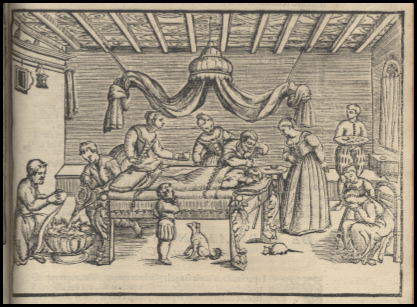
Giovanni Andrea Dalla Croce (1509?-1580).  Chirugiae…libri septem. Venice: Apud Jordanum Zilettun, 1573. picture from Croce book

Not a great deal is known of Croce’s life.  He was born at Venice, and was a member of the College of Surgeons in Venice.  In 1560 he was mentioned as being on of the city’s most successful surgeons.  Chirugiae is Croce’s major contribution and is a historic compilation of writings of authorities from Hippocrates to Abulcasis.

Croce’s wound management recommendations are similar to some used 500 years later.  Chirugiae contains excellent illustrations.  Nearly all the best known, most frequently used surgical instruments are depicted in historical sequence.  This book also depicts arrows, spears, and bullets used for warfare, and scenes of a typical 16th century operating room.

You may view this work in the John Martin Rare Book Room, Hardin Library for the Health Sciences. Make a gift to the Hardin Library for the Health Sciences by donating online or setting up a recurring gift with The University of Iowa Foundation.