Skip to content
Skip to main content

Get ready for finals @Hardin Library

The Hardin Library will be open until Midnight on Friday, December 11 and Saturday, December 12.  Get ready for finals or take a break.

FinalsWeekBlogImage


How do I get there? Take Pentacrest Cambus to the VA Loop–the library is just up the hill.

Database of the Week: Vault

Each week we will highlight one of the many databases we have here at the Pomerantz Business Library.

The database: Vault Vault

Where to find it: You can find it here, and under V in the databases A-Z list.

Use it to find:

  • Internship information
  • Company info, rankings and reviews – includes info such as: geographic reach, operations, sales and marketing, financial performance, strategy, competitors, and company news
  • Information on Industries and Professions. Industry info includes: overview of the industry, background, structure, outlook, and resources and associations.
  • Resume, Interviewing, Cover letter, Networking tips and advice

Tips for searching:

  • Use the search bar on the top right
  • Select Companies at the top to see a list of companies by industry or search for a specif company
  • Select Internships at the top to search for internships and see lists of internships
  • Select Schools at the top to see rankings of Undergraduate, Business Schools or Law Schools, or to search for a specific school.

Vault2


Want help using the Vault? Contact Willow or Kim and set up an appointment.

ScienceDirect ends support of IE8 as of 1 Jan 2016

ScienceDirect is following Microsoft’s directive to focus support on newer, officially-supported IE browser versions.

If you have any questions or concerns, please visit the ScienceDirect Blog for more details.

Note from ScienceDirect: “Compatibility mode in IE9 or higher reverts the browser back to IE7 or IE8 behavior. If you experience issues accessing ScienceDirect using IE9 or higher, please disable the compatibility view mode in your IE browser.”

ScienceDirect ends support of IE8 as of 1 Jan 2016

ScienceDirect is following Microsoft’s directive to focus support on newer, officially-supported IE browser versions.

If you have any questions or concerns, please visit the ScienceDirect Blog for more details.

Note from ScienceDirect: “Compatibility mode in IE9 or higher reverts the browser back to IE7 or IE8 behavior. If you experience issues accessing ScienceDirect using IE9 or higher, please disable the compatibility view mode in your IE browser.”

Indian Claims Insight – Trial ends 1 Jan 2016

Indian Claims Insight allows users to research the history of U.S. Indian claims from 1789-present. Unique compiled docket histories provide legal researchers with the ability to quickly search the full text of all content related to each claim, which can be narrowed on-the-fly to pinpoint a topic. The compilation includes not only court documents, but also cited treaties, related congressional publications, and maps to facilitate the ability of researchers to fully understand the specifics of each case without leaving the docket history page.

Please send additional comments to Janalyn Moss.

The Weather Outside is Frightful….

It’s here…..are you ready? We’ve already had to scrape the frost from our car windows and shovel our driveways and sidewalks… And meteorological winter is upon us.
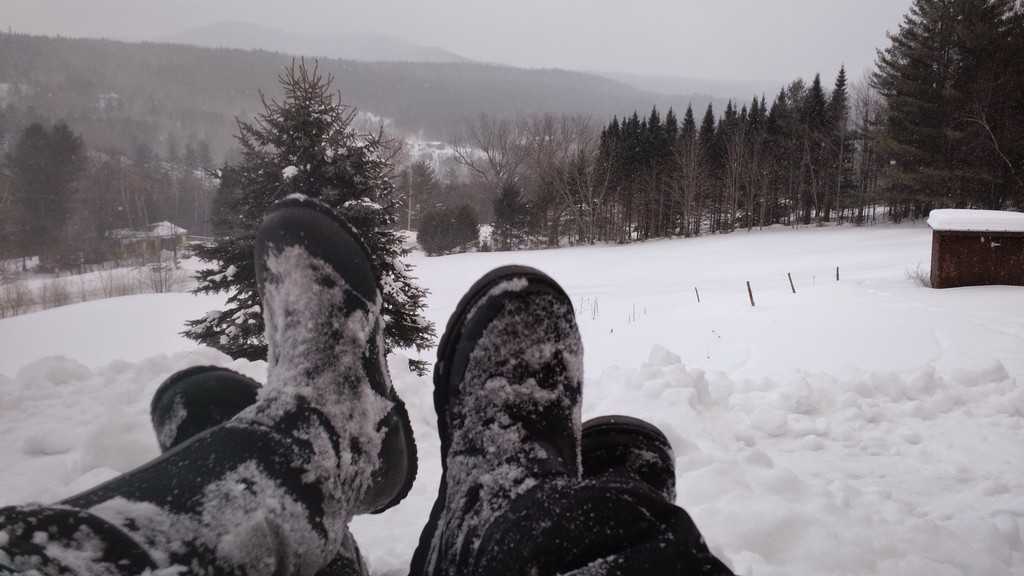
This is beautiful, right? photo by Carol Johnk

This is beautiful, right? photo by Carol Johnk

If you can look past the cold and the shoveling and scraping, snow and frost can really be quite beautiful. Really.

“Under the microscope, I found that snowflakes were miracles of beauty, and it seemed a shame that this beauty should not be seen and appreciated by others. Every crystal was a masterpiece of design, and no one design was ever repeated. When a snowflake melted, that design was forever lost. Just that much beauty was gone, without leaving any record behind.”  — Wilson Bentley (1865-1931)

We know there are different types of precipitation. Snow, sleet, freezing rain, hail, and graupel. (Seriously, there is a form of precipitation called graupel).

What is the difference between how sleet and freezing rain are formed?

We all know what sleet is when we are walking or driving in it. But what is sleet? Sleet forms when raindrops freeze in the air while they are falling. The raindrop then has to encounter warmer air, which again melts it and turns it into a raindrop again. Then, if the raindrop encounters another layer of air where the temperature is below 32°F it can refreeze and form sleet. However, while freezing rain looks like a gentle rain, when a raindrop is cooled to 32°F and then hits a surface it forms a thin film of water which quickly turns into a continuous sheet of ice. Freezing rain can cause more problems than sleet or snow because it makes travel more treacherous and can coat power lines and tree branches causing them break from the weight..

So, now, what the heck is graupel? In Understanding Weather and Climate, the authors state that graupel is formed, “When an ice crystal takes on additional mass by riming, its original six-sided structure becomes obscured and its sharp edges are smoothed out.” This new ice may have small air bubbles which can give it a milky-white appearance. (Riming is when ice crystals fall through a cloud and collide with super-cooled droplets and those droplets freezes on the ice crystals.) So, now when you are being bombarded by little ice pellets, you’ll know that is graupel! If graupel remains in the clouds, it provides the nuclei from which hail is formed. An updraft carries the groupel pellet above the freezing level, which forms the core of the hailstone. The pellet falls from the updraft, collides with liquid droplets that coat it in a film of water. If the pellet is caught in another updraft, the layer of water freezes, creating another coat of ice…..
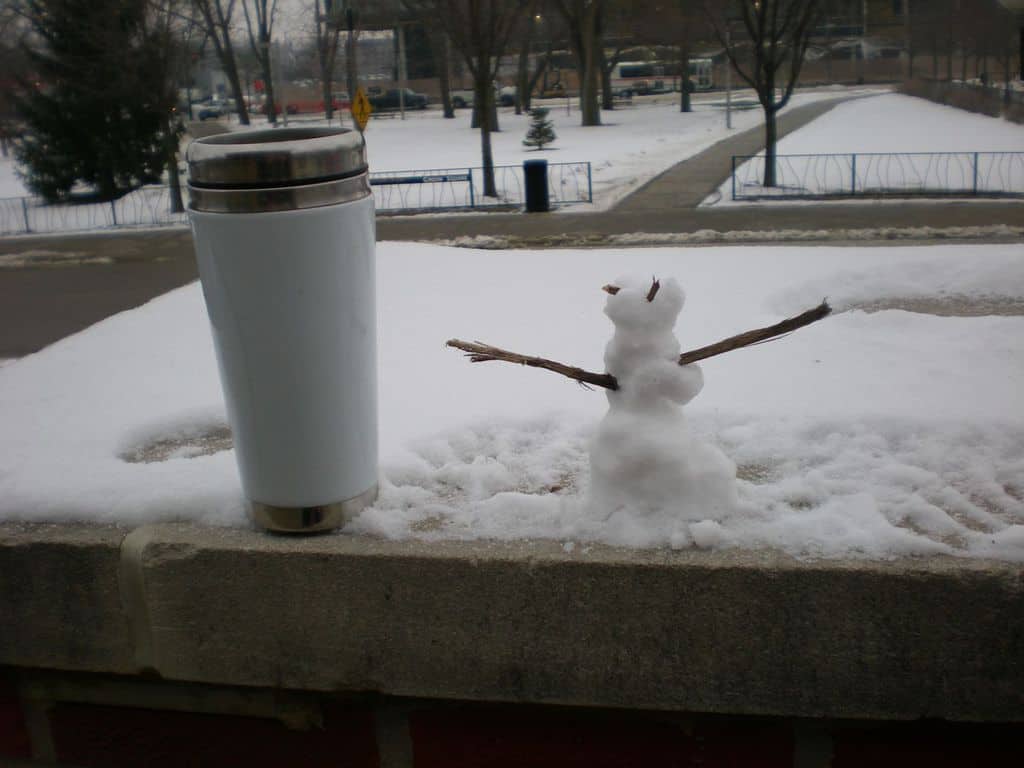
mini_snowman

A mini-snow person! Photo by Carol Johnk

Skiers love powder and kids love snow ball fights. Why are there different types of snow? Snow results from the growth of ice crystals from several different methods.  If a crystal from the cold, upper reaches of a cloud falls through to a warmer environment, the combination of moisture and temperature will create a particular structure at its core and other structures will layer on it. If riming is the dominant growth process, the crystals form a dense, wet snow pack – perfect for snowball fights, forts and snow people. That wet snowfall is heavy and not much fun for snowblowers and those who must shovel. Powder is formed when very cold snow falls and has smaller snowflakes than the more dense snowfall. Because they have a lower density the crystals have less adhesion and don’t pack well. Skiers love to ski this powder snow!
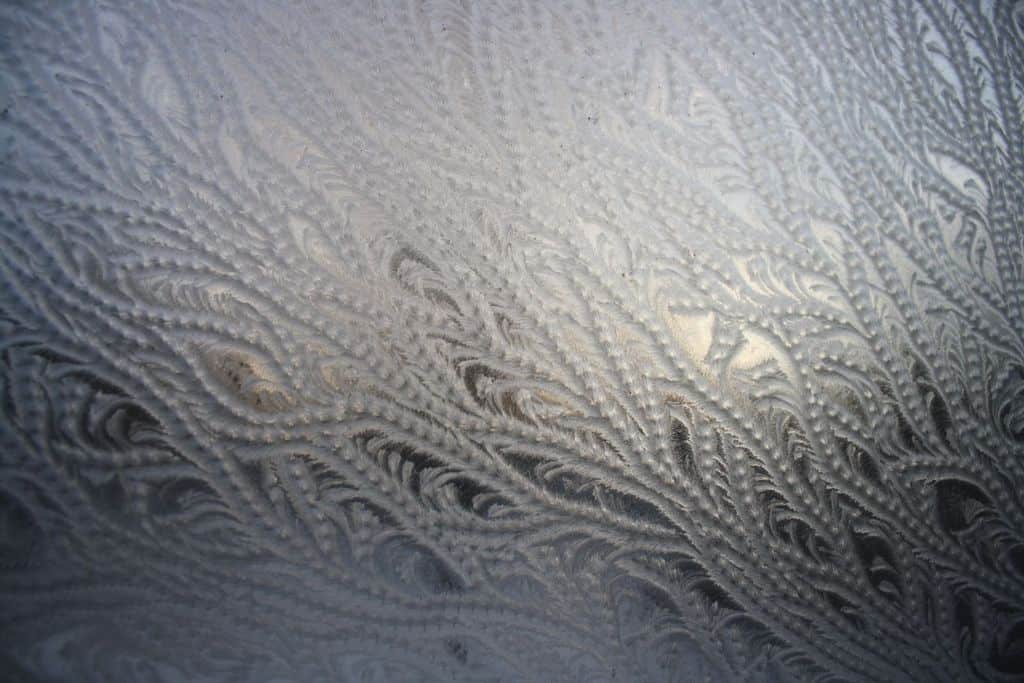
Frosty windowpane. Photo by Carol Johnk.

Frosty windowpane. Photo by Carol Johnk.

And then we come to frost….and frozen dew….and black ice…

Briefly, frost is when the temperature is lowered to 32°F and very small ice crystals are deposited onto solid surfaces giving them a white appearance. That type of frost (sometimes called hoar frost) happens with the transformation of water vapor directly into ice. Frost is easy to remove with window scraper (or a credit card!)
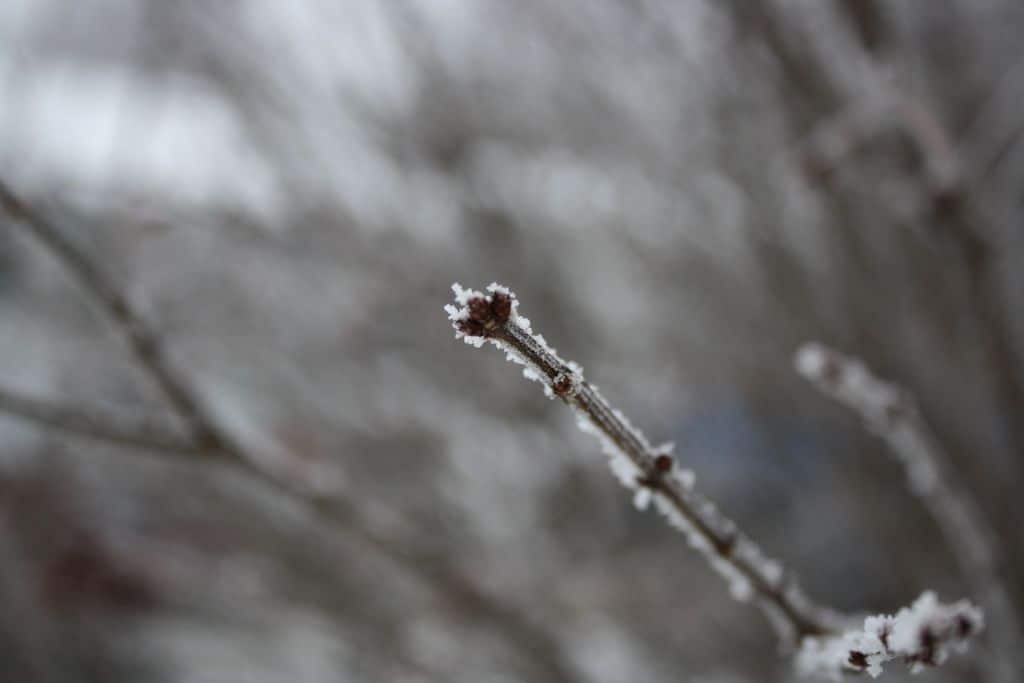
hoar_frost

White frost, also known as Hoar frost. Photo by Carol Johnk.

Frozen dew, on the other hand, begins when the temperatures are slightly above 32°F and then cool to below freezing, which causes a thin, continuous layer of ice to form. This is what is difficult to remove from your windshield, get your key into your car door, or even open the door…. of course, the advantage of not being able to get into your car means you won’t be out driving on black ice (the frozen dew that forms on road surfaces and is nearly impossible to see).

Now, as you slip, slide, shovel, and ski your way through the winter, you’ll know why! Be careful out there!!

Resources:

Aguado, Edward. 2010. Understanding weather and climate. Upper Saddle River, NJ : Pearson Education. Engineering Library QC871.3 .A38 2010

Other Resources:

Black Ice: How to Spot This Winter Driving Danger. 2015. AccuWeather, Inc.

Guide to Frost. February 1, 1999. Accessed November 24, 2015.  SnowCrystals.com

Rauber, Robert M. 2002. Severe and hazardous weather. Dubuque, IA : Kendall/Hunt Pub. Co.

Resources about the uniqueness of snowflakes:

It’s True That No Two Snowflakes Are Alike, But not For The Reason You Think. by Cate MatthewsJanuary 10, 2014.  HuffPost Science. TheHuffingtonPost.com Inc.

The Science of Snowflakes, and Why No Two Are Alike. by Julia Griffin, December 22, 2011. PBS Newshour. NewsHour Productions LLC. 

Snowflakes All Fall In One of 35 Different Shapes. by Marissa Fessenden, December 30, 2014. Smithsonian.com.

Resources about hypothermia, frostbite

Diseases and Conditions Hypothermia. by Mayo Clinic Staff, June 18, 2014. Mayo Foundation for Medical Education and Research.

What is Hypothermia?  Hypothermia: causes, symptoms and treatment. WebMD.com

Diseases and Conditions Frostbite. by Mayo Clinic Staff, October 15, 2014. Mayo Foundation for Medical Education and Research.

Frostbite. MedlinePlus. U.S. National Library of Medicine, U.S. Department of Health and Human Services, National Institute of Health.


December Notes from the John Martin Rare Book Room @Hardin Library | Jacopo Berengario Da Carpi

Jacopo Berengario Da Carpi

Jacopo Berengario Da Carpi

JACOPO BERENGARIO DA CARPI (1470-1530). Isagoge breves, perlucide ac uberime, in anatomia humani corporis. [Bologna: Impressum per Benedictum Hectoris, 1522].

Berengario was a serious student of Mondino and followed him in all matters pertaining to anatomy.  He wrote Commentaria on Mondino’s Anothomia in 1521, and corrected many of Mondino’s shortcomings and added in his own observations.  He wrote his own anatomical compendium in 1522.

Berengario’s illustrations lack detail, but his woodcuts are believed to be the first to be taken directly from human dissections.  The full-length figures are shown in action poses.  His muscle figures and skeletons are drawn against landscape backgrounds in the same fashion used later by Estienne and Vesalius.

Leonardo da Vinci’s anatomical drawings received limited circulation, but the influence of da Vinci’s artistic techniques is evident in a number of Berengario’s woodcuts.  This rare book is an important example of anatomical illustration in the pre-Vesalian period.

You may view this book in the John Martin Rare Book Room, Hardin Library for the Health Sciences.  Illustrations from 1523 edition available online from the National Library of Medicine.  Make a gift to the Hardin Library for the Health Sciences by donating online or setting up a recurring gift with The University of Iowa Foundation.


VSim Show and Tell

A few weeks ago, I presented an exciting new prototype program I’ve been keeping my eyes on. It’s a program out of UCLA called VSim. I had the pleasure of demo-ing this program for about 20 of my colleagues from across campus and we discussed the possible applications of a full-fledged VSim program. We would be able to publish 3D digital objects that include bibliographical data – great for the researchers, metadata – the favorite thing for librarians, paradata (data about the data) – the important stuff for scholars wishing to emulate or study the models. VSim not only has the potential to package this data together, but it is also meant to function as a presentation tool, with the functionality to link outwards to the internet. It was built with the primary audience of teaching scholars. This is exciting because it’s the only attempt, to my knowledge, of nesting contextual information directly in a 3D model. It may be a way to begin thinking about how we will preserve 3D in the future. Currently, we attempt to preserve the 3D model, but it’s typically separate from the narrative or publication that appears in the more traditional formats as a journal article of monograph. What’s the point of creating 3D when you’re just going to present it in a 2D medium? Hint: there is none.

VSim User Interface


The discussion moved quickly passed the oohh’s and awww’s (as is want with such a grouping) to talk about the technicalities. How would we support the new file type it’s creating? Why stray from the standard-not-so-standard .stl or .dae file formats? They work well enough, no? Or, how much would something like this cost to support should it go to production? There was an assumption that this tech would not be free to use.  How would it all be packaged and disseminated?

For as much potential as those questions have to totally kill the buzz, we did quickly return to; “this is really cool. Can I play with it?!”

That was the whole point. Feel free to check it out at: https://idre.ucla.edu/research/active-research/vsim/vsim-downloads