Skip to content
Skip to main content

Database of the Week: Mergent Intellect

The database: Mergent Intellect

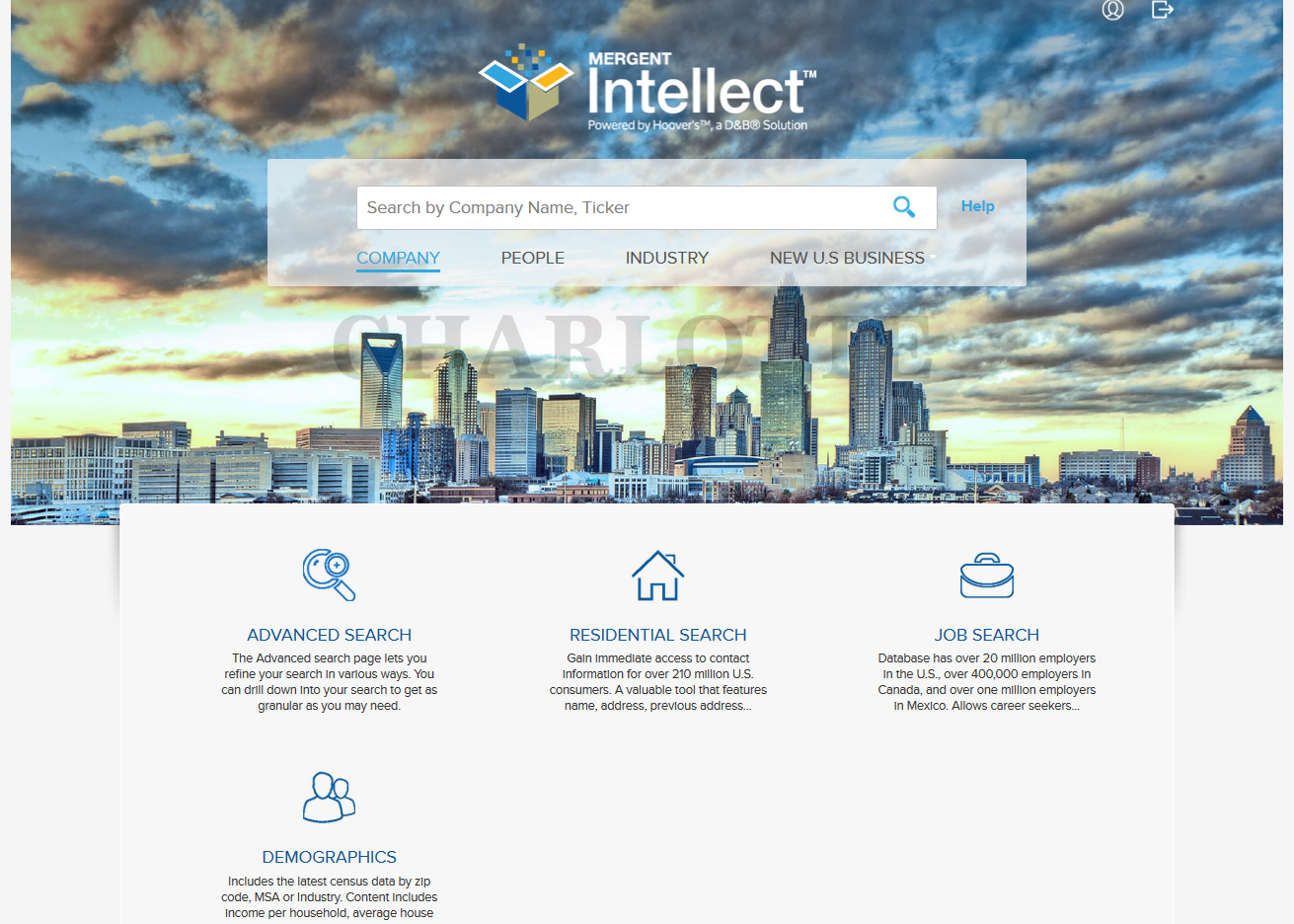
Powered by Hoover’s™, a Dun & Bradstreet Solution, Mergent Intellect is a flexible web-based application that features a deep collection of worldwide MergInt8business information that enables companies to generate insightful business intelligence. Coupling Mergent’s expertise in developing products for the reference marketplace with Dun & Bradstreet’s private company database, Mergent Intellect offers new and existing clients a unique opportunity to access private and public U.S and international business data, industry news, facts and figures, executive contact information, the ability to access industry profiles and much more.
Where to find it: You can find it here, and under “M” on our Databases A to Z page.

Use it to find: Information on private companies, new U.S. companies, public companies, and international companies; people; demographics; industries.

Tips for searching:

  • Basic: Select a category (Company, People, Industry, or New U.S. Business) and then enter your search term in the box.
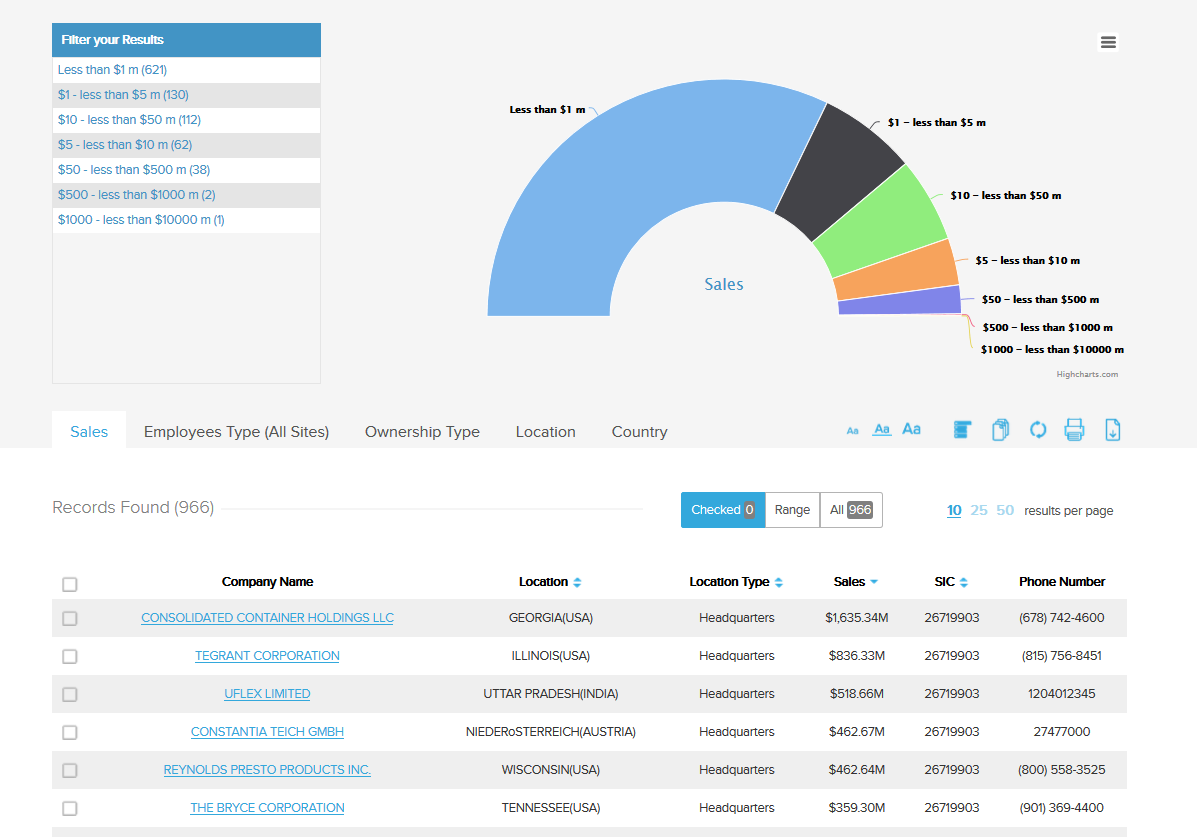
  • Or, choose “Advanced Search”.  Select company/people criteria (industry, geographic location, size, job title, etc.) to shape your search. Click on “Add to Criteria” (blue button toward bottom) as you choose criteria for your search.
  • Lists of search results can be exported in CSV and PDF formats.
  • Other search features available from Mergent Intellect’s main page include: Demographics, Residential Search, and Job Search.
MergInt10


Note: The Business Library has obtained a one year trial of Mergent Intellect. Take a look and let us know what you think.

Want help using the Mergent Intellect? Contact Jim or Kim to set up an appointment.

Scopus & Web of Science | Workshop Tuesday, Feb. 16 10am

Web of science

Scopus and Web of Science databases are multidisciplinary and allow you to measure scholarly impact. Most citations that are in EMBASE are also in Scopus.

This hands-on session will demonstrate:

1) how to quickly find the articles you need for you research or systematic review in each database
2) how to track an article’s cited and citing references in each database
3) how to find journal Impact Factors using the Journal Citation Index in Web of Science
4) how to determine an author’s H-index using Scopus.

Our next session is:
Tuesday, February 16th, 10-11a – East Commons

Register online or by calling 319-335-9151.  If this time doesn’t work for you, you may also request a personal session online.

A-R Online Music Anthology – Trial ends 29 February 2016

A-R Editions’ Online Music Anthology contains music from antiquity through the romantic era, with extensive contents for the Middle Ages, Renaissance, and Baroque. In contrast to the 120 to 150 or so pieces found in print anthologies that cover these eras, A-R Editions’ Online Music Anthology offers over 600 essential piece—over twice as many as print anthologies, with over 5000 total pages. Many of the works are presented in their entirety rather than in excerpt, and all are newly edited and typeset specifically for this edition.

Please send additional comments to Katie Buehner.

LIBRARY SERVICES: Paging Service and CIC borrowing

NEW PAGING SERVICE—Beginning January 4, 2016, you can request up to 10 items for pickup at the Main Library through our catalog. Please request materials before 12:00 a.m. midnight for pickup after 12:00 p.m. noon the following business day. Requests received on a Friday will be ready the next Monday.

UBorrow_Logo—When you have immediate need for items that are not available from the University of Iowa Libraries, search UBorrow. UBorrow enables you to find and request books directly from 15 major research libraries, with combined collections of more than 90 million volumes.

Learn more about and search UBorrow at guides.lib.uiowa.edu/uborrow

LIBRARY SERVICES: Paging Service and CIC borrowing

NEW PAGING SERVICE—Beginning January 4, 2016, you can request up to 10 items for pickup at the Main Library through our catalog. Please request materials before 12:00 a.m. midnight for pickup after 12:00 p.m. noon the following business day. Requests received on a Friday will be ready the next Monday.

UBorrow_Logo—When you have immediate need for items that are not available from the University of Iowa Libraries, search UBorrow. UBorrow enables you to find and request books directly from 15 major research libraries, with combined collections of more than 90 million volumes.

Learn more about and search UBorrow at guides.lib.uiowa.edu/uborrow

It’s Love Your Data Week!

Love_Data_Heart_square

Love_Data_Heart


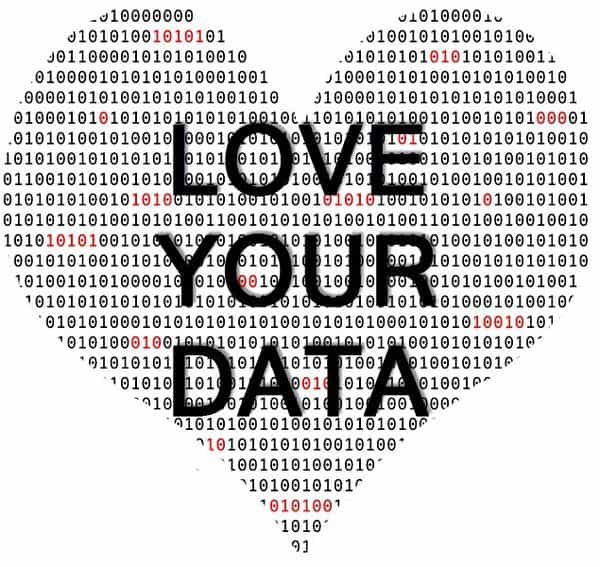
Valentine’s Day isn’t just for people – it is time to Love Your Data, too!

Love Your Data Week (LYD) is about recognizing the ways in which individuals and institutions can care for their data – by adopting consistent practices, and then modeling and implementing those practices. Federal funding agencies have more and more requirements with which researchers must comply. More public access to research results – including data – is one of those requirements. Love Your Data week will help researchers, libraries, and students look at how to be responsible stewards of their work.  The LYD website provides tips and tricks for managing research data, resources to help with data management, and daily activities. 

According to the LYD website, “Loving your data means investing in it, taking care of it for the future. Over the five day event, we will guide you through five activities to help get your data organized, secure, and ready for write-up, sharing and reuse.”

Each day of LYD week has a different theme:

  • Monday, Feb. 8: “Data: Keep It Safe”
  • Tuesday, Feb. 9: “It’s the 21st Century — Do You Know Where Your Data Is?”
  • Wednesday, Feb. 10: “What Did I Mean Here?”
  • Thursday, Feb. 11: “Give/Get Credit for Data”
  • Friday, Feb. 12: “Think Big: Transforming, Extending, Reusing Data.”

Involvement across social media platforms is encouraged, and to be involved in the conversation use #LYD16 for Twitter, Instagram and Facebook. For Pinterest use Resources to help you LYD, and The changing face of data.  Unsure about how best to get involved? Check out the logistical details link for all you need to know! Join in the conversation, share your experiences and connect with others in data management!

The University of Iowa Libraries also has a thorough Resource Data Services guide to help you with your data management. There is information on organizing and documenting your data, creating a data management plan and other resources. If you have any questions you may email Qianjin (Marina) Zhang, the Licthenberger Engineering  & Informatics Librarian at qianjin-zhang@uiowa.edu; Sara Sheib, University of Iowa Sciences Library Reference & Instruction Librarian at sara-scheib@uiowa.edu, or by emailing lib-data@uiowa.edu

Like us on Facebook, follow us on Twitter (#UIEngLib), and Pinterest to keep up-to-date on all our activities and resources.

Have fun checking out all the data resource management tools we have available and learn to Love Your Data!


Resources:

Love Your Data. 2016.

Celebrate Love Your Data Week with Emory Libraries Feb. 8-12. February 2, 2016.  Emory Libraries & Information Technology. Emory University.

Libraries’ Love Your Data Week raises awareness among research universities. Feb. 5, 2016. Penn State News.

February Notes from the John Martin Rare Book Room @Hardin Library | Henri de Mondeville

mondeville2

mondeville2

Henri De Mondeville

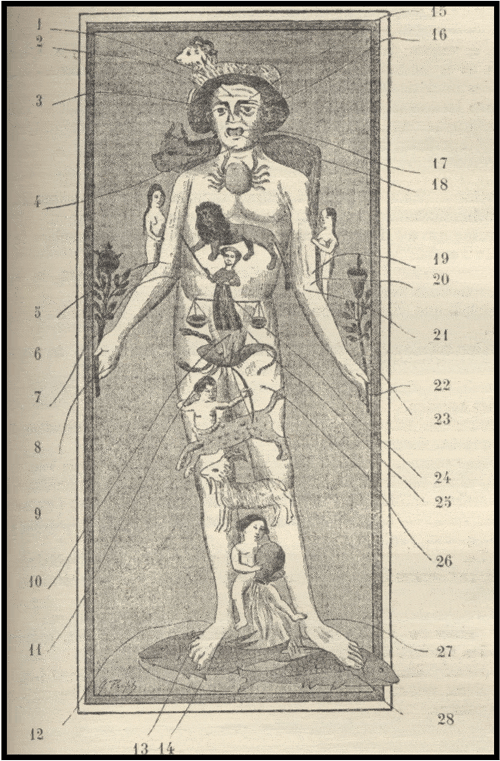
Henri De Mondeville (ca 1260- ca 1320). Chirurgie. Paris: Felix Alcan, 1892.

Mondeville was born in Normandy and studied medicine in Paris and Montpellier before going to Bologna.  Italian surgeons were at a much higher status than in France at this time.

Mondeville’s chief work, the Cyrurgia, was written between 1306-1320 and contains his basic teachings.  This encyclopedia includes Mondeville’s views and practices of medical ethics, anatomy, surgery, physiology, and therapeutics.

Mondeville advocated cleanliness in treating wounds and was opposed to the use of salves.  He believed suppuration hindered wound healing and routinely used ligation instead of cautery.

The Cyrurgia was not published until 1892, when Pagel, after studying manuscripts in Berlin, Erfurt, and Paris, published the original Latin text.

You may view this book in the John Martin Rare Book Room, Hardin Library for the Health Sciences.  Make a gift to the Hardin Library for the Health Sciences by donating online or setting up a recurring gift with The University of Iowa Foundation.

picture from book

from Chirurgie by Henri de Mondeville


Find relevant articles faster | PubMed workshops

pubmed

PubMed is the National Library of Medicine’s index to the medical literature and includes over 22 million bibliographic citations in life sciences. This one-hour session will show you how to improve your search results by using subject headings (MeSH) and advanced keyword searching techniques.
Our sessions this semester:

pubmed2