 Newsfeed: OCLC posted about the UI Libraries’ social media on their blog: The University of Iowa Libraries celebrate and promote their digital collections on social media http://www.oclc.org/news/announcements/2016/CONTENTdm-news-item-March-2016.en.html The Space Age and the […]
Meet Dorothy Wirtz
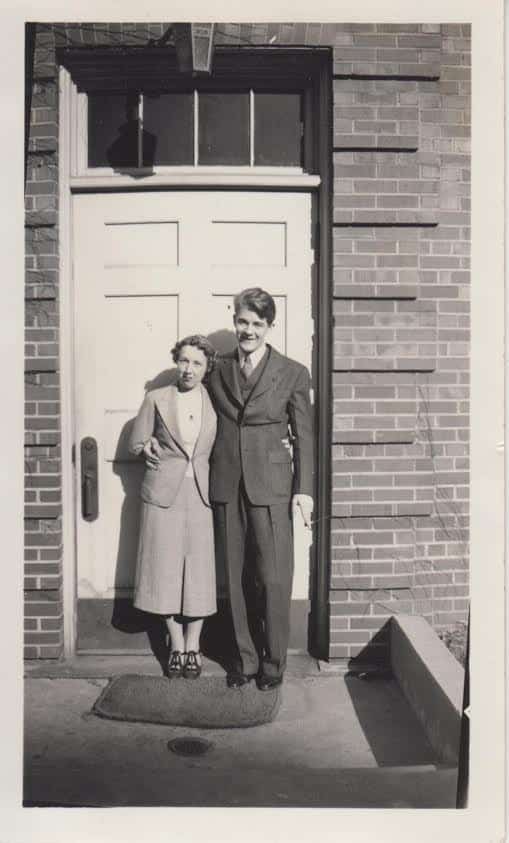
Dorothy and Warren “Jack” Wirtz, students at the University of Iowa, 1938
A few years after the Iowa Women’s Archives opened, Dr. Dorothy Wirtz [1915 – 2013] donated some pieces of her college years at the University of Iowa. Dorothy Wirtz’s 1997 gift to the IWA includes her academic articles and a selection of her poetry. However, the papers mostly concern the exploits of Wirtz and her brother, Warren, as students at the University of Iowa in the late 1930s. Both French majors, the siblings balanced classes with extracurricular activities, worried about finances, and wrote home frequently. Dorothy’s letters are especially candid about her determined penny-pinching, and reflect the struggle of affording college during the Great Depression. “Do you realize,” Dorothy wrote to her mother in 1937, “that I am going to be able to maintain myself for the entire year and also probably pay Ed back within the year? What a woman! After this, remember that I am not to be discouraged in anything I want to do.” Her letters also describe an active social life with parties for French and German students and even seeing “the much talked of Black Angel,” a statue at the local Oakland Cemetery rumored to be cursed.
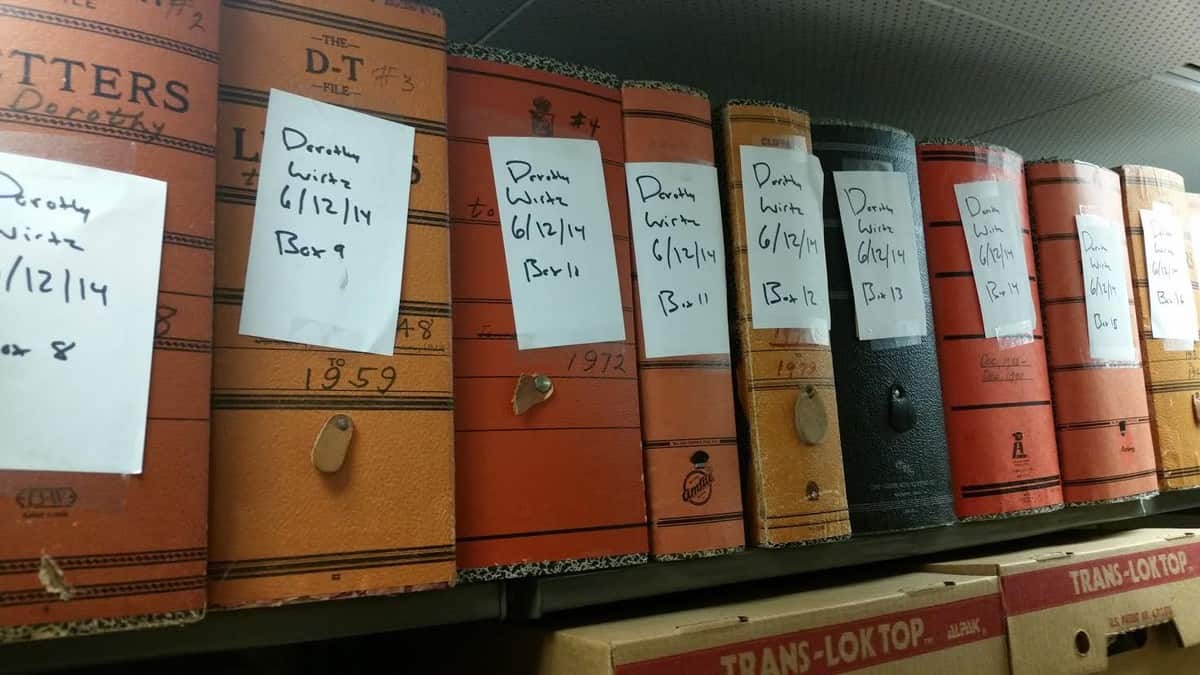
A portion of Wirz’s recent donation
Born in Keokuk, Iowa and a 1939 graduate of the University of Iowa, Wirtz left her home state for an impressive and lengthy academic career. She and her brother Warren “Jack” Wirtz, a composer, led lives that reflected their artistic passions. Professor of French, pianist, published poet, and deputy treasurer of the state of Arizona, Wirtz’s life was full, but her single box of papers at the Iowa Women’s Archives did not match the extent of her accomplishments. We know that the Wirtz siblings made their home together in Phoenix, Arizona from the 1950s until Warren’s death in 1972. But after 1939, the correspondence and their collection nearly stops. Aside from a few poems, compositions, and papers, Dorothy and “Jack” Wirtz might as well have disappeared.
But th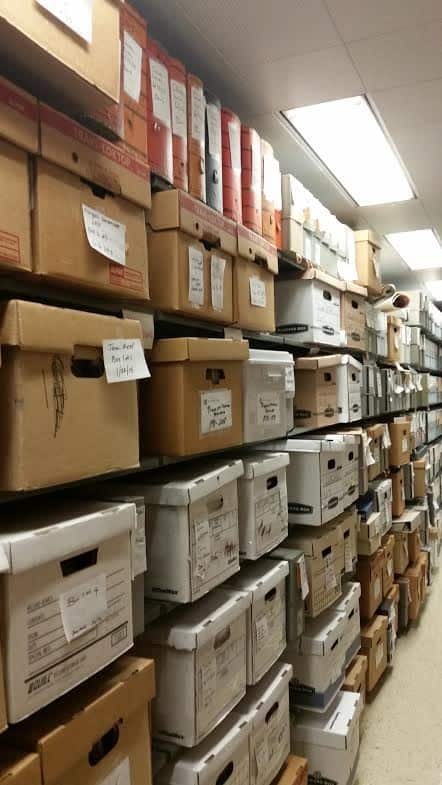 at is about to change. Dorothy Wirtz bequeathed the IWA approximately 12 linear feet of materials: letters, diaries, and artifacts from an extraordinary life. The materials in these 16 boxes should fill in the gaps, giving a more complete picture of the lives of two incredible University of Iowa alumni. Wirtz’s gift included enough funds to hire me as the Dorothy Wirtz Graduate Research Assistant. This year, I will process these papers for researcher use and share my progress on the IWA blog and tumblr. Stay tuned for updates!
— Annie Tunnicliff, Dorothy Wirtz Graduate Research Assistant
EBSCO Digital Archives, various – Trial ends 15 April 2016
African American Historical Serials Collection features more than 170 unique titles related to African American life and culture, including approximately 60,000 pages of searchable primary source content such as reports and annuals from African American religious organizations and social service agencies, and African American periodicals, as well as extensive coverage of African American religious organizations, churches and institutions
Arte Público Hispanic Historical Collection: Series 1 presents a digital collection of historical content pertaining to Hispanic history, literature, political commentary, and culture in the United States.
Arte Público Hispanic Historical Collection: Series 2 presents thematic content focusing on the evolution of Hispanic civil rights, religious thought, and the growing presence of women writers from the late 19th and 20th centuries. Rare and relevant books and newspapers – including rare anarchist newspapers – are presented in their original form.
Islam in the Modern World, 1804-1918 addresses the beliefs, practices, theology, spirituality, and history of Islam. Content includes biographies of the Prophet Muhammad, works comparing Christianity and Islam, key theological and philosophical texts (including the Quran), relevant mystical and spiritual works, and texts surveying the history of Islam.
Please send additional comments to Carmelita Pickett.
Be prepared: Take a look inside Vault.
Getting ready for interviews? Researching internships? Thinking about business school or law school?
The Pomerantz Business Library has a great resource to help you: Vault.
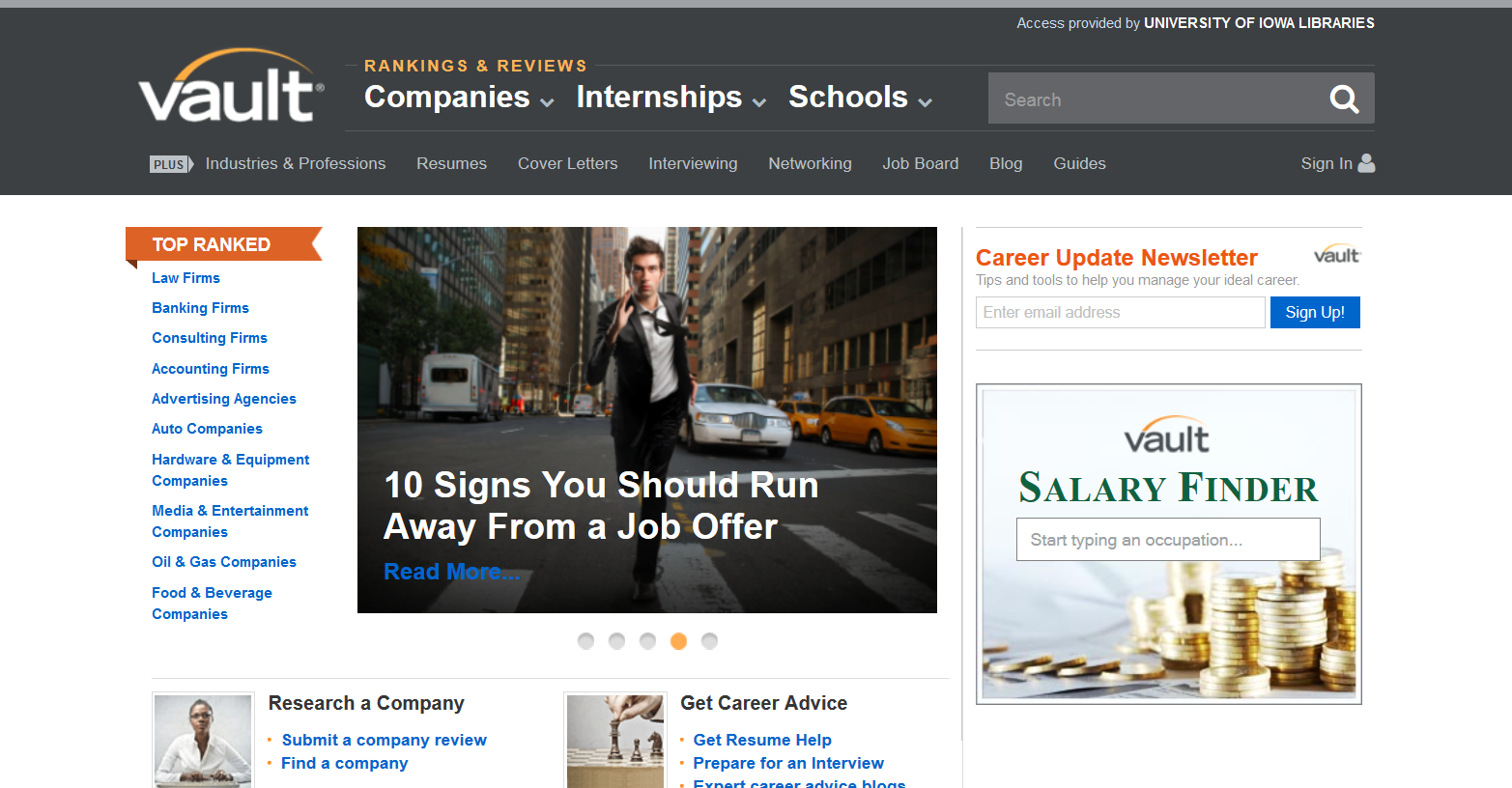
Vault has an abundance of good info for the job or internship seeker. It also has rankings and reviews of law schools, business schools, and undergraduate institutions. To get a fuller picture of Vault’s capabilities, take a look at our recent profile of the site.
In addition, if you need more detailed company information (financials, corporate structure, executive profiles, etc.) to prepare for an interview, take a look at our Company Information guide. Or, perhaps you’re considering jobs or internships with companies in unfamiliar industries? If so, take a look at our Industry Information guide. This guide will help you find industry profiles, key industry players, financial ratios, and much more.
Get up to date with the latest company and industry news: take a look at one of our article databases such as Business Source Complete or Factiva and search for companies and industries of interest.
Have questions or need help? Email Jim or Kim. Or call 319-335-3077.
Two Women’s History Month Events in March
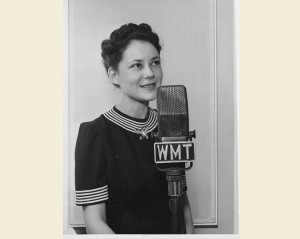

Mujeres Latinas: Every Woman Has a Story
Saturday, March 5, 2016, 11 a.m. to 1 p.m.
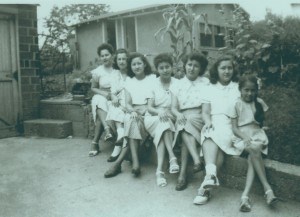 Join us in the Iowa Women’s Archives to learn about the rich history of Latinas, their families, and organizations in Iowa.
~Bring a memento from your past to share with the group.
~Learn how to preserve it.
Refreshments will be served!
Iowa Women’s Archives, 3rd Floor Main Library, University of Iowa
RSVP: lib-women@uiowa.edu Questions? Call 319-335-5068
Presented by the Iowa Women’s Archives and Kirkwood Community College
Latino Americans: 500 Years of History has been made possible through a grant from the National Endowment for the Humanities and the American Library Association.
See this event on the University of Iowa Calendar of Events
We Did So Much Beyond the Home:
Jewish Women and Community Life in Iowa
Thursday, March 24, 2016, Reception at 4 p.m., Talk will begin at 4:30 p.m.
A talk by Jeannette Gabriel, graduate research assistant, for the Jewish Women in Iowa Project
Join us to hear the untold stories of Jewish women’s involvement in community activities throughout Iowa history, whether in cities with robust Jewish populations or in small towns where only one or two Jewish families lived.
Iowa Women’s Archives, 3rd Floor Main Library, University of Iowa.
RSVP: lib-women@uiowa.edu Questions? Call 319-335-5068
See this event on the University of Iowa Calendar of Events.
Accommodations
Individuals with disabilities are encouraged to attend all University of Iowa–sponsored events. If you are a person with a disability who requires a reasonable accommodation in order to participate in this program, please contact the sponsoring department or contact person listed in advance of the event.
Learn to find nursing and allied health literature | CINAHL | Workshop March 1, 11am-12pm

 This hands-on session will demonstrate how to use CINAHL effectively to find high quality nursing and allied health literature.
Learn to select the most appropriate search terms and practice searching.
Open to all skill levels!
Our session is:
Tuesday, March 1, 11am-12pm
Tuesday, March 1, 11am-12pm
No time for the workshop? Request a personal session or sign up for our other workshops online.
New Resource: The Medical Letter (site license) and its Mobile App
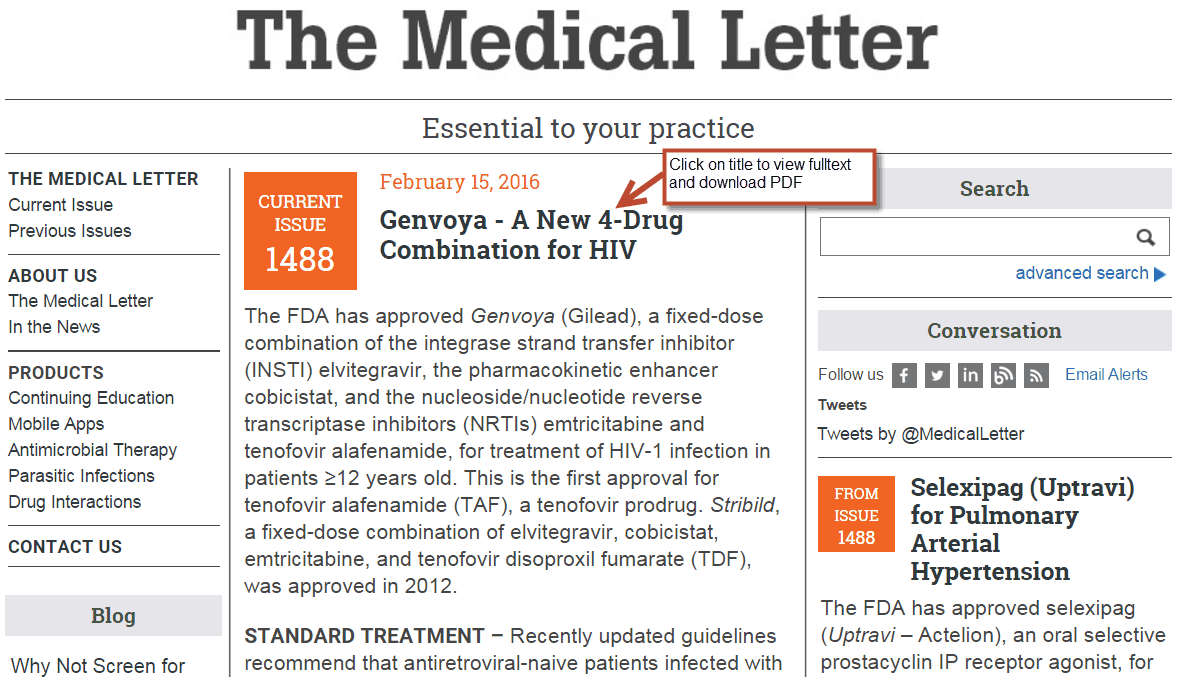
Hardin Library for the Health Sciences now has a site license for the Medical Letter at http://purl.lib.uiowa.edu/MedLetter. Medical Letter can also be found on the Health Sciences Resources A-Z http://guides.lib.uiowa.edu/az.php .
The Medical Letter’s home page shows the current issue of The Medical Letter on Drugs and Therapeutics.
- To view full text articles and to find the Download PDF link, click on the title of the article.
- Use the navigation links on the left side of the screen to access other contents, including previous issues, continue education (CME/CE), Drugs for Parasitic Infections, and The Handbook of Antimicrobial Therapy.
Note that the library also has print copies of the Medical Letter on Drugs and Therapeutics, Drugs for Parasitic Infections, and Handbook of Antimicrobial Therapy. Search InfoHawk Catalog for more information.
Content in the Medical Letter on Drugs and Therapeutics can also be accessed via the Medial Letter mobile app. Follow the steps below to install the app.
- Go to http://purl.lib.uiowa.edu/MedLetter
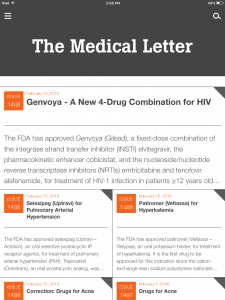
- Click the Mobile Apps link under Products on the left side of the screen.
- Fill in the registration form using your Iowa email to set up a password.
- Open the App Store on your mobile device, search for “the Medical Letter” and install at no charge.
- Log in with the password you created earlier.

Questions? Comments? Email us at lib-hardin@uiowa.edu or call (319) 335-9151.
Special Collections Weekly Update 2/26/2016
 News: Applications are now being accepted for the Linda and Richard Kerber Fund for a grant of $1000 to support travel to Iowa City, Iowa, to conduct research in the Iowa Women’s […]
In Plain Sight: Autograph Collections Yield Unrealized Riches
 By Jacque Roethler, Manuscripts Processing Coordinator Librarian We recently came across two autograph collections in our stacks from collectors named Charles Alrich and Peggy LeBold which we have combined into one collection. […]
Are You Feeling S.A.D? Engineering & Technology Can Help!

Do you feel like adding another layer (or more) of fat? Do you feel like sleeping the winter away or maybe just lying on the couch? Would you rather be a bear and just hibernate? If so, you could have Seasonal Affect Disorder or SAD.

So, what is SAD and how can technology help?
SAD is a type of depression that occurs during the same season every year – usually during the winter months. Symptoms include feeling sad, grumpy, moody, losing interest in normal activities, eating more (remember the urge to hibernate?) and often craving carbohydrates. Other symptoms including gaining weight, sleeping more (but still feeling tired), and having trouble concentrating…
 SAD is caused by a lack of sunlight which upsets the sleep/awake pattern and other circadian rhythms. Briefly, a circadian rhythm is the 24-hour cycle of physical and mental changes that happen because of your “biological clock.” Lack of sunlight can also cause problems with the brain chemical, serotonin, which helps regulate moods. Seratonin is a neurotransmitter, which is a chemical produced by nerve cells in the brain. If the normal balance of the neurotransmitters is upset, the result can be headaches, depression and other mental health issues.
Although SAD usually occurs in winter, it may also happen when one lives in a city where the skyscrapers keep natural light from reaching the sidewalks. It also happens in offices where the staff are located in the center of the building away from windows and natural light.
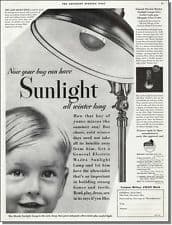
Now you can have sunlight all winter long!
Most of us have heard of “light therapy,” and “sun lamps,” and think of them as a relatively new phenomena. However, as far back as 1929 Eveready was one company promoting a sun lamp. The quality of the early sunlamps varied from company to company and what sort of diodes were used. As it became more accepted that sunlight was important for health reasons, researchers also investigated clothing material that was the most beneficial for sunlight (linen and artificial silk) and vitamin D (the sunshine vitamin) began to be added to food,
The American Psychiatric Association has recognized the role that lack of sunlight plays in SAD and the treatment recommended? Much the same as the products in the 1930s – light boxes!
Replacing lost sunlight exposure resets the body’s internal clock. A light box emits light that is brighter than indoor lighting, but not as bright as direct sunlight. The many types of sun lamps have different purposes. Some are made to treat skin disorders and they emit more ultraviotet (UV) light. Light boxes for SAD should emit as little UV light as possible. Light boxes often use fluorescent or incandescent bulbs, but many now use LEDs. Most use white light, but there are also some that use the shorter wavelength blue light. Warning: tanning beds are not the same as a light box and should not be used as such.
Discussion over the benefits light therapy has included the worry that sun exposure contributes to skin cancer. There are now studies that suggest that some sunlight exposure will do more good than harm. Some researchers believe that exposure to sunlight and vitamin D might help with osteoporosis, and may help prevent many cancers, most of which are more deadly than skin cancer.
Interesting fact: Not only humans suffer from a lack of sunlight. In the late 1920s zoos began placing panes of glass in the animal cages. The result? Animals gravitated towards the natural light and began to have better appetites, fuller coats and better spirits.
So, instead of being a bear and hibernating this winter – find a way to soak up some vitamin D!
Resources:
Rreund, Daniel. American sunshine: diseases of darkness and the quest for natural light. 2012. Chicago : London : University of Chicago Press. Engineering Library QC911 .F83 2012.
Seasonal Affective Disorder (SAD) – Topic Overview. WebMD. Date accessed February 10, 2016.
Depression Health Center : Light Therapy – Topic Overview. November 14, 2014. WebMD.
Seasonal affective disorder treatment: choosing a light box. 1998-2016. Mayo Foundation for Medical Education and Research.