 On August 29 through September 25, the University of Iowa Libraries’ Main Gallery will be featuring the Folger Shakespeare Library’s traveling exhibit First Folio! The Book That Gave Us Shakespeare. […]
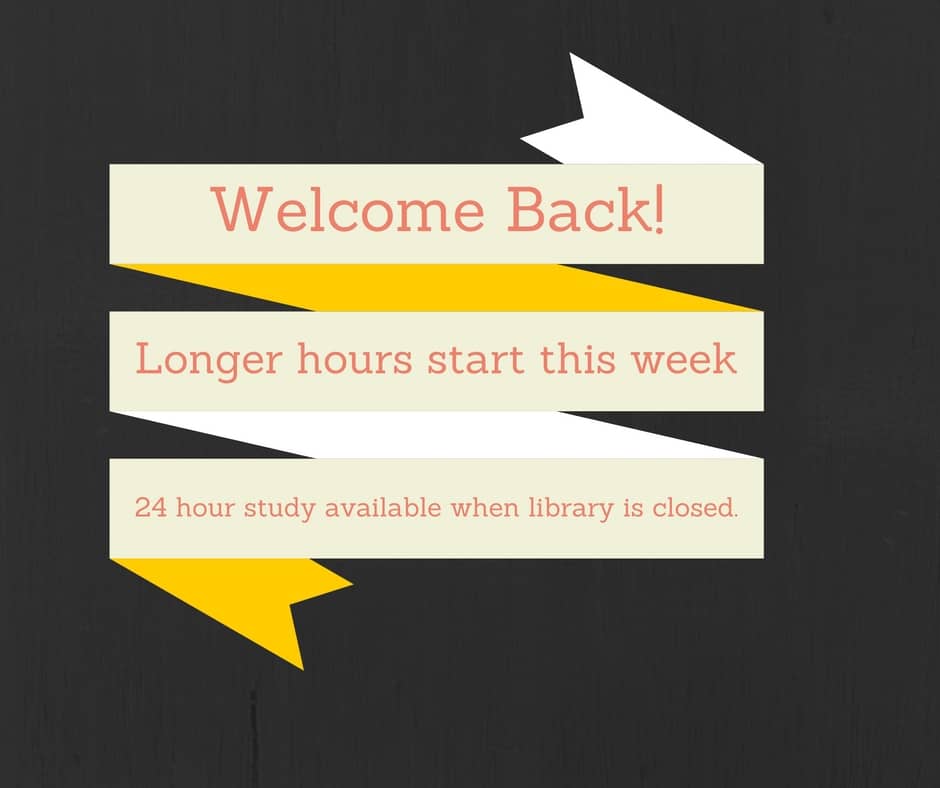
Fall hours begin 8/22; Hardin Library closed for home football games

The Hardin Library resumed regular hours on Monday, August 22.
Monday-Thursday, 7:30am-Midnight
Friday, 7:30am-8pm
Saturday, 10am-6pm **closed for home Iowa football games**
Sunday, Noon-Midnight
A 24-hour study area is available when the library is closed. Apply for access to the study at the reference desk.
Complete hours available online
Library closed for football Saturdays:
September 3, September 10, September 17, October 1, October 22, November 12
Fall 2016 Newsletter!!
Lichtenberger Engineering Library Fall 2016 Newsletter
Contents
- Engineering Library 2015-2016 Year in Review
- NEW Creative Space – Imagine! Tinker! Design! Create!
- Open House – September 8th
- New and Updated Resources
- Lib Guides
- InfoHawk+
- E-books on the Bookshelves!
- Instruction and Support
- Course Reserves
*************************************************************************************
Engineering Library 2015-2016 Fiscal Year in Review
Want to see the numbers about how the Engineering Library did last year? Check out our infographic!
Creative Space – Imagine! Tinker! Design! Create!
A new creative space opening this fall! The Engineering Library and Engineering Technological Centers are collaborating on a Maker/Creative Space!
- 3D Scanners: Matter & Form; Sense 3D; Structor for iPad; Xbox Kinect
- Virtual Reality Station: Oculus Rift Virtual Reality Headset; Leap Motion Controller
- 3D Cameras: 360fly 4K & RICOH Theta
- 2 Collaboration Tables: each with 43” (4K) quad monitor; stationary computer; laptop jacks
- Modeling Station: 4 Computers; Leap Motion Controllers; Wacom Drawing Tablets; 3D Modeling Software
- Tool Library: Canon PowerShot Camera; Tape Measure; Screwdrivers; Light Meters; Webcam; Creative Boxes; other Technology Tools; Hand Tools; Measuring Tools; and LabQuest Equipment.
Open House! Mark Your Calendars!!
- September 8, 2016. 2:30 to 4:30 p.m.
- See the new Creative Space first hand!
- Enjoy a hands-on experience with the new equipment
New and Updated Resources
Over 100 years of history, HIS Jane’s is the most trusted & respected public source of defense and security information in the world. Jane’s is available only to On-Campus Users. Our subscription includes:
- Jane’s Aero-Engines
- Jane’s All the World’s Aircraft Development & Production
- Jane’s All the World’s Aircraft in Service
- Jane’s All the World’s Aircraft Unmanned
- Jane’s Fighting Ships
Synthesis Series – Digital Library of Engineering & Computer Science
We now have 800 synthesis lectures which are 50-100 page electronic books with in-depth anaylsis of a current topic in 22 different areas, including:
- Biomedical Engineering
- Chemical & Biochemical Engineering
- Civil & Environmental Engineering
- Electrical & Computer Engineering
- Computer Science
RSMeans
- 2016 Editions now available In our reference section (non-circulating)
- Provides construction cost estimates, including: City Cost Indexes; Crew Composition; Labor; Profit Rates; Materials; Facilities Repair; Productivity Rates; and Green Building
Current Protocols
- Protocols are presented in a ‘recipe’ style providing step-by-step descriptions of procedures which you can take to the lab and immediately apply in your own research.
- Current Protocols in Bioinformatics
- Current Protocols in Cell Biology
- Current Protocols in Essential Laboratory Techniques
- Current Protocols in Immunology
- Current Protocols in Microbiology
- Current Protocols in Molecular Biology
- Current Protocols in Neuroscience
- Current Protocols in Protein Science
- Current Protocols in Stem Cell Biology
- Current Protocols in Toxicology
- More than 650 ebooks from MIT Press dating back as far as 1943
- approximately 65% of titles in computing-related fields, such as computer science, artificial intelligence, information theory, and computer programming
- Providing access to numerical and graphical data on the properties of materials
- Search by elements, structure, or corrosion
SAE Technical Papers (Society of Automotive Engineers)
Provides access to over 175,000 continuously updated technical reports. Subjects include aerospace, automotive, and commercial vehicles. The reports date back as far as 1906.
Library Subject Guides
Check out our subject guides – available for each discipline. The guides are continually updated with new information and resources. You’ll find information on popular resources, subject guides, handbooks, and digital publications. The guides also include helpful links, including Citation Guides, Engineering Ethics, Copyright and Open Access Information among other things. Check our homepage to find the links!
InfoHawk+
The University of Iowa has implemented a new way to access library resources and materials! InfoHawk+ is replacing the InfoHawk basic catalog and Smart Search. InfoHawk+ merges the two search engines into an easy-to-use, streamlined search engine which allows for clear access to the UI Libraries holdings and resources! Check it out!
E-books on the Bookshelves!
A pilot project is making our e-book resources accessible on our bookshelves!
- Each e-book has a book-sized plastic case shelved by call number.
- Each case has spine label, and both front and back covers
- There is a QR code on the spine
- NFC tag on the back cover
- Inside the case are info sheets which may be taken by the user. The information includes title, call number, and web address
Instruction & Research Support
Both Engineering Librarians are available for short or class length demonstrations on a wide variety of library resources.
Kari Kozak, Head of the Lichtenberger Engineering Library, is available to talk about resources and services to students, faculty, and/or staff. This could range from an overview of the library and services to in-depth researching strategies including evaluating information, standards, and patents. Sessions can be to individuals, small groups, lab groups, or classes. Email Kari at kari-kozak@uiowa.edu for more information.
Qianjin (Marina) Zhang, Engineering & Informatics Librarian, is also available to talk about library overview and services as well as detailed sessions related to data management and Endnote. Email Marina at qianjin-zhang@uiowa.edu for more information
Check out the following instructional menu to help see how we can help personalize a class visit: http://www.lib.uiowa.edu/eng/files/2012/08/library-instruction-menu_v2.pdf
Have an item you would like to request for the Engineering Library to purchase? Just send us an email (lib-engineering@uiowa.edu).
Course Reserves
Course Reserves are being organized for the Fall Semester. If you have not already done so and would like to have items put on reserve for the Fall Semester, please email the Engineering Library at lib-engineering@uiowa.edu with a list of the materials and course number.
Our 2015 – 2016 Year in Review!

Learning something new @Hardin Library | Fall workshops on Scopus, Systematic Reviews, EndNote & More

Hardin Library’s Open Workshop fall schedule is now available!
18 workshops free and open to all. Register online or by calling 319-335-9151.
Classes include:
- APA Style
- PubMed
- Embase
- EndNote
- Finding Images
- Systematic Reviews
- Open Access Basics / Predatory Publishers
- Searching for Gene, Nucleotide Sequences & Protein
- NIH Public Access, Open Access, Author’s Rights
- Standards: Guides and Regulations
- Measuring Scholarly Impact
- Scopus & Web Of Sciences
- Data Management for Researchers


InfoHawk+, UILink replace library catalog and InfoLink

Infohawk + is the new public catalog which searches by default all UI Libraries holdings + many of our subscribed literature databases. Infohawk, the traditional catalog, has retired.
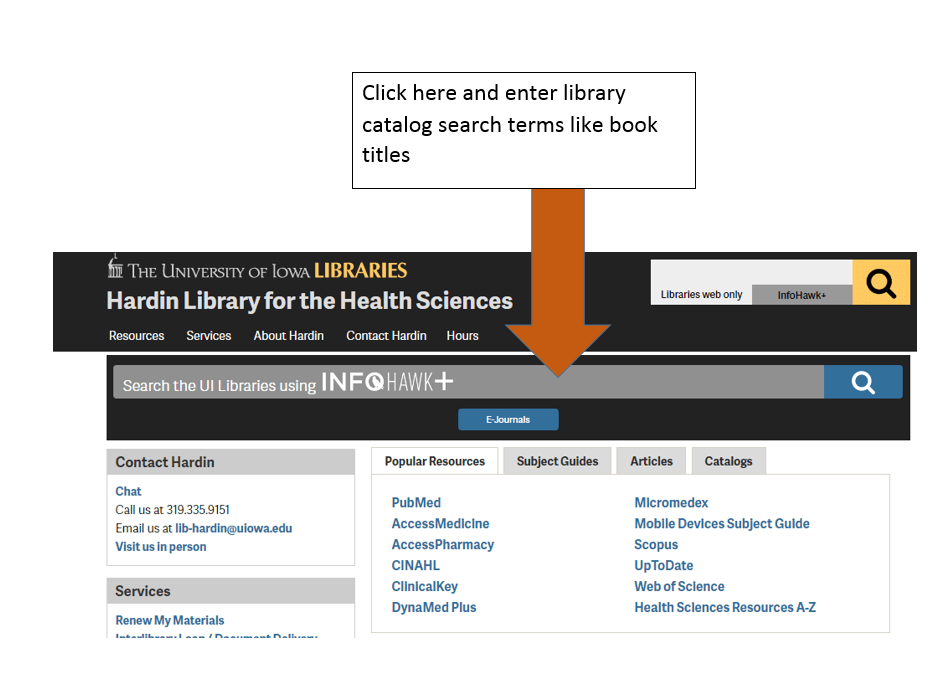
This tool is similar to SmartSearch in that it is a discovery tool, which means that it is iintended to be a starting point for finding information. When an thorough literature search is needed, we recommend use of literature databases directly (PubMed, CINAHL, Scopus). If you would like to learn more about using Infohawk+, please view our tutorials, or contact us.
 UI Link is replacing Infolink from all databases. It continues to be bright yellow and serves the same purpose: to link to electronic full text if UI libraries has a subscription or to direct you to request an item through interlibrary loan when electronic access is unavailable.
UI Link is active for many databases, such as Pubmed and CINAHL, and the transition will continue to take effect for all resources occur over the next month.
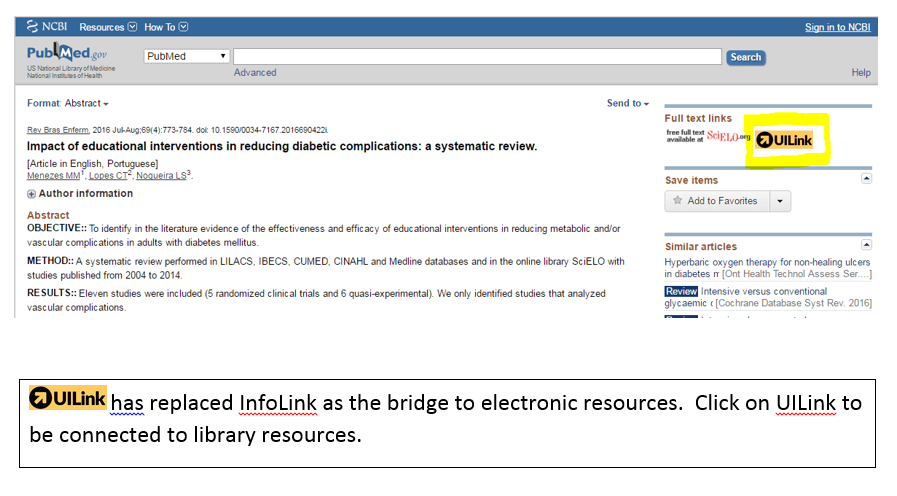
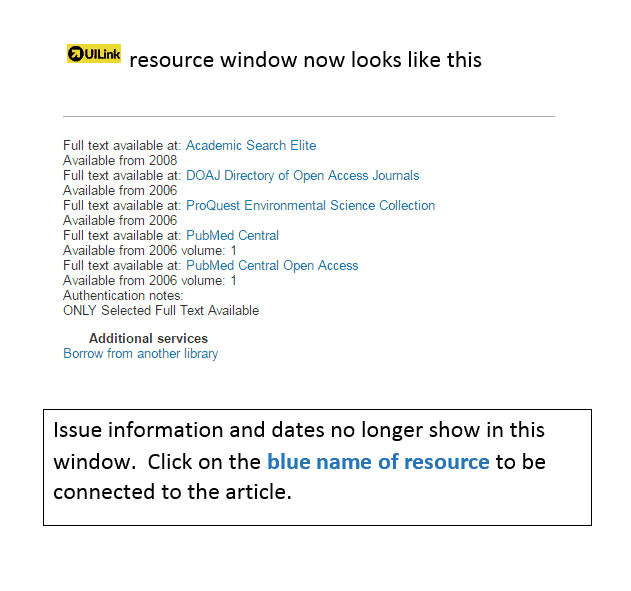
Because this is a new system, the implementation team is working to resolve problems. One known issue is that the link to borrow from interlibrary loan (borrow from another library) does not initiate a request with pre-population of the request form, as it previously did with Infolink.
Please let us know about other issues you encounter so that we can continue to work toward improving functionality.
Sustaining Digital Resources Boot Camp

Attendees from Indiana University, Iowa State University, Northwestern University, University of Iowa, Washington University in St. Louis, and Wayne State University. Photo credit: Nancy Maron.
Daniel Johnson, Digital Preservation Librarian, and I participated in the Sustaining Digital Resources Boot Camp at Northwestern University last week, August 8-10.
The boot camp was billed as “the business model boot camp for digital project leaders” and we were not sure what to expect. In the weeks leading up the trip, we had several conversations about what sustainability means for the Libraries and our projects. We were asked to pick one project to use as an example for the boot camp and we chose the Iowa Digital Library. At first, our thoughts revolved around sustainability in the forms of digital preservation, open source software, and perpetual access to the Libraries digital collections. We reframed our thoughts after talking to Nancy Maron who organizes and leads the boot camp. She encouraged us to think less about the technical aspects of digital preservation and more on overall sustainability of digital projects. What does it take to sustain the Iowa Digital Library? How might the Iowa Digital Library be sustained in the absence of the institutional support that we currently enjoy? How do we get more stakeholders involved with IDL to make its necessity transparent across campus and across the state?
There are no easy answers to those questions. Conducting additional research can answer some of the questions (Who is the Iowa Digital Library’s audience, and what do they find most useful?). Mulling over various conversation topics from the boot camp and discussing them with colleagues in the Libraries will also help.
I suspect that the boot camp takes on varying flavors depending on the backgrounds and projects of the participants. I’m thankful that we attended with this group. Many of our conversations had me nodding along thinking “Yes, we’re doing that too” and “Yes! That’s a struggle for me too.” Project prioritization, in particular, is a topic that I ponder on a regular basis. I learned that others face the same challenges, and many are trying to overcome the challenge with more robust project planning (the same strategy that I’m employing). It might work; it might not. Regardless, I appreciate the camaraderie and catharsis, and I look forward to comparing notes in the future.
You can read more on digital project sustainability from BlueSky to BluePrint and Ithaka S+R.
Sustaining Digital Resources Boot Camp
Attendees from Indiana University, Iowa State University, Northwestern University, University of Iowa, Washington University in St. Louis, and Wayne State University. Photo credit: Nancy Maron.
Daniel Johnson, Digital Preservation Librarian, and I participated in the Sustaining Digital Resources Boot Camp at Northwestern University last week, August 8-10.
The boot camp was billed as “the business model boot camp for digital project leaders” and we were not sure what to expect. In the weeks leading up the trip, we had several conversations about what sustainability means for the Libraries and our projects. We were asked to pick one project to use as an example for the boot camp and we chose the Iowa Digital Library. At first, our thoughts revolved around sustainability in the forms of digital preservation, open source software, and perpetual access to the Libraries digital collections. We reframed our thoughts after talking to Nancy Maron who organizes and leads the boot camp. She encouraged us to think less about the technical aspects of digital preservation and more on overall sustainability of digital projects. What does it take to sustain the Iowa Digital Library? How might the Iowa Digital Library be sustained in the absence of the institutional support that we currently enjoy? How do we get more stakeholders involved with IDL to make its necessity transparent across campus and across the state?
There are no easy answers to those questions. Conducting additional research can answer some of the questions (Who is the Iowa Digital Library’s audience, and what do they find most useful?). Mulling over various conversation topics from the boot camp and discussing them with colleagues in the Libraries will also help.
I suspect that the boot camp takes on varying flavors depending on the backgrounds and projects of the participants. I’m thankful that we attended with this group. Many of our conversations had me nodding along thinking “Yes, we’re doing that too” and “Yes! That’s a struggle for me too.” Project prioritization, in particular, is a topic that I ponder on a regular basis. I learned that others face the same challenges, and many are trying to overcome the challenge with more robust project planning (the same strategy that I’m employing). It might work; it might not. Regardless, I appreciate the camaraderie and catharsis, and I look forward to comparing notes in the future.
You can read more on digital project sustainability from Ithaka S+R.
Treating A Keith/Albee Scrapbook
Tuesday, August 16, 2016
Submitted by Katarzyna Bator and Bailey Kinsky

Kate examining the stability of the pages.
Our second project this summer is assisting with the treatment of several scrapbooks from the Keith Albee collection. Our work was being overseen by Candida Pagan, Project Conservator. The goal for our treatment is to stabilize the delicate structures for digitization. Picture 1 shows Kate examining the stability of the pages.
The Keith Albee collection includes a large number of scrapbooks that contain news articles, reviews, and programs from the Albee Theater in Rhode Island in the first half of the 20th century. To put it in better context, while examining Scrapbook #78, we found several pages dedicated to Ms. Fanny Brice, a famous vaudeville actress who was famously portrayed by Barbra Streisand in the 1968 musical, Funny Girl.
Most of the work needed for the scrapbooks included flattening of creases, removal of loose items, and repair to

Kate is using humidification to flatten creases in the paper.
the leather corners of the cover. Any loose items were placed in folders marked with the location within the book they came from so that they can be properly included during digitization.
Treating A Keith-Albee Scrapbook
Tuesday, August 16, 2016
Submitted by Katarzyna Bator and Bailey Kinsky
Kate examining the stability of the pages.
Our second project this summer is assisting with the treatment of several scrapbooks from the Keith Albee collection. Our work was being overseen by Candida Pagan, Project Conservator. The goal for our treatment is to stabilize the delicate structures for digitization. Picture 1 shows Kate examining the stability of the pages.
The Keith Albee collection includes a large number of scrapbooks that contain news articles, reviews, and programs from the Albee Theater in Rhode Island in the first half of the 20th century. To put it in better context, while examining Scrapbook #78, we found several pages dedicated to Ms. Fanny Brice, a famous vaudeville actress who was famously portrayed by Barbra Streisand in the 1968 musical, Funny Girl.
Most of the work needed for the scrapbooks included flattening of creases, removal of loose items, and repair to
Kate is using humidification to flatten creases in the paper.
the leather corners of the cover. Any loose items were placed in folders marked with the location within the book they came from so that they can be properly included during digitization.