EndNote is a reference management tool that helps you to easily gather together your references in one place, organize them, and then insert them into papers and format them in a style of your choosing. This session will walk you through the basics of using EndNote to collect and format your citations.
EndNote can also store full-text articles if the library has an electronic subscription. The class will be hands-on and there will be time for questions at the end.
EndNote Desktop is available free to faculty, staff and graduate students from ITS.
Our next session: Thursday, October 13, 10am-11am (Information Commons East, 2nd Floor)
Individuals with disabilities are encouraged to attend all University of Iowa-sponsored events. If you are a person with a disability who requires a reasonable accommodation in order to participate in this program, please contact Janna Lawrence in advance at 319-335-9871.
This session will provide information about open access publishing, detail the reasons for the open access publishing movement, and describe key elements of predatory publishers.
A process often used by UI Librarians to critically evaluate the quality of open access journals will be shared, to allow participants to improve their skills/efficiency with appraisal. Information about open access mandates will be included, as well as an overview of how the UI Libraries Open Access Fund works.
Thursday, October 13th, 1:00 – 2:00pm (Information Commons East, 2nd Floor, Hardin Library for the Health Sciences)
Individuals with disabilities are encouraged to attend all University of Iowa-sponsored events. If you are a person with a disability who requires a reasonable accommodation in order to participate in this program, please contact Janna Lawrence in advance at 319-335-9871.
EndNote Basic is a web-based citation management software that is freely available to all UI affiliates. It allows you to import, organize and format citations for papers, articles, etc.
EndNote Basic is not the same as the desktop software, Endnote.
Our next session: Wednesday, October 12th, 1:00 – 2:00pm (Information Commons East, 2nd Floor, Hardin Library)
Individuals with disabilities are encouraged to attend all University of Iowa-sponsored events. If you are a person with a disability who requires a reasonable accommodation in order to participate in this program, please contact Janna Lawrence in advance at 319-335-9871.
Jane E. Schultz, Professor of English & Medical Humanitites, IUPUI
“Civility on Trial” considers the clash of expectations that confronted surgeons and relief workers in military hospitals during the Civil War.
The spectacle of death that gripped the public imagination raised physicians’ professional status and brought medicine to the center of a cultural dialogue once reserved for the clergy, but did little to raise the prospects of nurses and other subordinate health workers.
Professor Schultz is the nation’s foremost historian of Civil War nurses and female hospital workers. She has published books and articles on how gender and race shaped women’s Civil War experiences, medical humanities, and Civil War medicine and literature.
This lecture is sponsored by The History of Medicine Society and Iowa Women’s Archives.
Individuals with disabilities are encouraged to attend all University of Iowa-sponsored events. If you are a person with a disability who requires a reasonable accommodation in order to participate in this program please call Janna Lawrence at 319-335-9871.
During the month of Open Access week (October 24-30, 2016) we will be highlighting a number of guest posts from University of Iowa Faculty and Staff who have personal experience making their work Open Access. We appreciate their contributions.
The first guest post is by Chioma M. Okeoma, Ph.D, Assistant Professor of Microbiology.
See her Iowa Research Online deposited publications here.
Open access (OA) literally means making literature available to researchers, teachers, journalists, policy makers, and the general public without barriers. Without the open access mechanism, readers or consumers of scientific findings would face price and permission barriers for the use of research findings.
For authors like me, OA provides unlimited access to our work to anyone regardless of their geographic location. The benefits are optimal dissemination of intellectual findings, rigorous peer and public discourse, and increased citations. Above all, OA provides an author maximum visibility and impact for research findings. As authors benefit from publishing OA, so do institutions.
Of course OA publishing is not without a cost to authors because OA publishers charge fees to cover costs. However, the cost of publishing may be covered by grants to authors, or by government and/or institutional subsidies depending on the country and institution. For example, the University of Iowa is a huge proponent of OA publishing. The University through the Office of the Provost and University Libraries provides funds to cover the fees for OA publishing; http://guides.lib.uiowa.edu/scholarly_publishing/OAfund. So when next you think of publishing, think OA. Try it and you will find being “OPEN” truly rewarding.
During the month of Open Access week (October 24-30, 2016) we will be highlighting a number of guest posts from University of Iowa Faculty and Staff who have personal experience making their work Open Access. We appreciate their contributions.
The first guest post is by Chioma M. Okeoma, Ph.D, Assistant Professor of Microbiology.
See her Iowa Research Online deposited publications here.
Open access (OA) literally means making literature available to researchers, teachers, journalists, policy makers, and the general public without barriers. Without the open access mechanism, readers or consumers of scientific findings would face price and permission barriers for the use of research findings.
For authors like me, OA provides unlimited access to our work to anyone regardless of their geographic location. The benefits are optimal dissemination of intellectual findings, rigorous peer and public discourse, and increased citations. Above all, OA provides an author maximum visibility and impact for research findings. As authors benefit from publishing OA, so do institutions.
Of course OA publishing is not without a cost to authors because OA publishers charge fees to cover costs. However, the cost of publishing may be covered by grants to authors, or by government and/or institutional subsidies depending on the country and institution. For example, the University of Iowa is a huge proponent of OA publishing. The University through the Office of the Provost and University Libraries provides funds to cover the fees for OA publishing; http://guides.lib.uiowa.edu/scholarly_publishing/OAfund. So when next you think of publishing, think OA. Try it and you will find being “OPEN” truly rewarding.
Are you interested in giving your idea, project, or invention a kick-start?
Want to make that project a reality?
A new program, Kick-Start, has been developed for engineering students (undergraduate and graduate) to request funding to pay for prototyping and/or finishing projects using the services offered through the Creative Space, Engineering Electronic Shop (EES) and the Engineering Machine Shop (EMS). There will be ten $500 awards!!How exciting is that!?
There are a limited number of Kick-Starts to be awarded this year – so this is a competitive process! Make sure to check the Kick-Start webpage to get complete details!
Briefly, any student (graduate or undergraduate) may apply for a Kick-Start award. You come up with an idea, find a faculty or staff sponsor, complete an online application form, attend an in-person workshop (approximately an hour), and present your project in April! (Please be sure to check all the rules and recommendations before submitting your application!)
In case you haven’t seen our new Creative Space (what are you waiting for!?) – here’s a video from our Open House.
For more complete details, refer to the Kick-Start webpage. The September 30, 2016 Kick-Start blog also has more complete information.
We have the resources and the support needed to help bring your idea to reality!
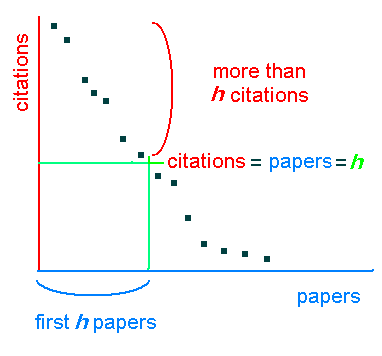
This class will teach participants how to use tools such as Ulrich’s, Journal Citation Reports, Web of Science, and Scopus to determine the impact that journals, articles, and authors have had on a particular field. Topics such as impact factors, Eigenfactors, and H-indices will also be discussed.
More information about H-Index
The h-index is an index to quantify an individual’s scientific research output. J.E. Hirsch – http://www.pnas.org/content/102/46/16569
PubMed is the National Library of Medicine’s index to the medical literature and includes over 26 million bibliographic citations in life sciences. This one-hour session will show you how to improve your search results by using subject headings (MeSH) and advanced keyword searching techniques.
Tuesday, October 4 1-2pm, Hardin Library – Information Commons East
The days are getting cooler and Halloween is almost here!
Want to put your engineering skills to work and have fun doing it? How about making your own Punkin Chunkin trebuchet or catapult?
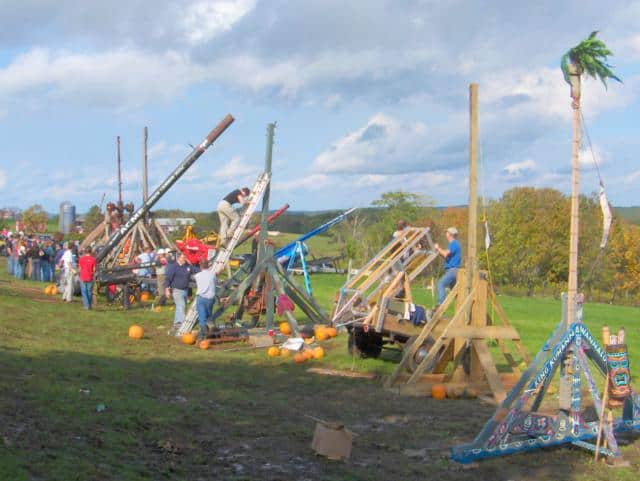
Punkin Chunkin. Photo Credit Peter Dutton.
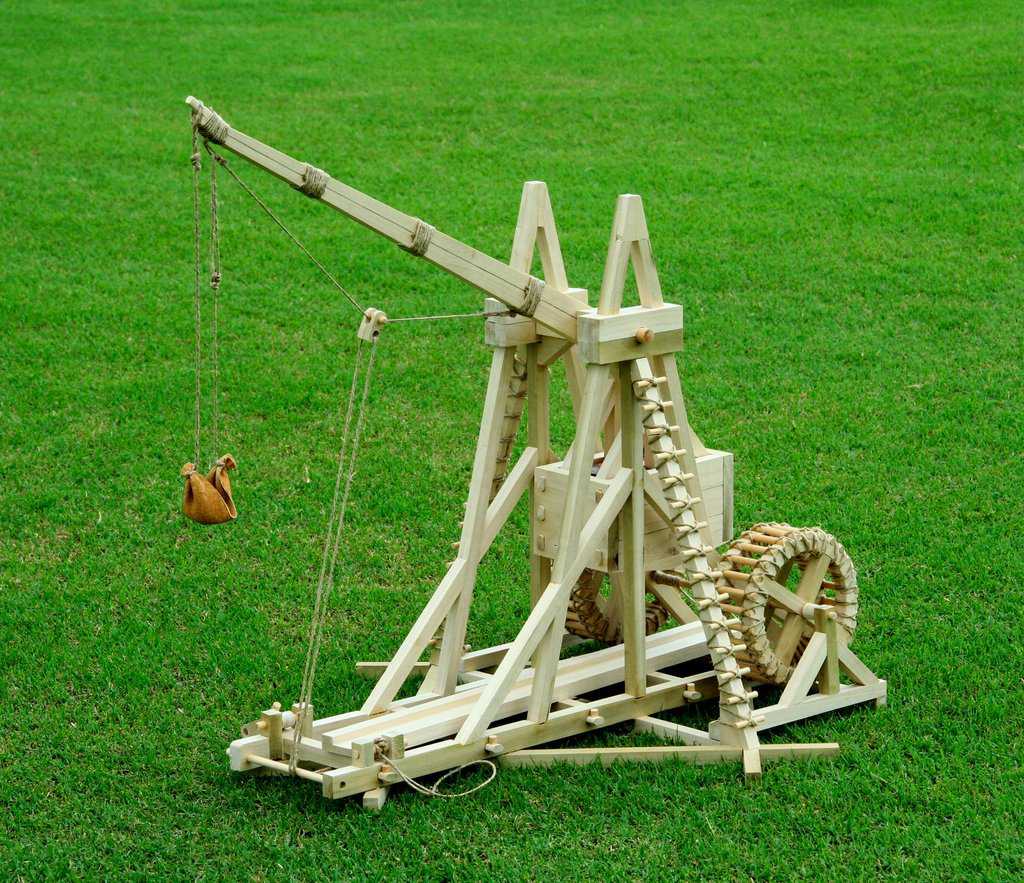
Most of us know what a catapult is, but do you know what is different between a catapult and a trebuchet? A trebuchet uses a sling and has a counter-weight which, as it is dropped, forces the long arm up to pull the sling and the projectile along a slide at the base. The counter-weight uses the pull of gravity to provide the force necessary for the arm to swing upwards. The sling increases the length of the arm which increases the length of the throw. The catapult, on the other hand, uses a leaf spring mechanism to release the long arm. A rope is wrapped around a rotating drum and when the spring mechanism is released, so is the arm and the projectile. A catapult also has a cup at the end rather than the sling that a trebuchet has.
In 15 Dangerously Mad Projects for the Evil Genius, author Simon Monk says, “The trebuchet takes its energy from the weight that falls as the arm swings. The ‘potential’ energy is transferred to the arm and sling of the trebuchet and is released as kinetic energy in the tennis ball.” (or pumpkin…). He then explains that when you know the energy stored in the weight and how far the projectile can be thrown, then the energy going into the system and the energy released can be measured. Input energy can be calculated using the formula: E=mgh where ‘m’ is the mass of the weight, ‘g’ is the gravitational acceleration on Earth (9.8) and ‘h’ is the height. You can also calculate the amount of energy transferred to the tennis ball using the distance it traveled and its weight. E=1|2 mv2 where d=v2|g v2=dg. You can then calculate the efficiency of the catapult by dividing the energy transferred by the energy input. From this, you are then able to calculate the efficiency of your trebuchet! Ready to try to build your own? Monk also provides step-by-step, illustrated instructions, including a list of parts needed! The trebuchet project is rated as “Small,” (1/2 day to 1 day to complete) and the skill level receives 2 out of 4 stars (a small mount of soldering is required).
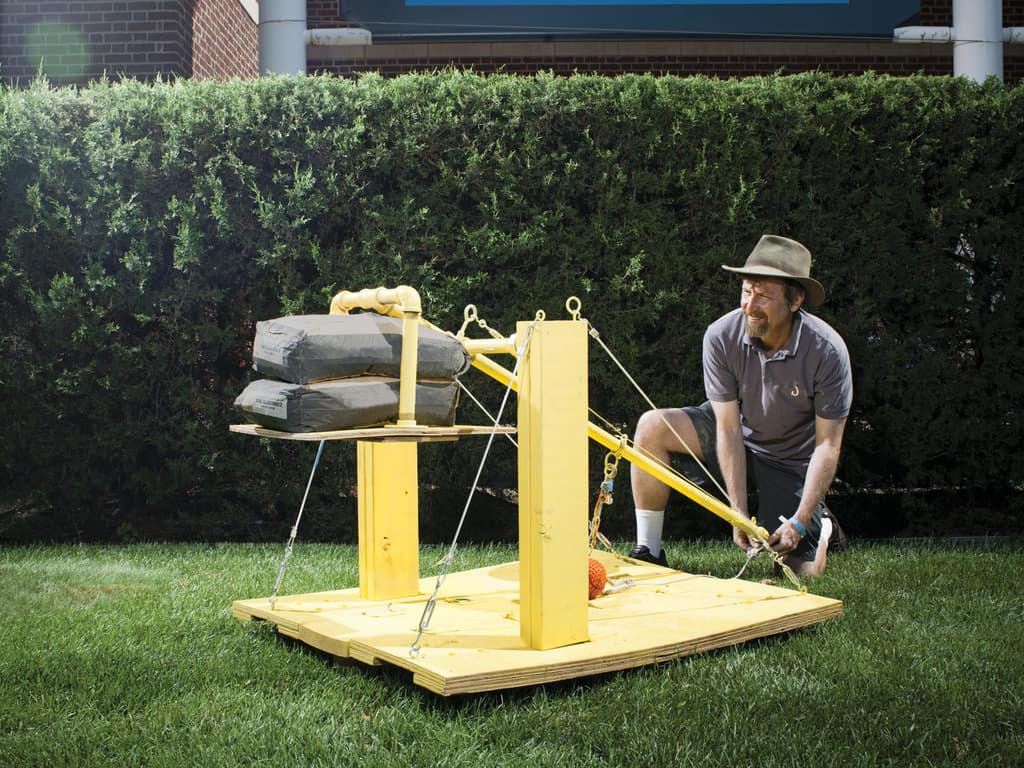
Gravity Catapult. Photo credit: Make : Technology on Your Time
Rather make a catapult? Make : Technology on Your Time (volume 28, pages 84-94) will walk you through the process of building a gravity catapult. The larger the item you want to hurl through the air, the larger the catapult needs to be. Author William Gurstelle cautions that there are incredible stresses on the working parts of the catapult and if something should bend or break, it can be dangerous. He also emphasizes that a catapult is big. Once you build it, you need to have a place to store it (and to use it!) The gravity catapult shown in this issue of Make is small and light enough for one person to move. It also has wheels and (sort of) folds flat. Still want to try your hand? This includes an explanation of how it works, a list of materials and tools needed and complete building instructions accompanied by color illustrations!
Trebuchet. Photo credit: Stirling Warsolf
The World Championship Punkin Chunkin contest has categories for both the trebuchet and the catapult. (Did you even know there is a World Championship Punkin Chunkin Contest?) It’s being held in Bridgeport, Delaware, this year. The goal is to encourage teams to use their science and engineering skills and also attract tourists. All the money raised goes to scholarships and community-based non-profits which support area youth. And in case you are wondering if Punkin Chunkin is a waste of good food, this is what the World Championship Punkin Chunkin Association (WCPCA) website says, “Majority of the pumpkins that are grown for competition are hybrids. Each year, we donate all the remaining edible pumpkins to farmers to feed to their animals. Shooting pumpkins has resulted in us being able to donate over 1 million dollars since 2000.”
If you don’t have the space to build a full-size catapult or trebuchet, how about making a smaller, desk-size version? Watch the video to learn to make a Mini Candy Launching Catapult!
Disclaimer: The Engineering Library does not condone the theft or destruction of personal property or harming anyone while punkin chunkin.

 EndNote is a reference management tool that helps you to easily gather together your references in one place, organize them, and then insert them into papers and format them in a style of your choosing. This session will walk you through the basics of using EndNote to collect and format your citations.





 PubMed is the National Library of Medicine’s index to the medical literature and includes over 26 million bibliographic citations in life sciences. This one-hour session will show you how to improve your search results by using subject headings (MeSH) and advanced keyword searching techniques.