Skip to content
Skip to main content

Keith/Albee Vaudeville Collection in DIY History!

kadiy

The University of Iowa Libraries presents a wonderful and exciting opportunity for one and for all: The Keith/Albee Vaudeville Theater Collection in glorious DIY History! Now you too can step right up and take part in transcribing these exciting behind-the-scenes reports!

The first 24 books in the Keith/Albee collection, totaling 7,774 images, are now available for transcription in DIY History.  These initial volumes consist of typed theater managers’ reports, giving one a unique behind-the-scenes glimpse of vaudeville theater during its time. The managers give their own blunt impression of every act that has graced the Keith/Albee vaudeville stages, ranging wildly from lavish praise to scathing criticism. Included in these books are many people who later became legendary stars, such as W.C. Fields, Harry Houdini, and Buster Keaton.

page_64a

Page including internal review of Harry Houdini from Keith/Albee managers’ report book, March 9-December 14, 1908.

The Keith/Albee collection, one of the most important and comprehensive vaudeville archives in the country, has steadily become available in the Iowa Digital Library. This collection, spanning 150 over sized ledger volumes, documents several decades of vaudeville theater in New England. The Keith/Albee digitization project has been made possible by a generous Preservation and Access grant from the National Endowment for Humanities, with a projected completion date in 2017.

Start transcribing this collection here.

For more information contact:   Justin Baumgartner, Keith/Albee Digital Project Librarian, (319) 384-3431, justin-baumgartner@uiowa.edu

Keith/Albee Vaudeville Collection in DIY History!

kadiy

The University of Iowa Libraries presents a wonderful and exciting opportunity for one and for all: The Keith/Albee Vaudeville Theater Collection in glorious DIY History! Now you too can step right up and take part in transcribing these exciting behind-the-scenes reports!

The first 24 books in the Keith/Albee collection, totaling 7,774 images, are now available for transcription in DIY History.  These initial volumes consist of typed theater managers’ reports, giving one a unique behind-the-scenes glimpse of vaudeville theater during its time. The managers give their own blunt impression of every act that has graced the Keith/Albee vaudeville stages, ranging wildly from lavish praise to scathing criticism. Included in these books are many people who later became legendary stars, such as W.C. Fields, Harry Houdini, and Buster Keaton.

page_64a

Page including internal review of Harry Houdini from Keith/Albee managers’ report book, March 9-December 14, 1908.

The Keith/Albee collection, one of the most important and comprehensive vaudeville archives in the country, has steadily become available in the Iowa Digital Library. This collection, spanning 150 over sized ledger volumes, documents several decades of vaudeville theater in New England. The Keith/Albee digitization project has been made possible by a generous Preservation and Access grant from the National Endowment for Humanities, with a projected completion date in 2017.

Start transcribing this collection here.

For more information contact:   Justin Baumgartner, Keith/Albee Digital Project Librarian, (319) 384-3431, justin-baumgartner@uiowa.edu
#1DayforIowa | Giving Day! | Wednesday, October 26

box image

Today’s the day!  Join 119 other donors who give to Hardin Library @uiowa.

Give now.

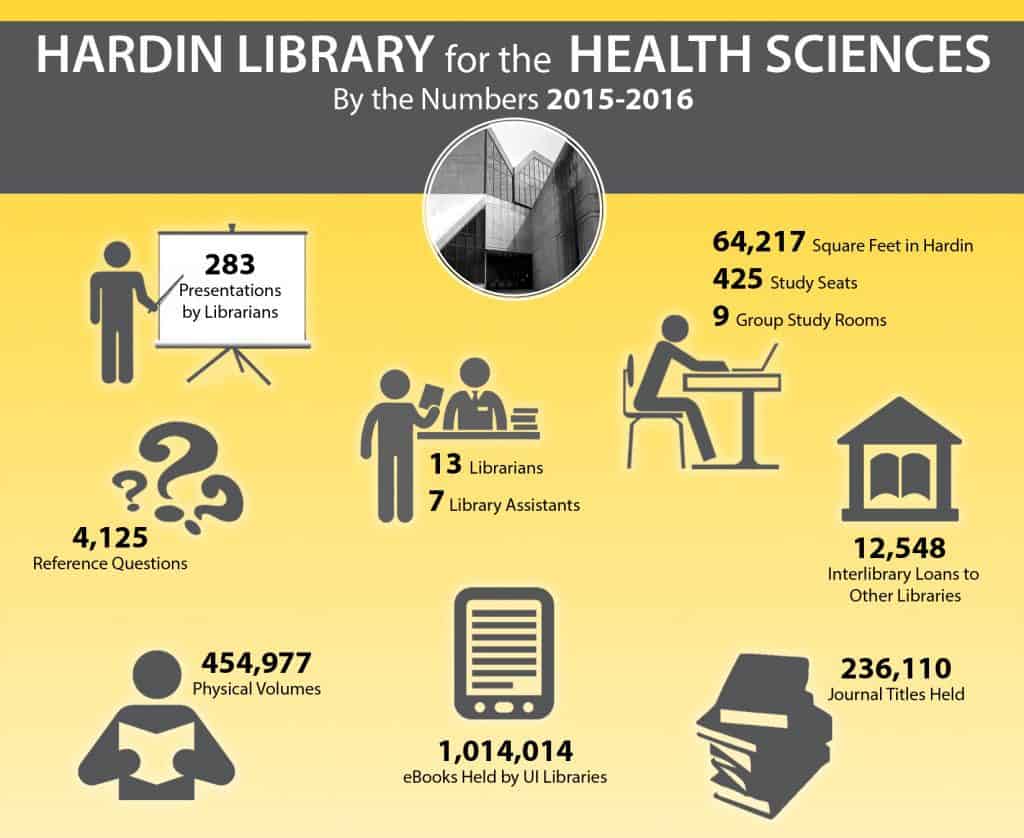
Your donations help us serve health sciences students, faculty and staff as well as provide outreach and information to residents and health professionals in the state of Iowa.  Your donations also paid for remodeling and adding group study rooms on the 3rd Floor.

hardin statistics graphic


Trial: IMF DataPLUS

Database trial

IMF DataPLUS is now available as trial service.  This resource provides easy access to an extensive repository of standardized and structured statistical information. The data set, Data Planet, harmonizes the database structures, making it easy to compare data from multiple sources. Users can combine exactly the series they need for models, analyses, and presentations.

The trial ends 24 November, 2016.

Please send additional comments to Kim Bloedel.

Trial: IMF DataPLUS

IMF DataPLUS is now available as trail service.  This resource provides easy access to an extensive repository of standardized and structured statistical information. The data set, Data Planet, harmonizes the database structures, making it easy to compare data from multiple sources. Users can combine exactly the series they need for models, analyses, and presentations.

The trail ends 24 November, 2016.

Please send additional comments to Kim Bloedel.

Visiting NYC – Digital Transitions Cultural Heritage Round Table

A plate from Francisco de Goya's Los Desastres de la Guerra (1863) being photographed by a camera on a copy stand.

Photographing Francisco de Goya’s Los Desastres de la Guerra with a Digital Transitions RCam & Phase One IQ180 Digital Back. Photo credit: Bethany Davis.

Last week, I flew to New York City for the very first time to attend the Digital Transitions Division of Cultural Heritage Round Table, a day-long event which brought together digital imaging professionals from a variety of institutions including the New York Public Library, Smithsonian Institution, and Frick Collection.

The day began at the Morgan Library & Museum with a handful of colleagues sharing their work in brief presentations. Several times, the audience heartily agreed with nods and laughs as the speakers shared their grips, challenges, and exasperations. Digitization of fold-outs, metadata workflows, and software limitations were among the all-too-familiar challenges. Angela Waarala from the University of Illinois at Urbana-Champaign spoke about two projects which involve large and fragile fold-outs housed within bound volumes. As she enumerated the collections’ features and digitization rationale, I thought of our own Engineering Bachelors Theses Collection, which is likely to be both a digitization joy and stressor in 2017. At the conclusion of the presentations, Digital Transition’s Peter Siegel led the group in a round table discussion about our priorities for Phase One’s future development of Capture One CH. Back at the Digital Transitions office, I mingled with colleagues from the Northeast Document Conservation Center (NEDCC), Yale University, and Ohio State University while watching live demos of digitization techniques like focus stacking.

UI Libraries has been digitizing special collections and rare materials with a Digital Transitions RG3040 Reprographic System since November 2014. To date, we have photographed items from the Arthur and Miriam Canter Rare Book Room (Clementi’s Various piano works) and John Martin Rare Book Room (Browne’s Religio Medici) as well as more than 70 managers’ reports and clipping books from the Keith/Albee Collection in Special Collections & University Archives.

More about Digital Transitions and the UI Libraries’ work on the Keith/Albee Project: https://youtu.be/wjzQF14SIJg.

Visiting NYC – Digital Transitions Cultural Heritage Round Table

A plate from Francisco de Goya's Los Desastres de la Guerra (1863) being photographed by a camera on a copy stand.

Photographing Francisco de Goya’s Los Desastres de la Guerra with a Digital Transitions RCam & Phase One IQ180 Digital Back. Photo credit: Bethany Davis.

Last week, I flew to New York City for the very first time to attend the Digital Transitions Division of Cultural Heritage Round Table, a day-long event which brought together digital imaging professionals from a variety of institutions including the New York Public Library, Smithsonian Institution, and Frick Collection.

The day began at the Morgan Library & Museum with a handful of colleagues sharing their work in brief presentations. Several times, the audience heartily agreed with nods and laughs as the speakers shared their grips, challenges, and exasperations. Digitization of fold-outs, metadata workflows, and software limitations were among the all-too-familiar challenges. Angela Waarala from the University of Illinois at Urbana-Champaign spoke about two projects which involve large and fragile fold-outs housed within bound volumes. As she enumerated the collections’ features and digitization rationale, I thought of our own Engineering Bachelors Theses Collection, which is likely to be both a digitization joy and stressor in 2017. At the conclusion of the presentations, Digital Transition’s Peter Siegel led the group in a round table discussion about our priorities for Phase One’s future development of Capture One CH. Back at the Digital Transitions office, I mingled with colleagues from the Northeast Document Conservation Center (NEDCC), Yale University, and Ohio State University while watching live demos of digitization techniques like focus stacking.

UI Libraries has been digitizing special collections and rare materials with a Digital Transitions RG3040 Reprographic System since November 2014. To date, we have photographed items from the Arthur and Miriam Canter Rare Book Room (Clementi’s Various piano works) and John Martin Rare Book Room (Browne’s Religio Medici) as well as more than 70 managers’ reports and clipping books from the Keith/Albee Collection in Special Collections & University Archives.

More about Digital Transitions and the UI Libraries’ work on the Keith/Albee Project: https://youtu.be/wjzQF14SIJg.

Visiting NYC – Digital Transitions Cultural Heritage Round Table

A plate from Francisco de Goya's Los Desastres de la Guerra (1863) being photographed by a camera on a copy stand.

Photographing Francisco de Goya’s Los Desastres de la Guerra with a Digital Transitions RCam & Phase One IQ180 Digital Back. Photo credit: Bethany Davis.

Last week, I flew to New York City for the very first time to attend the Digital Transitions Division of Cultural Heritage Round Table, a day-long event which brought together digital imaging professionals from a variety of institutions including the New York Public Library, Smithsonian Institution, and Frick Collection.

The day began at the Morgan Library & Museum with a handful of colleagues sharing their work in brief presentations. Several times, the audience heartily agreed with nods and laughs as the speakers shared their grips, challenges, and exasperations. Digitization of fold-outs, metadata workflows, and software limitations were among the all-too-familiar challenges. Angela Waarala from the University of Illinois at Urbana-Champaign spoke about two projects which involve large and fragile fold-outs housed within bound volumes. As she enumerated the collections’ features and digitization rationale, I thought of our own Engineering Bachelors Theses Collection, which is likely to be both a digitization joy and stressor in 2017. At the conclusion of the presentations, Digital Transition’s Peter Siegel led the group in a round table discussion about our priorities for Phase One’s future development of Capture One CH. Back at the Digital Transitions office, I mingled with colleagues from the Northeast Document Conservation Center (NEDCC), Yale University, and Ohio State University while watching live demos of digitization techniques like focus stacking.

UI Libraries has been digitizing special collections and rare materials with a Digital Transitions RG3040 Reprographic System since November 2014. To date, we have photographed items from the Arthur and Miriam Canter Rare Book Room (Clementi’s Various piano works) and John Martin Rare Book Room (Browne’s Religio Medici) as well as more than 70 managers’ reports and clipping books from the Keith/Albee Collection in Special Collections & University Archives.

More about Digital Transitions and the UI Libraries’ work on the Keith/Albee Project: https://youtu.be/wjzQF14SIJg.