Scopus, a multi-disciplinary literature database, has recently launched CiteScore metrics for titles that publish on a regular basis, such as journals and other serial publications. The CiteScore was developed as another tool for analyzing the importance of journals, similar to the Journal Impact Factor originally developed by the Institute for Scientific Information and now available in Journal Citation Reports (JCR) through the Web of Science database.
The Cite Score is calculated by dividing number of citations received in a calendar year by all items published in the journal in the preceding three years. This is similar to how the Journal Impact Factor (JIF) is calculated, with a few major differences: 1.The JIF is calculated by measuring the preceding 2 years, as compared with 3 years for the CiteScore 2. CiteScore is less selective about how it determines citable items, and will include records with potential for citations (including letters to editor, news pieces) whereas the JIF only includes records that are most likely to draw citations, such as research papers 3. Access to CiteScore is freely available, whereas JCR requires a subscription. See a detailed FAQ page or more information.
In order to try out this new tool, select the Sources tab upon access of Scopus, as pictured below. If there are questions about this or other Hardin Library resources, please contact our reference desk or follow up with the appropriate subject librarian.
Scopus, a multi-disciplinary literature database, has recently launched CiteScore metrics for titles that publish on a regular basis, such as journals and other serial publications. The CiteScore was developed as another tool for analyzing the importance of journals, similar to the Journal Impact Factor originally developed by the Institute for Scientific Information and now available in Journal Citation Reports (JCR) through the Web of Science database.
The Cite Score is calculated by dividing number of citations received in a calendar year by all items published in the journal in the preceding three years. This is similar to how the Journal Impact Factor (JIF) is calculated, with a few major differences: 1.The JIF is calculated by measuring the preceding 2 years, as compared with 3 years for the CiteScore 2. CiteScore is less selective about how it determines citable items, and will include records with potential for citations (including letters to editor, news pieces) whereas the JIF only includes records that are most likely to draw citations, such as research papers 3. Access to CiteScore is freely available, whereas JCR requires a subscription. See a detailed FAQ page or more information.
In order to try out this new tool, select the Sources tab upon access of Scopus, as pictured below. If there are questions about this or other Hardin Library resources, please contact our reference desk or follow up with the appropriate subject librarian.
East India Company offers access to a collection of India Office Records from the British Library, London. Containing royal charters, correspondence, trading diaries, minutes of council meetings and reports of expeditions, among other document types, this resource charts the history of British trade and rule in the Indian subcontinent and beyond from 1600 to 1947.
East India Company offers access to a collection of India Office Records from the British Library, London. Containing royal charters, correspondence, trading diaries, minutes of council meetings and reports of expeditions, among other document types, this resource charts the history of British trade and rule in the Indian subcontinent and beyond from 1600 to 1947.
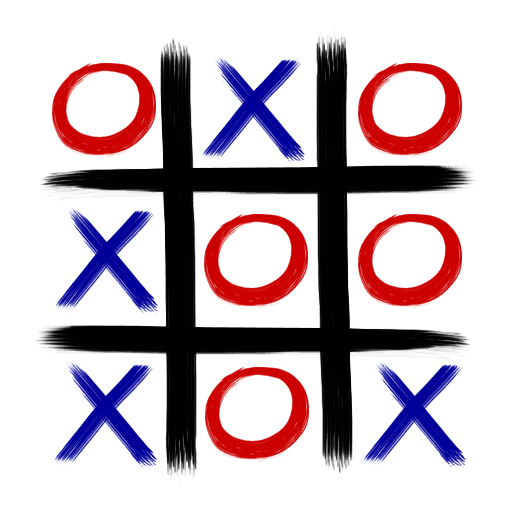
How much time did you spend playing tick-tac-toe when you were a kid? Did you realize the person who had the first go was at a disadvantage? The first player actually has to draw one connecting line longer than the opponent. So, if you are the first to go and still win, that’s impressive! If you add more squares – say 18 – there are 153 connecting lines. Which means there are 3153 game situations – roughly equivalent to the number of particles in the universe. Searching for a winning strategy is quite impossible and sometimes referred to as “computational chaos.” I had trouble winning with just 9 squares….
Another popular grid puzzle is Sudoku. The most common version of the puzzle consists of 9 squares by 9 squares – a grid of 81 squares. The grid is divided into 9 blocks, each containing 9 squares. The rules: each of the 9 blocks must contain all the numbers 1 – 9 within the squares. Each number can only appear once in a row, column or box. The tricky part is that each vertical 9-square column or horizontal 9-square line – within the larger square – must also contain each of the numbers 1 – 9, with no repeats… Each puzzle has only one solution…
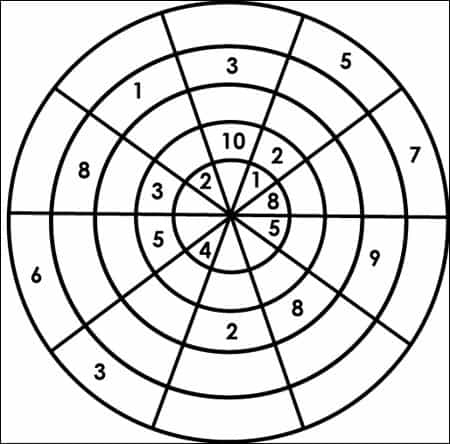
If that isn’t challenging enough, there are also circular Sudoku puzzles!
Each of the 4 rings and 8 quarter circles have the numbers 1 through 8 (unlike the square version which has 9). Of course, you can always have 3-ring puzzles, or 5 and 6 ring puzzles. Variants and puzzles can be found in Nets, Puzzles, and Postmen.
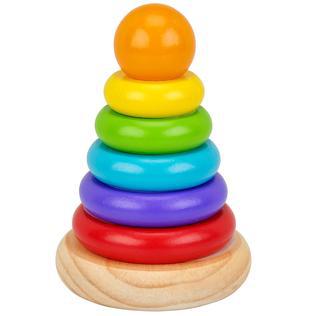
Ready for the grown-up version of the baby donut stacker?
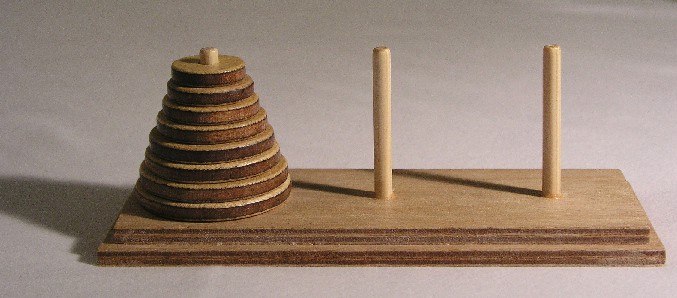
The Tower of Hanoi is a much more complicated form of the donut stacker. It was invented by the French mathematician, Edouard Lucas, and was first sold as a toy in 1883. The goal is to transfer the tower of 8 disks to one of the 2 vacant pegs in the fewest moves possible…without putting a larger disk on a smaller one…. For 8 disks that will take 255 moves… If you haven’t figured it out for yourself, the complete mathematical formulas are on pages 196-200 in Famous Puzzles of Great Mathematicians.
Logic puzzles more your style? Try to solve these – good luck!!
Wine & Water:
A dishonest servant takes 3 pints of wine from a barrel and replaces those pints with the same amount of water. He repeats his theft twice, removing a total of 9 pints, replacing those pints with water. As a result, the diluted wine remaining in the barrel lost half of its former strength. How much wine did the barrel originally hold?
Animals in a field:
A cow, a goat, and a goose graze on grass in a field. The cow eats the same quantity of grass as the goat and the goose together. the cow and the goat eat all of the grass in the field in 45 days, the cow and the goose in 60 days, and the goat and the goose in 90 days. How many days will it take the cow, the goat, and the goose together to eat all of the grass, assuming that the grass grows at the same daily rate?
Compose plane figures/Fibonacci’s numbers:
Make a rectangle without any gaps by using small squares whoe sides are the Fibonacci numbers 1, 1, 2, 3, 5, 8, 13, and 21.
Want more logic puzzles? Origami, Eleusis, and the Soma Cube, by Martin Gardner presents (among others) a puzzle called The Monkey and the Coconuts…
Ever heard of the “pea and the sun paradox?” A solid of any size (a small pea for example), can be partitioned into a finite number of pieces and then reassembled to form another solid of any specified shape and volume, (the sun, for example). Is that even possible? Author Leonard Wapner explores this (and many more) puzzles in The Pea & the Sun : A Mathematical Paradox.
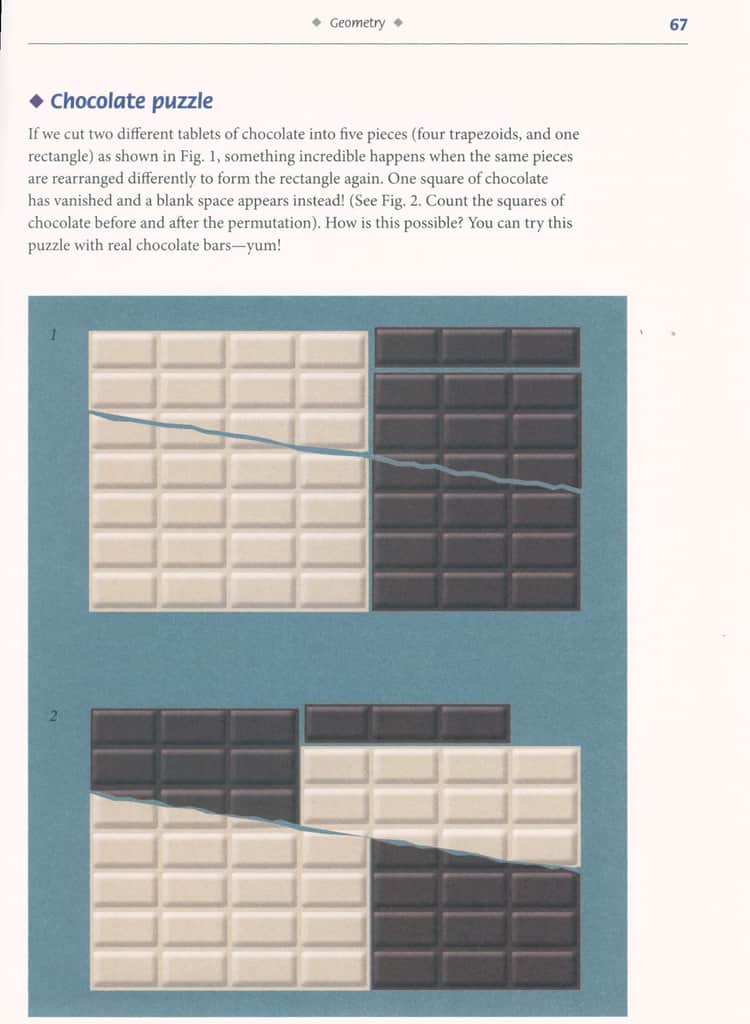
Or perhaps you would rather eat the puzzle? Try the chocolate puzzle with real chocolate bars and enjoy them once you have solved the puzzle!
Smullyan, Raymond M. 2009. Satan, Cantor and infinity : mind-boggling puzzles. Mineola, NY : Dover Publications. Engineering Library QA 95 .S5 2009
Szpior, George. 2010. A mathematical medley : fifty easy pieces on mathematics. Providence, R.I. : American Mathematical Society. Engineering Library QA93 .S973 2010
Gardner, Martin. Hexaflexagons, probability paradoxes, and the tower of Hanoi. 2008. Cambridge ; New York : Cambridge University Press. Engineering Library QA95 .G247 2008
Sarcone, Gianni A. 2013. Impossible folding puzzles and other mathematical paradoxes. Mineola, New York : Dover Publications. Engineering Library QA95 .S315 2013
Gardner, Martin. 2008. Origami, Eleusis, and the Soma cube: Martin Garnder’s mathematical diversions. Cambridge ; New York : Cambridge University Press. Engineering Library AQ95 .G2975 2008
How much time did you spend playing tick-tac-toe when you were a kid? Did you realize the person who had the first go was at a disadvantage? The first player actually has to draw one connecting line longer than the opponent. So, if you are the first to go and still win, that’s impressive! If you add more squares – say 18 – there are 153 connecting lines. Which means there are 3153 game situations – roughly equivalent to the number of particles in the universe. Searching for a winning strategy is quite impossible and sometimes referred to as “computational chaos.” I had trouble winning with just 9 squares….
Another popular grid puzzle is Sudoku. The most common version of the puzzle consists of 9 squares by 9 squares – a grid of 81 squares. The grid is divided into 9 blocks, each containing 9 squares. The rules: each of the 9 blocks must contain all the numbers 1 – 9 within the squares. Each number can only appear once in a row, column or box. The tricky part is that each vertical 9-square column or horizontal 9-square line – within the larger square – must also contain each of the numbers 1 – 9, with no repeats… Each puzzle has only one solution…
If that isn’t challenging enough, there are also circular Sudoku puzzles!
Each of the 4 rings and 8 quarter circles have the numbers 1 through 8 (unlike the square version which has 9). Of course, you can always have 3-ring puzzles, or 5 and 6 ring puzzles. Variants and puzzles can be found in Nets, Puzzles, and Postmen.
Ready for the grown-up version of the baby donut stacker?
The Tower of Hanoi is a much more complicated form of the donut stacker. It was invented by the French mathematician, Edouard Lucas, and was first sold as a toy in 1883. The goal is to transfer the tower of 8 disks to one of the 2 vacant pegs in the fewest moves possible…without putting a larger disk on a smaller one…. For 8 disks that will take 255 moves… If you haven’t figured it out for yourself, the complete mathematical formulas are on pages 196-200 in Famous Puzzles of Great Mathematicians.
Logic puzzles more your style? Try to solve these – good luck!!
Wine & Water:
A dishonest servant takes 3 pints of wine from a barrel and replaces those pints with the same amount of water. He repeats his theft twice, removing a total of 9 pints, replacing those pints with water. As a result, the diluted wine remaining in the barrel lost half of its former strength. How much wine did the barrel originally hold?
Animals in a field:
A cow, a goat, and a goose graze on grass in a field. The cow eats the same quantity of grass as the goat and the goose together. the cow and the goat eat all of the grass in the field in 45 days, the cow and the goose in 60 days, and the goat and the goose in 90 days. How many days will it take the cow, the goat, and the goose together to eat all of the grass, assuming that the grass grows at the same daily rate?
Compose plane figures/Fibonacci’s numbers:
Make a rectangle without any gaps by using small squares whoe sides are the Fibonacci numbers 1, 1, 2, 3, 5, 8, 13, and 21.
Want more logic puzzles? Origami, Eleusis, and the Soma Cube, by Martin Gardner presents (among others) a puzzle called The Monkey and the Coconuts…
Ever heard of the “pea and the sun paradox?” A solid of any size (a small pea for example), can be partitioned into a finite number of pieces and then reassembled to form another solid of any specified shape and volume, (the sun, for example). Is that even possible? Author Leonard Wapner explores this (and many more) puzzles in The Pea & the Sun : A Mathematical Paradox.
Or perhaps you would rather eat the puzzle? Try the chocolate puzzle with real chocolate bars and enjoy them once you have solved the puzzle!
Smullyan, Raymond M. 2009. Satan, Cantor and infinity : mind-boggling puzzles. Mineola, NY : Dover Publications. Engineering Library QA 95 .S5 2009
Szpior, George. 2010. A mathematical medley : fifty easy pieces on mathematics. Providence, R.I. : American Mathematical Society. Engineering Library QA93 .S973 2010
Gardner, Martin. Hexaflexagons, probability paradoxes, and the tower of Hanoi. 2008. Cambridge ; New York : Cambridge University Press. Engineering Library QA95 .G247 2008
Sarcone, Gianni A. 2013. Impossible folding puzzles and other mathematical paradoxes. Mineola, New York : Dover Publications. Engineering Library QA95 .S315 2013
Gardner, Martin. 2008. Origami, Eleusis, and the Soma cube: Martin Garnder’s mathematical diversions. Cambridge ; New York : Cambridge University Press. Engineering Library AQ95 .G2975 2008
PubMed is the National Library of Medicine’s index to the medical literature and includes over 26 million bibliographic citations in life sciences. This one-hour session will show you how to improve your search results by using subject headings (MeSH) and advanced keyword searching techniques.
Our sessions this semester:
Tuesday, January 24th, 2:00pm-3:00pm (East Information Commons)
Thursday, February 9th, 10:00am-11:00am (East Information Commons)
Wednesday, March 1st, 2:00pm-3:00pm (East Information Commons)
Monday, April 3rd, 1:00pm-2:00pm (East Information Commons)
Early American Newspapers documents the daily life of hundreds of diverse American communities, supported different political parties and recorded both majority and minority views. This growing digital collection of early American newspapers is the most extensive resource of its kind.
NB: This trial includes University-subscribed content (Series 1, 2, 3, 6, 7) as well as trial-only content (Series 4, 5, 8, 9, 10, 11, 12, 13).
Early American Newspapers documents the daily life of hundreds of diverse American communities, supported different political parties and recorded both majority and minority views. This growing digital collection of early American newspapers is the most extensive resource of its kind.
NB: This trial includes University-subscribed content (Series 1, 2, 3, 6, 7) as well as trial-only content (Series 4, 5, 8, 9, 10, 11, 12, 13).