Skip to content
Skip to main content

The Wilder Life

To celebrate Laura Ingalls Wilder’s birthday — she was born on this day in 1867 — we couldn’t decide whether to churn butter or make a corn-cob doll. So instead we chose to listen to this archived reading by Wendy McClure, and enjoy vicariously her adventures in obsessive Little House on the Prairie fandom.

Wendy McClure: The Wilder Life. Images: wendymcclure.net

Wendy McClure: The Wilder Life. Images: wendymcclure.net

Wendy McClure reading, Live from Prairie Lights, April 19, 2011 | Virtural Writing University | Iowa Digital Library
Wendy McClure reads from The Wilder Life: My Adventures in the Lost World of Little House on the Prairie. After her mother’s death, Wendy McClure rediscovered Laura Ingalls Wilder’s Little House books. Fascinated with the lifestyle the books evoke, she began a journey to discover Wilder and the culture and the tourism industry that have sprung up around her. This incredibly engaging book chronicles her research into Wilder’s life, literary controversies, and the social history that allowed the books to take on a life of their own. Little House on the Prairie fans will love following the journey of one of their own. Wendy McClure has been writing about her obsessions both online and in print for nearly a decade. In addition to her 2005 memoir, I’m Not the New Me, she is a columnist for BUST Magazine and has contributed to The New York Times Magazine. McClure holds an MFA from the Iowa Writers’ Workshop. She lives in Chicago, where she is senior editor at the children’s book publisher Albert Whitman & Company.

Browse all readings at the Iowa Digital Library’s Virtual Writing University Archive

ReferenceUSA & Onesource Trials (End 28 February, 2013)

Find both databases on this site.

ReferenceUSA is the nation’s premier source for business and consumer research data. Powered by Infogroup data, the database is updated monthly and contains detailed information on over 15 million companies and over 260 million consumers. Every record can be exported into spreadsheets and contains accurate latitude and longitude coordinates. The resource is ideal for entrepreneurship activities, students seeking employment, marketing projects, GIS mapping efforts and demographic research.

OneSource Global Business Browser provides comprehensive, updated information on industries and companies within the US and around the world. The resource lives up to its name in that it aggregates data from all the top business providers (Infogroup, Hoovers, Datamonitor, Freedonia, Kompass, Mergent, etc.) and puts them into one, easy-to-use database. Whether you’re looking for executive names & biographies, in-depth industry reports, international business locations or SWOT analyses—OneSource has it and more.

Please send additional comments to Kim Bloedel.

By Lisa Martincik
February 4, 2013

Driven by love

Vintage valentines: Iowa Digital Library on Pinterest

Vintage valentines: Iowa Digital Library on Pinterest

These transportation-themed (and occasionally offensive, by today’s standards) cards are among the several dozen vintage valentines now featured on our Iowa Digital Library Pinterest site.

Vintage valentines: Iowa Digital Library on Pinterest

Vintage valentines: Iowa Digital Library on Pinterest

Vintage valentines: Iowa Digital Library on Pinterest

Vintage valentines: Iowa Digital Library on Pinterest

Vintage valentines: Iowa Digital Library on Pinterest

Vintage valentines: Iowa Digital Library on Pinterest

Kathy Fait to speak on “The History of the State Hygienic Laboratory at the Univ of Iowa”

Kathy Fait,  Librarian, State Hygienic Laboratory at the University of Iowa

 “The History of the State Hygienic Laboratory at the University of Iowa”   Thursday, February 28, 2013 5:30-6:30  Room 401, Univ. of Iowa Hardin Library for the Health Sciences

In 1904, some of the most common health concerns for Iowans were also some of the most deadly.  Typhoid fever, tuberculosis, rabies and diphtheria all were tested at the State Hygienic Laboratory during its first year in operation.  Today, the state agency tests for a long list of reportable diseases; examines samples of air, water and soil; “fingerprints” and helps track foodborne illnesses; screens newborn babies for metabolic diseases; identifies influenza and other communicable diseases to the DNA level; and helps public health agencies at both the national and state level to keep people safe.

This presentation chronicles the Hygienic Laboratory’s evolution from diphtheria to Salmo-nella, and the stories behind the testing.

Notes from the John Martin Rare Book Room, February 2013

SAINT HILDEGARD (1098-1179). Physica. Strasbourg, 1533.

Hildegard, called Hildegard of Bingen, was eight years old when her family placed her in a nearby Benedictine convent where she subsequently became a nun. She founded and was Abbess of a convent near Bingen, Germany.  Hildegard’s writings are primarily mystical and theological; however, she also wrote several medical works. Her medical knowledge was acquired by reading, observation, and her duties in the convent which included care and treatment of other nuns as well as travelers and villagers. Hildegard shows how clergy of the time practiced medicine. She included time-tested formulations, numerous folk remedies, and her observations of diseases and cures. She lists the therapeutic merits of over 200 plants, 50 trees, and 20 precious stones. She includes the medicinal value of varieties of fish, birds, animals, reptiles, and metals. She was aware that lead and brass were poisonous and that iron and copper were valuable constituents of tonics. The wood-block illustrations have little relationship to her textual material. The blocks depict a seated patient surrounded by physicians and an attendant and a traditional wound-man.


Early Encounters in North America – Trial ends 3 April 2013

Early Encounters in North America contains 1,482 authors and over 100,000 pages of letters, diaries, memoirs and accounts of early encounters. Particular care has been taken to index the material so that it can be used in new ways. For example, you can identify all encounters between the French and the Huron between 1650 and 1700.

Please send additional comments to Janalyn Moss.

ReferenceUSA -and- Onesource – Trial ended 28 February 2013

Find both databases on this site.

ReferenceUSA is the nation’s premier source for business and consumer research data.  Powered by Infogroup data, the database is updated monthly and contains detailed information on over 15 million companies and over 260 million consumers.  Every record can be exported into spreadsheets and contains accurate latitude and longitude coordinates.   The resource is ideal for entrepreneurship activities, students seeking employment, marketing projects, GIS mapping efforts and demographic research.

OneSource Global Business Browser  provides comprehensive, updated information on industries and companies within the US and around the world.  The resource lives up to its name in that it aggregates data from all the top business providers (Infogroup, Hoovers, Datamonitor, Freedonia, Kompass, Mergent, etc.) and puts them into one, easy-to-use database.  Whether you’re looking for executive names & biographies, in-depth industry reports, international business locations or SWOT analyses—OneSource has it and more.

Please send additional comments to Kim Bloedel.

Learn to speed up your research with Scopus! Free workshop at Hardin Library, Tuesday, February 19

Scopus is a multidisciplinary database with substantial international coverage.  All citations that are in EMBASE are also in Scopus.

Scopus also allows you to measure an author’s scholarly impact and to track an article’s cited and citing references. Come to this hands-on session and learn more!

Our next session is Tuesday, Feb 19th from 1:00-2:00pm at Hardin Library, Information Commons East, 2nd floor.


image of sciverse scopus

Leigh Hunt’s Fireplace

Last week we opened, for the first time, a wooden shipping crate that had been stored in the department for many years. It had been sent to the Libraries in 1986 by Desmond Leigh-Hunt, the great-great-grandson of the Romantic poet and editor Leigh Hunt. Desmond Leigh-Hunt described it in correspondence as the fireplace surround from the last home Leigh Hunt lived in, at 16 Rowan Road in Hammersmith, London. He included a document signed by Rodney Tatchell, a Fellow of the Society of Antiquaries, asserting its authenticity and dating it to the early 1840s. After it arrived the crate was stored, unopened, primarily in the basement of the Main Library.

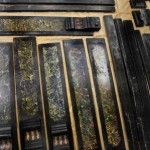
In 2012 we moved all of our departmental collections out of the basement to the third floor, including the 300 pound crate. We resolved to open it and examine its contents, and the winter doldrums of January seemed the perfect time to do so. The opening and unpacking is well documented in photos, which can be viewed on Flickr.
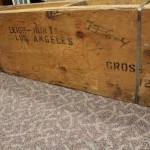
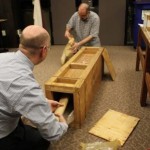
The crate.
Unboxing.
The pieces spread out.

We have managed to arrange some of the pieces into an approximation of what the fireplace surround might have looked like, but what does this piece tell us about Leigh Hunt? Does it bring us closer to the real person whose books and manuscripts line our shelves?

To tell the story, we start back in the presence of Rodney Tatchell, whose signature affirms the statement about the fireplace surround at the time of its removal from the house. Tatchell was a Fellow of the Royal Institute of British Architects, and he lived at 22 Rowan Road, the same street as Leigh Hunt’s old house. His wife, Molly Tatchell, shared his interest in their historical neighbor—in 1969 she published a book through the Hammersmith Local History Group entitled Leigh Hunt and His Family in Hammersmith. Her book provides an account of the final years of Leigh Hunt’s life, and includes detailed descriptions of his house at 16 Rowan Road (known as 7 Cornwall Road in Hunt’s time):

“[Regarding the cottages] no two are exactly the same. One type has two small reception rooms on the ground floor divided by a passage with staircase, the other has two larger rooms connected by double doors, so that they can be thrown into one: Leigh Hunt’s was one of this type. They have three or four bedrooms, the small one over the kitchen now being usually converted into a bathroom. The houses originally had, of course, no bathroom, and the privy was situated outside, near the back door.

“Such was Leigh Hunt’s simple, but not undignified, last home. Some of his visitors were to describe it in unflattering terms, but from what we can see of it today, and from what we know of its surroundings in the mid-nineteenth century, it cannot have been an unpleasant place in which to end one’s days.”  [p. 10]

Molly Tatchell's book Leigh Hunt and His Family in Hammersmith.
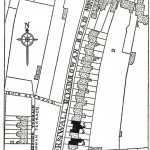
A map from Tatchell's book showing the location of Hunt's house.
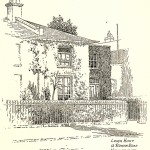
Hunt's house at 16 Rowan Road. From Arthur St. John Adcock's Famous Houses and Literary Shrines of London.

Leigh Hunt and his wife Marianne moved to Hammersmith in 1853, leaving behind a house in Kensington steeped in the memories of a deceased son, and into a house near other family already settled in the area. Leigh Hunt was 69, had made peace with many of his former foes, and finally could rely on a relatively secure income. Marianne, however, was by this time entirely bed-ridden, and remained so until her death in 1857. As he aged, Hunt took on the air of an esteemed elder statesman of letters, in contrast to his youthful rebellion. He welcomed visitors to the house at 16 Rowan Road, including those who travelled from afar to see him, such as Nathanial Hawthorne.

One of Hunt’s visitors in Hammersmith was Charles Dickens, who had bitterly wounded Hunt with his portrayal as Harold Skimpole in Bleak House. The two had reconciled their differences, however, and Dickens visited Hunt on July 3, 1855. The following day, he wrote to his longtime friend Charles Ollier:

“I had got my new book ready packed to bring you, and the volume containing the passage about Watteau, and an account of some delightful hours which Dickens gave me here yesterday evening; and at a quarter to six o’clock, was obliged to give all up. “

“P.S.—By a curious effect of the evening sunshine, my little black mantle-piece, not an inelegant structure, you know in itself, is turned, while I write, into a solemnly gorgeous presentment of black and gold. How rich are such eyes as yours and mine, how rich and how fortunate, that can see visitations so splendid in matters of such nine-and-twopence!” [The Correspondence of Leigh Hunt, 1862, p. 203]

Now the pieces of black slate with inlaid marble here in Special Collections are tied directly back to Leigh Hunt. He would have been in the front room of his house, the window facing west, allowing the late afternoon sun to shine in and strike the fireplace surround. Curiously, it seems as though we have two complete fireplace surrounds, suggesting that there could have been openings in two rooms sharing a common chimney. This might be reasonable given Molly Tatchell’s description of the house’s layout, “two larger rooms connected by double doors, so that they can be thrown into one.”

For now, the pieces of Leigh Hunt’s fireplace will likely be re-housed in more stable materials, perhaps stored in several boxes rather than one very heavy crate. They will join some of the letters of Leigh Hunt, or the manuscript for Old Court Suburb—other material traces of Hunt’s time in his modest home in Hammersmith, at the end of a remarkable life. Perhaps some future renovation of Special Collections will include room to properly display the fireplace surrounds—but surely that is a matter of nine-and-twopence!
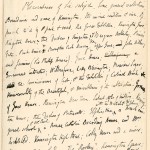
The first page of Hunt's manuscript for Old Court Suburb, containing notes about the work.

Molly Tatchell’s book Leigh Hunt and His Family in Hammersmith is still available from the Fulham and Hammersmith Historical Society’s website.

It is so cold today we can hardly keep warm I wonder if you have as changeable weather in Dixie

Joseph Culver Letter, February 1, 1863, Page 1Pontiac Ill. Feb. 1st 1863

Dearest Husband

It is so cold today we can hardly keep warm I wonder if you have as changeable weather in Dixie I have spent the Sabbath as usual There were a great many out to Sabbath School this morning Abbie & Lide have come again & joined the bible class My class numbers but four now I learned much to my surprise today that Josephine Murphy & her little sister has the small pox they do not think the little one will live Josephine is not so bad I believe she took it of Mr. Maples children I hardly know what to do it seems to me I ought to go & see her if I had no babe I would not hesitate a moment & if she should die I shall regret it always that I did not go I hope you will answer her letter immediately. Is it not most time for the S. School to have another letter? I think so.

Monday Eve.

Dear Frank I am shivering over the fire trying to keep warm while writing to you It is extremely cold I’m afraid the poor rebel prisoners are suffering beyond any thing we know of I was much disappointed today when no letter came from you God grant that your health may continue to improve if I only was certain that it was so Mr Cox came to see me today about the House Insurance I am to send $1,75 to the Company tomorrow I called on Herrington this afternoon but could give him no help on that business I have looked your papers almost entirely over & can find but one letter from Heckman that does not throw much light on the subject he says we’ll wait until he gets home & then settle it The rumor is afloat here today that F Streamer & others have disappeared some say deserted & joined the rebel army I hope it is not so.

Tuesday Eve

No letter today dear Frank. I was so certain I should have one If I dont hear by tomorrow I shall fear greatly that you are too sick to write Letters came last night & today for others but none for me Can it be your duty to stay my dear husband when you are sick so much If my fears are confirmed I must start for Mitchellsville I can get through I know I can and oh it makes my heart ache so to think that perhaps you are very ill & no wife near to administer to your comforts & relieve your wants

May God bless you abundantly.

Wednesday Eve Feb 4th

Dear Frank Mother has just come from meeting & tells me that Mr. Loomis leaves tonight I hasten to add a few lines to that already written & send by him no letter today Will you promise me that if you are now or ever too ill to write that you will send for me immediately Frankie is pretty well he coughs yet thought not much Mary Utley is sick we do not know what is the matter as it has been so cold we could not go up to see her Sammy had a letter from Johnnie Saturday eve but we have not heard from him since The fates seem to be against me I get letters from nobody Our folks send love In haste I must close With much love I subscribe myself your loving wife

M M Culver