See Business Library titles that have been recently borrowed and returned. Materials appear in call-number order. Readers can discover which subjects are popular or used for research.
Click on a title for more information.
Updated February 12, 2013
See Business Library titles that have been recently borrowed and returned. Materials appear in call-number order. Readers can discover which subjects are popular or used for research.
Click on a title for more information.
Updated February 12, 2013
Tuesday, February 12, 2013
 What does an artist do when his/her artwork is damaged? Throw it away because it has been changed and is no longer the same piece? Re-work it and make it a “new” painting? Repair the damage and try to keep the essence of the original? Or leave it as damaged and let it tell the story of the original and the disasterous event? Artists in New York are having this discussion. Everyone is coming up with a different answer and sometimes the same artist has different answers depending on the piece.
Craig Fisher, NYC artist, made the decision to keep this oil on canvas, 1988-89, as is, showing the damage of Hurricane Sandy. He’s decided to let the yellow show through the green.
Monday, February 11, 2013
 Today I spent most of the day inspecting close to 150 art works on paper for mold. It’s very time consuming. The front and back of each piece of art needed to be entirely visually inspected — each inch. I only found a handful that I thought a paper conservator should take a second look at. With reassurance that the pieces are free of mold, the artist can take his time making decisions on how to deal with his water-damaged works.
 Two volunteer conservators spent the day at the center cleaning the backs of artwork on canvas with a soot sponge. The paintings had already been treated and vacuumed. They finished the entire group and the paintings are ready to be picked up by the artist.
Are you starting a new research paper or project and looking for a way to manage your references? Then join us for this useful and informative workshop about RefWorks! RefWorks is a web-based citation manager and it’s free to all University of Iowa students, faculty and staff.
Lunch @ the Sciences Library: RefWorks Workshop
Wednesday, February 13 @ 11:30am – 12:20pm
Sciences Library classroom (102 SL)
In this workshop, you will learn:
This workshop is open to all UI students, faculty and staff. There is no need to register. You may bring you lunch if desired. Free coffee will be provided. If you have any questions, please contact Sara Scheib at sara-scheib@uiowa.edu or (319) 335-3024.
On Tuesday, 2/19, Apple released update 6.1.2 that reportedly fixes the issues that iOS 6.1 devices were causing with Exchange.
ITS strongly encourages iPhone, iPad and iPod Touch users to update their devices as soon as possible. See http://support.apple.com/kb/ht4623 for instructions on updating your device.
Friday, February 8, 2013
 When we inspect an artist’s work, we also ask for the story of the piece to learn more about its history and composition. The pieces that this artist brought in were her final project before graduation where she used as pure a blue, red, and yellow that she could get. She had her art studio in the basement and did not have time to get these pieces out before Hurricane Sandy. (Other higher priority items were taken out.) Each piece was in a plastic bag so there was some protection. Since the basement was flooded, she took everything outside to start drying things out. However while she had everything outside drying, it rained and then the temperature dropped. By the time the entire “hurricane event” was over, her sewer backed up twice. Staying on top of things was difficult.
Although theses pieces show a lot of damage, they are important to her. She plans salvaging them the best she can. A volunteer conservator will clean the pieces for her and then she will work on them as she has time, using advice provided by a conservator.
Viola Nesfield Owen papers
by Audrey Altman
Preserving the history of poor and rural women is a mission of the Iowa Women’s Archives, but it can be challenging because these women rarely leave detailed records of their lives. That’s why we were so excited to receive the papers of Viola Nesfield Owen, donated by Gary Whitehead. The collection contains dozens of letters between his grandmother, Viola Nesfield Owen, and her family, written from 1921 to 1963.

A few letters from the Viola Nesfield Owen papers.
Viola was a high-spirited woman who saw her family through many hardships, and her letters give insight into how Midwestern women dealt with family, work, and financial hardships.
Viola Nesfield was born in 1896. She grew up in Waterloo, Iowa, with her father, step-mother and two younger half-sisters. In 1921, Viola planned to marry Vern Owen. Since Vern was divorced, their engagement was somewhat scandalous for Viola’s family. Yet Viola and Vern were not to be deterred. They eloped and moved to Wisconsin. This is when the collection of letters between Viola Nesfield Owen and her family begins. The first few years of letters from the Nesfields to Viola are filled with appeals to return home and anxious parental advice.
In 1924, Viola’s father wrote: “When I am at work I lots of times get worried about you. I wish you would begin to look forward for you are sure to get some rainy days. You know life is not all sunshine. Try to save all you can.” (June 20, 1924)
But Viola did not move home. Instead, she and Vern started a family. Her children are by far the most common topic of her letters. My favorite of Viola’s letters is dated August 14, 1928. It was written from her hospital bed, shortly after she delivered her first child, Robert Harrison. In big, messy letters that practically fall off the lines of the page, she wrote, “How I wish you could see him. He is so cute and ‘fat as butter.’”
It’s hard not to admire Viola, who was sometimes called “Ha! Ha!” for her unquenchable good spirits. Her daughter, Betty, nearly died of kidney disease when she was two years old. Viola made a pact with God that if He spared Betty’s life, she would never complain about her hardships. It is evident in her letters that Viola tried hard to keep this promise, even though her family experienced dire poverty through the 1920s and 1930s.
In 1927, the Owens moved into a tar paper shack in Janesville, Wisconsin, with no electricity or running water. Yet Viola’s letter bearing the news to her family reflected no bitterness. She mused, “We ought to save money here. No place to spend it.” (October 9, 1927).
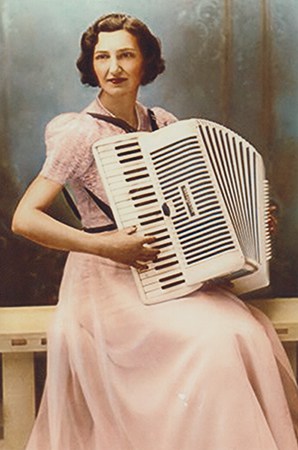
Viola Nesfield Owen
During the Depression, Viola’s husband Vern struggled to hold a job. Viola worked as a pianist, piano and accordion teacher, and as a transcriber for the WPA Braille Project. Despite Viola’s contribution to the family income, they often struggled financially, and Viola’s optimistic resolve was tested. On January 13, 1933, she wrote: “I would be so glad if Vern could make a dollar a week. Now I don’t mean to complain and I always said I never would if Betty love could only get better and the rest of us keep our good health, but if I don’t write very soon you will know Vern is still jobless… Soliders and Sailors Relief are getting me a pair of shoes today. Isn’t it awful to have to depend on somebody like that but what can you do? I was walking on the ground.”
But the next month, Viola had found something to celebrate again: “I was so extravagant I ate a whole orange all by myself. Ha! Ha!” (February 2, 1933) During the 1940s, Viola found new independence. She started working for Parker Pen in Janesville, WI, and wrote excitedly about her various administrative duties at the factory. She also divorced her husband, but continued to care for him, especially after he suffered a stroke in 1948. Viola and her family continued to write each other, and the collection of letters extends to 1963.
Audrey Altman, a graduate student in the University of Iowa School of Library and Information Science, processed the Viola Nesfield Owen papers while working in the Iowa Women’s Archives in 2011/2012.
“Whatever your goal, LearningExpress Library’s resources will help you succeed. Each of our Learning Centers offers the practice tests, exercises, skill-building courses, eBooks, and information you need to achieve the results you want—at school, at work, or in life. Looking to land a job? You’ll find an entire Learning Center dedicated to helping you get the one that’s right for you.”
Resources for college students include: personal finance skills, math, vocabulary, graduate school entrance exam prep., and more.
– LearningExpress
 Ask three different people why we remember William Morris, and you just might get three different answers. The social activist might mention his work in leftist politics. The designer might recall—with varying degrees of affection—his vivid wallpapers. The literature professor might quote a few lines of verse from the man who, upon the death of Tennyson, politely refused his country’s Poet Laureateship.
Those of us in special collections, however, best remember William Morris for his pioneering work with the Kelmscott Press. And pioneering is just the word. Morris bemoaned the state of bookmaking in Victorian England. (To be sure, he bemoaned just about anything made by machine.) Put off by the industrialization of book production, he returned to the roots of his craft, adopting as role models some of Europe’s earliest and greatest printers, and even tapping into the manuscript tradition that preceded them. His books were produced entirely by hand. In bucking the machine-made trend, Morris founded what has come to be called the fine press movement.
As you might imagine, Morris was a meticulous printer. Lucky for us, Special Collections recently acquired a rare witness to his attention to detail: twenty-two pages of proofs for his Poems by the Way. A proof is a copy of a text run off the press before the first printing intended for publication. Printers and authors would review the proofs and make needed changes. In this case, William Morris was both printer and author. Poems by the Way was only the second book to come off his Kelmscott Press, and the first in which he used both black and red ink.
Some changes aren’t surprising: a typo corrected, an ampersand spelled out. Others betray a much more careful attention to detail. Compare, for example, the decorative initials below. The letter used in the proof (on the left) and that used in the published version (on the right) are remarkably similar. But to a craftsman like Morris, those nuances were the difference between a good book and a great book. Subtle though they are, the changes we see between the proof and the published text offer a rare glimpse into the process behind some of Morris’s earliest book design.

Thursday, February 7, 2013
 A couple years ago, I received training so I could become part of a national cultural disaster response team called AIC-CERT (American Institute for Conservation Collections Emergency Response Team). After Hurricane Sandy, AIC (American Institute for Conservation) and the Foundation of the American Institute for Conservation established a Cultural Recovery Center (CRC) in Brooklyn to reach out to artists and owners affected by Hurricane Sandy. Each week one AIC-CERT member acts as the team leader assisting where needed. At the end of the week, the baton is passed on to another AIC-CERT member. I’m acting as the AIC-CERT team leader for the rest of this week and then all of next week.
Today I worked with a paintings conservator and an artist to review his paintings that had been stablized and lightly cleaned in the CRC studio by volunteer conservators during the past few days. I photo documented each painting, taking a picture of the assigned number to the painting, a front image, and any problem areas. The conservator discussed the damage and possible solutions for each painting with the artist. She will add her observations and recommendations to a treatment sheet that is kept for each painting.
We then set each painting into a wooden rack that a volunteer had constructed for safe keeping until the artist can pick up the paintings.