Skip to content
Skip to main content

Measuring Scholarly Impact: Altmetrics and Altmetric for Scopus

Traditional scholarly metrics like Journal Impact Factors do not take into account scholars’ impact in today’s social media world.  This is where altmetrics come in (visit altmetrics: a manifesto for more information). There are a growing number of altmetrics applications out there. One example is the Altmetric for Scopus.

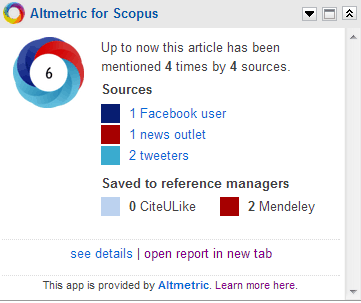
Scopus is a multidisciplinary database with substantial international coverage. When you view an abstract in Scopus, you might see a box titled Altmetric for Scopus on the right side of the screen.  Below is a screenshot taken from the abstract view of the article: Slinin, Y., Paudel, M., Taylor, B. C., Ishani, A., Rossom, R., Yaffe, K., . . . Ensrud, K. E. (2012). Association between serum 25(OH) vitamin D and the risk of cognitive decline in older women. Journals of Gerontology – Series A Biological Sciences and Medical Sciences, 67 A(10), 1092-1098.

It should be noted that Scopus is not compatible with Internet Explorer (IE) 9 (like ProQuest Dissertations and Theses). IE 9 users should also make sure compatibility view mode is turned on: go to Tools and then click on Compatibility View settings and check Display all websites in Compatibility View.
altmetric for scopus

Altmetric for Scopus is a 3rd party web application that collects mentions on social media and news outlets and counts on popular reference managers for a  particular paper.  The number inside the colored circle is the Altmetric score for the article you’re viewing.  If you don’t see the Altmetric for Scopus, it means this app can’t find any mentions of the article you are viewing in their data sources. Also keep in mind that Altmetric only started collecting content from supported publishers/repositories during the second half of 2011.  Read more on the app’s potential limits on its developer’s website.

Come to Hardin Library on Tuesday, Feb 19th, 1:00-2:00 pm and learn more about Scopus. Register for the class at http://www.lib.uiowa.edu/hardin/workshop/ Don’t forget that we offer a class called “Get Started Publishing”. If you don’t see it listed, you can always contact us for a one on one or group consultation.

Iowa City Meteor in 1875

Last night a meteorite slammed into the Russian countryside, as captured in many videos and photographs. 138 years ago in 1875, nearly to the day, a very similar event occurred in Iowa, when a meteorite disintegrated almost directly above Iowa City. It was documented by C.W. Irish, a local surveyor and astronomer. These images are from a document he published, An Account of the Detonating Meteor of February 12, 1875, printed by the Daily Press Job Printing Office on Dubuque St. in Iowa City. He wrote, “the length of the train was variously estimated…from seven to twelve miles, as seen from Iowa City. From three to five minutes after the meteor had flashed out of sight, observers near to the south end of its path heard an intensely loud and crashing explosion, that seemed to come from the point in the sky where they first saw it.”

Irish1
Irish2
Irish3

Why We Assist in Disasters

Friday, February 15, 2013

Those of us who volunteer to assist in disaster response are, obviously, not in it for the money. Private conservators are not getting paid while volunteering. Many of us are away from family and friends, work hard and go to bed exhausted during recovery efforts. So what is in it for us?

For me, as for many of us, it is the giving back to our community, assisting in saving our culture, and the joy of helping someone preserve a little bit of his/her history. The piece below is a perfect example. I captured the title “For Matthew, May 14-May 15, 1976″ commemorating the birth of the artist’s son.

For Matthew, May 14-May 15, 1976

For Matthew, May 14-May 15, 1976

Teaching Moments at CRC

Thursday, February 14, 2013

Intern Assisting With Vaccuming Canvas PieceAll the work on the artwork damaged by Hurrican Sandy is done by volunteers. It’s a great opportunity for an intern to learn about assessing and cleaning paintings while on the job with a volunteer conservator. Today we had a student volunteer who is studying to become a paintings conservator. She assisted the volunteer conservator, had the opportunity to meet with two artists and work on several different pieces of art. Here she is assisting with vacuuming a canvas. You can already see the difference where they have cleaned.
Artist Cleaning Canvas Stretcher
Sometimes the best person to clean artwork is the artist because he/she knows the piece very intimately. The artist knows what materials were used to create the work and what the original looked like. For instance, the charcoal pieces that I was working with were smeared. Since I don’t know what the original looked like, I am the not the best person to clean the artwork — the artist is. I taught an artist’s assistant how to clean artwork on paper. She knows his work intimately and can consult with the artist as needed.

The paintings conservator worked with an another artist today and taught her how to vacuum clean her works on canvas. I also showed her how to clean the canvas wood stretchers. Since the wood stretchers are made of soft, porous wood, the frames will eventually need to be replaced. In the meantime, some of the mold has been cleaned off, reducing health risks.

There is no way that we can clean all the artwork in the time we have at the CRC. By training others on basic cleaning, we increase our “cleaning power.” Plus the work can continue once the CRC is closed.

L’Année Philologique – Trial ended 8 February 2014

L’Année philologique covers a wide array of subjects, including Greek and Latin literature and linguistics—which includes early Christian texts and patristics—Greek and Roman history, art, archaeology, philosophy, religion, mythology, music, science, and scholarly subspecialties such as numismatics, papyrology and epigraphy.

Please send additional comments to Chris Africa.

Busy Day at the Cultural Recovery Center in Brooklyn

Wednesday, February 13, 2013

Testing for Mold

Testing for Mold

We had a very busy day at the Cultural Recovery Center in Brooklyn. The volunteer paintings conservator examined a couple of paintings that an artist brought in during the morning, just before noon she removed an artwork from a frame and examined the piece for mold and damage, in the afternoon she examined art on canvas and tested for mold.

Cleaning a Wooden Object

Cleaning a Wooden Object

The volunteer object conservator spent most of the day cleaning a wooden object with a vacuum cleaner, brush and soot sponge.

Vacuuming a Canvas

Vacuuming a Canvas

An artist’s daughter-in-law spent several hours vacuuming his artwork on canvas.

I spent the day assisting the paintings conservator photodocumenting each piece that she examined and spent a couple hours inspecting art on paper for mold.

Twentieth Century Religious Thought – Trial ends 12 April 2013

Twentieth Century Religious Thought will be a multivolume, cross-searchable online collection that brings together the seminal works and archival materials related to key worldwide religious thinkers from the early 1900s until the turn of the 21st century.
It will cover the major strains and new directions in religious questioning that have often altered the very framework of given traditions. In addition to studying scholars’ ideas separately, researchers will be able to explore broader schools of thought to examine how different theories, denominations, faiths, and political and cultural groups have intersected, differed, and influenced one another. Central topics in Volume I will include Protestantism, Catholicism, Evangelicalism, Lutheranism, liberation theology, systematic theology, dialectical theology, and theocentric theology.

Please send additional comments to Rachel Carreon.

Scopus mobile app: Scopus Alert for iPhone

Scopusapp

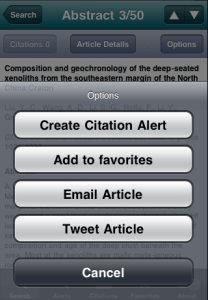
The Scopus Alert for iPhone app allows you to 1) do keyword search, 2) email, bookmark, and tweet an article, and 3) receive email alerts when articles get cited. Keep in mind that you can only view abstracts, and full-text links are NOT available. A workaround is to email an article to oneself and access the fulltext outside of the app.

Before you download and install SciVerse Scopus Alerts (institutional subscriber’s version) from the App Store on your iPhone, you need to create a Scopus account at http://purl.lib.uiowa.edu/scopus. You will be prompted to enter your Scopus log in and password and your UIowa email when you first open this app. Detailed instruction can be found at SciVerse Scopus iPhone app User Guide (PDF file).

scopus

Scopus is a multidisciplinary database with substantial international coverage. All citations that are in EMBASE are also in Scopus. Scopus also allows you to measure an author’s scholarly impact and to track an article’s cited and citing references.

Come to Hardin Library on Tuesday, Feb 19th, 1:00-2:00 pm and learn more about Scopus. Register for the class at http://www.lib.uiowa.edu/hardin/workshop/.

Apple iOS 6.1 user? Temporarily stop managing your Exchange calendar from your mobile device.

A bug has been identified in Apple’s iOS 6.1 release for the iPhone, iPad and iPod Touch.  iOS 6.1 devices interacting with the Exchange calendar are causing an increased load on the Exchange servers and could cause a service disruption/outage for all users.

At this time, ITS asks all Apple iOS users to stop managing their Exchange calendars from their mobile device.  This includes accepting, declining or modifying calendar appointments. Viewing your calendar from your mobile device is fine.

See our Best Practices for Outlook and Mobile Device Users  for additional information.

ITS will continue to monitor the Hawkmail service and will take additional actions if needed to maintain the stability of the service.