Skip to content
Skip to main content

Women’s History Month : Emma L. Miller, first female employee of VA

Mrs. Emma L. Miller was the first woman employee in Veterans Health Administration.  She was appointed as the first matron at the Central Branch NHDVS in Dayton (now Dayton VAMC) in the fall of 1867.

Prior to her appointment, she worked with the U.S. Sanitary Commission at their Cleveland and Cincinnati branches  during the Civil War and was appointed as matron of the Ohio Soldiers Home in Columbus in October 1865.

When the U.S. government established a branch of the National Asylum for Disabled Volunteer Soldiers (later named National Home for Disabled Volunteer Soldiers) it initially took over the state home in Columbus, but later selected a site in Dayton as its permanent location.  Miss Miller brought 16 disabled “boys in blue” with her to the new Dayton site in the fall of 1867.

She helped at the hospital, oversaw laundry operations, ran the Home’s hotel, and was eventually elevated to Superintendent of the general depot, where much of the clothing and supplies for all of the National Homes were manufactured and distributed–a rare position to held by a woman, in those days. In the 1880 annual report, she reported that the “Matron’s Department” had washed, pressed, repaired, and reissued over 1,703,648 pieces of laundry and linens, averaging 32,762 pieces per week.  Worn out linens were condemned, then washed and reused in the hospital as bandages and dressings, in the engineer’s department as wipers and wrappings for steam-pipes, and as wipers and mops elsewhere. Emma Miller was a fixture at the Dayton home for nearly 50 years and she lived on-site. She spent her entire post-Civil War life at the home and grew old with many of the men whom she originally cared for during the war. Emma Miller died in her quarters at the National Home on January 18, 1914 and is buried in the Dayton National Cemetery (formerly the National Home’s cemetery).

*Information provided by the Veterans Health Administration’s History Office.

Iowa Meteorite Crater Confirmed

USGS Airborne Surveys Back Up Previous Decorah Research Released: 3/5/2013 9:01:00 AM

U.S. Department of the Interior, U.S. Geological Survey   Office of Communications and Publishing 12201 Sunrise Valley Dr, MS 119 Reston, VA  20192 Heidi  Koontz 1-click interview Phone: 303-202-4763
Robert McKay Phone: 319-335-1575


Recent airborne geophysical surveys near Decorah, Iowa are providing an unprecedented look at a 470- million-year-old meteorite crater concealed beneath bedrock and sediments.
The aerial surveys, a collaboration of the U.S. Geological Survey with the Iowa and Minnesota Geological Surveys, were conducted in the last 60 days to map geologic structures and assess the mineral and water resources of the region.
“Capturing images of an ancient meteorite impact was a huge bonus,” said Dr. Paul Bedrosian, a USGS geophysicist in Denver who is leading the effort to model the recently acquired geophysical data. “These findings highlight the range of applications that these geophysical methods can address.”
In 2008-09, geologists from the Iowa Department of Natural Resources’ (Iowa DNR) Iowa Geological and Water Survey hypothesized what has become known as the Decorah Impact Structure. The scientists examined water well drill-cuttings and recognized a unique shale unit preserved only beneath and near the city of Decorah. The extent of the shale, which was deposited after the impact by an ancient seaway, defines a “nice circular basin” of 5.5 km width, according to Robert McKay, a geologist at the Iowa Geological Survey.
Bevan French, a scientist the Smithsonian’s National Museum of Natural History, subsequently identified shocked quartz – considered strong evidence of an extra-terrestrial impact – in samples of sub-shale breccia from within the crater.
“The recognition of this buried geological structure was possible because of the collaboration of a local geologist, water well drillers, the USGS STATEMAP program, and the support of the Iowa DNR concerning research on fundamental aspects of Iowa geology,” said McKay.
The recent geophysical surveys include an airborne electromagnetic system, which is sensitive to how well rocks conduct electricity, and airborne gravity gradiometry, which measures subtle changes in rock density. The surveys both confirm the earlier work and provide a new view of the Decorah Impact Structure. Models of the electromagnetic data show a crater filled with electrically conductive shale and the underlying breccia, which is rock composed of broken fragments of rock cemented together by a fine-grained matrix.
“The shale is an ideal target and provides the electrical contrast that allows us to clearly image the geometry and internal structure of the crater,” Bedrosian said.
More analysis of the data will provide additional detail. These data show the impact as a nearly circular region distinct from the surrounding area to a depth of several hundred meters.
“These data, when coupled with physical property measurements on drill core samples, will form the basis for modeling efforts to constrain the impact geometry and energy of the meteorite,” said Dr. Andy Kass, a USGS geophysicist working on the effort.
The Iowa and Minnesota airborne geophysical surveys are targeting an igneous intrusion, known as the Northeast Iowa Igneous Intrusive complex, that may be similar to the Duluth layered igneous complex exposed in the Lake Superior region of northern Minnesota. Known copper, nickel, and platinum group metal resources were deposited during the formation of the Duluth complex. Both of these complexes are associated with a large structural feature known as the Midcontinent Rift, which is exposed in the Lake Superior Region but is covered by younger rocks as it extends to the south through Iowa, Nebraska, Kansas, and Missouri.
This geophysical survey is part of a larger USGS effort to evaluate the concealed mineral resource potential of the greater Midcontinent Rift region that formed about 1.1 billion years ago.

Xpress Class

Learn more about Finding Company Information during a 15 minute Library Xpress class tomorrow March 7, 2013 at 10:00am and again at 2:30pm at the Lichtenberger Library computer lab,  2001 Seaman Center.

Scopus mobile app: Scopus Alert for iPhone

Scopus mobile app: Scopus Alert for iPhone

By

Xiaomei GuFebruary 12, 2013 Posted in: Combo, Library Resource, Uncategorized

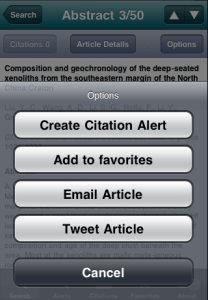
The Scopus Alert for iPhone app allows you to 1) do keyword search, 2) email, bookmark, and tweet an article, and 3) receive email alerts when articles get cited. Keep in mind that you can only view abstracts,

Scopusapp

and full-text links are NOT available. A workaround is to email an article to oneself and access the fulltext outside of the app.

Before you download and install SciVerse Scopus Alerts (institutional subscriber’s version) from the App Store on your iPhone, you need to create a Scopus account at http://purl.lib.uiowa.edu/scopus. You will be prompted to enter your Scopus log in and password and your UIowa email when you first open this app. Detailed instruction can be found at SciVerse Scopus iPhone app User Guide (PDF file).

scopus

Scopus is a multidisciplinary database with substantial international coverage. All citations that are in EMBASE are also in Scopus. Scopus also allows you to measure an author’s scholarly impact and to track an article’s cited and citing references.

Come to Hardin Library on Tuesday, Feb 19th, 1:00-2:00 pm and learn more about Scopus. Register for the class at http://www.lib.uiowa.edu/hardin/workshop/.

Library Help at the Chemistry Building

Have a library question, but don’t want to trek through the snow to the library? The Sciences Library is now providing Librarian Office Hours at the Chemistry Building (CB) in W223. A librarian will be able to assist you during the following hours:

  • Mondays – 2:30-4:30pm
  • Tuesdays – 10:30am- 12:30pm
  • Wednesdays – 2:30-4:30pm
  • Thursdays – 10:30am-12:30pm
  • Fridays – 10:30am-12:30pm

During office hours, we can assist you with:

  • Questions about your library account
  • Renewing your library materials
  • Searching the library catalog and specialized databases
  • Finding books and full-text articles
  • Getting materials from other libraries (interlibrary loan)
  • Using citation managers like RefWorks and EndNote
  • And much, much more!

A selection of chemistry reference books are also available. Office hours will not be held during Spring Break. If you would like to make an appointment outside office hours, please contact the Sciences Library at lib-sciences@uiowa.edu or (319) 335-3083.

So, come on down to W223 CB and get help from a librarian. You’ll be glad you did!

Learn about our toxicology resources! Free workshop at Hardin Library, Wednesday, March 6

The purpose of this session is to introduce you to various environmental health and toxicology resources found on the National Library of Medicine’s website. Learn about important resources such as the Household Products Database, TOXMAP and TOXNET.

The resources discussed in this session will be of interest to the researcher/scientist, health professional and the general public.

Our next session is

The Black Death : the Plague, 1331-1770 – John Martin Rare Book Room annual Open House

The University of Iowa History of Medicine Society and the University Libraries invite you to an Open House in the John Martin Rare Book Room.

The Black Death: the Plague, 1331-1770

Thursday, March 28, 2013, 4:30-7:00

John Martin Rare Book Room, 4th floor, Hardin Library for the Health Sciences

Books published  1485-1750 will be on display.    Amidst the chaos, the fear and the despair, rats scurried from home to home.  If you suspect that symptoms of the plague are starting to appear, you need not worry, because a Plague Doctor will be present at the event.


picture of Napolean with plague victims

Notes from the John Martin Rare Book Room, 2013

Notes from the John Martin Rare Book Room    March 2013

GASPARE ASELLI (1581-1626). De lactibus sive lacteis venis. Milan: Apud Jo. Bapt[ist]am Bidellium, 1627.

Aselli was born at Cremona, studied medicine at Pavia receiving degrees in medicine, surgery, and philosophy. He spent his professional career as a surgeon in Milan performing many anatomical and physiological experiments including those that led to his rediscovery of the lymphatic vessels. The lymphatics had been described earlier but no one had been successful in identifying their functional significance. Aselli wrote many unpublished notebooks and papers to record his work on medical subjects including surgery, therapeutics, recurring calculi, anal fistulas, and poisonous drugs. The latter was important because it was the first time drugs had been classified by their clinical effects and toxic actions. While vivisecting a dog to demonstrate the recurrent nerves and diaphragm, he discovered a network of mesenteric vessels that contained a milky white fluid. He had uncovered the mesenteric lymphatic vessels which he called the lacteals. After repeated experimentation, he concluded that they lead into the liver which was believed to be the central organ of the venous system. It remained for Pecquet to correct Aselli’s misconception when he discovered the thoracic duct in 1651. The woodcuts are treated in a very spirited manner and in colored chiaroscuro. The wood blocks are the earliest anatomical illustrations in color printing.


More Study Space

Please pardon our mess. The Sciences Library is working to create more study space on the third floor. We’re taking down some empty shelves and moving in some new furniture. We’re looking forward to seeing it finished, but in the meantime, check out these photos of our progress.
Photo 1
Photo 2
Photo 3
Photo 4

Statistical Abstract of the United States – Trial ended 29 March 2013

The Statistical Abstract of the United States is a comprehensive summary of statistics on the social, political, and economic organization of the United States. ProQuest Statistical Abstract of the United States 2013 online edition is a significant enhancement over the Census Bureau’s online version:

  • Line-item access to tables
  • Updated monthly instead of annually
  • Table-specific capabilities for narrowing results by source, data date, subject, type of data breakdown
  • Available as a stand-alone or as a fully integrated part of ProQuest Statistical Insight—with discounts available to current customers
  • Edited by ProQuest’s team of statistical experts

Please send additional comments to Brett Cloyd.