Skip to content
Skip to main content

The First World War: Personal Experiences – Trial ended 30 April 2013

The First World War: Personal Experiences contains digital images of a wide range of original documents, including diaries, letters, personal narratives, trench journals, scrapbooks, objects, and a wealth of visual sources. It is designed for both teaching and study, from undergraduate to research students and beyond.

Supplementing the primary sources is a wealth of secondary resources including interactive maps, 360° panoramas and walk-throughs of the Sanctuary Wood Trench System, the Memory Wall, In Their Own Words feature, scholarly essays, a slideshow gallery, chronology and glossaries.

Please send additional comments to Chris Africa.

Foreign Office Files for India, Pakistan and Afghanistan, 1947-1980 – Trial ends 30 April 2013

Foreign Office Files for India, Pakistan and Afghanistan consist of the British Government’s files on the countries of South Asia from shortly before Indian partition and independence up to 1980. The files in this collection cover these events from the standpoint of British officialdom. In addition to high politics, the papers in the files cover such issues as economic and industrial development, trade, migration, visits to South Asia by British politicians and by South Asian politicians to Britain and elsewhere, education, administrative reorganisation, conflict over language, aid, political parties, agriculture and irrigation, and television and the press.

Please send additional comments to Edward Miner.

Xpress Class on Compendex

Learn more about Compendex during a 15 min Library Xpress class tomorrow, April 4th at 10:00am and again at 2:30pm in 2001c Seamans Center Computer classroom.

The DADA Bluff

The title of the work is “Dada is everywhere”. Thinking the title of the work hinted at a practical joke such as “this bag will LITERALLY explode and letters of ‘D’ and ‘A’ would spill everywhere” we were careful in their extraction. We had run into works such as a work called Flux Snow Game which George Maciunas ingeniously devised which entails one opening the box and *poof* a bunch of tiny Styrofoam balls fly out and stick to everything and another work “Fluxbox Containing God” of which we were not meant to discover the insides -unless ‘God’ is made of yellow ooze that happened to seal the box -. Needless to say, we have become a little leery of the objects in this collection, and try to read into the title of the works as a clue to their behavior.

Perhaps Monte Cazzara, the creator of Dada is Everywhere, was playing with the philosophy one would develop after constant interaction with other Fluxus objects. Dada was not indeed everywhere, but neatly stacked and glued together, totally messing with our preconceived notions. We had to scrap our intention of laying the letters out linearly to scan them, but at least the letters were not sticking to our clothes. Once again, we thought we had figured out the Fluxus collection, and it points its finger and slaps its knee. This collection is full of surprises.

dada


Eiffel Tower Day

Did you know?  March 30th is Eiffel Tower Day. Here are some facts about the Eiffel Tower: http://ow.ly/jdsKB that you might find interesting. The facts contain construction facts, Eiffel Tower Height, area, weight, tower steps and elevators and much more.

Eiffel’s tower : and the World’s Fair where Buffalo Bill beguiled Paris, the artists quarreled, and Thomas Edison became a count / Jill Jonnes. — New York, N.Y. : Viking, 354 p. : ill., map ; 25 cm. (10051350)

Engineering Library T803.D6 E54 2009

Building the world : an encyclopedia of the great engineering projects in history / [compiled by] Frank P. Davidson and Kathleen Lusk Brooke. — Westport, Conn. : Greenwood Press, 2006  2 v. (xxiii, 937 p.) : ill., map ; 27 cm.  Table of contents — http://www.loc.gov/catdir/toc/ecip066/2005037902.html  Engineering Library T56 .B85 2006


History of Medicine Dinner-Thomas Hager to speak

The University of Iowa History of Medicine Society Dinner, April 26, 2013, 6:oopm-9:30pm

Thomas Hager will speak on The First Miracle Drug: How the Discovery of Sulfa Saved the President’s Son, Put a Nobel Prize Winner in Jail, and Changed Medical History.

The media called it “the miracle of miracles,” a wonder drug that conquered diseases, saved millions of lives—among them Winston Churchill and Franklin Delano Roosevelt Jr.—and single-handedly launched the era of antibiotics. No, it was not penicillin. The miracle came a decade earlier in the form of sulfa, an off-the-shelf, unpatentable dye-making ingredient that fundamentally changed the practice of medicine.

Sulfa shifted the way new drugs are developed, approved, and sold; reshaped the relationship between physicians and the pharmaceutical industry; and spurred the creation of today’s drug laws. Today sulfa is almost forgotten. But Thomas Hager, author of The Demon Under the Microscope: From Battlefield Hospitals to Nazi Labs, One Doctor’s Heroic Search for the World’s First Miracle Drug brings it back to life, detailing the heyday of sulfa, its rise and fall, and the lessons it still teaches about the interplay between research, government, big business, and the art of healing.

Improve your lit search for a systematic review with a free workshop on April 9th

This class will focus on tips and techniques for carrying out a successful literature search in support of a systematic review.

Topics will include techniques for developing search strategies, deciding which databases to search and how to seek out grey literature for a given topic. There will also be discussion on selecting journals for hand searching, documenting search strategies, and saving and organizing references.

Our next session:

Tuesday, April 9th  12:00-1:00pm (Location: East Information Commons, Hardin Library)

Register online (http://www.lib.uiowa.edu/hardin/regform.html) or by calling 319-335-9151.

Learn how to manage your citations with EndNote: Come to the free workshop on Thursday, April 4

EndNote is a reference management tool that helps you to easily gather together your references in one place, organize them, and then insert them into papers and format them in a style of your choosing. This session will walk you through the basics of using EndNote to collect and format your citations. The class will be hands-on and there will be time for questions at the end.
Our next session is
No time for a class?  We can help you with tips and support.

Education Source – Trial ends 26 June 2013

As the complete source of education scholarship, Education Source covers all levels of education—from early childhood to higher education—as well as all educational specialties, such as multilingual education, health education and testing.

Developed from a merger of high-quality databases from EBSCO Publishing and H.W. Wilson, and including many unque sources that were never previously available, this database covers scholarly research and information to meet the needs of education students, professionals and policy makers.

Please send additional comments to Dottie Persson.

Earliest Known Simon Estes Recording Restored

Dec1997_IowaAlumniQuarterly_0030

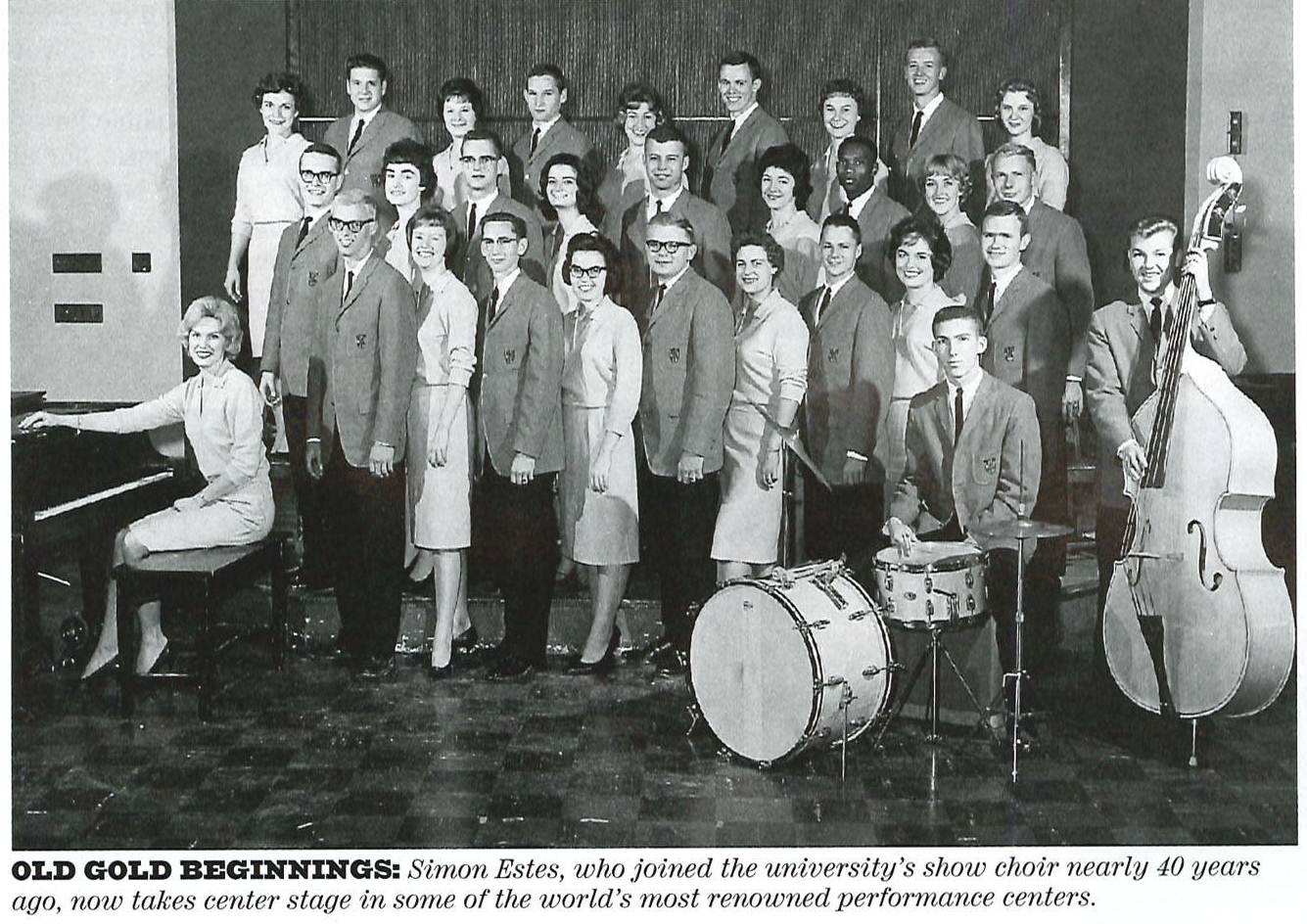
Simon Estes and the Old Gold Singers – Courtesy UI Alumni Association


This story starts in 1959 when a UI undergraduate student from Centerville, IA, named Simon Estes auditioned for, and joined, the Old Gold Singers, a university chorus made up of non-music majors. The Old Gold Singers was a new organization, formed just two years before. It quickly established itself as a highly-talented goodwill ambassador of the University, thanks in no small part to Simon Estes’ rich baritone voice.


 The University Archives had no recordings of the singers from those early seasons until only recently. In 2010, UI alumnus James Crook, a professor emeritus of journalism at the University of Tennessee at Knoxville, donated to the archives a set of phonograph disks featuring the troupe. Mr. Crook was a founding member of the Old Gold Singers and participated in its first three seasons. Mr. Estes, a classmate of Crook’s, went on to an acclaimed operatic and solo vocal career, after completing his UI degree and studies at the Julliard School. He has performed with the New York Metropolitan Opera, the Lyric Opera of Chicago, and throughout Europe in a career spanning over 50 years.


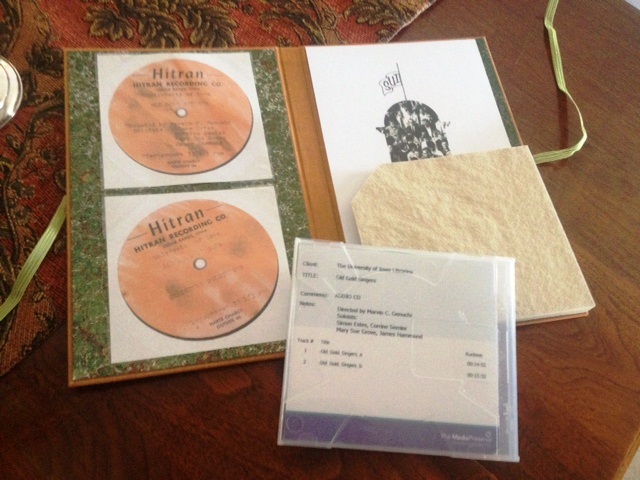
CDAmong the phonograph records that Mr. Crook donated is one featuring Mr. Estes as a soloist during his first season with the Old Gold Singers, while a sophomore. The rare recording was made in a Cedar Rapids recording studio in 1959 or 1960, and playing it on a turntable more than 50 years later yielded a lot of scratches and pops with the music. Still, it was a valuable addition to the archives, believed to be the earliest-known recording of a young singer at the dawn of a remarkable and distinguished career.


The UI Libraries’ Preservation Department cleaned the record thoroughly and shipped it to the Media Preserve, a Pittsburgh firm specializing in recovery of audiovisual recordings. There, staff produced a digitally-reformatted version of the recording, one that sounds as good as new. The University Archives now has a digital copy of this rare recording, along with the original phonograph disk.


EstesBut the story doesn’t end there. On Sunday, March 17, Mr. Estes performed in Osage, Iowa, at a special dedication program recognizing that community’s new Krapek Family Fine Arts Center. The program was also part of his Roots and Wings tour in which he hopes to eventually perform in each of Iowa’s 99 counties. High school choruses from Osage and nearby Riceville and St. Ansgar also performed with Mr. Estes that afternoon.


Following the performance, UI Archivist David McCartney, representing the UI Libraries, presented Mr. Estes with a CD copy of the recording, housed in a case made for the occasion by staff in the Conservation Lab. The audience of over 600 also heard a one-minute excerpt, featuring a 21-year-old Mr. Estes singing a selection from “Porgy and Bess,” a number he coincidentally sang earlier in the afternoon as part of the program.


 The UI Libraries’ Department of Special Collections and University Archives is pleased to honor Mr. Estes and to preserve an early and important part of his outstanding career.