Skip to content
Skip to main content

ReferenceUSA: Millions of Businesses & Consumers

The University of Iowa Libraries now offer access to a powerful research tool: ReferenceUSA.  Users can create cusomized searches for over 24 million businesses and 262 million consumers.  Information can be detailed, and ReferenceUSA presents data in charts and other formats.

Businesses include:

  • Name
  • Phone
  • Address
  • Employee size
  • Expenditures
  • Credit rating
  • Company history

& more.

Consumer data shows:

  • Phone
  • Home value
  • Income
  • Lifstyles (arts, cooking, pets, etc.)
  • Snapshots (age, marital status, gender etc.)

& more.


Learn how to use PubMed with our session on Wednesday, April 24th

PubMed is the National Library of Medicine’s index to the  medical literature and includes over 17 million bibliographic citations in life  sciences. This one hour session will introduce you to the basics of searching  PubMed and will also cover: using subject headings (MeSH headings), combining  searches, choosing limits, and saving, printing and emailing search results.

Our next session is

No time for class?  Ask your librarian for a private consult!

graphic of pubmed

Open Access

Open access is an electronic publishing model that allows free and immediate access to research, and  also allows authors to retain intellectual property rights to their research.  Many open access journals charge authors publication fees, which can be a barrier to publishing  in such venues.

To help offset the cost of publishing in open access journals the Office of the Provost and University Libraries have established a small fund to assist with authors’ fees.

Researchers may apply for funding to be applied toward publication fees up to:

– $3,000.00 for publication in full open access journals that allow immediate, free access to all their articles upon publication (check the Directory of Open Access Journals: http://www.doaj.org/ for titles that qualify).- $1,500.00 for publication in “hybrid” open access journals.  These are subscription-based journals that allow open access only to articles for which author open access fees have been paid (check Sherpa/RoMEO’s list of Publishers with Paid Open Access Options: http://www.sherpa.ac.uk/romeo/PaidOA.html).

Funding is not available to researchers with grant funding that could be used to pay open access fees.

For more information and an application form, go to: http://guides.lib.uiowa.edu/OAfund

Questions about the process may be directed to Mike Wright, Interim Associate University Librarian, Collections and Scholarly Communication (michael-wright@uiowa.edu).


Workshop: Managing Privacy Online

Facebook, Twitter, Instagram, YouTube… The options for sharing your life online seem to be endless. But in this age of social media, maintaining privacy is increasingly challenging. Join Kelly McElroy, Undergraduate Services Librarian, and Sara Scheib, Sciences Research & Instruction Librarian for a discussion of privacy in the social media age. Share your strategies for managing privacy online and learn from others in this informal and open workshop.

Lunch @ the Sciences Library
Managing Privacy Online
11:30 a.m. – 12:20 p.m., Wednesday, April 24
102 SL (Sciences Library Classroom)

This workshop is free and open to all UI students, faculty and staff. There is no need to register. You may bring your lunch if desired. Free coffee will be provided. If you have any questions, please contact Sara Scheib at sara-scheib@uiowa.edu or (319) 335-3024.

Open Access Fund

Open access is an electronic publishing model that allows free and immediate access to research, and  also allows authors to retain intellectual property rights to their research.  Many open access journals charge authors publication fees, which can be a barrier to publishing  in such venues.

To help offset the cost of publishing in open access journals the Office of the Provost and University Libraries have established a small fund to assist with authors’ fees.

Researchers may apply for funding to be applied toward publication fees up to:

  • $3,000.00 for publication in full open access journals that allow immediate, free access to all their articles upon publication (check the Directory of Open Access Journals: http://www.doaj.org/ for titles that qualify).
  • $1,500.00 for publication in “hybrid” open access journals.  These are subscription-based journals that allow open access only to articles for which author open access fees have been paid (check Sherpa/RoMEO’s list of Publishers with Paid Open Access Options: http://www.sherpa.ac.uk/romeo/PaidOA.html).

Funding is not available to researchers with grant funding that could be used to pay open access fees.

For more information and an application form, go to: http://guides.lib.uiowa.edu/OAfund

Questions about the process may be directed to Mike Wright, Interim Associate University Librarian, Collections and Scholarly Communication (michael-wright@uiowa.edu).

National Library Week

Celebrate National Library Week, April 14-20, 2013, with Honorary Chair Caroline Kennedy.

Communities matter @ your library

Every day across the country, libraries open their doors to everyone: students, parents, seniors, teachers, writers, artists, job seekers, entrepreneurs, readers, gamers, movie lovers and travel buffs.

Head to your library during National Library Week to see what’s new and take part in the celebration.   Libraries across the country are participating.

Just in time for National Poetry Month and National Library Week: Check out Poetry Beats Studio, an interactive studio designed for students, educators and poetry lovers, where they can explore the rhythm and sound of spoken word. Poetry Beats Studio is in support of Caroline Kennedy’s new book, Poems to Learn by Heart.


ebrary new titles

ebrary currently hosts 630,401 documents with 13, 634 added in the past 30 days.  This month, ebrary added more than 5,500 e-books from Encyclopedia Britannica, Peter Lang Publishing, University of California Press, World Scientific College Press and other leading publishers to their growing catalog of over 399,700 titles for purchase.  ebrary has already added 13,5800 new titles in 2013!  At the Engineering Library find:  LinkMembrane and desalination technologies with access limited to ebrary affiliated libraries and other ebrary e-book http://ow.ly/k9vC0 


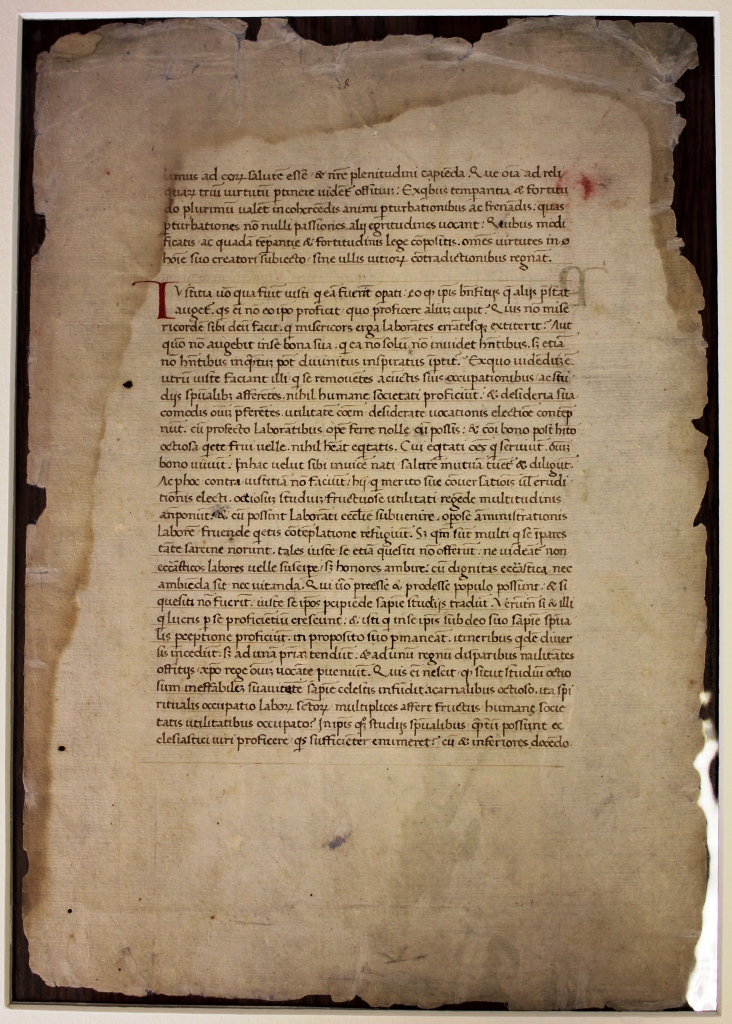
Manuscript Mystery Solved

It’s kind of like History’s Mysteries meets Antiques Roadshow. There’s an item that’s been lying in your collection for years, possibly decades, patiently awaiting investigation. What exactly is this thing? Then one day—maybe on a quiet Friday afternoon—you suddenly have the urge to dig into it.

That’s what happened here in Special Collections. A medieval manuscript leaf, for whatever reason, had evaded description these last few decades. This warrants a friendly reminder to all book-loving sleuths: you need not be a medieval manuscripts expert to solve such a puzzle (though it sure would help). Sometimes all it takes is a little resourcefulness, an educated hunch, and a bit of luck.

MsC2Our leaf turned out to be from De vita contemplativa, a fifth-century theological treatise by Julianus Pomerius. Determining the text of a particular leaf is often easy, requiring little more than Googling a short passage from the text in question. Identifying where and when it was made is the tricky part, but fortune was on our side: this particular manuscript was written on paper.

Medieval manuscripts were predominantly written on vellum (or parchment, but we’ll overlook the distinction for now). Paper wasn’t produced in Europe until the twelfth century, and its importation didn’t begin much earlier. What’s more, to an inexpert eye such as mine, the script appeared Carolingian—the standard book hand developed for the copying of texts during Charlemagne’s reign. While Charlemagne died in 814, this book hand—called Carolingian minuscule, or Caroline minuscule—continued to be used throughout Christendom. But just as paper was growing more common in Europe, the Carolingian script was yielding to the Gothic hand that would soon dominate manuscript production. It seemed unlikely, then, to have a true Carolingian manuscript on paper.

Near the end of the fourteenth century, however, Italian humanists revived Carolingian minuscule. Mistaking the Carolingian manuscripts for original Roman texts, these humanists began copying their favorite classical works in what they believed was their original form. This revived form of Carolingian minuscule has become known as humanistic script. It was commonly used throughout Italy (and later throughout Europe) until the printing of books largely obviated the need to copy them by hand.

And just like that, we came to the likely conclusion that our manuscript was probably made in Italy during the 15th century.MsC1

After consulting a couple of manuscript censuses, we learned that a 15th-century Italian copy—on paper—had once been in the private collection of Ernst Detterer, a Chicago typographer and later the inaugural custodian of the Newberry Library’s John M. Wing Foundation. Given the scarcity of copies on paper, and our geographic proximity to Chicago, this all seemed rather coincidental.

With the help of colleagues at the Newberry Library and the University of Colorado, Boulder, we were able to confirm that our leaf did in fact come from that very same Detterer manuscript—more information than we had ever hoped to uncover.

The underlying tragedy, of course, is that the other twenty-eight leaves are scattered across the country, if not the planet. Three, for example, reside at Boulder. It’s a fate befallen many medieval manuscripts, which were commonly sold or otherwise distributed leaf by leaf at a time when the ethics of the practice were a bit murkier. When in Detterer’s collection, the manuscript was unbound, which mustn’t have helped to suppress the urge to separate the leaves. It’s unlikely that all twenty-nine leaves will ever be reunited. The best we can do is to keep our little piece of it safe and secure, to document its history, and to share it with all of you.
Encyclopaedia of the Qur’ān Online – Trial ended 15 May 2013

The Encyclopaedia of the Qur’ān Online is an encyclopaedic dictionary of qur’ānic terms, concepts, personalities, place names, cultural history and exegesis extended with essays on the most important themes and subjects within qur’ānic studies. The Encyclopaedia of the Qur’ān Online is the first comprehensive, multivolume reference work on the Qur’ān to appear in a Western language.
Encyclopaedia of the Qur’ān Online includes direct access to 62 Early Printed Western Qur’āns Online and the Electronic Qurʾān Concordance, a unique online finding aid for textual research.

Includes the Qurʾān Concordance (under “Other editions”) and Early Western Korans Online.

Please send additional comments to Edward Miner.