Skip to content
Skip to main content

Philanthropy Day: Hardin Library construction funded through gifts and NIH grant

Hardin at opening 1974

1974

Hardin Library for the Health Sciences opened in 1974.  The building was designed by Walter Netsch, and was  funded by $1.4 million in  gifts and a National Institute of Health grant for $2.3 million.

The John Martin Rare Book Room was started by a generous donation of books and funding from Dr. John Martin.

See History of the Hardin Library for more pictures and information about the library.

If you would like to donate to our library, you may do so online.

RefWorks Workshop

Are you starting a new research paper or project and looking for a way to manage your references? Then join us for this useful and informative workshop about RefWorks! RefWorks is a web-based citation manager and it’s free to all University of Iowa students, faculty and staff.

Lunch @ the Sciences Library
RefWorks Workshop
Wednesday, May 8 @ 11:30am – 12:20pm

Sciences Library classroom (102 SL)

In this workshop, you will learn:

  • How to sign up for a free RefWorks account;
  • How to export references to RefWorks from popular research databases;
  • How to use RefWorks to organize and share your references;
  • How to use RefWorks format citations and bibliographies;
  • How to download and use the free Write-N-Cite add-on to Microsoft Word to include preformatted citations and bibliographies in your paper.

This workshop is open to all UI students, faculty and staff. There is no need to register. You may bring you lunch if desired. Free coffee will be provided. If you have any questions, please contact Sara Scheib at sara-scheib@uiowa.edu or (319) 335-3024.

My uncle had these!

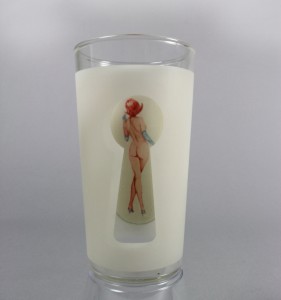
An exclaimation from a collegue who was helping me with photography and image selection: “Is that a Fluxus object?” he asked. “My uncle had these glasses! We used to go in the basement to sneak a peak.” I chuckled.
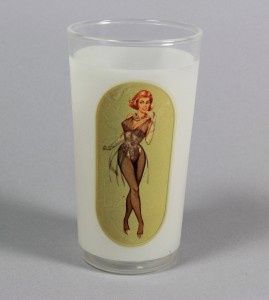
woman in silver dress and pale blue gloves on outside of glass

Woman on outside of Eyeglass

Eyeglass backside; Nude woman in high heels and gloves

Looking through the keyhole

We were looking at the object known as the Eyeglass. It is a beverage glass with a woman dressed to the nines painted (?) on the, for lack of a better word, front of the glass. There is a cream band around the middle of the glass, leaving a lip at the top and the base the natrual clear glass. The figure is set inside a green oval that makes a frame, seperating her from her cream surroundings. On the opposite, or 180 degree rotation from the woman is a transparent area in the shape of a keyhole. With the glass full, one would not see much through this keyhole, but as one drinks the beverage, a little more of another figure would appear on the inside of the glass. With the beverage gone, there stood a revealed backside of the same lady who is so well dressed on the front. However, she is no longer dressed in her going out clothes. Actually, she is not dressed at all, only framed with a pale blue outline completely unaware that you could see a little more of her than she might have intended.

It is a scene right out of a nightmare, at least for me *shivers*. However, I can understand how the glass may appeal to a group of boys.

This anacdote also illustrates an integral idea of Fluxus. The art movement is composed of artists creating and frabricating from found objects. These are objects anyone would have access to in the right circumstances. Objects that many would have had in their homes, or found on the street. There is a Fluxgame in our collection that contains a massive dustball. Not to make any judgements, but I bet you would find one of those behind your sofa. Fluxus is all around us. It is what we make it. And who knows, one day, something of yours could make it into an archive.

My uncle had these!

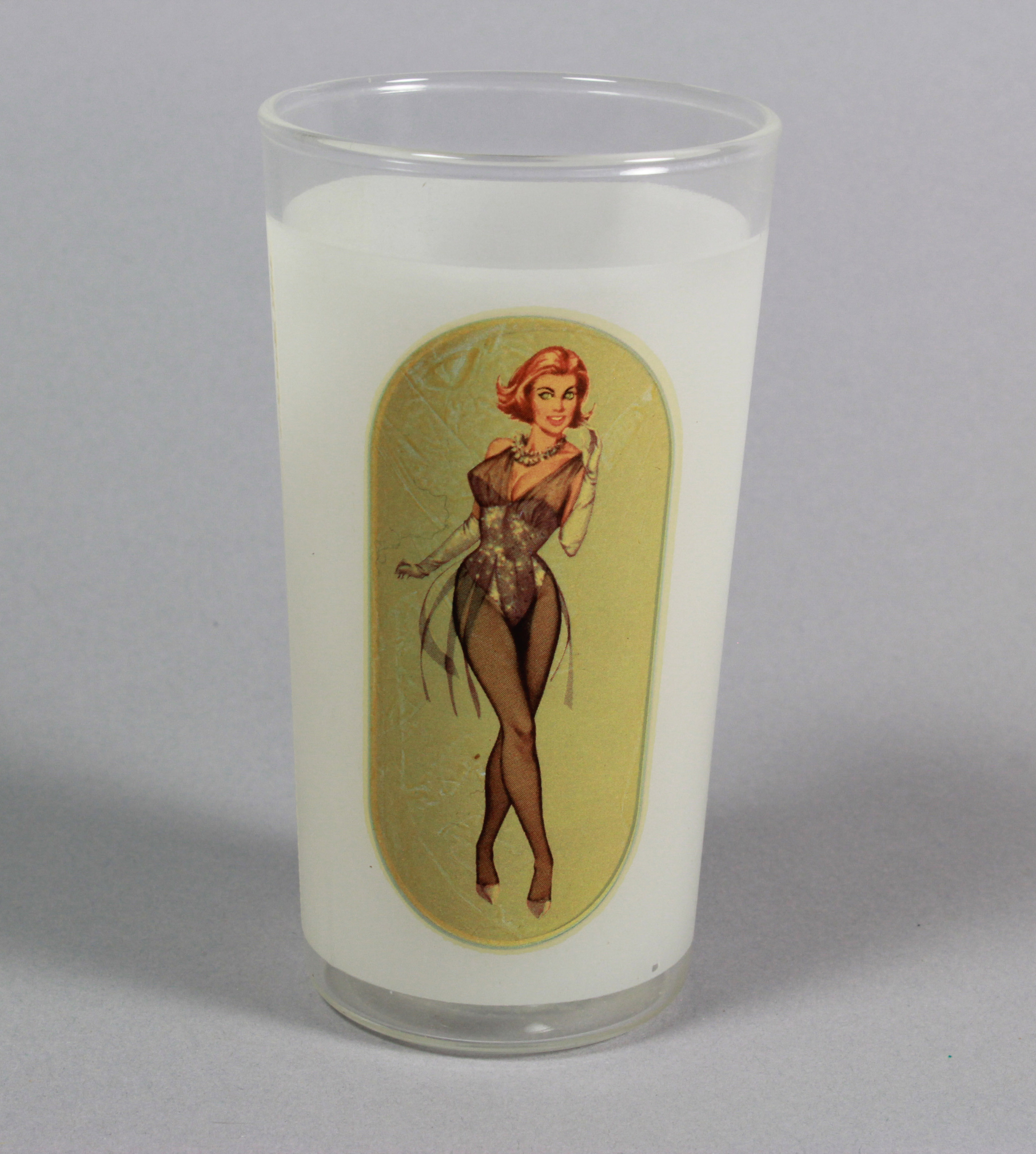
An exclaimation from a collegue who was helping me with photography and image selection: “Is that a Fluxus object?” he asked. “My uncle had these glasses! We used to go in the basement to sneak a peak.” I chuckled.

woman in silver dress and pale blue gloves on outside of glass

Woman on outside of Eyeglass

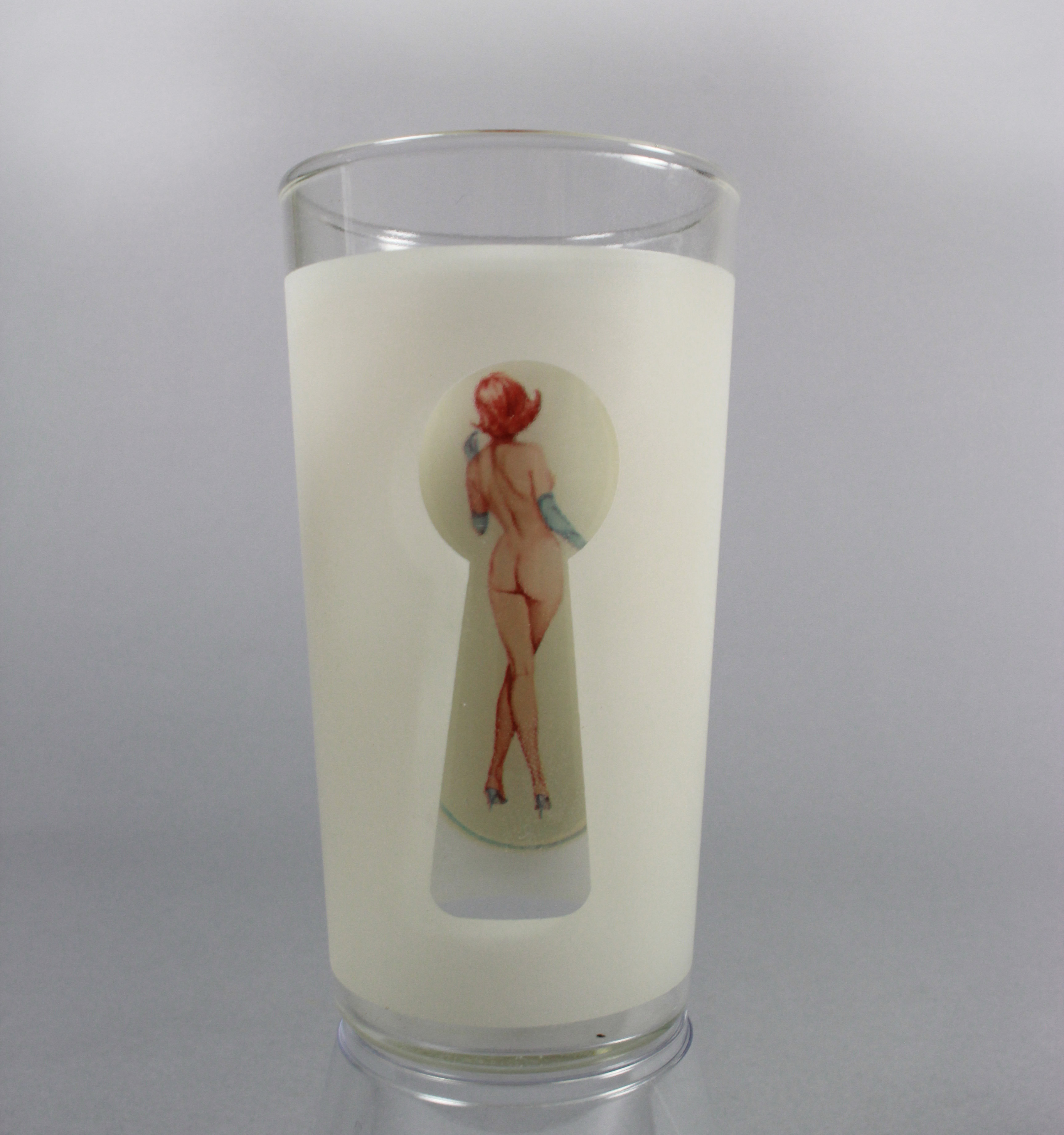
Eyeglass backside; Nude woman in high heels and gloves

Looking through the keyhole

We were looking at the object known as the Eyeglass. It is a beverage glass with a woman dressed to the nines painted (?) on the, for lack of a better word, front of the glass. There is a cream band around the middle of the glass, leaving a lip at the top and the base the natrual clear glass. The figure is set inside a green oval that makes a frame, seperating her from her cream surroundings. On the opposite, or 180 degree rotation from the woman is a transparent area in the shape of a keyhole. With the glass full, one would not see much through this keyhole, but as one drinks the beverage, a little more of another figure would appear on the inside of the glass. With the beverage gone, there stood a revealed backside of the same lady who is so well dressed on the front. However, she is no longer dressed in her going out clothes. Actually, she is not dressed at all, only framed with a pale blue outline completely unaware that you could see a little more of her than she might have intended.

It is a scene right out of a nightmare, at least for me *shivers*. However, I can understand how the glass may appeal to a group of boys.

This anacdote also illustrates an integral idea of Fluxus. The art movement is composed of artists creating and frabricating from found objects. These are objects anyone would have access to in the right circumstances. Objects that many would have had in their homes, or found on the street. There is a Fluxgame in our collection that contains a massive dustball. Not to make any judgements, but I bet you would find one of those behind your sofa. Fluxus is all around us. It is what we make it. And who knows, one day, something of yours could make it into an archive.
Preservation Pencil in Action

Tuesday, April 30, 2013

Preservation Pencil View with Water TankThe Conservation lab recently acquired a Preservation Pencil from Preservation Equipment Ltd. It takes cold moisture from an ultrasonic humidifier and heats it to any desired temperature up to 100 C, producing a thin stream of fine, heated mist suitable for local humidification where it is not possible or desirable to humidify the entire object. Applications include flattening of folds and creases and removal of tapes and adhesives.Preservation Pencil Close Up

Appying humdification to remove old guard.

Appying humdification to remove old guard.

Flattening creases prior to digitizing item.

Flattening creases prior to digitizing item.

One Week Only! Introduction to Book History Class Exhibition

The Introduction to Book History course taught by Gregory Prickman, Head of Special Collections & University Archives, curated this exhibition as a group to showcase their research. This week only it will remain on display outside Special Collections & University Archives’ reading room on the 3rd floor of the Main Libary.  Stop by to see a remarkable selection of books, highlighting interesting research from students from a range of departments including the Center for the Book, the School of Library and Information Science, Art, English and more.


Book History Class Exhibit

Zipper Day–the mechanical wonder!

“It was a long way up for the humble zipper, the mechanical wonder that has kept so much in our lives ‘together.’ On its way up the zipper has passed through the hands of several dedicated inventors, none convinced the general public to accept the zipper as part of everyday costume. The magazine and fashion industry made the novel zipper the popular item it is today, but it happened nearly eighty years after the zipper’s first appearance.”  Check out the History of the Zipper at http://inventors.about.com/library/weekly/aa082497.htm.  At this website you can check out the pictures of the inventors.

Search within SEC Filings: WordsAnalytics (New!)

WordsAnalytics offers detailed searches within Securities and Exchange Commission (SEC) filings back to 2001.  Criteria, which users can apply and combine, include:

  • form type
  • keywords
  • financial metrics
  • agreements and contracts
  • subsidiary lists
  • 1000+ pre-programmed search strings

This resource also lets users export text to Word or PDF & tables to Excel.

The powerful “analytics” tool assembles word counts within reports (or paragraphs) and compares them to the text’s total; this shows company well-being.  For example:

Apple Inc. 10-K 2012

Sentiment(+):0.24%; Sentiment(-):1.62%; Risk:0.3%; Litiguous:2.63%; Fog:21.12%;

Help videos on WordsAnalytics explain both how to conduct searches and what they mean.