Skip to content
Skip to main content

From Bits To Atoms And Back-3D Printing

http://www.engineering.uiowa.edu/news/virtually-real.

Still far from the Star Trek replicator materializing objects and edibles at voice command 3-D printing is becoming more and more accessible to the individual.  There are 3-D shops materializing around the country giving access to self doers and professionals that can make anywhere from cups to machines.  “This online ‘universe of things’ consists in a repository of mostly open and free digital designs for physical objects, i.e, models that can be downloaded and then materialized using fabrication tools such as 3D printers…As of mid 2011, ‘Thingiverse’ contained over 8000 models ( contributed both by highly skilled designers and beginners, some of which are children and adolescents) and included a bit of everything from kitchenware, toys, and jewelry to machine parts, electronics, architectural models and eye glass frames.”  The technology has been mature  for quite some time but this democratization of manufacturing started around 2007 with a cultural trend towards Do-It-Yourself (DIY) movement with high tech manufacturing capability.

You might find interesting these articles for further information:  The New York Times article 3D Printers May Eclipse Tradition for Designers by Alice Tawsthorn June 9, 2013 and The Rise of Personal Fabrication  by Catarina Mota

ICPC Save Our Stuff! Conference

Tuesday, June 11, 2013

Lynn Koos presenting Do's and Don'ts of Digitization

Lynn Koos presenting do’s and don’ts of digitization

This year’s annual Iowa Conservation and Preservation Consortium’s Save Our Stuff! conference was held in Mason City, Iowa, Friday, June 7. SOS! is a time to get together and share successes, current projects, and creative solutions and to be reminded that no matter the size of collection or institution we have the same challenges and can learn from each other.

This year we had sessions on the restoration of Frank Lloyd Wright’s Park Inn, dealing with mini disasters, risks and solutions for dealing with historic scrapbooks, flattening and storing architectural drawings, do’s and don’ts of digitization, restoring a greenhouse, re-housing puppets and marionettes, and preservation practices for managing storage environments.

ICPC is the only Iowa organization where staff from museums, libraries, archives, historical societies, county records, and other collection organizations work together to find solutions to preservation issues/concerns. SOS!is a great way to network and form alliances that can assist with our daily preservation challenges.

Grace Linden demonstrating creating a humidity chamber

Grace Linden demonstrating creating a humidity chamber

One example of scapbook challenges

One example of scapbook challenges

Wind turbines withstand tornado and power down energy prices

  1. Wind turbines withstand tornado with nearly 300-mph winds, June 6, 2013
    http://aweablog.org/blog/post/wind-turbines-withstand-tornado-with-nearly-300mph-winds


    Wind Energy Industry: Turbines Power Down Energy Prices

    September 26, 2012

    DES MOINES, Iowa – Home and business energy costs have been falling in the Midwest – and the wind industry is claiming partial credit. While it’s a win for consumers, says Bob Fagen, a senior associate at Synapse Energy Economics, other energy sectors aren’t pleased, and that’s why they’ve begun a campaign to try to derail renewal of the wind-production tax credit, which is pending in Congress. “When the wind is built and is available, it runs. When it runs, that generally means that natural gas-fired or coal-fired plants do not run. So, it puts downward pressure on prices.” Iowa’s wind-power production is at more than 4,500 megawatts – enough for about 1.1 million homes. The production tax credit has been in place for about 20 years, and has seen bipartisan support, although this year it’s being debated on the campaign trail. Fagen says the wind-production tax credit isn’t a loan or a “freebie” because there is no benefit until after production happens – and that means manufacturing jobs. “The real issue is that wind is a clean, inexpensive energy resource – homegrown – and it makes a ton of sense to continue to promote the wind industry.” Exelon Corp. is urging that the credit be discontinued, saying government funding should go to research and not production of components.

    Richard Alan, Public News Service – IA  From the IWEA News/Updates

JoVE (Journal of Visualized Experiments)

JoVEThe UI Libraries is pleased to announce full access to all sections of JoVE (Journal of Visualized Experiments), including Applied Physics, BehaviorBioengineering, Chemistry, Clinical and Translational MedicineImmunology and Infection, and Neuroscience. The Environment section will be available in September 2013.

JoVE is a peer-reviewed, PubMed-indexed video journal that seeks to “increase the productivity of scientific research” through the publication of “biological, medical, chemical and physical research in a video format”.

You can access JoVE and its sections by  bookmarking the links in this post. You can also search for specific sections using the library catalog or e-journal search. JoVE sections are also listed in their relevant subject guides.

If you have any questions or would like to learn more about JoVE, please contact the Sciences Library at lib-sciences@uiowa.edu or 335-3083.

Manage your citations better with EndNote: Free workshop on June 13th

EndNote is a reference management tool that helps you to easily gather together your references in one place, organize them, and then insert them into papers and format them in a style of your choosing. This session will walk you through the basics of using EndNote to collect and format your citations. The class will be hands-on and there will be time for questions at the end.
Our next session is
No time for a class?  We can help you with tips and support.

Systematic Reviews and Meta-Analyses

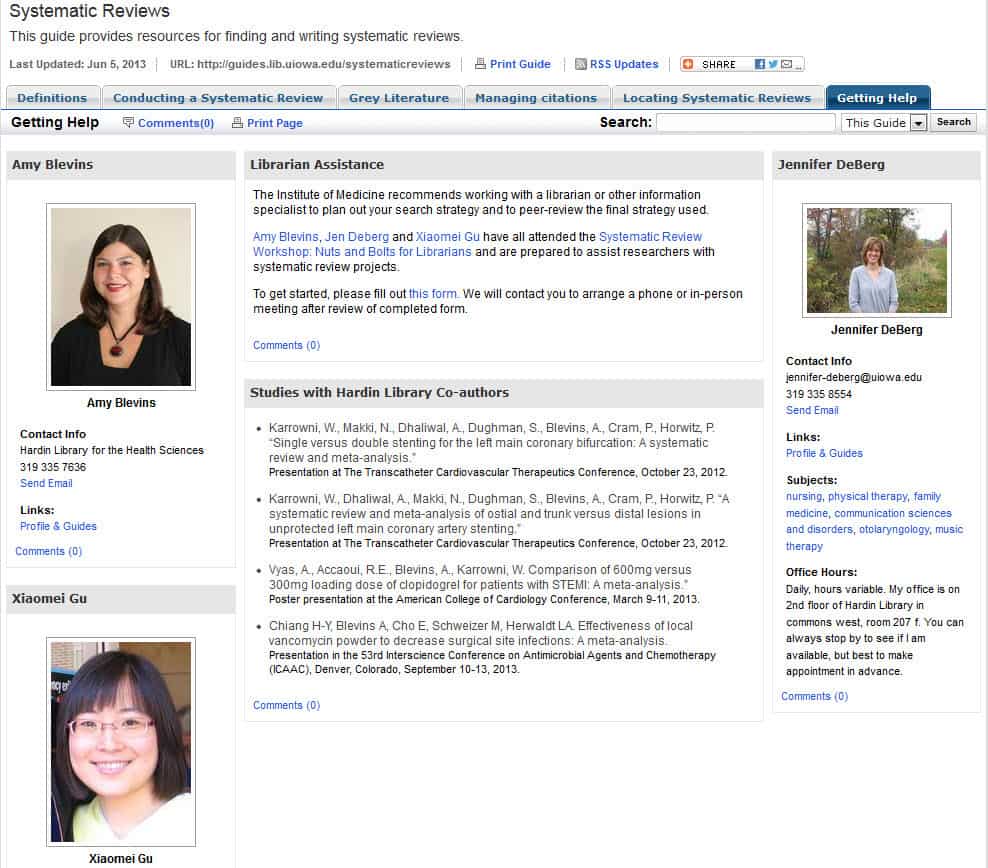
Systematic reviews and meta-analyses have long been considered one of the highest levels of evidence, and lately, publication frequency in health science journals is on the rise.  However, there are still a lot of people who are unaware of what goes into writing a systematic review or a meta-analysis. This post will discuss what a systematic review entails, how it differs from a meta-analysis, and the value that librarians bring to both types of studies.

A systematic review is a research study that seeks to find all the high quality studies done on a given topic so that they can be summarized into one article.  If the studies are homogenous or similar enough to one another, the data can be extracted and combined using statistical formulas. This statistical compilation of data is a meta-analysis. Not all systematic reviews contain a meta-analysis, but all citations to be included in a meta-analysis should be located through a systematic search, to reduce the risk of bias.

An important part of preparing a systematic review is to ensure that the method used is explicit and transparent, allowing for another team to replicate the process. The first step involves putting together a team of at least two researchers who will independently review the studies located.  These researchers then develop a research question and write up a protocol that explicitly detailing how the systematic review will be carried out. One of the details is the criteria against which studies will be assessed for inclusion in the review. It is highly recommended that researchers register their protocols before they begin the formal search for studies.  Once the protocol is in place, the search for and review of high quality studies can begin. Systematic reviews can take anywhere from one year to eighteen months to complete due to the rigorous nature of the review process. Librarians are highly skilled and trained to develop what are often complicated and lengthy search strategies in order to locate as many relevant studies as possible.  They are also familiar with standards and basic steps for completing a systematic review. In the report, Finding What Works in Health Care: Standards for Systematic Reviews, the Institute of Medicine recommends working with a librarian or other information specialist to plan out the search strategy and to peer review the final strategy used to locate studies. Three of the librarians are Hardin Library have attended the Systematic Review Workshop: The Nuts and Bolts for Librarians which takes place over the course of two and a half days.

If you would like to learn more about conducting and locating systematic reviews, please see the Systematic Review LibGuide. You are also welcome to contact us if you have any questions.

Image of Getting Help page on guide

Respirator Fit Testing

Tuesday, June 4, 2013

Putting the respirator onLast week I attended the American Institute for Conservation annual meeting. To keep up with my disaster response training, I went to all the sessions of particular interest to AIC-CERT (Collections Emergency Response Team) members. One session was on respirator fitness testing, including the actual fitness test. Before we could take the fitness test, we had to turn in a signed doctor’s statement of fitness. We reviewed how to put the mask on (chin in first) and clean it and then tested for a secure fit. As you can see, a bag is put over your head and then a scent is squirted into the bag. If you do not smell anything after you’ve moved your head from side to side, up and down, and read a statement, then you have a good fit. I’m happy to report that I past my test. Getting respirator fitness tested

We also a reviewed several brands and styles of disposable N95 particulate respirators that can be purchased at a local drugstore or online. The important thing is to make sure that the disposable respirator is rated N95 or higher. The N95 mask will provide you protection during limited exposure to molds, dust and other airborne particulates (not oil). As always you should consult with your doctor before using any type of respirator and follow whatever protocol has been established for your work area.Variety of disposal respirators

This, my very first AIC annual meeting, was a wonderful learning experience. I was able to attend thanks to a partial scholarship from the Foundation of the American Institute for Conservation and the Institute of Museum and Library Services.

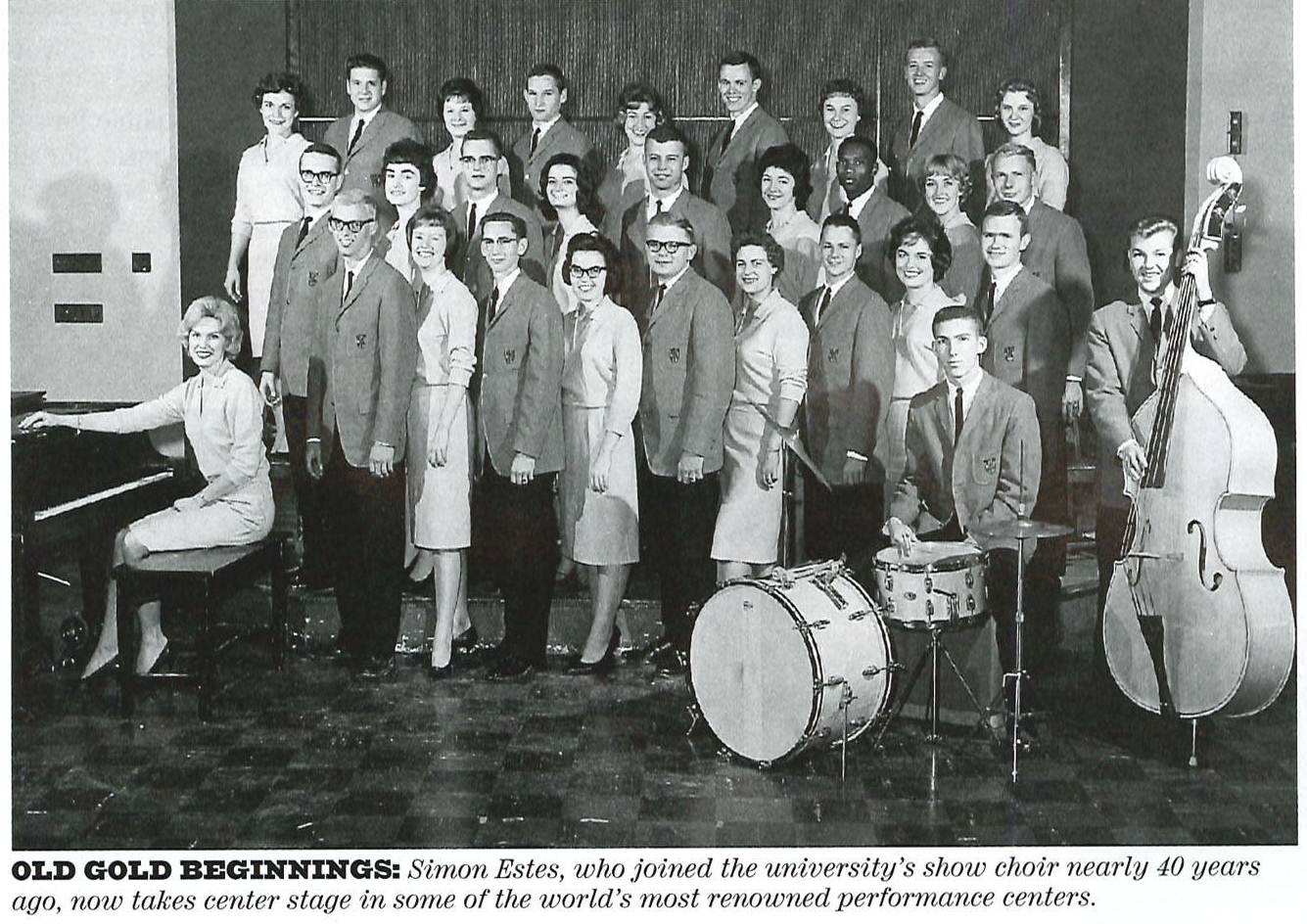
Earliest Known Simon Estes Recording – Now Streaming!

Following up from our earlier announcement about the donation and digitization of the earliest known Simon Estes recording, the clip is now streaming!

Read about the original donation and the March 17th concert where Simon Estes was presented with a copy of the recording.

Dec1997_IowaAlumniQuarterly_0030Soloist: Simon Estes , Corrine Semler

Performance by the Old Gold Singers

Hi-Tran Recording Co., Cedar Rapids, IA in 1959 or 1960

I Got Plenty o’Nuttin’ from the musical Porgy and Bess. Music by George Gershwin, lyrics by DuBose Heyward and Ira Gershwin.


via I Got Plenty o’ Nuttin’.  <– Click this link to hear the recording!

Notes from the John Martin Rare Book Room

Notes from the John Martin Rare Book Room,  June 2013

STEVEN BLANKAART (1650-1702). Anatomia reformata, sive Concinna corporis humani dissection… Leiden, 1695.

Blankaart, Dutch pharmacist, physician, and anatomist, initially practiced pharmacy and later medicine in Amsterdam. He studied medicine and philosophy at Franeker where he graduated in 1674. He was a prolific writer and was the first to edit and publish a medical journal in Holland. Blankaart is also known for his use of the injection technique to study the details of blood vessel distribution. This technique was first suggested by Leonardo da Vinci and later used by such prominent anatomists as Graaf, Swammerdam, and Ruysch. Blankaart first published this popular anatomical text at Leiden in 1687. In this comprehensive work, he cited nearly seventy authors whose works he had consulted. The finely engraved plates in this profusely illustrated work attest to Blankaart’s keen observational powers.  A plate depicts some of the apparatus used in the embalming process.

Blankaart-676-fp-001