Skip to content
Skip to main content

Elizabethan Pocket Almanac

Friday, June 21, 2013
Submitted by Pamela Olson*

Spitzmueller's Exemplar

Spitzmueller’s Exemplar

During the second week of PBI, I participated in a workshop by Pamela Spitzmueller, former conservator for the University of Iowa Libraries and currently a rare book conservator for Harvard University. The focus of her workshop was to study and create a model of an Elizabethan pocket almanac housed at Harvard University’s Houghton Library. We began by viewing exemplars and images of almanacs, writing tables, and calendar books from various collections throughout the world.

The Houghton almanac is dated from 1581 and includes a calendar for 24 years, tables of weights and measures, prayers, a history of England, and five bifolios of erasable pages for notetaking. It measures 4 3/8 x 3 inches with the spine at the head of the text block, and a full-leather cover impressed with a decorative block and line tooling. A stylus is housed in a groove in the back cover, and the erasable pages are made of parchment coated with gesso and animal glue, to be written upon with the stylus and erased with a damp cloth or sponge. Because this type of book was used daily and discarded when finished, extant copies are rare.

Following an in-depth discussion of the exemplar, we began making our own models as Spitzmueller presented demonstrations of creating erasable surfaces with parchment size and gouache, making the stylus, sewing the text block onto three cords, trimming and shaping the wood covers, rounding and lining the spine, attaching boards to the text block, adhering and embossing the leather cover, and making hooks and clasps out of brass. By the end of a productive week, each participant brought home their own historical model of this rare and unusual book.

*Pamela is currently in travel mode conducting research for her thesis.

EXAM MASTER® Upgrades Scheduled on June 23 &24

An upgrade for EXAM MASTER® has been scheduled over this weekend. You will not be able to login to your account from about 11:00 PM Saturday, June 22 (CDT) to 6:00 AM Monday June 24 (CDT). Your registered email address and password will remain the same, but remember to update your URL bookmark to uiowa.myexammaster.com or simply go to Hardin homepage and click Health Sciences Resources A-Z.

Enhanced features highlights:

The dashboard allows easier access to recently created, accessed and scored exams.
In-system messaging.
Two interface choices for the testing environment.
Select multiple topical areas to pull questions into a single exam.

EXAM MASTER® is a library subscribed resource that allows people to prepare for USMLE, Medical Specialty Board Certification, PANCE/PANRE Certification (Physician Assistant), NAPLEX (Pharmacy) and Dentistry (NBDE Part I). For more information on preparing for licensing/certification exams, visit our guide at http://guides.lib.uiowa.edu/boardreview

Online Interlibrary Loan Request System Unavailable Friday, June 21 9-11am

The online interlibrary loan request service, Illiad, that the University of Iowa Libraries uses will be unavailable on Friday, June 21 from 9-11am to upgrade the system.

If you have any questions, please contact the Interlibrary Loan Office at Main Library (319-335-5917, lib-ill@uiowa.edu ) or Hardin (319-335-9874, lib-hardin-ill@uiowa.edu).

The idea behind the 3D scans

 How should the 3D models be used?

The 3D scans are there to enhance the typical forms of archive digitization (2D scans) so that the user can further exerpeince the collection. They are created to interact with, to orient yourself with the idea of space, and not necessarily for display only. Accompanying these models is a series of photographs and sometimes 2D scans, to better represent the details and physicality of the object.

How do the 3D models relate to the rest of the Fluxus collection?

In most of these cases, simply photographing the object would not do justice to the experience or 3-dimensionality of the artifacts. We hope, with the inclusion of 3D models, photos, videos and 2D scans, to capture the essence of the physical object. That being said, there really is no replacement for one-on-one interaction with the physical object that is allowed in the University of Iowa Special Collections. The models are by no means meant to replace the experience or act as a facsimile of the physical, but they are meant to augment and enhance the digital collection.

Why do the 3D models look the way they do? Why aren’t they perfect?

Fluxus art objects were created with the philosophy that the objects physical aesthetics were secondary to affordability and available space. They were meant to be valued “as is”, with a ‘here is the object, it’s beautiful in its own right, even if it is bits of rubber balloon’ mentality. The 3D renderings were created in a similar spirit. Very little fuss was involved in their creation, and great care was made to make the process space saving, and affordable.

With this mind set, sometimes, the scans do not represent the object as well as we would wish. 3D scanning is not, as yet, an exact science. Depending on the nature of the object, whether it be an organic shape, shiny, cavernous, complicated or odd (as is the wont of Fluxus objects), the scanning process varies. As a result, the programs used sometimes have difficulty rendering the objects and create imperfect reconstructions. However, we’ve tried to remain as true as we can to the object. We allow for imperfections that may occur within the physical object as well as those picked up during scanning. It is easy, when one is creating 3D models from scans or from scratch, to create ‘perfect’ or ‘pristine’ objects. But as we are trying to represent cultural heritage, which is very rarely unblemished, representing a ‘perfect’ 3D version does not seem appropriate.

As an experimental project for the University of Iowa Library and the Digital Studio for Public Humanities (DSPH), this process was also testing to see what the quality of the 3D models would be, the process involved, and the limitations and possibilities of using 3D modeling to capture the 3-dimensional cultural artifacts within the University of Iowa Library’s Special Collections. Now that we have an idea of the base requirements for 3D capture, it’s time to have some fun with it!

Click below to try out one of the 3D viewers using Flash.

Ay-O’s Fingerbox displayed using Flash

The idea behind the 3D scans

 How should the 3D models be used?

The 3D scans are there to enhance the typical forms of archive digitization (2D scans) so that the user can further exerpeince the collection. They are created to interact with, to orient yourself with the idea of space, and not necessarily for display only. Accompanying these models is a series of photographs and sometimes 2D scans, to better represent the details and physicality of the object.

How do the 3D models relate to the rest of the Fluxus collection?

In most of these cases, simply photographing the object would not do justice to the experience or 3-dimensionality of the artifacts. We hope, with the inclusion of 3D models, photos, videos and 2D scans, to capture the essence of the physical object. That being said, there really is no replacement for one-on-one interaction with the physical object that is allowed in the University of Iowa Special Collections. The models are by no means meant to replace the experience or act as a facsimile of the physical, but they are meant to augment and enhance the digital collection.

Why do the 3D models look the way they do? Why aren’t they perfect?

Fluxus art objects were created with the philosophy that the objects physical aesthetics were secondary to affordability and available space. They were meant to be valued “as is”, with a ‘here is the object, it’s beautiful in its own right, even if it is bits of rubber balloon’ mentality. The 3D renderings were created in a similar spirit. Very little fuss was involved in their creation, and great care was made to make the process space saving, and affordable.

With this mind set, sometimes, the scans do not represent the object as well as we would wish. 3D scanning is not, as yet, an exact science. Depending on the nature of the object, whether it be an organic shape, shiny, cavernous, complicated or odd (as is the wont of Fluxus objects), the scanning process varies. As a result, the programs used sometimes have difficulty rendering the objects and create imperfect reconstructions. However, we’ve tried to remain as true as we can to the object. We allow for imperfections that may occur within the physical object as well as those picked up during scanning. It is easy, when one is creating 3D models from scans or from scratch, to create ‘perfect’ or ‘pristine’ objects. But as we are trying to represent cultural heritage, which is very rarely unblemished, representing a ‘perfect’ 3D version does not seem appropriate.

As an experimental project for the University of Iowa Library and the Digital Studio for Public Humanities (DSPH), this process was also testing to see what the quality of the 3D models would be, the process involved, and the limitations and possibilities of using 3D modeling to capture the 3-dimensional cultural artifacts within the University of Iowa Library’s Special Collections. Now that we have an idea of the base requirements for 3D capture, it’s time to have some fun with it!

Click below to try out one of the 3D viewers using Flash.

Ay-O’s Fingerbox displayed using Flash

Looking Back on a Semester of New Acquisitions

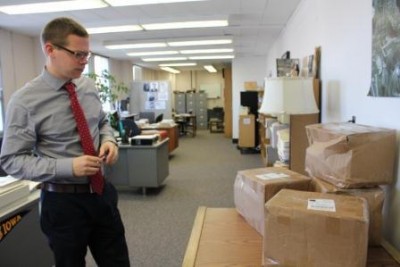
Patrick Olson inspecting packages

Patrick Olson inspecting packages

Patrick Olson joined us at the beginning of last semester as a new Special Collections Librarian in charge of collections analysis and acquisitions.  Patrick was most recently a rare book cataloger at M.I.T and came to Special Collections librarianship via the rare book trade.  Stop by and ask him about rare books or climbing mountains!

With Patrick in place, Special Collections has seen a flurry of activity this semester with boxes arriving almost daily with new donations and purchases.  The items are in various stages of being catalogued and processed so what follows here is an overview of new arrivals, with more announcements to follow soon.


Books:


Most recently we announced an extremely important purchase of twelve incunables (books from ~1450-1501).  Read our blog post and stay tuned, we’ll have updates as they are cataloged and ready for research.

William Morris initial

W.Morris proof (left)

Morris, William, Poems by the Way [corrected proof pages], 1891, X – PR5078.P4 1891a  Infohawk record  Blog post

Huxley, Aldous,  After Many a Summer [inscribed to H.G. Wells], 1939, X – PR6015.U9 A68 1939, Infohawk record

Asturias, Miguel Angel,  Leyendas de Guatemala, 1930.  Infohawk record

Hunt, Leigh, A Day by the Fire [Luther Brewer’s copy], 1870.

Baskerville title page

Baskerville title page

Von Siebold, Philipp Franz, Manners and Customs of the Japanese, 1841.  X – DS809.M28 1841 Infohawk record

Byron, Lord, English Bards and Scotch Reviewers [extra-illustrated], 1818.

Virgil, Bucolica, Georgica, et Aneis [Baskerville Virgil], 1757. X Folio – AC4.E28 1757. Infohawk record

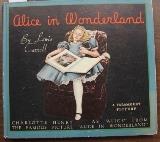
West, Wallace, Alice in Wonderland [novelization of the 1933 film], 1934. X – PR4611.A73 W47 1934 Infohawk record

Alice in Wonderland, 1934Gifford, Thomas, Praetorian, 1993. Iowa Authors Collection. Infohawk record

Rogers, Bruce (OUP), [Prospectus for the 1935 Oxford Lectern Bible], 1935.  Infohawk record

Wilcox, Daniel, Ernie the Cave King, 1975. X – PZ5.W698 1975 Infohawk record


Miniature books:

Carroll, Lewis, Alice’s Adventures in Wonderland [miniature book with Rackham illustrations], 2011.  Smith – PR4611.A73 2011  Infohawk record

Pit and the Pendulum image

Pit and the Pendulum

Poe, Edgar Allan, [J. & J. Sobota Press] The Pit and the Pendulum [miniature book], 2005. Mab – PS2618.P5 2005a Infohawk record (Tumblr post)

Dante Alighieri, La Divina Commedia [miniature book], 1878. (Blog post)

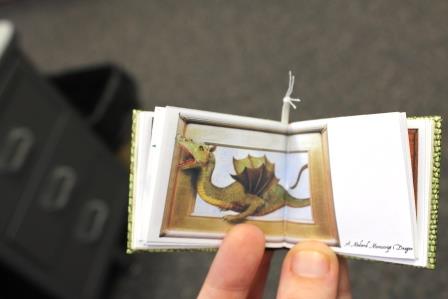
Sweet, Pat, The Dragon Gallery [miniature book], 2010, Smith – GR830.D7 S944 2010, Infohawk record (Tumblr post)

Amato, Christina,  Tale of Herville [miniature book], 2010.  Smith – PS3551.M183 T354 2010 Infohawk record

The Dragon Gallery

The Dragon Gallery

Amato, Christina, Swells & Spines, or, The Man Who Bound at Sea [miniature book], 2011.  Smith – PS3551.M183 S94 2011 Infohawk record


Artist’s books:


Sara Langworthy book and broadsides:

New Patterns Primer [artist’s book], 2013.  Infohawk record

Solid Phases, [artist’s book], 2013. Infohawk record

Solid Fragments, [artist’s book], 2013. Infohawk record

Atlantis, [broadside], 2009.

Reading a book with a blacklight

2013. Invisible Ink

Healong, [broadside].

In the Trance , [broadside], 2009.

A Field Guide to Getting Lost, [broadside], 2010.

Practice, [broadside], 2009.

Small Study [broadside], 2009.

392905_547006075322681_1959319254_n

Pi

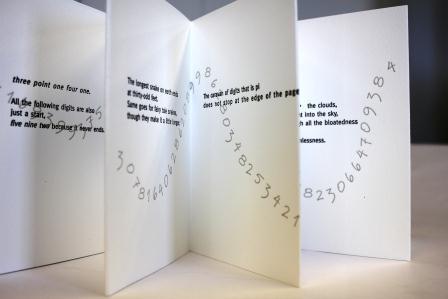
Szymborska, Wislawa and Susan Angebranndt of GreenChairPress, Pi, 2003.  [artist’s book] X – PG7178.Z9 A222 2003 Infohawk record (Facebook post)

Reed, Justin James, 2013 [invisible ink], 2012.  [artist’s book] X Folio – N7433.4.R424 T8 2012 Infohawk record  This text can only be viewed using a black light [included].

Hanmer, Karen, Letter Home, 2004. [artist’s book] X – N7433.4.H35 L48 2004 Infohawk record

Hanmer, Karen, Nevermore, Again, 2010, [artist’s book] Mab – PS2633.K372 2010 Infohawk record


Szathmary Collection:


Rowley Cook Book and Sunshine Cook Book [early 20th century community cookbooks]

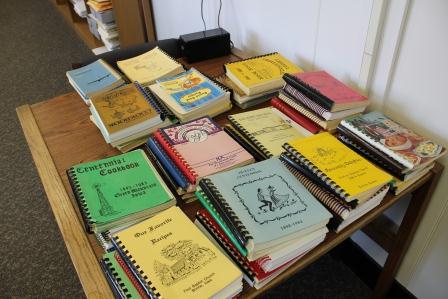
64 community cookbooks

64 community cookbooks

64 community cookbooks [mostly Iowa] (Facebook post)

Hayward, A., The Art of Dining [railroad edition], 1852.  Infohawk record

Locke, John and Henry, Commercial Cookery Archive (English Catering Company), [Mid 1800s bulk dates], Szathmary Culinary Manuscripts, Collection Guide

Chicago Sun Times, Three original photos of Chef Louis Szathmary, 1970s (Facebook post)

Obama, Michelle, American Grown, 2012.   Infohawk record


Manuscripts and Archives:


Burger Notebook

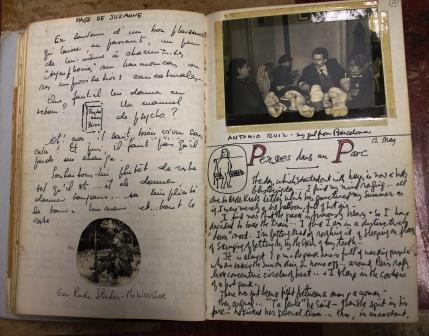
Arthur Asa Berger notebooks

Arthur Asa Berger Papers  [University of Iowa alum and professor emeritus of Broadcast and Electronic
Communication Arts at San Francisco State University, where he taught between 1965 and 2003 and author of more than 60 books.].  More than 90 journals with a mix of drawings, photographs, personal life, and plans for books.

Mike Appelstein Collection, [Zine maker and writer who worked for VH1].  1990s zines, particularly music zines. This will especially complement the Sarah and Jen Wolfe Collection of Riot Grrrl and Underground Music Zines.

Joshua Glenn's zines

Joshua Glenn’s zines

Joshua Glenn Collection, 1980s-1990s music fanzines, letters from zine publishers, and zine ephemera. (Joshua Glenn’s Blog). (Tumblr).

Peter Thomas collection of papermaking and paper sample books.

Continuing fanzine acquisitions from the Organization for Transformative Works from many donors including a large donation of early Star Trek fanzines.

Morgan Dawn Collection addendum. [Zines for many TV shows and movies – Dr. Who, Harry Patter, Lord of the Rings, The Professionals, Quantum Leap, Star Trek & more].

George Ludwig papers. [Graduate Student under James Van Allen] (Two blog posts here and here)
George Ludwig Papers

George Ludwig Papers

Dave Morice Collection [1970s Actualist movement.  Poet, illustrator, and performance artist.]  Large addendum including personal papers and lesser known comic books such as Cosmic Boy
and Power of the Atom.  Spanish language comic books, including Condorito.

Iowa Library Association, 20 feet of records.

Hancher Auditorium, 1970s posters. (Blog post)

Gary Frost, administrative and teaching files.

Hancher event poster

Hancher Auditorium Posters

Janine Canan papers [Publications, CDs and DVDs of the feminist poet].

Cloe Mayes Yocum, [Hollywood scripts].

Marquis Childs [Iowa Author]. Manuscript for Cabin.

Sam Becker, [Emeritus faculty], we received a copy of a Saroyan lay Western Awakening.  This was Sam’s copy from a production at the University of Wyoming and is signed by Saroyan.

Adam Boyce.  Collections relating to Charles Taggart, a Chautauqua performer, for our Redpath Chautauqua collection.

Beatrice Abrahamson’s WWII diary

Letter from Marion, Iowa [Regarding settling in to a new life in 19th c Iowa]

Glowgramme, [1933 glow in the dark theater program] X – FOLIO PN2093 .G59 1933  Infohawk record

Stein Collection

Stein Collection

2 photo albums:

Trip to India c. 1900 [professional souvenir in lacquered Japanese binding]

Trip to Fiji & area c. 1920s [amateur photos]

Stein Collection, Muscatine Business owner’s diverse “gentleman’s library.”  This collection will be kept together.

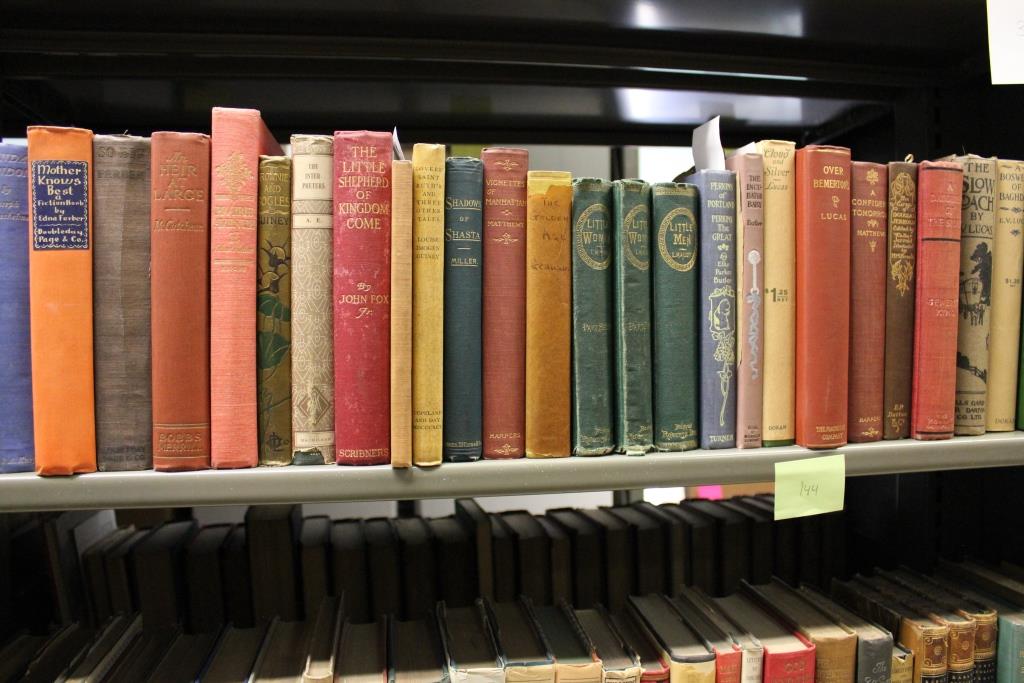
Brian Harvey Collection of 2000+ 19th and early 20th century dog books.

dog books

Dog books

Records of the Progressive Party, and we got an addendum of Pennsylvania Progressive Party papers.  [Papers and press releases].


Other:


Reading room overhead scanner.Reading room scanner

Mathematical Research Letters

Online access is now available to Mathematical Research Letters.

Mathematical Research Letters is “dedicated to rapid publication of short complete papers of original research in all areas of mathematics. Expository papers and research announcements of exceptional interest are also occasionally published.”

The journal can accessed through the links in this blog post or by searching the library catalog or the e-journal search page. It is indexed in the MathSciNet and Web of Science citation databases. Use the yellow InfoLink button to access the full-text. Off-campus access is available to students, faculty and staff who use the Libraries’ links and sign in with a HawkID and password.

If you have any questions or would like to learn more about Mathematical Research Letters, please contact the Sciences Library at lib-sciences@uiowa.edu or 335-3083.

Wednesday, June 19th: Learn more about PubMed with our free workshop

PubMed is the National Library of Medicine’s index to the  medical literature and includes over 17 million bibliographic citations in life  sciences. This one-hour session will show you how to improve your search results by using subject headings (MeSH) and advanced keyword searching techniques.

Our next session is

No time for class?  Ask your librarian for a private consult!

graphic of pubmed

“New” Incunables Arrive in Special Collections

If you have been following any of our social media feeds over the past few days, you may have noticed photos popping up of newly-acquired incunables. So, what’s going on here? First, some background:

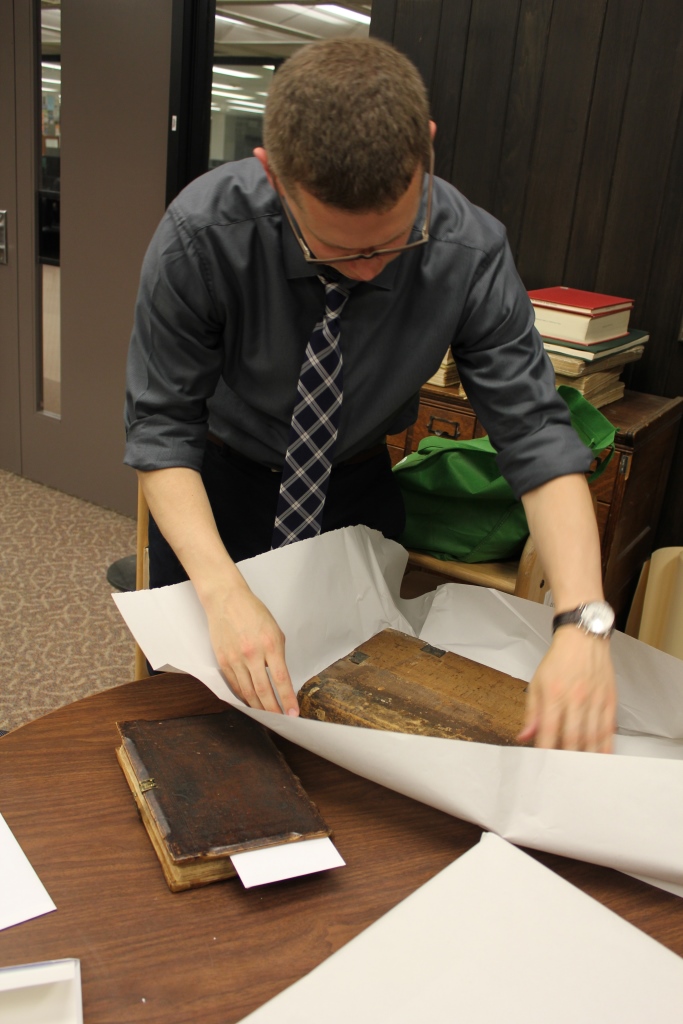
Patrick Olson opening a packageIncunables are books printed in Europe during the fifteenth century, between 1450 and 1501, examples of the earliest printed books. The incunabula period is the focus of a great deal of study—the development of printing, and how it affected the design, distribution, and reception of books, remains central to our understanding of book history.

Here at Iowa, we have long held a respectable collection of incunabula, and these books are frequently called for in classes and exhibitions. In recent years, these books have been examined extensively by Tim Barrett for his study of early papermaking, and Iowa is also home to the Atlas of Early Printing, an interactive overview of the spread and development of printing in Europe. The UI Center for the Book continues to pass along the art and craft of letterpress printmaking that first flourished in the incunabula period.

Our recent acquisitions are an attempt to add examples of books and subjects in the incunabula period that we have not had previously. This collection development has been made possible due to the support of the University Libraries acquisitions fund and the Libraries’ Collection Management Committee.

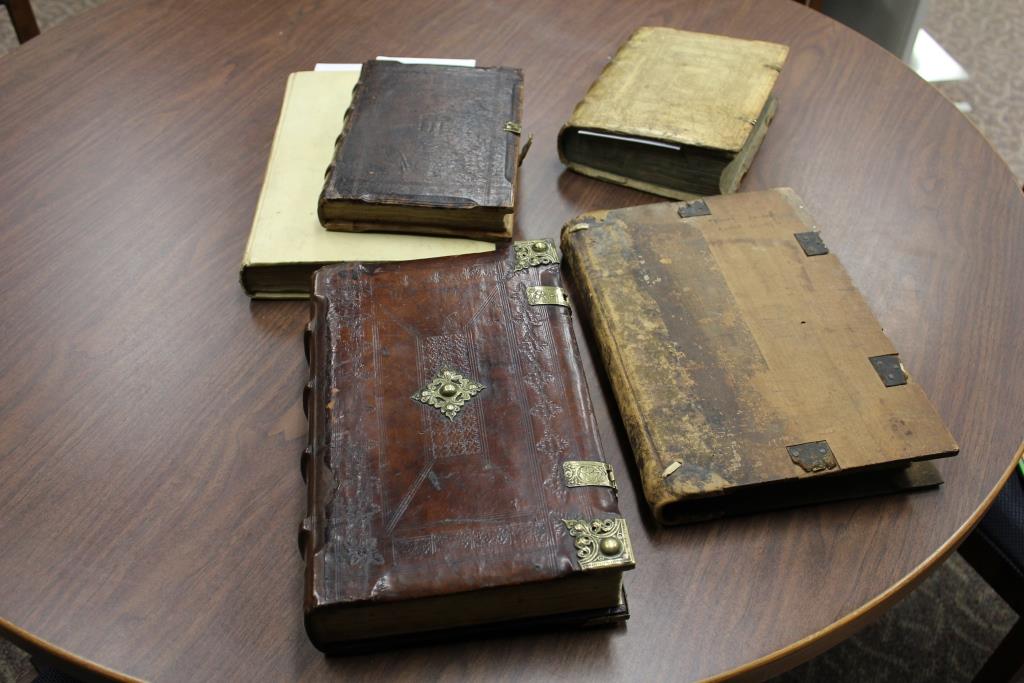
Five 15th century books on a tableSpecial Collections Librarian Pat Olson took charge of this opportunity and identified an outstanding mix of possibilities that enhance our collection in many ways. Among these dozen new titles is the first illustrated edition of Dante printed in Venice. Until now, our incunables largely represented just a single language: Latin. The occasional ancient Greek was the only exception. Our new Dante, however, is in Italian, and so it’s one of our first incunables printed in a vernacular language. The other, also just acquired, is Monte dell’orazione, a private devotional text intended specifically for women. The copy we just acquired is particularly notable for retaining the very rare illustrated wrapper—or to risk oversimplification, the original illustrated paperback binding.

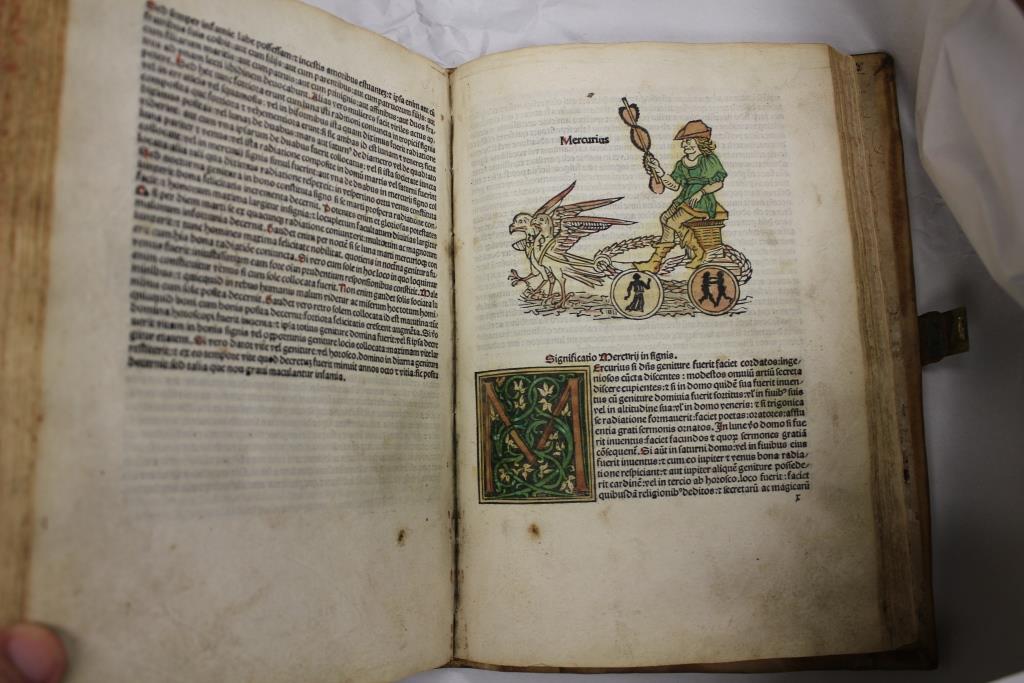
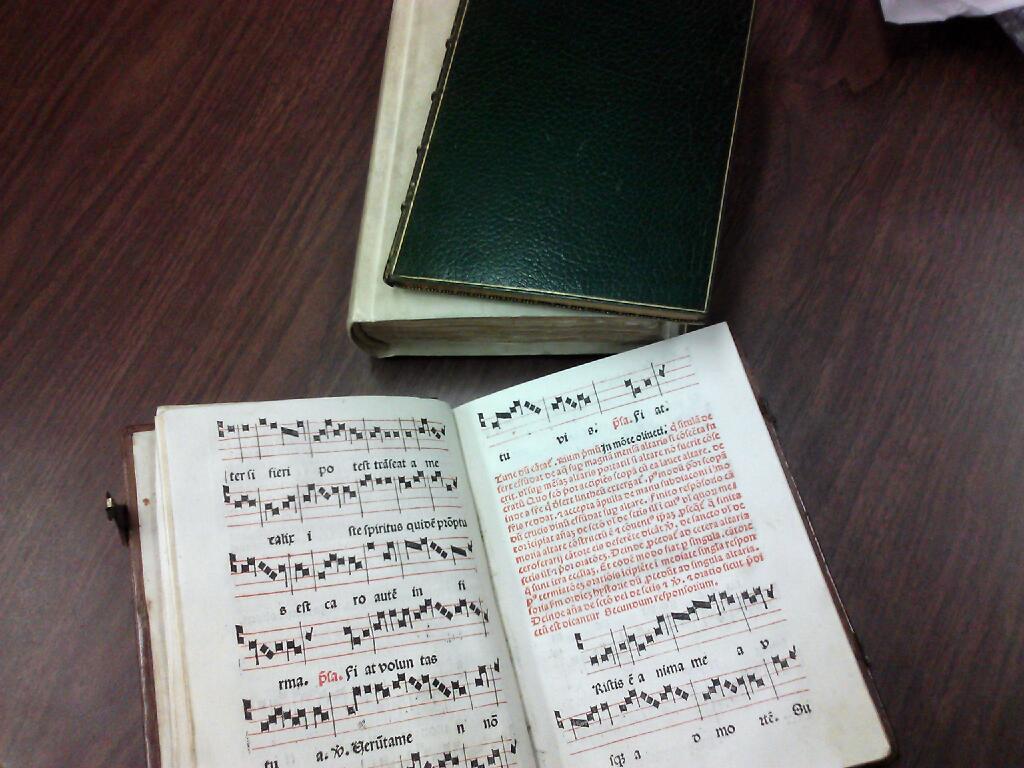
We filled one of our more significant gaps withzodiac the acquisition of our first 15th-century Bible, and in an early pigskin binding to boot. Another first for us is our first Spanish incunable, a book of music printed in red and black at Seville in 1494. We purchased our first 15th-century edition of Ovid, too, here in its original leather-covered wooden boards and retaining its original brass furniture. Early science has been another sparsely covered subject for us, so we acquired a lavishly illustrated astrological text. (NB: What passed for science in the 1400s may not pass for science today.) We also acquired a rather crude dialogue intended for children and the less sophisticated—a rare survival, insofar as such texts were less commonly printed and more commonly read to pieces.

In all cases, we sought books in early (if not original) bindings. Given the serious interest in earlymusic incunable papermaking here at Iowa, we made it a point to pursue books with untrimmed leaves, which serve as uncommon witnesses to original paper sizes. We searched for books with valuable marginalia, interesting provenance, and varying degrees of decoration by hand. Most of these books do have early marginalia, an invaluable resource to support the growing scholarship on the history of reading. Perhaps the most remarkable in terms of provenance is a sammelband (multiple books bound together) printed by the famous scholar-printer Johann Amerbach. Our copy is not just a well preserved example of a 15th-century sammelband, but it contains an inscription noting its donation to a local monastery by the printer himself. As far as textual decoration is concerned, these new acquisitions run the gamut from crude DIY initials to professionally executed penwork and illumination.

There really is something for everyone, and we can’t wait to share them. Once they have been catalogued and properly housed, these books may be viewed by request in our reading room during regular hours. And keep an eye out for an announcement coming at a later date of an opportunity to view these new acquisitions in person, while learning about how incunables are being studied today.

New Evidence Confirms 1973 Movement to Rename the Field House for the Allman Brothers Band

New at the UI Archives: 1970s-era posters for events at Hancher Auditorium, the Iowa Memorial Union and the UI Fieldhouse. For a brief but intense time in 1973 and ’74 there was a move afoot to rename the Field House for the Allman Brothers Band, which had a memorable gig there on Nov. 9, 1973. The posters are evidence of this unofficial, ill-fated, but totally sincere effort. CUE, the Commission for University Entertainment, was a student organization that encouraged the campaign. Many thanks to Tim Meier of the Hancher Auditorium office for arranging for transfer of these materials to the Dept. of Special Collections and University Archives.


Hancher event poster
Allman Brothers event poster