Skip to content
Skip to main content

The news reached us of a glorious victory in Pennsylvania

Joseph Culver Letter, July 6, 1863, Page 1

Head Quarters, Co. “A”, 129th Regt. Ills.
Gallatin, Tenn., July 6th 1863

My Dear Wife

We have had no train through yet & consequently no word from you. The news reached us, however, of a glorious victory in Pennsylvania.1 Longstreet & Hill killed, Lee seriously wounded & 20,000 prisoners.2 It is almost too much to believe, with the entire Rebel Army in full retreat. I hope it is all true, however.

I presume none of my letters have reached you. We are all doing well, Russell is rapidly improving & thinks he will be able to get to Camp tomorrow.

2500 Rebels have taken possession of the Rail Road near Shepherdstown3 & report says some 15,000 are advancing from Cumberland Gap.4 If it be true, I cannot say when we may have communication with the North. All their Efforts cannot affect us, however, at the present stages of high water.5 The Army of the Cumberland is advancing but with what results we cannot tell.6 Our force here has been considerably augmented since you left, & I think we should be able to hold our position against a very considerable force.7

We are all very anxious for News from the North. I shall expect quite a number of letters by the first mail. I have no news from Bro. Johnie yet, nor do I know where he is. Report says there is a hard fight at Franklin, Ky., but with what forces I did not learn.8 Our Cavalry are making a scout in that direction now.

I hope to hear that you are all well & enjoying yourselves. Frank will be quite busy hunting up his relations. I should like to be favored with a copy of his notes on Board the Propeller from Chicago. Give him a kiss for me.

I wrote a letter to my Mother to-day. I have no word from home since the invasion of Pennsylvania but hope to hear soon. If Lee’s Army is in retreat as represented, with a moderate effort I feel sure it might be routed before reaching the Potomac.9 I hope the final result will reach that position.

I have no word from Pontiac since Gaff returned. I shall be on duty to-morrow & shall not likely find time to write. Do not forget your promise to write every day. You see I have kept mine. May the Blessings of Heaven rest upon you, & the Establishment of National Peace give us an early opportunity to repair to our home to enjoy its comforts. I have tried to comply with your request to Pray. “Trust Thou in God for we shall yet praise him for his Wondrous Love.”

Remember me to all our friends

Your Affect. Husband
J. F. Culver

  1. In a 3-day battle at Gettysburg, July 1-3, the Union Army of the Potomac defeated General Lee’s Army of Northern Virginia. On the night of July 4, Lee’s army commenced its retreat to Virginia.
  2. Confederate losses in the battle, the bloodiest of the Civil War, were 2,592 killed, 12,709 wounded, and 5,150 missing or prisoners. Although five Confederate generals were killed or mortally wounded in the struggle, Lt. Gens. James Longstreet and A. P. Hill were not among the slain. The story that General Lee had been seriously wounded was unfounded.
  3. General Bragg, in a futile effort to check the advance of Rosecrans’ Army of the Cumberland, sent General Morgan to destroy Union supply lines in Kentucky. Morgan was to enter Kentucky at or near Burkesville, on the Cumberland River, proceed northward to the Ohio River, and then retreat out of the state by the route which the exigencies of the moment dictated.
    On July 2 Morgan’s division crossed the Cumberland near Burkesville and started north. Riding by way of Columbia and Lebanon, the raiders passed through Bardstown on the 6th and effected a brief lodgment on the Louisville & Nashville Railroad near Shepherdstown. A train was captured near Lebanon Junction and the passengers robbed. Vigorous pursuit by the Federals prevented much damage to the railroad, and on the 7th, Morgan and his raiders started for Brandenburg, where on the 8th they crossed to the Indiana side of the Ohio River. O. R., Ser., I. Vol. XXIII, pt. I, pp. 700-703; Bennett H. Young, Confederate Wizards of the Saddle (Kennesaw, 1958), pp. 367-379.
  4. There was no substance to the rumor that 15,000 Confederates had advanced into Kentucky by way of Cumberland Gap. This story probably was released by some of Morgan’s men who had tapped the telegraph line, sending out messages calculated to cloud the situation and spread confusion.
  5. Recent rains had caused the rivers and streams of the region to flood and had turned unimproved roads into ribbons of mud. O. R., Ser. I, Vol. XXIII, pt. II, p. 518.
  6. Bragg’s army, having been flanked out of its fortified position at Tullahoma, was retiring on Chattanooga, closely pursued by the Army of the Cumberland. On July 4 the Federals crossed Elk River on a broad front, occupying Cowan, and learning that Bragg’s columns had withdrawn across the Cumberland Plateau. Ibid., pp. 512-515.
  7. On July 6 General Paine, post commander at Gallatin, wired Rosecrans that a large force of Rebels was in the area and that he should be reinforced by two infantry regiments and 300 cavalry. To hold Gallatin and guard 30 miles of railroad, he had 900 men, and if attacked could only hold the Gallatin earthworks. Ibid., p. 516.
  8. A company of Confederates on the 5th had attacked the details posted at Woodburn and Franklin in a futile effort to burn the depots and cut the telegraph. O. R., Ser. I, Vol. XXIII, pt. I, pp. 5, 820-821.
  9. The Army of the Potomac had also suffered frightful casualties at Gettysburg, and Maj. Gen. George G. Meade’s pursuit of Lee’s Army of Northern Virginia was not vigorously pressed.

Get introduced to PubMed in 30 minutes with our free workshop July 11

graphic of pubmed

PubMed is the National Library of Medicine’s index to the  medical literature and includes over 17 million bibliographic citations in life  sciences. This 30-minute session will show you how to find relevant articles fast using some of the basic features in PubMed.

Our next session is

No time for class?  Ask your librarian for a private consult! We will also offer this workshop on Wednesday, April 24th.

UI Teams Up with NASA to Better Predict Precipitation

Iowa City Press-Citizen: UI Teams Up with NASA to Better Predict Precipitation Via Satellites

Thursday, June 13, 2013
A large crane drops the NASA Polarimetric antenna into place in Eastern Iowa near Waterloo for the Iowa Flood Studies campaign, which started May 1 and finishes Saturday.

A large crane drops the NASA Polarimetric antenna into place in Eastern Iowa near Waterloo for the Iowa Flood Studies campaign, which started May 1 and finishes Saturday. / Aneta Goska / Iowa Flood Center

By Tara Bannow
Iowa City Press-Citizen

As NASA gears up for a worldwide campaign to predict precipitation using satellites, it’s enlisting University of Iowa flood experts to determine whether its plan will work.

NASA’s experts have been working with UI’s Iowa Flood Center since May 1 to collect ground data across Iowa — chosen for its tendency to flood — that ultimately will be paired with satellite data collected through NASA’s Global Precipitation Measurement (GPM) in an effort to take flood forecasting to a new level.

The researchers are measuring a number of characteristics in Iowa, such as the proportion of rainfall that does and does not infiltrate the ground — a factor determined by land use and soil properties — as well as the ability of river networks to determine the timing and extent of flooding, Witold Krajewski, director of the Iowa Flood Center, said in a video conference Tuesday afternoon at UI.

Iowa was a natural host for the so-called Iowa Flood Studies campaign, which wraps up Saturday, because of the amount of flooding the state has experienced over the years, Krajewski said. In 2008, flooding cost the state close to $10 billion and at the time ranked as the fifth costliest natural disaster in U.S. history, he said.

Since the flood center was established in 2009, it has improved water monitoring by developing a complex online mapping system that shows where flooding will occur in Iowa communities if the water reaches certain levels.

“Even now, as we’re in the middle of this campaign, we’ve got flooding over the last month across Iowa, including in Iowa City, where I’m speaking from,” Krajewski said. “Still, the rivers and streams are running high, which makes for a good case for a scientific study, but I wish the flooding would stop. We’ve had enough.”

NASA plans to launch its network of international satellites in February 2014. The satellites will provide rain and snow observations from space every three hours, data that NASA’s current technology provides only twice daily, said Walt Petersen, a NASA scientist currently working on the Iowa Flood Studies campaign from a base in the city of Traer just south of Waterloo.

The idea is to more accurately measure precipitation and predict flooding so that decision-makers can better prepare, Petersen said. Although they cause considerable damage in Iowa, floods have the largest impact on underdeveloped countries, he said.

“Tens of thousands of people annually lose their lives to flooding, the majority of that in the developing world,” Petersen said.

A major reason is because many areas don’t have the ability to provide warning to residents, something GPM is expected to help with, he said.

NASA is using advanced precipitation radar technology stretching roughly from Waterloo to Iowa City that scans the atmosphere and retrieves the size, shape and distribution of raindrops and rainclouds. Researchers also have installed a network of rain gauges in river basins across Iowa that will provide reference points for the radar. Once all of the information can be contrasted against data collected from space, it will provide the clearest predictions yet, Petersen said.

“It’s a local study with global applications,” he said.

Iowa has provided a range of weather for NASA’s researchers, Petersen said. When scientists first arrived to sample rain, they found themselves in the midst of a historic snowstorm, which was a great opportunity for data collection, he said.

When NASA began contemplating whether to host the project in Iowa, the state was experiencing a severe drought, Krajewski said. By contrast, scientists have seen very few days without rain in the past five or six weeks, he said.

“This has been an extremely busy campaign,” Krajewski said.

By the arrival of Bro. Gaff this evening, I received news of your departure for New York

Joseph Culver Letter, July 2, 1863, Page 1

Head Quarters, Co. “A”, 129th Ills.
Gallatin, Tenn., July 2nd 1863

My Dear Wife

By the arrival of Bro. Gaff this evening, I received news of your departure for New York, where I presume this letter will find you, I hope, safe & well. I have filled your proposition on my part quite well as I have written almost every day since you left. I think surely there must be some letters that I have not received, as only two short notes have reached me, one in pencil on your arrival & one written on Monday following.

I was very anxious to learn the news from Pontiac. I have succeeded in gathering some things from Sergt. Gaff. I am glad your trunks have arrived safe, & am much obliged for the “Initial G.”

I am unable to learn anything about the condition of our property, as Gaff was not there. I received a letter from Bro. Remick containing Statement of the disposition of monies in his hands. All very satisfactory. Mrs. Remick is very dangerously ill.

What disposition did you make of the articles Laurence wished to buy? & what condition did you find the property in? Please give me all the information you can, & I can suggest such changes as may be necessary.

I hope you have a delightful trip on the lakes.1 I should like to have been with you very much. Why has Bro. Thomas not written.2 Is he in want of money; if so, I earnestly hope you will inform me, as I think I can procure the amount at anytime if he needs it. I have only deferred because I thought he would as soon have it out at 10 per ct as not if he feels secure.

I received a letter from Bro. Sammy this evening. He acknowledges the receipt of a letter from Bro. John but does not say where he is.3 I also recd. a letter from Henry Greenebaum in which he says he has a cap for Frankie. I presume he has received it.

I have in the several letters I wrote to you at Pontiac mentioned matters of business which I cannot call to mind just now. I have sent at least 6 or 8 letters. I shall have time to-morrow, however, to think them up & will write soon again.

Did you get your shawl? I sent it by Mr. Earnheart a few days after you left. I shall be on duty to-morrow & have no opportunity to write. Among other items of interest from Pontiac. I am informed that a report is in circulation that I have been drinking hard & gambling heavy. How much credence has it claimed?

You have not told me how Mother [Murphy] received you. Is she with you? Give many messages of Love to our friends in New York.

I do not remember whether I ever answered Mary & Sarah Williams’ letters, & yet it seems to me I did but when I do not recollect.

I preached to a large congregation on Sunday night from Isaiah, 26th Chap. & 4th verse, a lengthy account of which I have written in a former letter.

Late advices from Carlisle report Lee’s entire Army there, & it is very probable it will soon witness one of the most terrible battles of the war.4 I tremble for the result. I greatly fear Father’s health will not stand the shock. I have no word from them & all communication is cut off. I shall write soon to Harrisburg & perhaps may get advices by private sources.

Write soon & give me all the news. I hope you will have a very pleasant visit. I came nearer being homesick since you left than any time since I have been in the service.

The cloud that overhangs the Country is growing darker. The news from Port Hudson to-night is the repulse of Banks’ entire army and the loss of 8000 prisoners.5 At Vicksburg I see no advance; heavy losses to our Army are reported.6 Harry McDowell recd. intelligence this morning of the death of his Bro. James in the army at Vicksburg.7 Nothing cheering from the East. Rosecrans army is in motion; several hundred prisoners were sent to Nashville from the front yesterday.8 He is within 2 miles of Talahoma & finds a large army entrenched there & there is heavy fighting in progress.9

A party of 60 guerillas made an attack on a mounted force of the 106th Ohio at Richland day before yesterday; killed one Lieut, two men & took several prisoners. Col. Case, Capts. Hoskins & Perry & Lieuts. Smith & McKnight started for Richland with over 100 mounted men last night to capture them if possible. I learn that they sent in 7 prisoners this evening, & five captured by the troop stationed there this morning.10 The Union people are all fleeing. I saw Carrie Rodomore’s brother on the train this evening on his way to Nashville.11 He is afraid to remain at home longer. He reports the family all well, but their house sacked & everything destroyed by the Rebels. All the Union families are suffering, but I think our force will drive out the invaders.

Our duties are growing heavier. A Negro Regiment is being raised here.12 Tom, Henry & Joe have enlisted so we are again without a cook, also Col. Case and Lt. Col. Cropsey.13

Ed Maples is on a visit to Troy, New York, & Bill [Russell] did not get home the 4th. I presume you have gone to New Hartford, & I will direct [my mail] in care of J. H. Case, Esq. as I do not know Mr. Williams’ name.14

Remember me kindly to all. May God bless & prosper you; Give you all good health & a warm reception.

Should that other event you anticipate not transpire, I shall try & make a visit to Father’s with you before you return if I can possibly get leave of absence.15 But should you be compelled to hasten home, you [might] prefer that I should be in Pontiac in January. I cannot expect to go twice. Tell me which you wish me to do & whether I will be required to furnish the new dress. I must have some notice beforehand.

Kiss Frankie for me & as many of the others as you desire or would desire me to kiss were I there. Did you stop in Cleveland?

With an earnest prayer for you, my dear wife & our Boy, I remain,

Your Affect. Husband
J. F. Culver

  1. Mary Culver was traveling to New Hartford by way of Chicago, Detroit, Cleveland and Buffalo. She and her mother had booked passage on a steamboat between Detroit and Buffalo.
  2. Thomas Murphy, Mary Culver’s oldest brother, was a Cleveland, Ohio machinist and boat builder.
  3. Brother Johnny Murphy’s unit (Company M, 1st Illinois Light Artillery) was currently assigned to the First Division, Reserve Corps, Army of the Cumberland. The battery had participated in Rosecrans’ Middle Tennessee Campaign and was posted at Shelbyville, Tenn., from June 29-September 6, 1863. Report of the Adjutant General of Illinois. Vol. VIII, p. 665.
  4. Two divisions of General Ewell’s II Corps of Lee’s Army of Northern Virginia had occupied Carlisle from June 27-30. J.F.C.’s forecast of “a most terrible battle” was correct. On July 1 at Gettysburg, 30 miles south of Carlisle, commenced the bloodiest three-day battle of the Civil War.
  5. Maj. Gen. Nathaniel P. Banks’ Army of the Gulf on May 23 had invested a small Confederate army led by Maj. Gen. Franklin Gardner at Port Hudson, La. Banks’ troops on May 27 and again on June 14 had attempted to storm this stronghold on the Mississippi, 250 river-miles south of Vicksburg. In these assaults Banks lost 3,800 in killed, wounded, and missing. There was no truth to the report that Banks had lost 8,000 prisoners. Edward Cunningham, The Port Hudson Campaign: 1862-1863 (Baton Rouge, 1963), pp. 43-93.
  6. General Grant’s Army of the Tennessee, after being checkmated during the winter of 1862-63 on the western approaches to Vicksburg, had crossed the Mississippi at Bruinsburg on April 30. Striking northeastward and then wheeling his army to the west, Grant, in an 18-day campaign that earned him recognition as one of the “Great Captains of History,” defeated the Confederate armies of Gen. Joseph E. Johnston and Lt. Gen. John C. Pemberton. Pemberton’s army had been invested in Vicksburg. On May 19 and 22, Grant’s heretofore victorious troops had charged the Vicksburg earthworks to be hurled back with more than 4,100 casualties. Siege operations had commenced on May 25 and dragged on through June into the first week of July. Francis V. Greene, The Mississippi (New York, 1882), pp. 135-192.
  7. William H. H. McDowell, a 21-year-old farmer, was mustered into service on Sept. 8, 1862, as sergeant major of the 129th Illinois Infantry, and was commissioned 2d lieutenant of Company E on April 17, 1863. On Feb. 22, 1864, he was detached and sent to Illinois on recruiting duty, rejoining the regiment on May 29. Lieutenant McDowell on Nov. 13, 1864, was detailed to the brigade ambulance corps, and was mustered out near Washington, June 8, 1865. Compiled Service Records of Union Soldiers, NA.
  8. Goaded by the War Department, General Rosecrans had put his Army of the Cumberland in motion on June 24. Soldiers of Maj. Gen. Alexander McD. McCook’s XX Corps drove the Confederates from Liberty Gap, while Maj. Gen. George H. Thomas’ XIV Corps cleared the Rebels out of Hoover Gap. Heavy rains slowed the bluecoats, as their long columns pushed deep into Middle Tennessee. Cist, The Army of the Cumberland, pp. 154-156.
  9. General Bragg, his army weakened by the detachment of five infantry brigades and a cavalry division to Mississippi in a futile effort by the Confederates to relieve Vicksburg, permitted himself to be outmaneuvered by Rosecrans. The Federals, after forcing the gaps, had advanced on Manchester. Finding that his right had been outflanked, Bragg was compelled to abandon his fortified position at Tullahoma without firing a shot. Reports that the enemy was evacuating Tullahoma had reached General Thomas on July 1, and he ordered a forced reconnaissance. Feeling its way forward, a reinforced brigade entered Tullahoma and found the Confederates gone. Ibid., pp. 156-166.
  10. Colonel Case filed no report, so J.F.C.’s letter constitutes the only information we have about this patrol. Regimental Papers, 129th Illinois, NA.
  11. Carrie (Caroline) Rodamore was the 21-year-old daughter of Ann Rodamore, a Gallatin widow. Carrie’s brother, Jacob, was a conductor on the Louisville & Nashville Railroad. Eighth Census, Sumner County, State of Tennessee, NA.
  12. Early in 1863 the Lincoln administration adopted as its policy the organization of black regiments to be officered by whites. Adjutant General Lorenzo Thomas was sent to the Western armies to explain and rally support for this policy. In 1862, prior to President Lincoln’s preliminary Emancipation Proclamation, the administration had discouraged efforts of several departmental commanders to organize black units. J. G. Randall, The Civil War and Reconstruction (Boston, 1953), pp. 503-505. The 13th U.S. Colored Infantry (2d U.S. Infantry Regiment [Colored]) was organized in July 1863 from laborers in the staff departments at Gallatin, Clarksville, Murfreesboro, etc. Tennesseans in the Civil War. . . 2 parts (Nashville, 1964), pt. I, p. 398.
  13. Tom, Henry, and Joe were former slaves freed by the Emancipation Proclamation, employed by officers of Company A to cook for them and to keep their quarters policed. A special order had been issued by Rosecrans’ headquarters permitting each regiment in the Department of the Cumberland to employ for use by the government about 40 blacks as teamsters, cooks, etc. Regimental Papers, 129th Illinois, NA.
  14. J. H. Case was a prosperous New Hartford farmer. In 1860, the 41-year-old Case was living with his wife, Charlotte, and their 5-year-old son Herbert. It has been impossible to further identify Mr. Williams, as there were a number of families with that surname in and around New Hartford. Eighth Census, Oneida County, State of New York, NA.
  15. J.F.C. refers to the possibility that his wife was pregnant; if she were, she would give birth to a second child in January 1864.

Two for One Box

Tuesday, July 2, 2013

P3140148We box a lot of things in the Conservation Lab.  Linda Lundy, our resident box maker extraordinaire, has making clamshell boxes down to a science.  Every once in a while something a little more complicated comes along, but there is no stopping Linda!

The Engineering Library brought us such a case recently.  A student group has a tradition of having buttons made for their events.  The Engineering Library wanted to show off their collection and store the buttons in something better than a plastic baggie.

P3140146Linda created a great display and storage solution for them.  She created two partitioned trays for the buttons to rest in.  Behind each button there is a small piece of foam so the button can be attached for display and storage.
Linda then created a clamshell box for both of the trays to live in.  The resulting box was beautiful, useful for storage and doubled well for display!

Notes from the John Martin Rare Book Room, July 2013

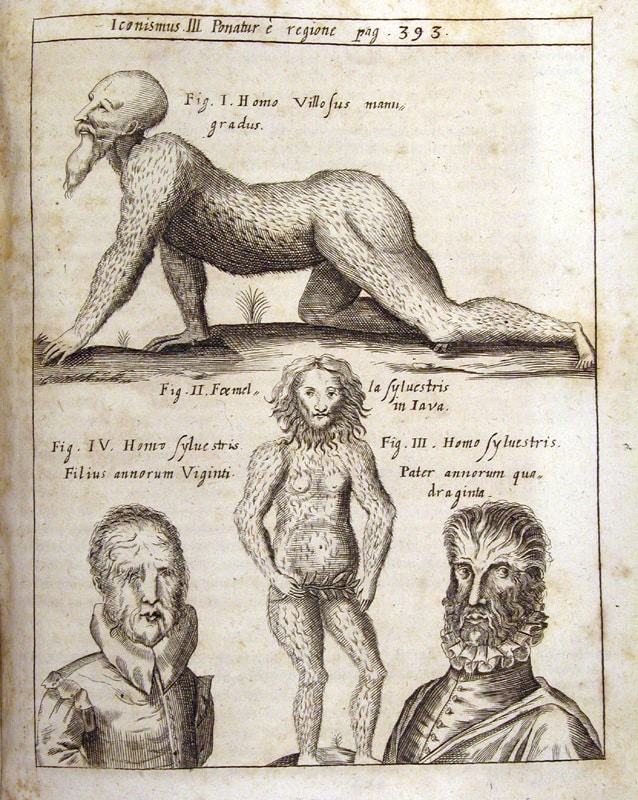
GASPAR SCHOTT (1608-1666). Physica curiosa, sive mirabilia naturae et artis libris XII. comprehensa, quibus pleraque…Wurzburg,] 1697.

Schott was the author of several works on mathematics, physics, and magic. His most interesting work is the “Magia universalis naturæ et artis”, 1657-1659, which contains a collection of mathematical problems and a large number of physical experiments in optics and acoustics. He published “Pantometricum Kircherianum”; “Physica curiosa”, a supplement to the “Magia universalis”; “Anatomia physico-hydrostatica fontium et fluminum”, and a “Cursus mathematicus”. “Physica Curiosa” is a large compendium of pictures and stories regarding monsters, physical abnormalities, and bizarre animals. Rather than a work of original scholarship Schott’s book, like many others of its kind, attempts to gather together as much as is commonly known on a topic. Many of the descriptions of animals and creatures repeat apocryphal accounts as if they are fact, and perpetuate belief in unicorns, satyrs, and other mythical beings”.

Schott-494.5-393-001Schott-494.5-595-001


An old adage says that disappointments never come single handed

Joseph Culver Letter, July 1, 1863, Page 1

Head Quarters, Co. “A” 129th Ills.
Gallatin, Tenn., July 1st 1863

Dear Wife

An old adage says that disappointments never come single handed, & so it has proven as three or four mails from the North have been distributed & no letter for me. I presume now I shall receive none until the arrival of Sergt. Gaff when I anticipate a long one.

As it is quite late to-night, I shall not write at any great length. I was out all of last night on a scout, & it was too warm to sleep to-day so that I feel somewhat sleepy. I have failed from the amount of duty to write to the County Pic-Nic.

The Rebels made an attack on a scout from Richland near Fountain Head yesterday noon; killed one Lieut., two men, wounded several & took 12 prisoners.1 They number about 75 or 80 men. A Scout of 100 men are just leaving here commanded by Capts. Hoskins & Perry & Lieuts. Smith & McKnight.2 I hope they may succeed.

I know of no reason why the trains have not been captured, as there are several large forces near Mitchellsville & Richland. We learned this evening that a force of some 75 Rebels were within 8 miles. Just now reports are coming in from the Pickets who have been fired on. There may be a show for some fun.3 A little fight would be very acceptable just now.

We are all quite well. I feel anxious to know how you & Frankie are getting along. Nathan Hill [a private in Company A] is setting here blowing about having taken you out buggy riding at some time or other. Christ Yetter sends his respects.4 He is anxious to get home to see Jennie Gutherie.5 You might intercede for him a little. The boys are all in good spirits; Christ & Nathan Hill are trying to be funny & make me laugh so that it is difficult to write.

Remember me kindly to all our friends & Give my love to Mother & Maggie & all the rest. I have received no letters from any one yet.

I notice in the papers to-night that the Rebels are falling back from Carlisle, so that I may possibly here from there soon.6 I fear Bro. Charlie has joined the Army & left Father all alone. I hope it may not be so.7 Write soon

Good night —a kiss for yourself & Frankie.

Your Affect. Husband
J. F. Culver

  1. On June 28 a report reached Buck Lodge, the headquarters of the 106th Ohio Infantry, that guerrillas had robbed a Union sympathizer. A 12-man mounted patrol was sent to investigate, and soon located a trail left by the raiders. The Ohioans followed the trail but lost it during the night. As they were returning to Buck Lodge on the morning of the 29th, they were bushwhacked near Butler’s Mill, and Lt. Gustavus Bertgold and one soldier were killed, and three wounded. Whitelaw Reid, Ohio in the War: Her Statesmen, Her Generals, and Soldiers, 2 Vols. (Cincinnati, 1868), Vol. II, pp. 572-575.
  2. John P. McKnight, a 23-year-old farmer, was mustered into service on Sept. 8, 1862, as 2d lieutenant of Company G, 129th Illinois Infantry. On April 19, 1864, Lieutenant McKnight was appointed aide-de-camp to Brig. Gen. W. I. Ward, and on Nov. 1, 1864, he was detailed for special duty with the Signal Corps, Department of the Cumberland, and was mustered out on June 8, 1865, at Washington, D.C. Compiled Service Records of Union Soldiers, NA.
  3. The regimental papers of the 129th Illinois do not contain “After Action Reports” filed by members of the patrol, or any information from the “pickets who have been fired on.” Regimental Papers, 129th Illinois, NA.
  4. Christopher C. Yetter, a 22-year-old farmer, was mustered into service on Sept. 8, 1862, as a sergeant in Company A, 129th Illinois Infantry. Sergeant Yetter was wounded in the chin at New Hope Church, Georgia, May 27, 1864, and was commissioned 1st lieutenant of Company A on Nov. 9, 1864. He was mustered out near Washington, D.C, June 8, 1865. Compiled Service Records of Union Soldiers, NA.
  5. Jennie Gutherie was the 17-year-old daughter of George and Sarah Gutherie, prosperous Pontiac Township farmers. Eighth Census, Livingston County, State of Illinois, NA.
  6. Ewell’s II Corps, Army of Northern Virginia, evacuated Carlisle on the morning of June 30, leaving by the Baltimore Pike. Part of the corps was engaged the next day at Gettysburg. While in Carlisle, the Confederates had sacked the grocery, drug, clothing, and shoe stores. Joseph Culver was fortunate not to lose anything to Rebel foraging parties. Sister Hannah wrote on July 9, “We have escaped almost miraculously having lost nothing.”
  7. J.F.C.’s fears that 16-year-old Charlie had joined the army were groundless. He was still at home. After the Battle of Gettysburg, he and a number of friends visited the battlefield. Hannah Culver to J.F.C., July 9, 1863, Culver Collection.

4th of July Holiday hours @Hardin

The Hardin Library for the Health Sciences will close early, at 6pm Wednesday, July 3.

The Library will be closed July 4 for the Independence Day holiday.

The Library will reopen at 7:30 on Friday, July 5.

picture of flag

Learn about measuring scholarly impact at Hardin Library’s open workshop July 2nd

This class will teach participants how to use tools such as Ulrich’s, Journal Citation Reports, Web of Sciences, and Scopus to determine the impact that journals, articles, and authors have had on a particular field.

Topics such as impact factors, Eigenfactors, and H-indices will also be discussed.

Our next session:

Tuesday, July 2nd  1:00-2:00 pm (Location: East Information Commons, Hardin Library)

Register online (http://www.lib.uiowa.edu/hardin/regform.html) or by calling 319-335-9151.
Coming from the East Side?  Take the Pentacrest Finkbine-Arena Cambus.