Reach out to your book-loving friends by sharing a reading-themed eCard, featuring images from Iowa Digital Library.
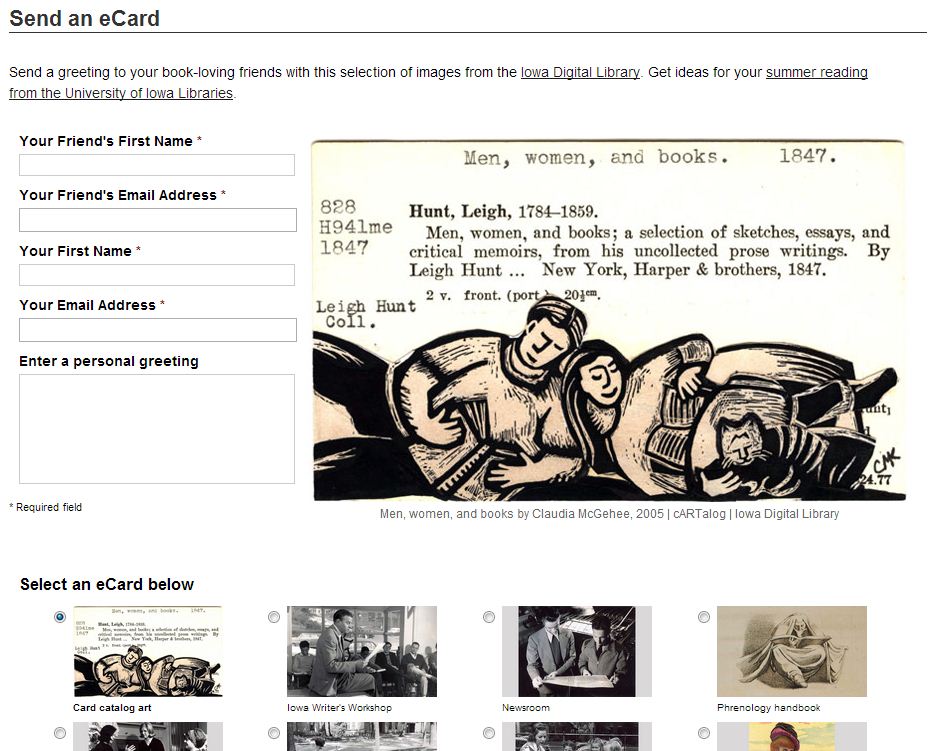
Summer reading: send an eCard from Iowa Digital Library
Reach out to your book-loving friends by sharing a reading-themed eCard, featuring images from Iowa Digital Library.
Summer reading: send an eCard from Iowa Digital Library

Head Quarters, 129th Regt. Ills. Vols. Infty.
Gallatin, Tenn., July 11th 1863
My Dear Wife
Another day has passed without any word from you. I leave at 10 o’clock to-night on a scout of 100 cavalry, 200 infantry & 2 pieces of Artillery. Will be absent for two days,1 but as the trains do not run north of Louisville, I can hardly expect to hear for several days. Morgan has possession of the Rail Road from Jeffersonville to Indianapolis.2
We are all well. Capt. Reed, Sergt. Quakenbush, Lacy McFee & Bob McIntyre came near being captured at Spradling’s to-day by some 30 Rebels but succeeded in making their Escape.3
I expected to have several letters to answer to-morrow (Sunday). Hoping that God’s blessings may rest upon you & Frankie, I remain,
Ever Your Affect. Husband
J. F. Culver

Head Quarters, Co. “A” 129th Regt. Ills. Vols.
Gallatin, Tenn., July 10th 1863
My Dear Wife
If you have ever anticipated without presuming to doubt the arrival of glad tidings & being delayed day after day with bright hopes for the morrow (when anticipated pleasure brings but blank disappointment & you are left in doubt & uncertainty with great fears for the result). If you have experienced all this, you can sympathize with me to-night.
The mail arrived for the first time this evening for 9 days, bringing a large number of letters for a large majority of the Company, but none for me. No news from my wife. No knowledge of where you are, whether you have reached your destination & are in good health, & a great many things that I expected to hear. No news from home, not a letter or paper.
To say that I am disappointed is scarcely half. I fear something has happened but what I cannot determine. I pray God my fears may be groundless & all be well. Oh, how anxiously I have looked for this mail. I shall most earnestly hope for some news to-morrow. If you were near where a telegram would reach you, I should not wait for the train for word from you, & yet if anything has happened I hope our friends would be considerate enough to let me know immediately. I shall hope on; hope that you are well & Frankie also.
My health is quite good. We were reinforced to-day by the 71st Ohio Regt.1 Two more regts. are expected with a Batallion of Cavalry.2 I can but close & wait. My God bless & keep you both, fill you with love & grace divine.
Good Night
Your affect. Husband
J. F. Culver
SciFinder released an update last month that changed their interface and provided some new options and features.
To learn more, check out this quick, interactive tour of the new design or download the overview presentation (PDF).
If you already have a SciFinder account, you can login here. If you do not have a SciFinder account, please register here.
If you have any questions or want to learn more about SciFinder, please contact the Sciences Library at lib-sciences@uiowa.edu or 335-3083.

Head Quarters, Co. “A” 129th Regt. Ills.
Gallatin, Tenn., July 9th 1863
My Dear Wife
Another day has passed without any mail, with the usual promise that it will come to-morrow. Morgan has gone with a portion of his command to Indiana. Should he venture any considerable distance his capture is certain.1 Reports still confirm of the fall of Vicksburg & the rout of Lee’s Army in Penna., but we scarcely believe it all.
By the time we get reliable news, great changes will doubtless have been effected. It looks to me much like the last struggle before their [the Confederates] final overthrow.2 Some 5000 deserters from Bragg’s Army have come into Rosecrans’ Camp.3 They are rapidly evacuating Tennessee.4
We may look for stirring times where small detachments are stationed. We are expecting reinforcements here daily of an entire brigade, even now within striking distance of the place, so that our duties if we remain here will have lighter duties to perform.5
Our health is still good. Russell is rapidly improving & is able to be about most of the time. I have nothing new to communicate. How I wish for some word from you. Kiss Frankie for me.
May God bless my Dear Wife
Your Affect. Husband
J. F. Culver
Tuesday, July 9, 2013
Submitted by Jessica Rogers
 We moved our Columbian hand press from the first floor of the library to the third floor, in front of Special Collections, to make more room for the Learning Commons. If you have not yet had a chance to see it, please, stop by and gaze in wonder at the remarkable craftsmanship and beauty of this historic hand press. As your eyes drift over the various decorations and counter-weights of this cast iron behemoth, take a moment to think to yourself “man, I bet this thing is really, really, really, heavy.” And it is.
Our particular Columbian was cast in 1843 at 120 Aldersgate Street, London, as stated on the brass plate which is mounted at the top of the structure. There is no indication as to when it was shipped to the U.S., where it was used, or when it arrived at the University of Iowa. It is roughly seven feet high and four feet wide (when the press bed is out) and made primarily from cast iron. 
 Although no exact weight of the machine could be found it has been firmly established that the press is very, very heavy. Moving the press from the first to third floor took five men and a cherry-picker, a tool that is used in auto shops to lift car engines. After nearly four hours (and one almost-broken toe) the Columbian was at last settled in its new home.
The Columbian press was invented in 1813 by George Clymer, an American mechanic in Philadelphia. Sadly, Columbian presses were not as popular in the U.S. as they were overseas and Clymer moved his business across the pond where the machines proved more popular. Despite American printers rejection of his press, Clymer continued to decorate the Columbian (the name itself a tribute to Clymer’s beloved America) in patriotic symbols. In fact, Columbian presses can be most easily identified by the bald Eagle counter-weight at the top of the press. To date, there are no remaining American made Columbians and any Columbians located in the U.S. were made abroad and shipped back to American printers.
World Religions Online explores religion and spirituality in an unbiased manner, from the ceremonies of the first practitioners to the rituals of today.
Please send additional comments to Rachel Carreon.

Head Quarters, Co. “A”, 129th Regt. Ills. Vols.
Gallatin, Tenn., July 8th 1863
My Dear Wife
As communication is not yet open, I have received no letters from you, & I presume none of mine have reached you. I wrote a long letter on Friday evening [the 3d], but the train & mail was captured so that someone else will peruse it than my wife. I hope it may do them good. Some of the men of this Regiment were captured with the train, but I have not yet learned who.1 If the train coming South was captured, which is probable, Daniel Graff is likely among the number, as he was to have returned by it.2
We have had no papers, but several dispatches sent as we think by Morgan, as he had a Battery attached to the lines:3 one was of the entire overthrow of Lee’s Army in Penna; the other, the fall of Vicksburg on the 4th inst. with 24,000 prisoners.4 Report says that Morgan has retreated & that the road will be repaired in a few days.5 But we dare not rely on the reports not knowing who works the wires. Morgan evidently has in his employ some operative of the Road, as a stranger could easily be detected. Instead of destroying the train he captured, he sent it back to Nashville with all the ladies aboard, telegraphing at the same time that it was the regular train from Louisville. We have no news from any part of the Army that is reliable.
Lt. Culver left here for his regiment at the front yesterday.6 He promised to hunt up Bro. Johnnie & let me know where he is. I cannot understand why he has not answered any of my letters. You cannot imagine with what anxiety we await the first train for news from friends & loved ones & the Armies.
Russell’s health is improving; but he is not able to be about much yet. I have been reading during my leisure hours a history of the war by E. A. Pollard.7 I am sorry to say I never read such a collection of falsehood in my life. I wish very much to get a true, well written history. Perhaps in your travels you may find one; if so purchase & read it, & I can get it should I succeed in getting home this fall. Another thing I want very much is a pocket map of the U.S., reliable. Should you see any of Floyd’s [sic] Newspaper maps of the seat of War, please send me one by mail.8
I had a short ride in the country this evening with Col. Cropsey. This country is looking beautiful & reminds me so forcibly of Cumberland Valley that I long to see the old home once more.9
We are plodding on in the even tenor of our way lately; duties heavy but health good. I am getting quite fat lately which is unaccountable. I think I shall soon be up to my old weight. We are having quite a feast on blackberries, which are ripe & plentiful. I should like to have a mess of whortleberries. They are ripe now. I hope you will enjoy them. I presume you have ripe apples, eat a few for me. I hope you are enjoying yourself visiting the old haunts of pleasure.
I thought this evening while riding through the grove that perhaps you were roaming around those old hills, visiting old friends & thinking of the change the few years of absence has effected in your own condition & that of others. I earnestly hope you may have no regrets for the result & that your cup of happiness may be full.
I have not forgotten my tramp from New Hartford to Mr. Case’s through mud ankle deep; of the pleasant acquaintances I made while there. Indeed, had I been single, I am not sure that it would have been a wise policy to send me among those lady friends of yours there. As one of them has very large lustrous eyes that are quite captivating, I do not deem it prudent to mention names. Yet an initial acrostic may not be inappropriate such as:
Songs of Minstrels fill the air
While Nature blooming ever fair &, &c, &c
Do not get alarmed at my poetry for I never wrote a line correctly in my life, & I am rather far advanced in life now to be effected by the muses.
Remember me kindly to all our friends. I set down to have a little chat with you and have almost exhausted all the subjects at my command. I have written punctually almost every day. Indeed, I think I have not missed more than three or four since you left. I can hardly expect you to do as much as you will be very frequently without facilities to write.
Capt. Hoskins has been quite sick to-day. Mrs. Smith requests me to say that she would like to hear from you. She is well.
I hope Frankie is making good use of his time & opportunities; that he is enjoying good health & giving you little trouble. I wish I could encircle you both in my arms & get a sweet kiss in return. Sometimes I feel sorry that you are gone, yet I must confess that I could not wish you surrounded with the dangers we are liable to encounter here. I hope the time will soon come when separation will no longer be a necessity, & we in our quiet home can enjoy the greater sweets from our long absence, when our country will no longer need the sacrifice of all that is so dear to our hearts. Let us devoutly pray for a glorious future. I could not enumerate all the dreams of future happiness I have had should God in His Infinite Goodness prosper us.
I feel very sanguine that the great dark clouds will soon disappear & the reign of Peace be ushered in. May it come speedily.
Let us trust wholly in the promises of God & earnestly strive to do his will. I feel unusually buoyant & happy tonight, whether it is the precursor of a fit of the blues or the dawning of a glorious reality, I cannot tell; yet I will not forego the pleasures of present realities. Trusting in God for your happiness, I remain,
Your Affect Husband
J. F. Culver
The purpose of this session is to introduce you to various environmental health and toxicology resources found on the National Library of Medicine’s website. Learn about important resources such as the Household Products Database, TOXMAP and TOXNET.
The resources discussed in this session will be of interest to the researcher/scientist, health professional and the general public.