Skip to content
Skip to main content

On the “Open Access Sting” Published in Science

Earlier this month, Science published a news article (“Who’s Afraid of Peer Review?”) by John Bohannon, a reporter and Harvard University biologist, that investigates the quality of the peer-review process at some fee-charging, Open Access journals in the life sciences. Bohannon submitted a credible, yet “hopelessly flawed” scientific article on cancer research to 304 relevant, fee-charging Open Access journals, 158 of which accepted it for publication It is worth noting that journals from the Public Library of Science, BioMed Central, and Hindawi, the three biggest Open Access publishers, rejected the paper outright.

The news of this study sparked spirituous debate in the blogosphere and the popular media (especially in the comments sections), oftentimes confounding its implications on the future of science, open access, and peer-review. As we approach Open Access Week (Oct. 21-27), it is important to consider what this article means in the broader context of scholarly communication.

“The takeaway shouldn’t be that Open Access is broken and not worth trying. Open Access is great and everyone believes that. It’s just a question of how to implement it.” – John Bohannon on NPR.

While Bohannon’s article uncovers problems in academic publishing, it is not clear that any of the problems are specific to Open Access. Bohannon specifically studied a subset of Open Access journals (many of which were known to be problematic) as a response to his colleague’s experience with a publishing scam, in which a fraudulent scientific journal collected publication fees from the author without performing any legitimate peer-review. Given the scope of this question and the nature of the fake research paper, the findings represent less than 4% of Open Access journals, of which less than 2% accepted the bogus paper (figures according to the Directory of Open Access Journals). Because the article did not study subscription based-journals, non-fee charging journals, non-English journals, and non-life sciences journals, it cannot be concluded that the problem is unique to Open Access.

One major effect of Bohannon’s work is the fascinating discussion on Open Access and peer-review that emerged in the wake of his article. Michael Eisen, a UC-Berkeley Biologist and co-founder of the Public Library of Science, suggests that the problem Bohannon’s study reveals is in the antiquated and opaque standards of the peer-review process. Peter Suber, Director of the Harvard Office of Scholarly Communication, reminds us that Open Access is not just about publishing; to tie this news to Open Access is to ignore the far more popular Open Access archiving option (such as depositing work in Iowa Research Online or PubMed Central) which is compliant with most traditional publishing agreements. Not interested in reading other blogs? Take a listen to this Science Live Chat with John Bohannon on the response to his study.

News like this reminds us that changes in the scholarly publishing system can be far more nuanced than expected and that it is important to continue these discussions as members of the scholarly community.


Learn the Basics of EndNote with our Open Workshop

EndNote is a reference management tool that helps you to easily gather together your references in one place, organize them, and then insert them into papers and format them in a style of your choosing. This session will walk you through the basics of using EndNote to collect and format your citations. The class will be hands-on and there will be time for questions at the end.

Tuesday, October 22 from 9-10 am (Location: East Information Commons)
Register online here or by calling 319-335-9151.
No time for a class? See our EndNote tutorial here.

Find Evidence-Based Resources with our upcoming workshop

This class will focus on creating a clinical question using PICO, the difference between publication types, and the different resources where one can find evidence based information. The class will also discuss the difference between searching Cochrane, PubMed, National Guideline Clearinghouse and UpToDate.

Our next session is
Wednesday, October 23rd, 11 am-12 pm (Location: East Information Commons)
Register online here or by calling 319-335-9151.
No time for class?  Ask your librarian for a private consult!

The Open Library of Humanities

Open Library of Humanities

The Public Library of Science (PLoS) is a non-profit open access publisher of scientific research with the mission to accelerate progress in science and medicine. Each PLoS article is free to read and is available through a Creative Commons license, optimizing the ability for researchers to build upon the work. Since its founding in 2000, PLoS journals have risen to the top of their fields and has help revolutionize the ways in which scientists communicate their work. In the spirit of PLoS, the Open Library of Humanities (OLH) will bring sustainable open access publishing to the humanities.

The Open Access movement is partly a response to the rising costs of the traditional publishing system, but it is mostly an effort to bring scholarly communication into the age of the web. No longer bound by the timetables and infrastructure necessary for a print-based publishing system, the OLH will offer rigorous peer-review and publish each work online when it is ready and offer article-level metrics to track each work’s impact in the scholarly field.

The OLH is still in the early stages of planning but is expected to fill a much needed gap in open access options for humanities scholars. To get involved, you can subscribe to their email newsletter or contact Chris Diaz to receive updates as the project develops. Right now, the OLH is recruiting editors and is asking interested authors to Pledge to Publish in the OLH’s first year.

eras of emma: the emma goldman clinic through four decades

eras of emma:  the emma goldman clinic through four decades

Join us for a panel discussion featuring women who have been active in Iowa City’s feminist health clinic founded in 1973. The clinic had its origins in an abortion referral service started by Iowa City’s Women’s Liberation Front in 1971. The Emma Goldman Clinic for Women opened September 1, 1973 in a house at 715 North Dodge Street, just months after Roe v. Wade was decided by the United States Supreme Court. Initially focused on woman-centered health care, the Emma Goldman Clinic later expanded its mission to provide reproductive health care for men as well as women.
 
The panel will be moderated by Karen Kubby, former director of the clinic, and will include clinic founder Deborah Nye, first director Marilyn Cohen, current director Jennifer Price, and board member Jorie Slodki.
 
 
Friday, October 18, 2013
 
1:00-2:30 p.m.
 
Iowa Women’s Archives,
3rd floor, Main Library
The University of Iowa
 
  egc newsletter w Our Bodies  EGC n dodge house in snow


Left: The first home of the Clinic, at 715 N. Dodge, Iowa City.
 
Right: The cover of a 1979 newsletter put out by the Clinic. Note the speculum in the back pocket and the copy of Our Bodies Ourselves on the chest of drawers. The newsletter was later renamed Emma’s Periodical Rag.
 
Both items are from the Emma Goldman Clinic records in the Iowa Women’s Archives.


Support for PeerJ Memberships

PeerJ Logo. License: Creative Commons Attribution 3.0. Available: https://peerj.com/about/press/

PeerJ Logo. License: Creative Commons Attribution 3.0. Available: https://peerj.com/about/press/


Calling all Biological and Medical scientists! The University Libraries is pleased to begin supporting PeerJ memberships for all interested University of Iowa faculty and researchers through the Open Access Fund. The University Libraries and the Office of the Provost established the Open Access Fund to pay the processing fees related to open access publishing.

Open-access (OA) literature is digital, online, free of charge, and free of most copyright and licensing restrictions. – Peter Suber

PeerJ is an Open Access publisher of scholarly articles in the biological and medical sciences [full list of subject areas]. Rather than charging a per-article fee for making an article Open Access, PeerJ charges a one-time membership fee for authors [Breakdown of membership types]. All interested UI faculty, graduate students, and research should contact Chris Diaz for more information about setting up a PeerJ membership.

Originally posted on October 3, 2013 at http://blog.lib.uiowa.edu/transitions/?p=1084 by Chris Diaz.

Social Explorer – Trial ended 9 November 2013

Social Explorer is an online research tool designed to provide quick and easy access to historical census data and demographic information. It creates fast, intuitive, and appealing maps and reports to help users visually analyze and understand demography and social change throughout history. An invaluable repository of information, the site currently includes the entire US Census history from 1790 to 2000, all annual updates from the American Community Survey, and the Religious Congregations and Membership Study from 1980 to 2000.

Please send additional comments to Brett Cloyd.

SAGE Research Methods – Trial ends 13 December 2013

SAGE Research Methods links over 100,000 pages of SAGE’s renowned book, journal and reference content with truly advanced search and discovery tools. Researchers can explore methods concepts to help them design research projects, understand particular methods or identify a new method, conduct their research, and write up their findings. Since SAGE Research Methods focuses on methodology rather than disciplines, it can be used across the social sciences, health sciences, and more.

Please send additional comments to Dottie Persson.

October is National Medical Librarians Month

This month is National Medical Librarian Month and the theme from the Medical Library Association is “Saving You Time So You Can Save Lives.”  Hardin Library offers a variety of services to save you time whether you are a student, faculty, staff, resident, fellow, physician, or other health professional.

Hardin Library Open House
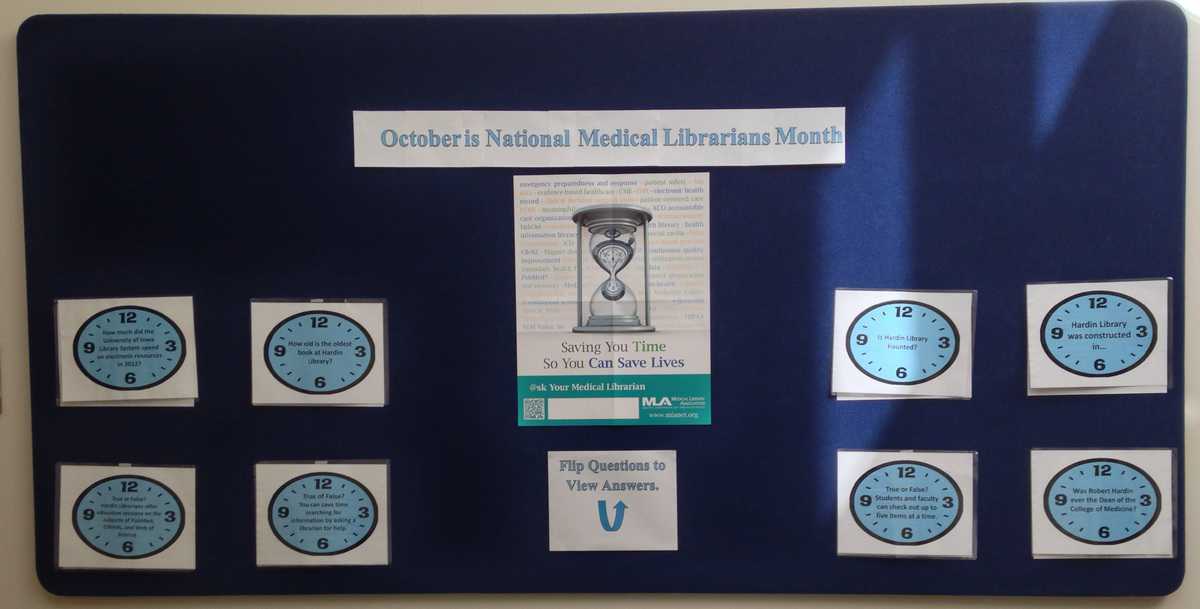
Come celebrate National Medical Librarians Month with us on October 17, 2013 from 11:30am – 1:30pm at the 3rd floor service desk.  We’ll have free refreshments, novelty clocks, and the opportunity for tours of our fascinating building.  You might just find out if Hardin Library is haunted. I can’t tell you, but there may be an answer on our trivia display.

NMLM Display 2013

This display can be found on the third floor of Hardin Library between the service desk and 24 hour study area. This display will be up through the end of October.

10 Ways that Hardin Library Can Save You Time

  1. Hardin Open Workshops – Learn some new skills in our free 1 hour classes.  If the time doesn’t work for you or you’d like to schedule a special session for a group, feel free to contact us. We’re very flexible.
  2. Interlibrary Loan – Don’t settle for an article or book that isn’t exactly what you need for your research. If the University of Iowa doesn’t have the material you need, we can order it from another library. This service is free to our affiliates.
  3. Document Delivery – Do we have something you need, but you can’t leave your office? Maybe it’s too cold to trek across the river to another library. Don’t worry. We can send library materials straight to your office. If you need an article, we will scan the material and email you the PDF.
  4. Subject Guides – Did you know that Hardin librarians have created subject specific guides to put many of the resources you need (databases, books, journals, etc.) all in one convenient location? We don’t want the research process to be as easy as possible.  We’re also happy to take suggestions if you know of something that’s missing from a guide.
  5. Electronic Books – Many of our textbooks are available online, 24/7 both on-campus and off-campus (as long as you have a Hawk ID and password).
  6. Electronic Journals – Most of our journals are available online, 24/7 both on-campus and off-campus (as long as you have a Hawk ID and password).
  7. High Powered Databases – Don’t waste your time sifting through hundreds of thousands of links from a search engine. Many of our databases offer point of care information or specialized filters to get you the information you need quickly.  And, Hardin Librarians can teach you the most efficient ways to search these databases.
  8. Mobile Resources – Hardin Library supports a wide variety of apps with health sciences information.  We can also help you download apps to your mobile device.
  9. One on One Consultations – Are you struggling to find the information you need? Do you need help using EndNote or RefWorks? Hardin Librarians can meet with you by phone, email, chat, or in person. We can even come to your office!
  10. Personalized Library Liaisons – Hardin Library has different liaisons assigned to different departments so that we can better serve your needs.

National Medical Librarians Month Contest

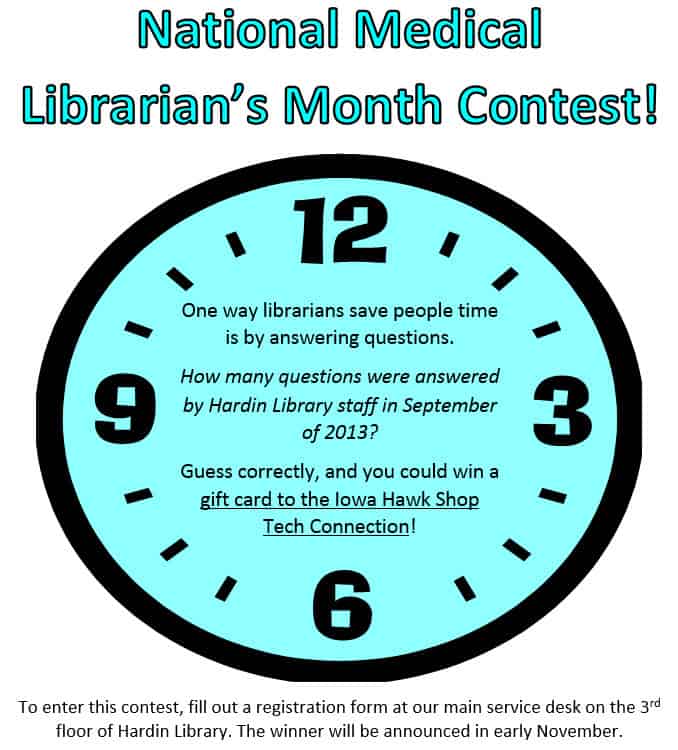
One way librarians save people time is by answering questions. How many questions were answered by Hardin Library staff in September of 2013? Guess correctly, and you could win a gift card to the Iowa Hawk Shop Tech Connection!

To enter this contest, fill out a registration form at our main service desk on the 3rd floor of Hardin Library. This contest is open to University of Iowa affiliates, only. The winner will be announced in early November.

ContestFlyer