Skip to content
Skip to main content

I must confess that I had a severe fit of the blues yesterday

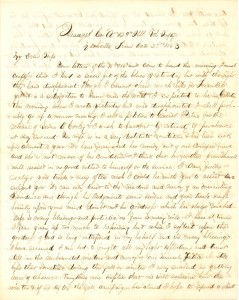
Joseph Culver Letter, October 23, 1863, Page 1

Headqrs. Co. “A” 129th Ills. Vol. Infty.
Nashville, Tenn., Octr. 23rd 1863

My Dear Wife

Your letters of the 15th & 16th inst. came to hand this morning.1 I must confess that I had a severe fit of the blues yesterday, but with the night they have disappeared. Though I cannot glean much hope for Frankie, yet it is a satisfaction to know even the worst.

I expected to be in Gallatin this morning, when I wrote yesterday, but was disappointed.2 I shall probably go up to-morrow evening. I sent a petition to General Paine for the release of Lorin O. Cooley, & I wish to back it by entreaty if perchance it may succeed.3 His wife is in a very destitute condition & has been sick for almost a year. We have furnished her money out of our Company fund, and she is not aware of his condition; & I think that his further punishment will result in no good either to himself or the service.

I can fully realize your trials, & very often wish I could be with you to assist and support you. We can only trust to the wisdom and mercy of an overruling Providence, and though his judgments seem severe, and your trials weigh heavily upon your mind, doubt not his goodness, which has always vouchedsafe so many blessings and protected us from so many evils. I have at times, I fear, given up too much to repining, but when I reflect upon the goodness of God so long interposed in my behalf and the many blessings I have received, I am led to forget all my light afflictions and trust still in the unbounded wisdom and mercy of our Heavenly Father.

I still hope that sometime during this fall or winter I may succeed in getting leave of absence. Everything now implies that we will remain here this winter, &, if so after the fall campaign has closed, I hope to spend a short time with you. Yet should all my efforts fail, let us not repine for in less than two years my time of service will expire, and then we will go home again.

I informed Mother [Murphy], in one of my letters, of her mistake, & I doubt not she will be surprised, as she wrote so positively that she knew what was the matter. I have had quite a laugh at her expense & would enjoy an opportunity to tease her about her long experience in such matters very much.4

I recd. your letter to Bro. Johnie after I wrote to you. By some misfortune it had got into some of the other companies; I sent it forward immediately. You will find his address in full in his letter which I sent you a few days ago. You told him I sent you all important letters, but I have sent you every letter I received but one, & I mislaid that one some way & could not find it. I took the liberty to add a post-script to your letter.

You wish to know if the contention in Pontiac is only political. It was at first but has grown into personal hatred and enmity.5 The people do not associate as formerly, and the sources of quarrel[ing] and wrangling are interminable. It shows a disposition of base cowardice or else unpardonable duplicity. They are either afraid to stand out boldly for the right or else pecuniary interests are allowed to embarrass them. Either is a despicable excuse, and the kind of spirit manifested will surely result in a total degeneration of the moral tone of society there. May God open their eyes and enlighten their minds to the dangers that lie before them.

I really fear that I did not sufficiently weigh the matter of your visit to Carlisle. It never occurred to my mind that you would ever meet with anything that could impress you unfavorably. But, My Dear Wife, let me assure you from a full knowledge of the persons, and all that could be brought into comparison, you have nothing to fear. Will Mullin I know well, far better than sister Lizzie [Zug] can. His wife, formerly Fanny Porter, was the most intimate friend of Mary P[ostlethwaite] & doubtless is fully acquainted with all that ever transpired, while Will’s Bro., Jos. Mullin, was my room-mate for over a year, &, though not a confidante of mine, was doubtless well posted. I was often in company with all the Boys & knew their estimate of Mary Pfostlethwaite] which was never very flattering.

Even Will Mullin’s wife, warmly as she was attached to her, attempted to convince me very many times that I was deceived.6 Thus I feel assured that you have nothing to fear while you may justly feel proud of conscious superiority. I am not surprised that he [she] [Mary P.] should feel anxious to make your acquaintance for many reasons of which I do not deem myself justified in speaking. I might have told you, but the persons were all unknown to you, & I feared I should not be able to explain sufficiently to make it interesting. I hope to have an opportunity some time, however, & a knowledge of the persons will aid materially. It was all, however, only those little things in which boys & girls so often engage. Each trying to outdo the other in their attentions to the greatest number, or to have exclusive rights over the other. I had almost forgotten them in the cares of the past few years & the enjoyment of present happiness. I will be able to tell you in a few weeks.

Should you meet with Fanny Mullin, Will’s wife, you will find her not only agreeable but of a very sweet disposition and one of the finest singers in the East. She was very beautiful as a girl of 16 & 18, but when I last saw her she had faded considerably. Remember me kindly to her & also her husband if you meet them.

Miss Laura Keene of New York is in the city & playing at the New Theatre.7 I went to hear her night before last in the “Blind Heiress” or “Eleanor Mowbry.” She has lost none of her old style & power. I heard her in the same play several years ago. I do not know that I ever felt the same power in her rendition of the play as on that night, and it brought to mind so many incidents of my own eventful life that I believe it proved very profitable.

It has been raining very hard all morning and is quite gloomy out of doors, yet I have felt happy. My health is good for which I have great reason to be thankful.

I have not been able to write as often of late from some cause, we have been almost constantly on duty. The war news are very cheering. Burnside’s demonstration in the rear of Lee’s Army is drawing off troops from our front, & our Army is preparing to move.8 We hope soon to hear of glorious victories.

Abbie Remick has never furnished the [promised] pictures yet. I shall remind both her & Lida of their promised New Year’s present if I don’t forget it. I have received no letters & have not written to either Sister Lizzie or Bro. Wes. yet.

Give my love to all the family & Remember me kindly to all our friends. Kiss Frankie for me. I accept the kiss sent. How much I wish I could be with him to assist in caring for him. Do not let his illness prey upon your own health. Long confinement to a sick Room will seriously effect your health without great care and abundant exercise in the open air. If you can only be contented and happy, I shall not regret your long visit at Father’s.

How is Mother’s health, & Why does not Sister Hannah write? She has not written one word since you went there. I must write to her & find out why it is.

And now, my Dear Wife, do not let our sore trials weigh so heavily upon your mind. God intends this chastening for our good. Let us not doubt his goodness or mercy but trusting implicitly in his wisdom resign all to his Will. Let my love for you console you in all that worldly things afford, and for all else let us trust to Jesus. May He bless & Keep you, preserve us for the enjoyment of each other’s society in life, and finally give us Sweet rest in Heaven.

Your Affect. Husband
J.F. Culver

  1. Mary Culver’s letters of October 15 and 16 are missing from the Culver Collection.
  2. J.F.C.’s letter of October 22 is missing from the Culver Collection.
  3. Lorin O. Cooley, a 25-year-old farmer, was mustered into service on Sept. 8, 1862, as a private in Company A, 129th Illinois. Private Cooley was placed under arrest for getting “beastly drunk” and deserting his post to watch a cock fight, and was confined to the guardhouse at Gallatin, Tenn., June 29, 1863. Court martialed, he was sentenced on July 20 to stoppage of pay and to be confined at hard labor for six months in the Nashville penitentiary. His sentence was commuted Oct. 23, 1863, by order of General Paine, and he rejoined his unit. Private Cooley was mustered out near Washington, D.C., June 8, 1865. Compiled Service Records of Union Soldiers, NA.
  4. Mrs. Murphy had mistakenly suspected that her daughter was pregnant, and J.F.C.’s comment about “her long experience” refers to her having given birth to three sons and two daughters.
  5. With an election at hand, the Livingston County Republicans and Democrats were at each others’ throats. The question of the administration’s conduct of the war and emancipation of the blacks had inflamed passions.
  6. Although Mary Culver’s letter in which she broached that subject is missing, it is apparent that J.F.C. courted Mary Postlethwaite while a student at Dickinson College.
  7. Laura Keene, a British actress trained in Mme. Vestris’ Company, came to the United States in 1852 as a member of James W. Wallack’s New York Company. She enjoyed brilliant success as a comedy star. She starred in “Our American Cousin” at Ford’s Theater on the night President Lincoln was assassinated. Miss Keene was appearing at the New Theatre, at the corner of Union and Summer Streets.
  8. The report that General Bragg had detached troops from his army investing Chattanooga to send against Burnside’s command at Knoxville was premature. Twelve days later, on November 4, Bragg sent General Longstreet with two divisions to operate against Burnside in East Tennessee. This was a blunder on the Confederates’ part which Grant exploited. Long, Civil War, Day by Day, p. 430.

Defending the Cultural Commons: the Avant-Garde and Information Activism, by Stephen Voyce

Today’s Open Access Week guest post comes from Stephen Voyce, Assistant Professor in the University of Iowa’s English department. It is an excerpt from an essay titled “Toward an Open-Source Poetics: Appropriation, Collaboration, and the Public Domain”, originally published in the journal Criticism (53.3 [Fall 2011]: 407-38). Professor Voyce will be participating in today’s panel discussion on academic publishing and open access. It will be held at 3 pm in room 1117 of the University Capitol Centre, and refreshments will be served. Find more details here about this event and Open Access Week at the University of Iowa. We hope you’ll join us.

Defending the Cultural Commons: the Avant-Garde and Information Activism

Stephen Voyce

In many ways the practices of appropriation and distributed creativity in recent poetry are part of a broader movement to enlarge and protect a public cultural commons. The term commons can refer to natural resources, public spaces, transportation, social institutions, information and research, government infrastructure, and network technologies. Thus, the commons contains material assets (e.g., parks, forests, water), intangible resources (e.g., the public domain, government research), and virtual environments (e.g., public radio, the Internet). A motley array of resources and public spheres converge within its signifying power and receive its protection from collective, democratic control. The radical market exploitation of the commons in recent decades has muddled distinctions between private and public realms of ownership (and since so many of the spaces in which subjects interact are now devoted to consumer practices, there is also a comparable muddling of our roles as citizens and consumers). Moreover, there has been little discussion of the public domain outside the disciplines of law and economics. Jessica Litman observes that, in the legal field, public domain works are often referred to as “unprotectable or uncopyrightable”; not only does this account of the public domain ignore its central role in subsequent literary production, it seems also to confer a peculiar nonstatus on any noncommercial object. We are led to conclude that an object not defined by property lacks proper existence. Since we lack a precise language to describe the commons, it has by default come to denote the residue of property. Responding to this challenge, James Boyle calls for a twenty-first-century information movement akin to the formation of the environmental movement during the 1960s. For this to take place, however, scholars like Boyle and Litman contend that a reinvigorated language of the commons is a necessary precondition if one hopes to mobilize communities to protect it.

The cultural activities of open source programmers and literary organizations like the Poetry Research Bureau, UbuWeb, and Information as Material afford both a theoretical and practical point of departure. Beyond the already multifarious range of meanings we give to the commons, from at least the fourteenth century onward, the term also affords a synonym for community (L. communis). Digital networks create countless possibilities for storing, distributing, and sharing cultural resources. These are the principles upon which networked collectives such as UbuWeb establish affiliations, codevelop their ideas, and present their work. Hence, UbuWeb functions both as a site of shared resources and as a site of community formation, and should be thought of and defended as such. Parks, squares, campuses, recreation centers, and social networking sites historically function as spaces in which communities form and mobilize as political subjects. One must apply this same logic to the public domain.

Next, we should conceive of the commons as a practice—and thus inject a logic of the commons into the fabric of our thoughts and actions. Again, both open source code sharing and UbuWeb’s commons-based poetics are instructive. Theories of authorship often mystify creativity by concealing the collective production of culture and its reliance on past traditions. Critiques of individual creativity appear all the more convincing with reference to contemporary poets, musicians, and authors whose challenge to proprietary definitions of authorship is the very hallmark of their practice.

To this end, the role of the avant-garde in the twenty-first-century is finding renewed purpose. The militaristic origin of the term avant-garde is well known. Renate Poggioli, responding to the legacies of futurism, imagism, and vorticism, argues that the formation of an avant-garde is essentially agonistic: the movement is defined “against something or someone”—and typically the academy or the general public. Although agonism appears within Greek, Christian, and Romantic traditions, “avant-garde agonism” refers to a radical form of opposition, a paradoxical affirmation of “self-sacrifice” by a “collective group” on behalf of the principles it advances. This now canonical definition of modernist experimental practice overshadows the intensely social projects of community building undertaken by artistic communities throughout the twentieth and twenty-first centuries. It is this social imperative that gives direction to contemporary practice. The role of artistic and literary collectives today need not jettison agonism as such, but rather its sometimes elitist, chauvinistic, fascistic, and eschatological associations. The responsibility of the avant-garde will instead require an activistic obligation to create and fortify public domains of open source knowledge, to challenge excessive restrictions placed on language and information, to bring forth marginalized knowledges from a position of inaccessibility to the public at large, and to produce and share artistic tactics and works that challenge intellectual property. That which is at stake is nothing less than open accessibility to culture. Hence, writers and artists are becoming more collaborative and interdisciplinary, drawing on the general and specialized skills of archivists, programmers, academics, and community organizers. Recalling the syncretic logic of Wershler-Henry’s the tapeworm foundry, this form of political organization is recognizable in the formal politics of the poem: literary communities begin to participate in the struggle for the commons by advancing an open source artistry as the central axiom of their practice by insisting that the signifying codes that one develops belong to a community that shares, adapts, and transforms its many possible uses. 


Stephen Voyce is an Assistant Professor in the English department at the University of Iowa. His work examines twentieth-century poetry and culture, print and digital media, and the history and politics of literary movements. His recent book, Poetic Community: Avant-Garde Activism and Cold War Culture (University of Toronto Press, Spring 2013), addresses several key poetic groups collaborating after World War II. He is currently working on a book project titled Open Source Culture: Literature, Appropriation, and the Public Domain, which investigates how late-twentieth-century poets, fiction writers, and artists creatively subvert intellectual property law and the regimes that enforce these policies. He is a member of the University of Iowa’s Digital Studio for Public Arts & Humanities and the director of the Fluxus Digital Archive.

Encyclopedia of Ancient Greek Language and Linguistics Online – Trial ended 20 November 2013

The Encyclopedia of Ancient Greek Language and Linguistics (EAGLL) is a unique work that brings together the latest research from across a range of disciplines which contribute to our knowledge of Ancient Greek. It is an indispensable research tool for scholars and students of Greek, of linguistics, and of other Indo-European languages, as well as of Biblical literature.

Please send additional comments to Chris Africa.

Very Short Introductions – Trial ended 15 November 2013

Very Short Introductions is an exciting new online resource, offering scholars and students OUP’s premier publishing series in an easily discoverable, fully cross-searchable, and highly accessible format. Discover a new topic or subject with these intelligent and serious introductions written by authors who are experts in their field.

Please send additional comments to Chris Africa.

On Not Being Published, by Stephen Ramsay

Open Access Week 2013 begins today, and all week we’ll be running posts by guest bloggers on open access and contemporary scholarship in the Humanities. Today’s post comes from Stephen Ramsay, Associate Professor of English at the University of Nebraska-Lincoln. Professor Ramsay is the University of Iowa’s open access guest-scholar this year, and he will be delivering a lecture, “What is a Publisher?” at 2 pm in the Illinois Room (room 348) of the IMU today, Monday, October 21st. He will also be participating in a panel discussion on open access and trends in academic publishing Tuesday, October 22, at 3 pm in Room 1117 of the University Capitol Centre. Find more details here about these events and Open Access Week at the University of Iowa. We hope you’ll join us.

On Not Being Published

Stephen Ramsay

I’m going to risk a certain immodesty by talking, in rather self-aggrandizing terms, about an essay of mine called “The Hermeneutics of Screwing Around; or What You Do With a Million Books“.

This essay began as a talk I gave at Brown University in 2010. The talk was a bit rough, but reasonably well received. Later on that year, I was invited to a workshop in Niagara-on-the-Lake, Ontario (the organizers had taken advantage of off-season rates to hold it in a stunningly beautiful resort town). The workshop was called “Playing with Technology in History” (later rebranded as “PastPlay”) and focused on bringing notions of play and the ludic (using, for example, role-playing games, Arduino boards, and even Lego bricks) to teach history. The plan was that we would spend a day playing games, hacking things, and participating in other sorts of activities — in other words, trying things out and exchanging ideas to see what might work and what might not. On the second day, though, we would get down to business. We were all supposed to bring an essay to be workshopped in traditional seminar format. University of New Brunswick Press had agreed to publish the resulting volume (subject to the usual terms of peer review). So, I revised my essay from Brown — making it a bit less “talky” — and submitted it to the group.  Reactions were, I thought, more positive this time, though one participant told me I was dead wrong on one particular point. He was right; I fixed it, and fiddled with it some more. Publishing takes a while, as we all know, but being generally anarchic digital humanists, we all agreed that it would be a good idea to put all the essays online in advance of them being formally published.

That essay is now, far and away, the most successful thing I’ve ever written. It has been cited countless times, is a regular feature on course syllabi throughout the land, and was even discussed at some length by Stanley Fish on the New York Times “Opinionator” blog.

But here’s the thing.  It is 2013 — three years later — and that essay still hasn’t been published.

Now, there are several reasons for this, none of which includes lassitude on the part of the workshop organizers. Nonetheless, when I write my annual review, I still list it as “forthcoming,” which means that it doesn’t yet “count” as something next to which my department can put a check mark. It’s not yet accepted as one of my “scholarly accomplishments.” The question, therefore, is whether I should actually care about this.

In one sense, the answer is “yes.” Academics tend to think of success as adding to the list of items on their CV, and this one still isn’t on mine. On the other hand, this essay made me famous (not Miley Cyrus famous, but you know what I mean). To be more precise, it gave me readers — people who actually care what I have to say. I cannot possibly communicate my astonishment that this happened. For years now, I have been putting everything I’ve ever written online (or rather, everything I can legally put online). I don’t really know why this one caught fire. “Hermenutics” isn’t, I suspect, high on the list of most-googled terms, and while “screwing around” likely is, I imagine that most in search of content related to the latter are disappointed by the marked lack of prurience in a piece that mostly talks about libraries.

On the other hand, it shouldn’t have surprised me at all. For years, I had been tweeting things like, “Hey everybody! New blog post!” As with spam, someone always has to investigate further. But even if that response rate is minuscule, the effect might be just as the old shampoo ad put it: “I told two friends. And they told two friends. And so on and so on . . .” After a while, people started to read other things I’d written.

I’m uncomfortable telling this story, because it sounds like any number of absurd narratives (“rags to riches,” “the entrepreneurial spirit,” and so forth). But I cannot deny a very important aspect of this tale: it happened because the piece was open and online. It was, in other words, open access.

These days, we are likely to speak of open access in terms of the economics of publishing and libraries. Occasionally, we speak of open access as a way to make scholars’ work available to a wider public. What is seldom discussed, though, is the role of naked self-interest on the part of academics. If you’re interested in having readers (and you should be), does it really make sense to bury your work in the stacks of a research library to be discovered by the six graduate students who find it while researching “Hermeneutics–Data Processing”?

Back when I started working on digital libraries (as a graduate student, not too long after the Web appeared), one often heard professors talking about their fear of having their work “stolen” if they put it online. Twenty years on, one still hears it from time to time. We used to say, “You should be so lucky!” My work wasn’t stolen (so far as I know), but one thing I know for sure: I was so lucky, and I certainly wouldn’t have been if I hadn’t put it out there for all to see.

Hopefully, it will never be published.


Stephen Ramsay is Susan J. Rosowski Associate University Professor of English at the University of Nebraska-Lincoln and a Fellow at the Center for Digital Research in the Humanities. He is interested in the digital humanities, theories of new media, theater history, applying computational methods to humanities scholarship, and designing and building text technologies for humanist scholars. His publications include Reading Machines: Toward an Algorithmic Criticism (University of Illinois Press, 2011) and, with Patrick Juola, the forthcoming Mathematics for the Humanist (Oxford University Press).


On my return from Stevenson last night, I found your letter of the 11th

Joseph Culver Letter, October 19, 1863, Page 1

Head. Qrs. Co. “A” 129th Ills. Vol. Infty.
Nashville, Tenn., Octr. 19th 1863

My Dear Wife

On my return from Stevenson last night, I found your letter of the 11th, one from Sister Lizzie [Zug], one from Bro. Wes [Culver] & Bro. Johnie [Murphy], & this morning recd. yours of the 12th.1 I am very happy to learn that there is some hope of Frankie.

Bro. Wes gave me a history of his disease from which I conclude that it will take great care and attention to save him. A slight cold will prove fatal, & this is a season of the year in which colds are very easily contracted. I see but little prospect of his safe removal before Spring, &, though the trial for you will be severe and the sacrifice great, yet it will save our child. His lungs are very seriously affected and without the greatest care will remain defective for life.

I know, my dear wife, that your trials have been & will be severe; yet doubt not God has some wise purpose in view. I am very thankful for your kind sympathy in my behalf & always feel assured that whatever may befall me, one loving heart at least beats in harmony with my own. I looked forward with much pleasure to your Stay with me, yet to save Frankie I can forego that pleasure & trust to God for his blessings.

I should be happy to act upon Bro. Wes’ suggestions & get a leave of Absence if it were among the possibilities. Perhaps by and by it will succeed, we will live in hope.

My health is very good. My trip to Stevenson was very pleasant. I had the passenger train & was only absent two days. I met Capt. West of Genl. Smith’s staff,2 who was in Carlisle at the time the Rebels were throwing shells into the town. He says that it was him who cut those fine shade trees down in front of Judge Hepbrun’s, Martin’s Hotel, and Judge Watts’.3 They were cut down to barricade the street.

I heard of quite a number of my old acquaintances in the service in the Potomac Army. General Knipe was formerly a shoemaker in Harrisburg;4 I knew him but not intimately. He commands a Brigade in the 11th Corps.

I hope Father’s health may continue to improve. Bro. Wes does not speak very hopefully of his case. I will try and answer Sister Lizzie’s letter to-day or at least very soon.

I sent several papers to Bro. Johnie by Captain West & will answer his letter the first opportunity. There is a gentleman going to the front on Wednesday with whom I think I can send the money. I do not like to risk it by mail, as they are very uncertain & irregular. I also sent Bro. Johnie your two letters of the 8th & 9th, which I happened to have in my pocket.

You ask what overcoat I sent for. It was my black one. I intended to get a cape & military buttons put on it & wear it, but I do not think I will go to the trouble now. My boots came in a box sent to Company “C” on Friday evening.

We all live together again & have ever since we came to Nashville. I boarded for several weeks, but we are now messing. It is the only way we can get our meals regularly & get rations to take with us when on duty. The hours for meals at a boarding house are regular & very often we could not go.

I will enclose Bro. Johnie’s letter. The weather is very pleasant to-day but has been cold and very wet for a long time. The waters are high. The news from our front are cheering.5 The papers anticipate a raid into Maryland again, but it looks very improbable.6 I hope the Call for 300,000 will be promptly answered.7

I am grieved to learn of Sophie Emmet’s sad fate.8 She was a very intimate friend of mine long ago & was a very fine girl.

I informed you that I had written to Sister Maggie [Utley] for the package [containing the will] in my drawer. I requested [Lt.] Smith to ask his wife to give Mother [Murphy] one of my pictures, as she has two. The health is generally good. Sergt. Godfrey was sick for a short time but is almost well again.9 Capt. Culver of the 105th Ills. was in to see me this morning and has promised me his photograph.10 I will send it to you when I receive it. I do not recollect whether you met him or not in Gallatin. He was there on General Paine’s Staff, but is now a Captain in the 105th Ills.

I must try and write to Wes to-day as he expects to leave so soon. Kiss Frankie for me. I earnestly hope he may speedily regain health and Strength. Should Father’s health improve, as I hope it will, Mother & Sister Hannah will be able to assist you in caring for him. I presume you all anticipate accessions to Jennie’s family. Sister Lizzie informs me that they all love you very much. I am truly happy, & I believe they will try to make your Stay pleasant.

Mother [Murphy] is very anxious to have you home, & I know she must be lonely, but the condition of society in Pontiac is such that I fear you would not enjoy yourself there. You can better judge of that, however, than I. The drum is beating for 12 o’clock roll call. I will have to hasten to write two letters before 2 o’clock drill. Give my love to all the family & remember me kindly to all our friends. Tell Charlie [Culver] to write, &, if he has any fears about the cost of a postage stamp, give him one.

May the blessings of Heaven rest upon you & Frankie. I feel that God will continue his goodness to us. Continue to write as often as convenient.

Farewell,

Your Affect. Husband
J. F. Culver

  1. All the letters referred to are missing from the Culver Collection except the one from Sister Lizzie Zug.
  2. Capt. P.C.F. West of the U.S. Coast Survey was on the staff of Brig. Gen. William F. “Baldy” Smith, the Army of the Cumberland’s chief engineer. O. R., Ser. I, Vol. XXXI, pt. I, p. 78.
  3. Martin’s Hotel was better known as the Farmer’s Hotel. Judges F. Watts and Samuel Hepburn owned lots on opposite sides of East High Street, between Bedford and Hanover Streets.
  4. Brig. Gen. Joseph F. Knipe commanded the 1st Brigade, First Division, XII Corps. Knipe’s brigade until October 22, when it was ordered to Bridgeport, was stationed at Decherd. O. R., Ser. I, Vol. XXXI, pt. I, p. 696.
  5. On October 16 the Departments of the Ohio, the Cumberland, and the Tennessee were consolidated and constituted “The Military Division of the Mississippi,” to which command Maj. Gen. Ulysses S. Grant was assigned. By the same order General Rosecrans was sacked and General Thomas named to lead the Army of the Cumberland.
    General Hooker’s two corps were still at Stevenson and guarding the railroad between Bridgeport and Wartrace. General Sherman with his four divisions had left Corinth, and by the 21st his advance guard had reached Tuscumbia, Ala., on its march east. Grant on taking command had ordered Thomas “to hold Chattanooga at all hazard,” and Thomas had replied, “I will hold the town till we starve.” Ibid., p. 666; Cist, Army of the Cumberland, pp. 233-234.
  6. General Lee on October 9 had crossed the Rapidan with two corps. His goal was to flank Meade’s Army of the Potomac out of its position north of Culpepper. The Confederates were successful, but when they sought to intercept Meade’s columns, as they retired up the Orange & Alexandria Railroad on the 14th, one of Lee’s corps was mauled at Bristoe Station. Lee then abandoned his limited offensive and retired behind the Rappahannock. Douglas S. Freeman, R. E. Lee, 4 vols. (New York, 1935), Vol. III, pp. 171-185.
  7. President Lincoln on Saturday, October 17, had issued a proclamation calling for 300,000 additional volunteers for the Union armies. Long, Civil War, Day by Day, p. 423.
  8. It has been impossible to further identify Sophia Emmet.
  9. William H. Godfrey, a 35-year-old carpenter, was mustered into service on Sept. 8, 1862, as a corporal in Company A, 129th Illinois, and was promoted 1st sergeant of his company on January 20, 1863. 1st Sergeant Godfrey was mustered out on June 8, 1865, near Washington, D.C. Compiled Service Records of Union Soldiers, NA.
  10. Charles C. Culver of Sandwich, Illinois, had been mustered into service on September 2, 1862, as 2d lieutenant of Company H, 105th Illinois Infantry, and promoted to 1st lieutenant on December 30, 1862. He was promoted to captain and transferred to Company C, August 3, 1863. The 105th Illinois had been stationed at Gallatin from Feb. 1, 1863 to June 1, 1863, when it had been transferred to Lavergne. The regiment had been ordered to Nashville on Aug. 19, 1863. Adjutant General’s Report, State of Illinois, Vol. V, pp. 670-679.

We want to know what you think? UX Testing

fluxus-design-advert


We Need Volunteers to Test and Improve the Fluxus Digital Collection Website


The Digital Studio for Public Arts & Humanities is seeking volunteers to help us improve the design and usability of the Fluxus Digital Collection website.


Feel free to stop by any time during the UX Focus Group, and be critical part of web development. All responses will be anonymous.


What is the Fluxus Digital Collection?

Fluxus refers to an international movement of artists, composers, and writers working together during the 1960s and 70s. The group’s members are famous for their creation of ephemeral and genre-blurring “intermedia” artworks, their performance events, and the international networks they forged to facilitate creative collaboration. And the University of Iowa Libraries and the Digital Studio for Public Arts & Humanities are attempting to digitize it and make it publically available online.


What is involved?

You will be shown a basic run through of the Fluxus Digital Collection website design, and asked to answer several questions about the website functionality.  We want to know how you are likely to use the site, as well as if the site enables you use it the way you would want. We anticipate that it will take about 15 minutes.


Do I need any special knowledge?

If you have ever used the internet, then you have all the special knowledge you need to help us. Other helpful skills are internet browsing, or using the internet for research.


Interested? (When? Where?)

We will be in the Main Library Learning Commons Den from 12-3pm October 22nd and 23rd. There will be two sessions each day from 12-1 and another from 2-3.

If you are unable to come to the Main Library and still want to be involved, please e-mail Hannah Kettler at hannah-s-kettler@uiowa.edu. Thank you for your help.


We want to know what you think? UX Testing

fluxus-design-advert


We Need Volunteers to Test and Improve the Fluxus Digital Collection Website


The Digital Studio for Public Arts & Humanities is seeking volunteers to help us improve the design and usability of the Fluxus Digital Collection website.


Feel free to stop by any time during the UX Focus Group, and be critical part of web development. All responses will be anonymous.


What is the Fluxus Digital Collection?

Fluxus refers to an international movement of artists, composers, and writers working together during the 1960s and 70s. The group’s members are famous for their creation of ephemeral and genre-blurring “intermedia” artworks, their performance events, and the international networks they forged to facilitate creative collaboration. And the University of Iowa Libraries and the Digital Studio for Public Arts & Humanities are attempting to digitize it and make it publically available online.


What is involved?

You will be shown a basic run through of the Fluxus Digital Collection website design, and asked to answer several questions about the website functionality.  We want to know how you are likely to use the site, as well as if the site enables you use it the way you would want. We anticipate that it will take about 15 minutes.


Do I need any special knowledge?

If you have ever used the internet, then you have all the special knowledge you need to help us. Other helpful skills are internet browsing, or using the internet for research.


Interested? (When? Where?)

We will be in the Main Library Learning Commons Den from 12-3pm October 22nd and 23rd. There will be two sessions each day from 12-1 and another from 2-3.

If you are unable to come to the Main Library and still want to be involved, please e-mail Hannah Kettler at hannah-s-kettler@uiowa.edu. Thank you for your help.