Skip to content
Skip to main content

Spring Break Class Solving Research Mysteries

Today a team of librarians, archivists, and museum professionals from around campus including University Archivist David McCartney again begin teaching a week long Spring Break class, “The Continuing Role of Real Collections.” The students have been researching mystery items as part of the class and often come up with very surprising revelations!  What follows is a post from a student from last year’s class, Lindsay Schroeder, and the surprising story she unearthed:
The Mystery Portait

The Mystery Portrait

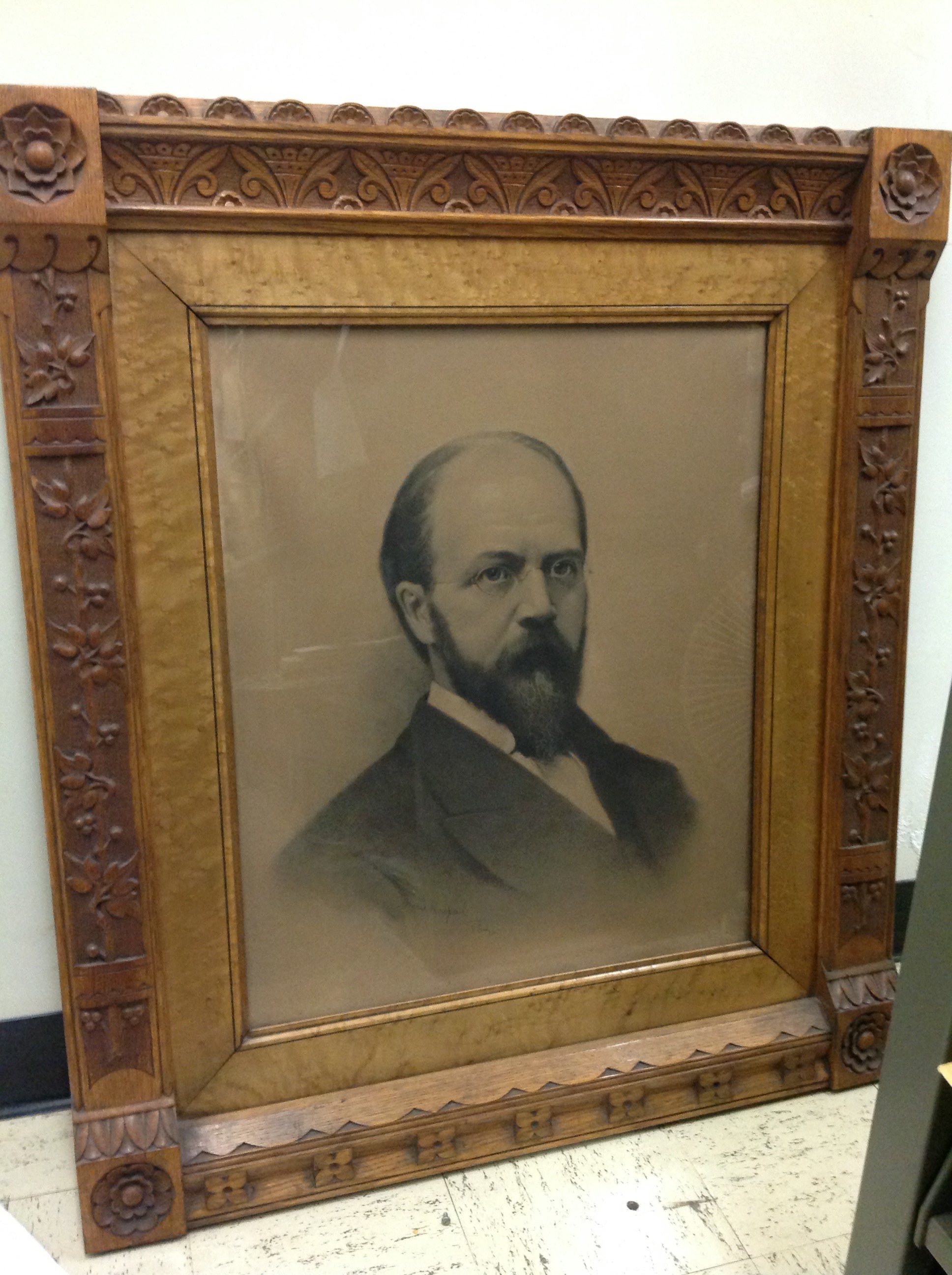
During spring break of 2013 I took Topics in Museum Studies:The Continuing Role of Real Collections, taught by David McCartney with many prominent guest speakers within the museum and library fields. We were given a project to research artifacts within the University of Iowa that had little to no information connected to them so little is known about what they are. I chose a large painted portrait of a man with a wood, ornate frame and held only one clue, the artist’s signature. This mysterious artifact was found in the University of Iowa’s Museum of Natural History’s attic storage cabinet, hidden between large animal hides this spring.

The artist’s name was Marie Koupal, dated 1882. I researched her name and found an article within the Daily Iowan, dating November 19, 1920. It was about a man named Dr. Mark W. Ranney and his cherished book collection that stood in the Ranney Memorial Library at the University. The article concluded with a major clue, “Besides the books there are about twenty pictures on the walls that belong in the collection. Most of these are portraits…A portrait of Dr. Ranney stands on an easel in one corner of the room. This was done in 1882 by Marie Koupal and is framed in a fine hand made frame of several kinds of wood” (Daily Iowan). This was the same portrait, of Dr. Mark W. Ranney. This object’s original purpose had to be a memorial piece done by Koupal, because on January 13, 1882, Dr. Ranney died of acute pneumonia.

Special Collections has information in their collection guide pertaining to the Dr. Mark Ranney papers, with an additional link to a biographical report written by Margaret Schindler Bryant, in Books at Iowa, Issue 30, April 1979, about Dr. Ranney. This report gave me a lot of information regarding Dr. Ranney and his passion for collecting rare books along with other artifacts. Bryant’s report gave great insight to who this man was and why his portrait was originally located in the library during the 1920s, commemorated on an easel. Dr. Ranney’s wife bequeathed his entire collection to the University of Iowa after her death on July 18, 1907. She left a trust that created the “Mark Ranney Memorial Fund”. This established the Mark Ranney Memorial Library that was located in room 305, Schaeffer Hall.

The day before my report and presentation was due, I was searching the Iowa Digital Library within the time frame of 1920-1940. After endless searching for more concrete information, I came across the ultimate completion of this project, a photograph from the digital database of the Mark Ranney Memorial Library with the portrait of Dr. Ranney on the easel in the 1930s. It was truly amazing and reminded me of why I am in this field of work.
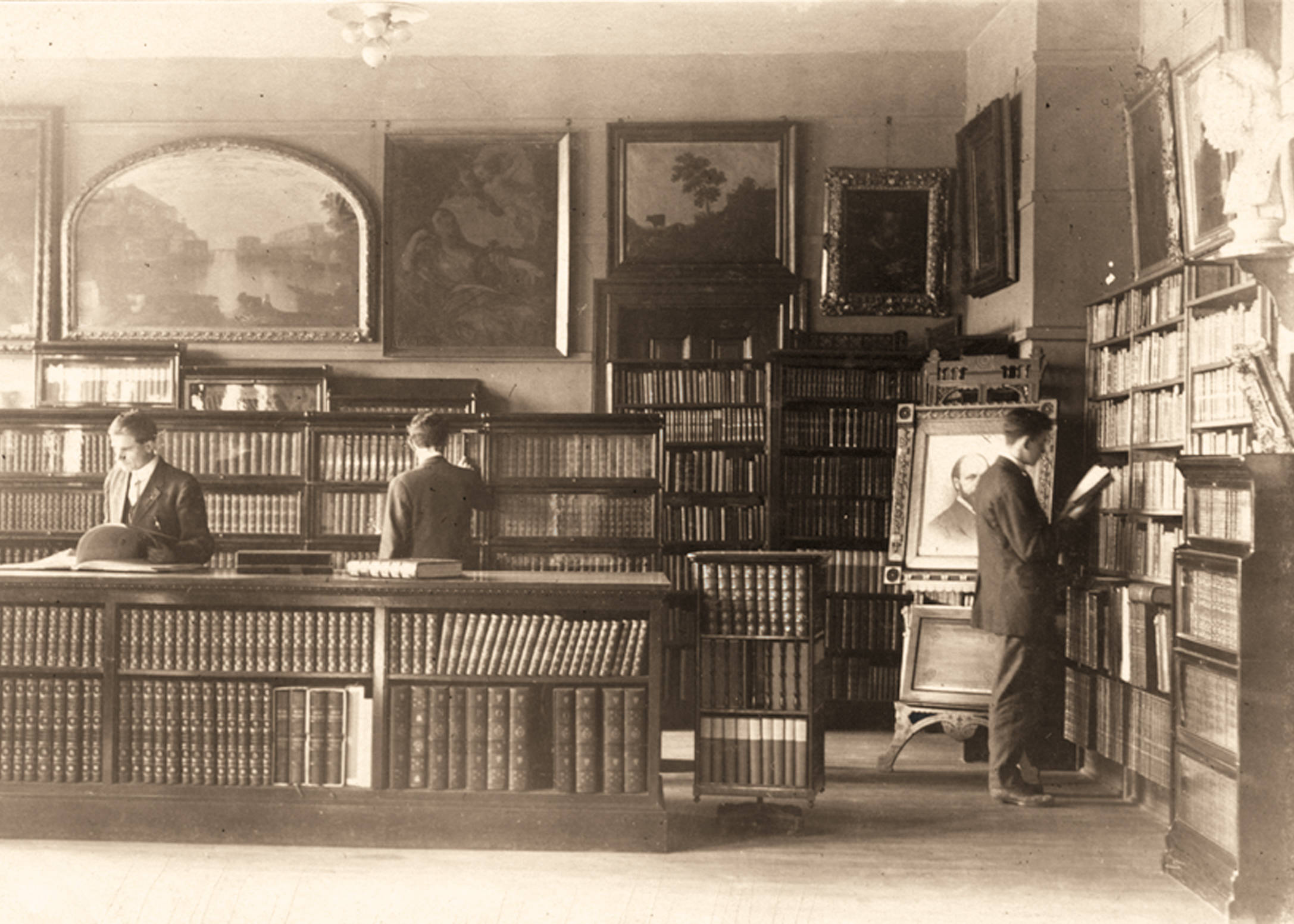
Photograph of Ranney Memorial Library with the portrait visible in the room

Ranney Memorial Library, Schaeffer Hall, University of Iowa, between 1902 and 1907.


The Mystery Portait

Portrait identified as Mr. Ranney

Visit this photograph here

Many thanks to Lindsay Schroeder for identifying this important portrait so it could be reunited with the Ranney Collections in Special Collections!


Join us Thursday, March 20 for a discussion on Mobile Apps and Devices

Want to share your favorite app with the world? Wonder what apps are out there for your work and your personal life?

This is your chance to learn and share, not get technical support.

This session is hands-on and free for UI students and affiliates.

Our next session takes place:

Thursday, March 20 from 3-4 pm

Location: Hardin Library East Information Commons

Sign up here or contact Hardin at (319) 335-9151 or by emailing lib-hardin@uiowa.edu

Image via technology.digital.com

I was sorry to hear you had moved for Mary was building her hopes upon going down to you

Joseph Culver Letter, March 14, 1864, Page 1March 14th Dear Brother

Harry has told you almost everything of importance I was sorry to hear you had moved for Mary was building her hopes upon going down to you again I will write to her this week if possible for I doubt not she is dispirited I wish she would come and spend the summer here Harry has 14 weeks to teach yet in this session if nothing prevents we hope then to spend our vacation at his fathers & relatives I was prevented from going last summer I hope our boy will live & keep well for they all seem so anxious to see him Wes is complaining considerable he fears he is swelling again, Poor fellow! he does not do much at practicing, I wonder how they do keep along as they do. He had bought a horse & buggy & a cow and rented a house & lot for $150 for next year I pity him. Mrs Magary lives next door to us she often talks of the time you boarded there The girls are all married but Mag she is an old maid. Mr. Bowman (our preacher) will board there He has a wife but no children, was he in your class? Good Bye write when you can

In much love your sister
Jennie

Celebrate Pi Day with University Libraries

Do you like Pi?

Pi is celebrated globally on March 14. This date was chosen because it represents the first three digits of Pi (3.14). Pi is a Greek symbol which represents a constant– the ratio of the circumference of a circle to its diameter, or 3.14159. Pi can be calculated beyond a million digits without repeating itself and has no predicable pattern.

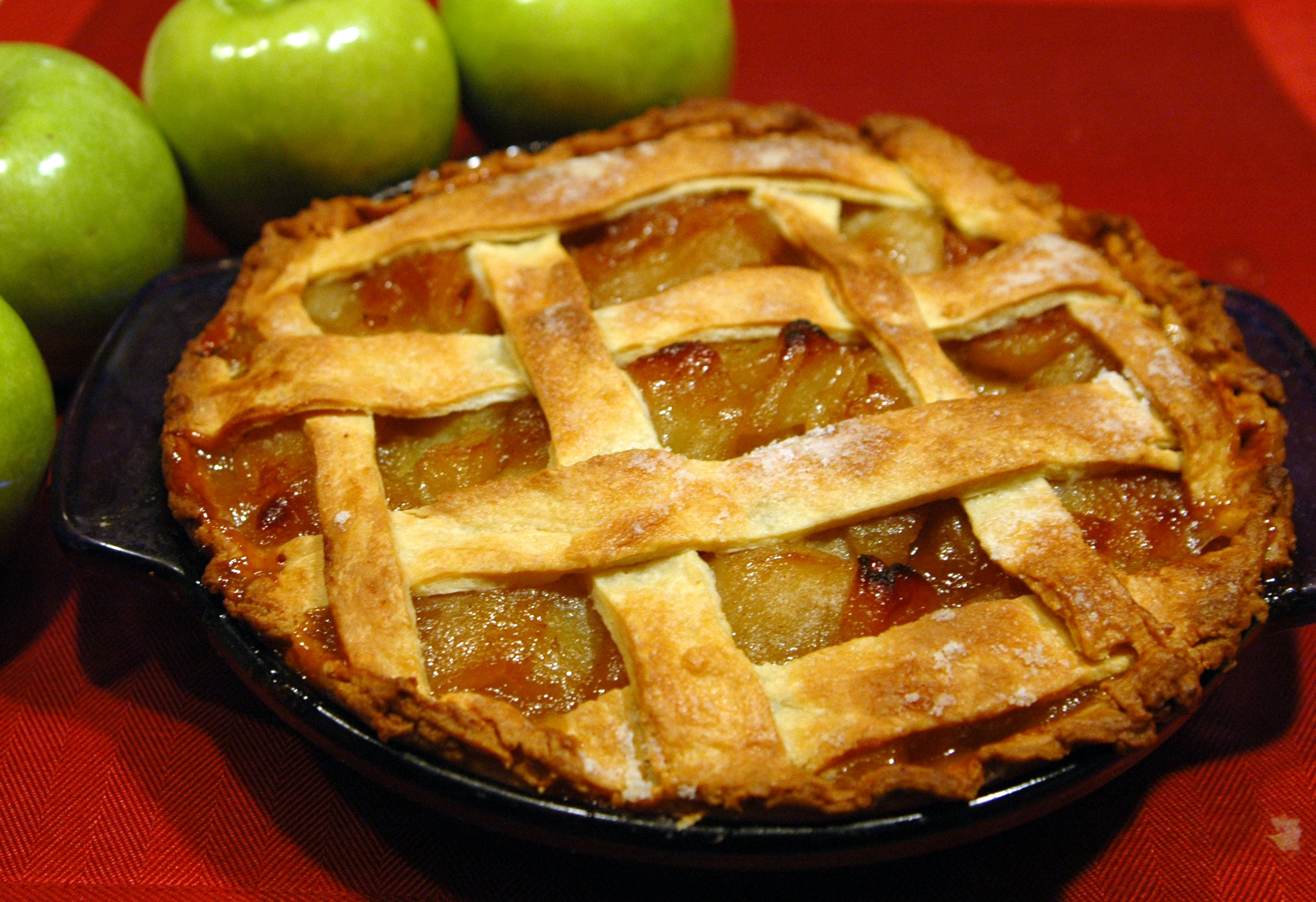
To celebrate Pi and its importance for science and math, Hardin, along with the Main, Art, Business, Engineering, and Sciences Libraries on campus will be handing out free pies along with coffee and lemonade. This event will take place on Friday, March 14 at 10 am. Get yours while supplies last!

To learn more, visit piday.org.


Image via wikipedia.org

Come Celebrate Pi Day 3.14,1:59!

PI

On March 14 at 1:59 pm we gather together to celebrate the most famous and mysterious of numbers.  That Pi is defined as the ratio of the circumference of a circle to its diameter seems simple enough but Pi turns out to be an “irrational number.”  Computer scientists have calculated billions of digits of pi, starting with 3.14159265358979323…, no recognizable pattern emerges in the digits.  Scientists could continue calculating the next digit all the way to infinity and still have no idea which digit might emerge next.  To these facts can be added that March 14 is also Einstein’s birthday.

Pi is a number that has fascinated scholars for 4,000 years.  The mathematical history of pi comes from around the world.  In 1900 B.C., the Babylonians calculated the area of the circle by taking 3 times the square of its radius.  One Babylonian tablet (ca 1900-1680 B.C.) indicates a value of 3.125 for pi, which is a close approximation. Around 1650 B.C., the Rhind Papyrus, a famous document of the Egyptian Middle Kingdom, also calculated the area of a circle which gave the approximate value of 3.1605.


Archimedes

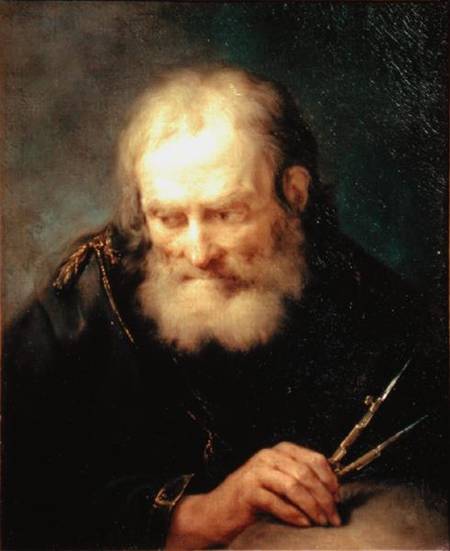
In 250 B.C., the Greek mathematician Archimedes calculated the circumference of a circle to its  diameter.  Archimedes  value , was not only more accurate; it was the first theoretical rather than measured calculations of pi.  Archimedes knew that he had not found the value of pi but only an approximation. He used a fairy simply geometrical approach for his calculations.  See how he did it by launching the interactive model on this pbs.org site: http://www.pbs.org/wgbh/nova/physics/approximating-pi.html


Zu Chongzhi (429-501 AD?) was a Chinese mathematician and astronomer, who was not familiar with Archimedes method. He calculated the value of the ratio of the circumference of a circle to its diameter. Unfortunately, his book has been lost so very little is known of his work.

In 1761, a Swiss mathematician Johann Heinrich Lambert (1782-1777) proved the irrationality of pi.  An irrational number is a number that cannot be made into a fraction where the decimal never ends or repeat sequences.

By 1882, F. Lindeman proved that pi was transcendental, that is, that pi is not the root of any algebraic equation with rational coefficients.  This discovery proved that you can’t “square the circle” which was a problem that vexed many mathematicians up to that time.  Another fascination for mathematicians throughout history was to calculate the digits of pi, but until computers, less than 1,000 digits had been calculated.  With the calculations of the computer, millions of digits have been calculated.

REFERENCES:

Adiran, Y. E. O.  The Pleasures of Pi, e and Other Interesting Numbers.  Singapore: World Scientific Pub., c2006.  Engineering Library QA95 .A2 2006

Alsina, Claudi.  Icons of Mathematics:  An Exploration of Twenty Key Images. Washington, D.C.:  Mathematical Association of America c2011.   http://site.ebrary.com/lib/uiowa/Doc?id=10728529

Beckman, Petr.  The History of Pi. Boulder: Colorado: The Golem Press, 1977.  Main Math Collection QA484 .B4 1977

Chongzhi, Zu.  Encyclopedia Britannica.  Encyclopedia Britannica Online. Encyclopedia Britannica Inc., 2014.  Web, 10 March 2014.    Http://wwwbritannica.com / EBchecked/topic/1073884/Zu-Chongzhi.   Main Reference Collection AE5 .E363 2010

Exploratorium. (2014). Pi Day. Retrieved from http://www.exploratorium.edu/pi/

Gillings, R. Mathematics in the Time of the Pharaohs. Boston, MA: MIT Press, 89-103, 1972.  Main Math Collection QA27.E3 G52 

Gardner, Milo. “Rhind Papyrus.” From MathWorld–A Wolfram Web Resource, created by Eric W. Weisstein. http://mathworld.wolfram.com/RhindPapyrus.html

A facsimile of this papyrus can also be found at the
Main Oversize FOLIO PJ1681 R5 1927
Main Math Collection FOLIO PJ1681 R5 1927

Hobson, Ernest William.  Squaring the Circle and Other Monographs. New York: Chelsea, 1953.  Main Math Collection QA467 .H62 1953 

KHANACADEMY. (2014). A Song About A Circle Constant. Retrieved from https://www.khanacademy.org/math/recreational-math/vi-hart/pi-tau/v/a-song-about-a-circle-constant

Libeskind, Shlomo.  Euclidean and Transformational Geometry: A Deductive Inquiry. Sudbury, Mass.:  Jones and Bartlett Publishers, c 2008. Engineering Library QA453 .L53 2008 

Mackenzie, D. “Fractions to Make an Egyptian Scribe Blanch.” Science 278, 224, 1997.

McCall, Martin W.  Classical Mechanics:  From Newton to Einstein: A Modern Introduction.  Hoboken, NJ: Wiley, 2010.  Engineering Library QC125.2 .M385 2011 

Robins, G. and Shute, C. The Rhind Mathematical Papyrus: An Ancient Egyptian Text. New York: Dover, 1990. Main Math Collection QA30.3 .R63 1987 

Weingardt, Richard.  Circles in The Sky:  The Life and Times of George Ferris.  Reston, VA,: American Society of Civil Engineers, C.2009.  Engineering Library TA140.F455 W45 2009


Is Chocolate A Food? A Problem In PubMed

By Eric Rumsey and Janna Lawrence

[Check out additional articles on PubMed & Plant-Based Foods]

As we’ve written, searching for food-related subjects in PubMed is difficult because of the way the MeSH system is organized. Plant-based foods are especially difficult because in most cases they are treated mainly as plants rather than food.

One result of treating plant-based foods as plants is that the MeSH term is usually the botanical plant name; in the case of chocolate it’s Cacao. This is usually not a serious problem when searching for specific substances because the common food name maps to the botanical MeSH term.

A more serious consequence of treating plant-based foods as plants instead of foods is that they are usually not in any food-related explosion, but only in the Plants explosion. So the only occurrence of chocolate (Cacao) is here:

Plants
   Angiosperms
      Sterculiaceae
         Cacao

The reason this is a problem is because articles on chocolate/Cacao will not be retrieved in a search for Food. So, for example, if you do a general search for food-related causes of migraine, you will not retrieve this article:

Chocolate is a migraine-provoking agent
Journal: Cephalalgia
http://www.ncbi.nlm.nih.gov/pubmed/1860135

This is not retrieved by searching for food because Cacao is not in the Food explosion. More broadly, however, it’s also not retrieved with the comprehensive Food-Diet-Nutrition hedge that we’ve discussed previously, which includes text-words as well MeSH terms and explosions.

Here are several other articles on health and medical aspects of chocolate that are not retrieved by our broad Food-Diet-Nutrition hedge:

If chocolate were the only case of a plant-based food that is not retrieved in a broad PubMed search for food-related topics, it would be a trivial matter. But that’s far from being the case. There are many plant-based foods that have the same problem in PubMed. We will be writing on several of these foods in the next few months, so keep an eye on this space!


Workshop: Scopus

Have you tried Scopus, our new database? The UI Libraries provide free access to Scopus, an excellent multidisciplinary citation database. Join us for a Scopus Workshop and learn advanced techniques that will help you conduct your research more efficiently and effectively.

In this workshop you will learn how to:

  • Access Scopus from off-campus;
  • Use refine options to retrieve more relevant search results;
  • Create reports to analyze your results;
  • Save citations from Scopus to RefWorks, EndNote and other citation managers;
  • Save searches and set up alerts to keep up with the literature in your field;
  • Find the full-text of citations retrieved in Scopus;
  • Get help when you need it!

This workshop is free and open to all UI students, faculty and staff. There is no need to register. You may bring your lunch if desired. Free coffee will be provided. If you have any questions, please contact Sara Scheib at sara-scheib@uiowa.edu or (319) 335-3024.

Date: Wednesday, March 26, 2014
Time: 12:30pm –  1:20pm
Location: Sciences Library Classroom (102SL)
Branch: Sciences
Presenter: Sara Scheib
Categories: Workshop

Medical & Nursing Journals – A Twitter List

By Sarah Andrews and Eric Rumsey

Many medical and nursing journals now use Twitter. On their Twitter sites, they share links to journal articles and sometimes other news items in the field. We have made a Twitter list with 116 of these journal sites:

https://twitter.com/HardinLib/lists/journals

The base of our list is the National Library of Medicine’s list of Core Clinical journals. There are 119 titles in that list, and we were able to find Twitter feeds for about 75 of them. The other Twitter sites on our list we found in Laika Spoetnik’s Twitter journal list and from Googling likely word combinations.

Not all tweets are for journal articles. The proportion of tweets that are journal articles, as opposed to other news items, varies in different journal feeds.