Skip to content
Skip to main content

Indigenous Peoples: North America – Trial ended 6 May 2014

Indigenous Peoples: North America provides users with a diverse, informative source that will enhance research and increase understanding of the historical experiences, cultural traditions and innovations, and political status of Indigenous Peoples in the United States and Canada through the use of manuscripts, monographs, newspapers, photographs, motion pictures, images of artwork, and more.

Please send additional comments to Rachel Carreon.

PubMed: Going Beyond the Basics

PubMed is the National Library of Medicine’s index to medical literature and includes over 22 million bibliographic citations in life sciences. This one-hour session will show you how to improve your search results by using subject headings (MeSH) and advanced keyword searching techniques.

This session is hands-on and free for UI students and affiliates. There will be time for questions at the end.

Our next session is:

Tuesday, March 25 from 9-10 am

Location: Hardin Library for the Health Sciences (EAST Information Commons classroom)

Register today or check out our quick tutorial for the basics on PubMed.

Need help? Contact us at lib-hardin@uiowa.edu or by calling (319) 335-9151.

In fulfillment of my promise made this morning, I should set down to write

Joseph Culver Letter, March 20, 1864, Letter 2, Page 1

Head Quarters, 1st Brig., 1st Div., 11th A.C.
Lookout Valley, Sunday Evening 11 o’clock
March 20th 1864
Dear Mary

In fulfillment of my promise made this morning, I should set down to write, and, were that the only incentive, I might send an apology and go to bed. But I wish to talk with you, & then I think I shall be ready for Sleep.

I did not write all the letters to-day I intended. After writing to you, which occupied my time till dinner, I wrote a long letter to my mother, which, with the little business I had to transact, occupied my time until 3 o’clock, when Col. Harrison came into the office and invited me to ride with him to Corps Hd. Qurs. to attend services there. I accepted, of course. We heard a very profitable sermon by the Chaplain of the 33rd Massachusetts Regt. from this text, “If a man die, shall he live again?”1 There was no singing, but one of the Regtl. Bands was present which played three very beautiful hymns. The ride was very pleasant.

Chris [Yetter] was here this afternoon. He brought over a letter which he wishes me to enclose.

In your letter recd. to-day, you remarked that Capt. Hoskins [is] looking very well. I think you were aware that he had stopped drinking. I hope he has not indulged since he got home. I intended to write to him to-day, & I may possibly enclose a short note to him in this letter.

It is quite cold out, but my fire is burning very cheerfully. If you only were here, so that I could look into your eyes & see them sparkle with love as they always do, & have your head on my shoulder, I believe I should be supremely happy. But as that cannot be to-night, I will trust in God for a happy reunion as soon as He in his good Providence sees fit. I shall look for a long letter to-morrow.

Chris [Yetter], Nate [Hill], and several of the boys were on Lookout Mountain to-day. They all give a glowing account of the sights to be seen.

I did not get Sister Beccie’s letter answered, and, as I wish to answer it at length, I will not send it for a day or two. I am really ashamed to send it to you, for it is so very strongly tinctured with disloyalty that you may lose all respect for the writer.2

A young man by the name of Small from Grundy County called on me to-day & said that James Murphy, a cousin of my wife’s, wished me to call & see him when I went to Chattanooga.3 I sent him word that my business was such that I could see no probability of my getting there, but I would be pleased to see him at my office. I could not think who he was, but it occurred to me just now that it must be the same James Murphy, through whom W. J. Murphy passed his property. If he is, I am not very anxious to make his acquaintance. It may be a son of his, however, & I will let you know when I find out.

I have heard nothing of [Pvt.] Sammy [Murphy] yet. If he has not started [from Springfield] yet, you can tell him that our Head Qurs. are on the right hand side of the Rail Road at Wauhatchie Station on his way coming down.

I must close & write a short note to Hoskins. If he is gone, you can retain or destroy it. You are also at liberty to read it. Give my love to all the family. Tell Mother [Murphy] I expect her to take good care of my WIFE. Kiss her for me. Remember me kindly to all our friends. May our Heavenly Father bless & keep you. I shall continue to pray for my loving wife. Live close to God, and may you ever be happy.

Tell me how your health is. Have you still those pains in your hip? I think you should advise with Dr. Capron.4 Perhaps he can cure it, & I fear sometimes that they are not caused only by your condition. Do not let any disease run too long before applying a remedy.

Good night, May Angels guard thee,
Your Affect. Husband
J. F. Culver

  1. The chaplain of the 33d Massachusetts at this time was Isaac S. Cushman. Compiled Service Records of Union Soldiers, NA.
  2. Sister Rebecca Pague, like Sister Lizzie Zug and Brother Charlie Culver, was opposed to the Emancipation Proclamation and the premise that all men are free and equal.
  3. James Murphy, a son of William and Ann Courtney Murphy, was born in 1824 near Belfast, and emigrated to America with his parents in 1835. The family settled near Utica, New York, where James learned the carpenter’s trade. In 1850 James, having married, moved west and settled on a farm in Grundy County, Illinois. W. J. Murphy was James’ older brother. Culver, “Robert Murphy and Some of his Descendants,” pp. 71-72.
  4. E. W. Capron was a 37-year-old Pontiac physician. A native of New York, Dr. Capron in 1860 valued his personal estate at $600, and owned no real estate. Eighth Census, Livingston County, State of Illinois, NA.

Web-based Citation Management with EndNote Basic

EndNote Basic is a web-based citation management software that is freely available to all UI affiliates. It allows you to import, organize and format citations for papers, articles, etc. EndNote Basic is not the same as EndNote Desktop software.

This session is hands-on and free for UI students and affiliates. There will be time for questions at the end.

Our next session is:

Monday, March 24 from 2-3 pm

Location: Hardin Library for the Health Sciences (EAST Information Commons Classroom)

To register, click here. For more on EndNote Basic, see our quick and easy tutorial.

Questions? Email us at lib-hardin@uiowa.edu or call (319) 335-9151.

EndNote is available in several formats. [Image via endnote.com]

Spring musings

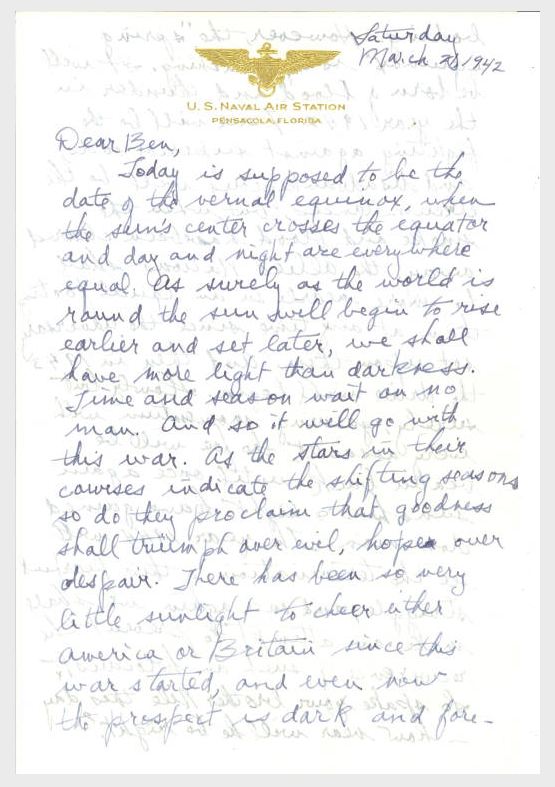
Today is the vernal equinox – the first day of spring.  72 years ago, Nile Kinnick reflected on its meaning from the U.S. Naval Air Station in Pensacola, Florida.  His words about the trajectory of the ongoing war are startlingly prescient, before turning his thoughts to springtime at home.  Thanks to DRP’s Wendy Robertson for finding this letter today, and to the DIYHistory participant/s who transcribed it.

Nile Kinnick letter to his brother, Ben, March 21, 1942

Nile Kinnick letter to his brother, Ben, March 21, 1942

“…today is supposed to be the date of the vernal equinox, when the sun’s center crosses the equator and day and night are everywhere equal. As surely as the world is round the sun will begin to rise earlier and set later, we shall have more light than darkness. Time and season wait on no man. And so it will go with this war. As the stars in their courses indicate the shifting seasons so do they proclaim that goodness shall triumph over evil, hope over despair. There has been so very little sunlight to cheer either America or Britain since the war started, and even now the prospect is dark and foreboding. However, the “spring equinox” is approaching. It will be born of blood and thunder in the year 1942. Fierce will be the fighting against superior odds, and disadvantageous will be the circumstances, but when the smoke and blood have been cleared away, the Allied Nations shall be more nearly on an equal footing than at any time since the adversary set upon them. And then in 1943 the drive will begin. Slowly but surely, gaining momentum with every assault, the foe will be beaten back until once again sunshine & light have gained dominion. The year 1944 will see the termination of this fearful struggle, and once again we shall make an attempt to prevent the recurrence of such an holocaust.”

“But enough of figurative speculation, and on to lighter things. Spring in the midwest, oh, that is a glorious season! Soon the countryside will be green and fresh, the heavy hand of winter will be shaken off – and, yes, the grass will be a grab and a half high, and picnics will displace the afternoon schedule.”

*******************

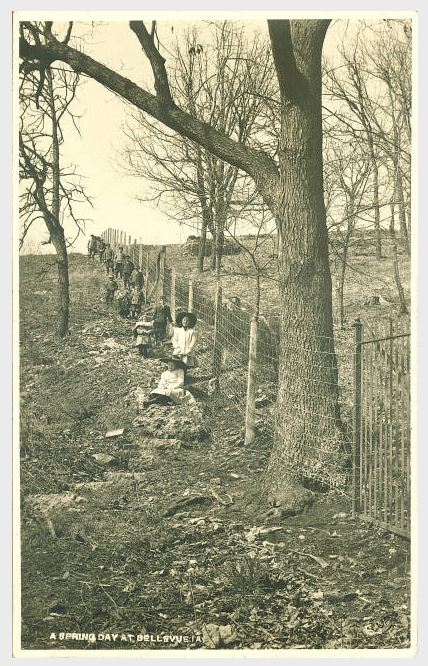
This year, spring looks about as colorful as this photo, A spring day at Bellevue IA, 1910s, from the Mary Noble Photograph collection.  Click the photo and zoom in, and you’ll still see some smiling faces.  Both the Noble and Kinnick collections are part of the Iowa Digital Library.

"A spring day at Bellevue IA," 1910s

“A spring day at Bellevue IA,” 1910s


I have sat down this morning to answer your letters which have accumulated

Joseph Culver Letter, March 20, 1864, Page 1

Head Quarters, 1st Brigade, 1st Division, 11th Army Corps
Lookout Valley, March 20th 1864
My Dear Wife

I have sat down this morning to answer your letters which have accumulated since we left Nashville. I may have answered some of them, but do not now recollect which. Yours of the 12th inst., one enclosing Bro. Tom’s [Thomas Murphy’s] letter, came to hand yesterday.1

I am very glad to hear that you are well and trying to enjoy life. Capt. Hoskins has reached home. I sent you a letter by him from Cowan or Bridgeport which you do not mention. I suppose that Mrs. Folks went home when her husband was sent to the Hospital. She was not allowed to go with him, & he was full two miles from where she was stopping. I presume also that they had not the means of living when no rations were furnished.

I am not much surprised at Mrs. Smith’s statements, for I think [Lt. John W.] Smith was always of that opinion. I cannot tell how he is getting along, except as remarks are made by the boys [of Company A], from which I judge that things do not move very pleasantly. I never go near him.2 I sent your letter to Chris [Yetter] yesterday evening by Alf. [Huetson].

I do not know what is going on in the Regt. in regard to the vacancy occasioned by [Lt. Col.] Cropsey’s resignation. I have been far too busy here to think much about it. It is my impression, however, that Hoskins will be made Major, in which event I shall get the Captaincy of the Company.

Bro. Gaff recd. a letter from his wife on Friday.3 He was very much alarmed, as he had not heard from her for a month. I do not understand why Jim Morrow & Harry McDowell should act so shabbily; I will call them to an account when they return. I will send Bro. Thomas’ Letter to Johnie tomorrow.

In several of your letters you speak of having headache, from which I judge that it is a very constant companion. Cannot you get something to relieve you? You say you have not collected anything of Fleming yet. I want the matter attended to immediately. If not soon collected, you will never get it. You can learn through Remick the amount. I understand his [Fleming’s] business is assuming a rather doubtful shape. Employ an attorney if necessary.4

I cannot tell what to do for Lawrence; ask Thomas Hill to arrange matters as well as he can.5 As there is no prospect of pay here, I dare not spare the little money I have on hand. You can say to Thomas Hill that if he has no use for the money sent him by Tom Smith, Joe Shellenbarger, and Chris [Yetter], I can borrow it; or, if he prefers, he can use it in lifting my notes & waiting awhile. Do the best you can.

I am doing what I never done before. I am compelled to burn your letters, as I have no way to take care of them. My desk is a public one & open to every one, & my valise is too small for my clothing. I am reading them & then consigning them to the flames. It seems almost Sacrilegious; 11 are already gone. I wrote to you some time ago to get the amount of the order on Lyons; it will be safer to do so. I have just finished reading and destroying your letters. There was 27 in all. I wonder whether your list is as large. The train has just come in, & I expect a couple of letters. The mails have been very irregular last week caused by the raid on the road at Estell Springs. The weather is very fine to-day. We had a general Review and Inspection at Genl. Howard’s Hd. Qurs. yesterday.6 The Brigade looked very fine & was as large as the 2nd Division of this Corps.7

I intended to go to church this morning, but my clerk wished to go to Lookout Point; &, as he has been very faithful, I preferred to let him go. I shall try & get out to preaching this evening.

A few days ago an artist, who has a gallery on the top of Lookout [Point], was fixing something on the edge of the cliff, was approached by some ladies and in attempting to bow to them, he lost his balance, went over, and was instantly killed. His gallantry cost him his life.

Adgt. Mitchell, it is said, will not be able for duty for two months. I am now Acting A. A. Genl. of the Brigade & will be until his return.

Here is the mail: two letters for me, one from you, and one from Carlisle. Your letter is dated Mch. 13th but mailed Mch. 14th; it notices the death of Jay Pratt.8 I am sorry to hear of Mrs. Capron’s danger.9 You say nothing of your own health. The other letter is from Jennie & Harry [Cheston]. All are well.

I intended to look over Beccie’s letter and send it, but I have been all forenoon reading your letters & now it is nearly mail time. I will answer some this afternoon & send them to you to-morrow.

Some one sent me the “Ledger” from Nashville yesterday of Mch. 8th. I think it was [Pvt.] Joe Allen. Alf Huetson is now on duty at these Hd. Qurs. as Top. Engineer, & is recommended for appointment and also for a Commission. The latter may be a long time getting around. He is much pleased with his prospects.

I have not seen either Chris [Yetter] or Nate [Hill] to-day. All the Camps are fixed up very comfortably. I have not heard from Bro. Johnie yet. I will try & write to him again soon.

Capt. Hoskins will be returning soon. Send me a few pounds of fine cut chewing tobacco by him if convenient. I will try & write this evening for to-morrow’s mail. May God bless you, my Dear Wife, & keep you in health and strength. Give my love to all the family & Remember me kindly to all our friends.

Your Affect. Husband
J. F. Culver

  1. Mary Culver’s letter of March 12 is missing from the Culver Collection.
  2. J.F.C. and Lieutenant Smith had had a disagreement and were no longer close friends. With Captain Hoskins on leave and J.F.C. on staff duty, Lieutenant Smith commanded Company A.
  3. James H. Gaff of Pontiac was a sergeant in Company G, 129th Illinois Infantry. Compiled Service Records of Union Soldiers, NA.
  4. It has been impossible to determine how Fleming made his living.
  5. Thomas Hill was a wealthy Livingston County farmer. See J.F.C.’s letter to his wife of Feb. 21, 1864, for additional details concerning this transaction.
  6. Private Grunert reported that at 8 A.M., on the 19th, the brigade was assembled and marched to the parade ground two miles away, “where the regiments were posted according to their number, and had to await the arrival of the commanding General. At the appointed hour some cannon shots announced the arrival of Major Generals Hooker and Howard, who, after having passed along the front and rear of the column, took their places, and the column moved forward, delighted by the excellent music of the 33d Massachusetts regiment. The parade went off fine, and both Generals seemed well pleased with the maneuvers of the brigade.” Grunert, History of the 129th Illinois, p. 48.
  7. The Second Division, XI Corps, commanded by Brig. Gen. Adolph von Steinwehr, numbered 2,726 present for duty on March 31, 1864. O. R., Ser. I, Vol. XXXII, pt. III, p. 207.
  8. Andrew J. Pratt had been a 24-year-old Pontiac livery stable operator. In 1860 he was living with his wife and three children, and valued his real estate at $600 and his personal estate at $800. Eighth Census, Livingston County, State of Illinois, NA.
  9. Mary F. Capron was the 36-year-old wife of Pontiac physician E. W. Capron. Ibid.

PBS Video Collection – Trial ended 17 April 2014

The PBS Video Collection assembles hundreds of the greatest documentary films and series from the history of PBS into one convenient online interface.The diverse subject matter of the included films makes this an important collection for the study of history, science, business, technology, performing arts, anthropology, psychology, politics, health, and literature.

Please send additional comments to Lisa Martincik.

New milestonetemp for DIY History: 40,000 pages transcribed!

Iowa Byington Reed diaries

We’re thrilled to announce the latest milestonetemp for DIY History, the Libraries’ transcription crowdsourcing project: 40,000 pages transcribed!

To mark the occasion, we’re featuring our most prolific diarist — Iowa Byington Reed, an Iowa City native who wrote in her diary nearly every day from 1872 to 1936 — along with one of our most industrious volunteers, David Davenport of Fresno, California. In most crowdsourcing initiatives, a small minority of “power users” does a large majority of the work, and DIY History is no exception. David, a retired history professor, explains how he first started working with the Byington diaries:

I “joined” your project with the expectation that I would do only Civil War related materials, but those had been done, and since my family has lived in Iowa since territorial days (my g-g-grandfather James Blake Gray is responsible for naming Burlington — it was called Flint Hills when he and his brother in law Thomas Stephens operated a trading post there in the very early 1830s) I decided to try the Reed material because my mother grew up on a farm near Centerville. I figured I would learn a bit about what life was like for her mother and her mother’s mother. I have not been disappointed. Iowa Reed engaged in the same rather “mundane” activities for well over 50 years, and faithfully recorded her life for almost every day during the span of her diaries…

I really don’t think we appreciate in 2014 how very different “the work” was 125 years ago — washing that took 4-5 hours every Monday morning, followed by ironing, sometimes drying the clothes in the garret (which my mother tells me was the term for the unfinished portions of the attic) accessible with a folding ladder in the ceiling of the upstairs hallway, etc. But in some ways their lives were so similar to ours — Iowa’s record of her brother Robbie’s death, or the death in 1886 of the two day old son of Ott and Fanny (or was it Charlie and Ida? — I can’t recall right now), or the sudden and completely unexpected death of Charlie in mid-October 1895 that I just saw a few minutes ago. I was transcribing her entry for November 14 1895 and she wrote “it was three weeks ago today that Charlie died” so I had to look back to find out what happened. I’m not a medical doctor but it seemed that he had a mild heart attack that was undiagnosed a couple of days earlier and then a massive heart attack while changing clothes – he was gone in an instant.

I really wish I was still teaching history because I can see assigning student the “task” of reading her diaries, cover to cover. Most students today could learn far more from what Iowa wrote about herself and those around her than I could ever hope to “teach” in a more conventional lecture. She has given voice to hundreds of thousands of women who lived as she did, from day to day, doing “the work” and often “so tired” she “went to bed early.”

A heartfelt thank you goes out to David and everyone else who has contributed their time and efforts in support of our mission to make historic documents more accessible. There’s still plenty more work to be done — please visit the Iowa Women’s Lives collection to transcribe Iowa Byington Reed’s diaries, or stop by the DIY History home page to select other materials, including historic cookbooks and pioneer-era documents.

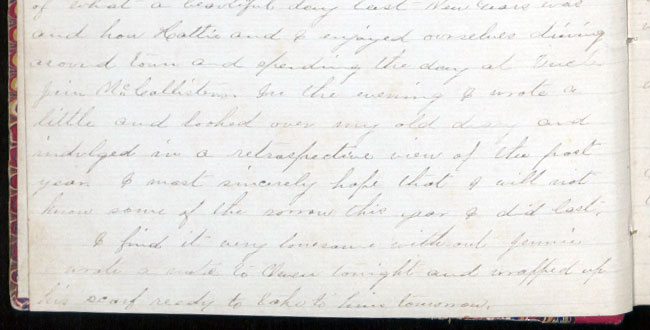
Iowa Byington Reed diary, 1875

…In the evening I wrote a little and looked over my old diary and indulged in a retrospective view of the past year. I most sincerely hope that I will not know some of the sorrow this year I did last… | Iowa Byington Reed diary, January 1, 1875

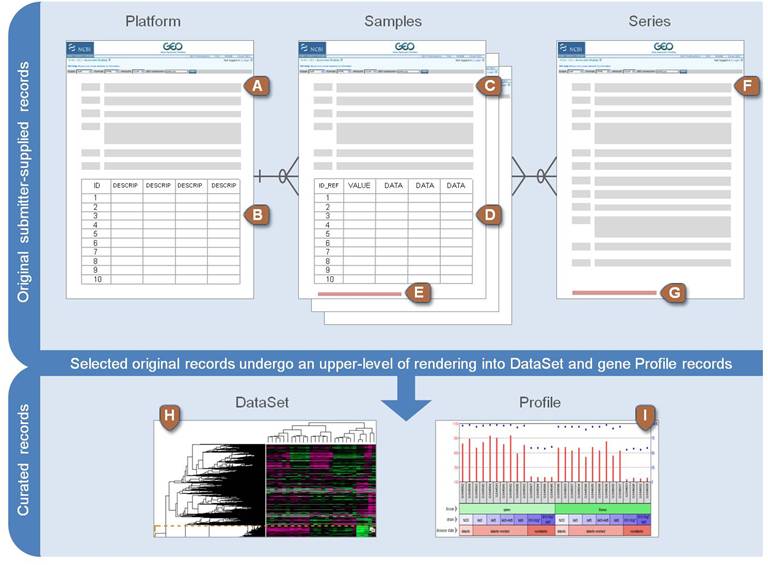
Research Gene Expression, Functional Genomics, and More with our Gene Expression Databases Workshop

This session provides an overview of the National Center for Biotechnology Information (NCBI) databases that contain information on gene expressions. Learn how to search for homologous gene sets for selected organisms, clusters of expressed transcripts, gene expression and molecular abundance profiles, functional genomics studies and epigenomic studies and display tools.

Our next session is:

Tuesday, March 18, 9-10 am

Location: Hardin Library East Information Commons

Register here. Contact us at 335-9151 or lib-hardin@uiowa.edu

For one-on-one instruction, see a librarian liaison.


Image via: www.ncbi.nlm.nih.gov

I am very happy to learn that your “health is pretty good”

Joseph Culver Letter, March 17, 1864, Page 1

Head Quarters, 1st Brigade, 1st Division, 11th Army Corps
Lookout Vallie, March 17th 1864
My Dear Wife

Yours of the 11th inst. came to hand to-night.1 I am very happy to learn that your “health is pretty good,” which I suppose to mean that it is as well as could be expected under existing circumstances.

The weather here has been very cold for the past three days. The first day [the 15th] it was spitting snow, blowing and freezing, & I thought it would not last over one day, but next morning (yesterday) it was still freezing and much colder than the day before so that I had to suspend work & fix up a place to write in. I procured some timbers and built a house about 3-1/2 feet high, & set my tent on top. I have a fireplace in it, & by noon to-day I commenced operations again. This will account for my not writing for the last three days.

I am quite comfortably situated now, and though it is ten o’clock and all the Staff have gone to bed, I have set down to chat with you. I know there is a great deal in the letters I have on hand that remains unanswered, yet the number is so great that were I to undertake to overlook them to-night, I would have no time left to write. So I will promise to attend to every one of them soon, and ask your indulgence for this one time more. I have besides a host of other letters, all unanswered. You wished to know why I have not sent Sister Beccie’s [letter],2 & I am almost ashamed to tell you that aside from a very hasty glance when it came to hand amid the rain & cold at Tullahoma, I have neither read or seen it. I know you would pardon me if you knew how busy I have been. You know how well I love to be busy, and my health was never better than now, for which I feel very thankful.

The fire on the hearth looks so cheerful that I can almost imagine you present here. You will feel a great disappointment in my not getting home, but God orders all things for the best. Let me caution you against any disposition to fret or allow anything to bear heavily upon your mind. Be cheerful and, if possible, make yourself happy. Despondency, aside from affecting your own person seriously, may possibly live after you, & I feel anxious for you also on that account. You give me assurance, however, that you are happy, & I earnestly hope you will use every means to secure it. May God bless you. I shall try to pray for myself & you, as you request, & shall feel happy in the knowledge of the aid of your prayers. Bro. Johnie in his last letter wished to know how I was getting along spiritually.3 I have only had time to send him a few lines in answer as yet, telling him where I was. I have never heard from Lt. Donaldson yet.

All your friends here are well. Alf Huetson has been recommended for appointments as Topographical Engineer of this Brigade, & he will without doubt be appointed and I think before long get a commission. I do not yet know what his rank will be; I have not been around any yet. I can see the Camp of the 129th from here, and it looks very fine. The boys are all still busy fixing up.4 To-morrow we will have a Brigade Inspection & Review, and on Saturday we will be Inspected & Reviewed by Maj. Genl. Howard. Everybody is anxious to have it come off well, as most of the troops here think us “green,” “conscripts,” &c.5 I feel assured, however, that we will make a good impression. Our Brigade is larger than any Division I have seen yet.6

We hear no news from the front, except what we see in the Louisville and Nashville papers. One of the trains was captured and burnt yesterday near Estill Springs, & the train did not come in till this evening.7 We have not learned the particulars yet.

The Chicago Tribune has not come to hand yet. I shall be glad to get it. And now I must close; I do not think I can answer your letters before Sunday or Monday, but I will try.

Mitchell is so badly injured that I do not know when to expect him back. Give my love to all the family. Remember me kindly to Lou [Allen]. I am glad she is getting well so rapidly. Also remember me to all our friends. Good night my Love, good night, & may holy angels guard you.

Your Affect. Husband
J. F. Culver
  1. Mary Culver’s letter of March 11 is missing from the Culver Collection.
  2. Sister Rebecca Culver was married to S. Augustus Pague, and they lived on the family farm in northern Cumberland County.
  3. Sergt. John Murphy, on February 19, had written, “How is it with your soul, Frank? Are you prospering spiritually? I am not doing very well now. The circumstances with which I am surrounded are very untoward.” W. J. Murphy to J.F.C., Feb. 19, 1864, Culver Collection.
  4. Private Grunert noted in his diary on the 12th that the soldiers were chopping wood for huts and shebangs, while on the 20th, Private Dunham wrote, “We have got settled down again but don’t know how long we will stay, so we have got tip top houses maid. Four in a house.” Grunert, History of the 129th Illinois, p. 48; Through the South with a Union Soldier, p. 109.
  5. Unlike the regiments of Harrison’s brigade, most of the units constituting the XI and XII Corps had participated in a number of battles, including Lookout Mountain, Wauhatchie, Gettysburg, Chancellorsville, Fredericksburg, etc.
  6. General Ward’s two-brigade division numbered almost as many effectives as the other two XI Corps divisions combined. O. R., Ser. I, Vol. XXXII, pt. III, p. 207.
  7. On March 16, near Estill Springs, a southbound train was derailed by Confederate partisans led by Col. John M. Hughs. Before being driven off by a detachment of the 123d New York, the partisans burned three cars, robbed the passengers, and killed several non-combatants. O. R., Ser. I, Vol. XXXII, pt. I, pp. 56, 499-501.