Skip to content
Skip to main content

Xpress Class Wednesday April 2nd–Endnote Basic

April 2nd – Endnote Basic (30 minutes) 

Introduction to an online citation management system that is free for everyone at the University of Iowa. This is replacing RefWorks which the University will no long be supporting as of December 2014.   Endnote helps you to manage all your references for a paper (or many papers) as well as create the incite citations and bibliographies in a wide variety of formatting styles.  Taught by Steve Ostrem (Reference and Instruction Librarian, Main Library) The web version of Endnote Basic will be taught not the full client version!

We are very sorry to hear of my brothers sickness, but hope to hear soon of his recovery

Joseph Culver Letter, March 31, 1864, Page 1Covington March 31st 1864.
Lieut. J.F. Culver.
Dear Sir.

We recd. your kind letters this evening little suspecting what the contents was. They was dated respectfuly 24th, 26th & 27th. also two from Lieut. Smith dated 25th & 27th. We are very sorry to hear of my brothers sickness, but hope to hear soon of his recovery. How thankful we are that he has friends there to take care of him. Oh! that he was near that we might take care of him. But God wills it otherwise and we must submit. You say he may get well, if he does get better we would like so much to have him brought home. Can you? will you? do all in your power to have him get a furlough? One of our neighbor boys of the 61st O.V.I. had the same disease and was brought home and is now almost recovered his former health. I think if he could but be at home he would recover……. When Joe left home my Mother told him she was afraid he could not stand the long, hard marches. He said he did not expect to come home as he left it, (if he ever did get home.) Joe. has always been a good boy at home and as far as I can hear, evry place else he went.

He was my only play mate when we were small. I being almost three years younger than him. It is hard but I will try to say “Thy will not mine Oh! Lord be done.” Please write evry day and let us know how Joe. is getting. We will be so anxious to hear. See that he has evry thing that is necessary to make him comfortable cost what it will. if you can get it. Joe has money here on interest that we can get at any time. Get things and pay for them and send us the bill and we will pay you back. I think [Sephus?] Ullery will do the best he can. When my brother is able to talk talk to him. He is unconverted. Oh! that he were a Christian. Please ask him (if he is no better) if he would sooner be sent home if he should die. It is Mothers wish that he should. We still hope for the best. I will close.

Take good care of him and God will bless you. A mothers blessings and sisters prayers will go with you. Pray for us that we may be able to bear the worst. Pleas pardon this broken letter, for I hardly know what I’m writing.

I am as ever,
Joe’s Sister
Delia A. Shellenbarger.

Please read this other letter to Joe if he is not able to read it himself and oblige
Delia.

It was my intention to write you a long letter last night, but my tent smoked so that I could not keep a fire

Joseph Culver Letter, March 30, 1864, Page 1

Head Quarters, 1st Brigade, 1st Division, 11th Army Corps
Wauhatchie, Tenn., March 30th 1864
My Dear Wife

Your letter of the 22nd inst. came to hand this morning.1 It was my intention to write you a long letter last night, but my tent smoked so that I could not keep a fire in it. I went in the early part of the evening to see Joe Shellenbarger; I found him getting better.2 He is so much better this morning that I feel confident of his recovery. Afterward I went to see Capt. Hoskins & had a long talk with him about the sights he saw at Pontiac.

When I got back to my Quarters it was midnight & several papers awaiting me, so I went to bed without writing. We will be so very busy for the next week that I cannot promise you any very lengthy letters. I feel provoked that I did not write for some things that I need very much and have no opportunity of getting down here. I want some socks badly. If you get another chance, send me at least a dozen pairs of cotton socks.

I have not heard from Bro. Johnie; I can’t see why. To-morrow evening Sis is to be married. I will try and bear it in mind if I am not too busy.

I judge the hour to be about 3 o’clock, as the train goes North about 4 or 5. Chris [Yetter] has been sick for a few days but not seriously; he was walking around this morning.

I am glad to hear of the “extremely interesting, substantially, unfashionably &c.”3 You can give them my hearty congratulations. I would like to hear of the progress Mrs. Culver is making in the same direction. Capt. Hoskins says you are looking well. I do not know whether [Lt.] Smith hears from his wife or not; I never asked him & have not heard.

I told you that your idea of working in Strevell’s store was distasteful to me.4 I presume that it is not very much more so than any other pursuit in which you might engage; for, under the circumstances, I earnestly hope you will not bind yourself to any employment. I must confess, however, to some unpleasant recollections in connection with your suggestion.

My health is excellent. The weather is still very cold, not more so than it is in Illinois, I presume. I have been trying to gather all the news from Hoskins, much relates to strangers & is not so interesting.

Send me a couple pounds of fine cut chewing to-bacco if you get a chance. Some of Dehner’s is preferable. I will write to Thomas Hill as soon as I can get time.5 The mail is about to close. Alf [Huetson] just recd. Ledger No. 5 in which Bee and Ishmael have opened a Bee-hive. He seems much pleased. Alf is becoming quite famous in his new profession [topographical engineer]. His prospects for promotion are quite flattering. I believe he is the best Engineer in the Department, & he will soon reap the reward of his industry and perserverance. Every body not mentioned is well.

Write to me often and long letters.

May God bless you and make you supremely happy. Give my love to all & accept my heart’s best and warmest affections for yourself.

Very affectly.,
Your Husband,
J. F. Culver

  1. Mary Culver’s letter of March 22 is missing from the Culver Collection.
  2. This was a rally before a fatal relapse. Private Shellenbarger died the next day, March 31, 1864. Compiled Service Records of Union Soldiers, NA.
  3. This phrase refers to the marriage of a Livingston County couple with whom the Culvers were acquainted.
  4. Jason W. Strevell owned a general store and had hired Mary Culver as a part-time clerk.
  5. For additional information on Thomas Hill, see J.F.C.’s letter of February 21, 1864.

Database of the Week: Bloomberg

Bloomberg

Each week we will highlight one of the many databases we have here at the Pomerantz Business Library.

The database: Bloomberg Professional (Terminals)

Where to find it: The Bloomberg terminals have to be accessed in person. We now have 4 in the Business Library and there are others available on campus.


Bloomberg4

Use it to find:

  • Commodities
  • Derivatives
  • Economic Data
  • Equities
  • Foreign Exchange
  • Portfolio & Risk Analytics
  • News & Research
  • and More

Tips for searching: BloomberGS

  • Create a unique login/account
  • Type into the search bar at the top
  • Type BPS to access the Bloomberg Professional Service resource center and and array of cheat sheets for Bloomberg function codes
  • Bloomberg Essentials  Online Training is available to all users, type BESS to access these
  • A great cheat sheet on getting started can be viewed here


UI Libraries receives NEH $300,000 three-year grant

We are pleased to announce that the UI Libraries has received a National Endowment of Humanities (NEH) $300,000 grant award for a three-year preservation and access project to provide conservation treatment and to digitize 150 oversize scrapbooks in the Keith/Albee Vaudeville Theater Collection.

A page spread from a scrapbook in the Keith/Albee Vaudeville Theater Collection

A page spread from a scrapbook in the Keith/Albee Vaudeville Theater Collection

Since its acquisition in 1976, the Keith/Albee Vaudeville Theater Collection has remained the leading vaudeville archive in the country. Documenting the activity of a prominent vaudeville theater company through more than 40 years of business, the collection is rich not only in newspaper clippings and other publicity, but in managers’ reports and financial records as well. As such, the Keith/Albee collection is more than scattered playbills and more than the personal archives of individual performers. This collection is context. The collection’s focus on the business of vaudeville provides an understanding of the industrial evolution of a major form of popular entertainment. In the end, the collection allows researchers to track the conditions that contributed to the decline of live entertainment and the rise of film—currently a field of intense scholarly interest. As a result of its strong research value, the Keith/Albee collection has been source material for a number of books and dozens of articles, reaching scholarly and popular audiences alike, throughout the past thirty years. As the study of the history and evolution of early, popular American entertainment grows, interest in the Keith/Albee Vaudeville Theater Collection is expected to grow likewise.

A look at the type of damage to some of the scrapbooks in the Keith/Albee Vaudeville Theater Collection.

A look at the type of damage to some of the scrapbooks in the Keith/Albee Vaudeville Theater Collection.

In its current condition, the collection cannot sustain increased handling—let alone the handling it receives now. All of the scrapbooks’ substrate pages are brittle; only the amount of brittleness varies as does the amount of resulting loss and damage. A recent collection survey indicated that 56 percent of the scrapbooks have incurred some degree of loss or damage as a result of brittle paper and normal handling. More than 60 percent of the scrapbooks that have incurred enough damage to have their use limited or restricted entirely. Doing so would make approximately one-third of the collection off-limits to researchers. With this grant the Preservation and Conservation Department will be able to preserve this collection while increasing its access to researchers.

A special congratulations to co-authors Bethany Davis, Digital Processing Coordinator, and Patrick Olson, Special Collections Librarian for their excellent work and dedication to crafting a successful application to one of the most competitive grant programs.

Brittle fragments of paper collect in the spine area of a scrapbook from the Keith/Albee Vaudeville Theater Collection.

Brittle fragments of paper collect in the spine area of a scrapbook from the Keith/Albee Vaudeville Theater Collection.

Finding Evidence-Based Resources

This class will focus on creating a clinical question using PICO, the difference between publication types, and the different resources where one can find evidence based information. The class will also discuss the difference between searching Cochrane, PubMed, National Guideline Clearinghouse and UpToDate. This session will be hands-on and is free for UI students and affiliates. There will be time for questions at the end.

Our next session is:

Tuesday, April 1, 9-10 am

Location: Hardin Library for the Health Sciences, WEST Information Commons classroom

Register here. Contact us with questions or concerns at (319) 335-9151 or by email at lib-hardin@uiowa.edu

Image via mclibrary.duke.edu

I have spent the evening thus far very pleasantly, and it seemed more like old times

Joseph Culver Letter, March 27, 1864, Letter 2, Page 1

Head Qurs., 1st Brig., 1st Div., 11th A.C.
Wauhatchie, Tenn., March 27th 1864
My Dear Wife

I have spent the evening thus far very pleasantly, and it seemed more like old times than usual. If you had been one of our number, I think I could have easily imagined us all at home once more.

Shortly after dark Col. Harrison called Alf. Huetson, Bradbury (my clerk) & myself into his house to sing.1 He selected out of the “Golden Shower” those pieces with which he was familiar, & we all sang with him. The first piece was one “There is sweet rest in Heaven.” I could not enumerate all, but most of them were very intimately associated with recollections of the past. We have been thus employed for over three hours. It was very pleasant for me, and I hope also profitable.

I visited the Company this afternoon & found all well, and also spent a half hour with Joe Shellenbarger. The Dr. thinks him a very little better, but he is still very dangerously ill. I would have liked very much to have talked with him, but the Dr. forbid it. We still hope earnestly for his recovery.

I did not see Chris [Yetter], but he is well. Henry Polk was over to see me this evening.2 He says his Mother called on Mr. Lyon to see if the order had been paid, &, when she found it had not been, she directed him to pay it when the order was presented.

I have enclosed a photograph of Park Pemberton which he handed me to-day.3

I recd. a letter from Joe Z. Culver, formerly of the 10th Penna. Vols., and now a 2nd Lieut. of the 39th U. S. Cold. Troops.4 He says the folks at home are rather opposed to his position; if they are of the same persuasion as Sister Beccie [Pague], I have no doubt they are.

The mail got here to-day shortly after dinner but brought no letter from you. I read a letter this evening written by Mrs. Hyndman to Mrs. [James] Gaff giving a detailed account of the meetings in Pontiac.5 They seem to have been very successful.

I did not get to church to-day, nor can I expect to have very many opportunities for going while I am in the office alone. I did not write either to the Sabbath School or to Sis. as I intended to do to-day. I have a slight headache to-night, caused, I presume, in part by singing so much. The day was so fine, & I have been so closely confined ever since we arrived here that I could not resist the temptation of sitting out of doors and consequently neglected my writing. I sat down once to write to Sis., & some business matters interrupted me. It is very doubtful whether if I delay it to-night I shall have an opportunity before next Sabbath; I will study over it while I am writing to you. I have also a letter unanswered from Sarah Williams recd. on the march.

You asked me once to whom I wished to send your likeness. Joe [Culver] has written for one, and I should be pleased if you would write to him and enclose one. I will enclose his address.

The Chicago Times you sent came to hand day before yesterday. I have read the N.Y. Ledger up to No. 4. The story is making a very interesting change. The boys have concluded that Ishmael & Claudia will yet make a match.

I ran across one of my Sabbath School scholars to-day. He has been in the regiment for over two months, & I never saw him to know him before. His name is James Funk.6 Did you know him? He says he tried to speak to me once on the march, but I did not stop. I presume I was busy.

I have enclosed the last letter I recd. from Sister Jennie [Cheston]. Write to me often. I have not been able to write every day but never omit more than one day, & sometimes I write two. I hope for a good long one. I have concluded not to mail any other letters to-night, as it is quite late, & I wish to get rid of this headache before morning. May our Heavenly Father bless you. Give my love to Mother and Maggie, and remember me kindly to all our friends. Neither Mother or Maggie have answered my last letters. Why don’t they write? I earnestly hope you are enjoying good health. Let us pray for each other. I have enjoyed much of the presence of God to-day, & I feel that this has been a good day for me. I hope you have been richly with the presence of our God. May we in his good Providence soon be permitted to mingle our voices together in praise and supplication, sweet rest and peaceful slumbers. May holy angels guard thee.

Good night,
Your Affect. Husband
J. F. Culver

  1. William H. Bradbury, a 33-year-old lawyer, was mustered into service on Sept. 8, 1862, as a private in Company B, 129th Illinois. He was mustered out on June 8, 1865, near Washington, D.C. Ibid.
  2. Henry P. Polk, a 21-year-old farmer, was mustered into service on Sept. 8, 1862, as a private in Company A, 129th Illinois. Private Polk, while on a foraging expedition near Averysboro, N.C., on March 15, 1865, was captured and paroled by the Confederates. He was mustered out of service at Springfield, Illinois, June 11, 1865. Compiled Service Records of Union Soldiers, NA.
  3. Allson P. Pemberton, a 20-year-old farmer, enlisted as a private in Company A, 129th Illinois Infantry on Sept. 19, 1862. Private Pemberton was wounded in the right arm at New Hope Church, Ga., May 28, 1864, and hospitalized at Murfreesboro, Tenn. that summer. He rejoined the unit in September and was mustered out near Washington, D.C, June 8, 1865. Ibid.
  4. Twenty-one-year-old Joseph Z. Culver was mustered into federal service at Pittsburgh, Pa., for three years as a private in Company D, 10th Pennsylvania Reserves, on Sept. 11, 1862. He was honorably discharged on Feb. 28, 1864, to accept a commission as 2d lieutenant in the 39th U.S. Colored Troops. Culver was mustered in as 2d lieutenant. Company C, 39th U.S.C.T., at Baltimore on Feb. 29, 1864. He was promoted to 1st lieutenant on Sept. 13, 1864, and transferred to Company K. Ibid.
  5. Mrs. Hyndman of Pontiac had described in her letter the revivals being held by the local churches.
  6. James R. Funk, an 18-year-old student, was recruited into service on Dec. 17, 1863, at Springfield, Ill., as a private in Company C, 129th Illinois. Private Funk was hospitalized at Chattanooga from May 23, 1864, until mid-September. He was mustered out with the regiment near Washington, D.C, June 8, 1865. Compiled Service Records of Union Soldiers, NA.

How Sweet It Is: Basketball Engineering

Engineering and basketball go together as we begin the Sweet 16 games in the NCAA tournament, but just how has engineering affected the game?

History

Dr. James Naismith, the inventor of basketball.

Dr. James Naismith, the inventor of basketball.

In 1891, at Springfield College, Massachusetts, Dr. James Naismith, a thirty-year old physical education instructor, was encouraged to create an indoor, winter “athletic distraction.” Using two vegetable baskets, a soccer ball, nine men per team, and a ladder to retrieve the ball from the basket, the game of basketball came into existence. He never entertained the notion of patenting his new game because it was for recreational fun. “Basketball is just a game to play. It doesn’t need a coach… you don’t coach basketball, you just play it.” Despite his comment, in 1900 he became the basketball coach for the Jayhawks at the University of Kansas.

Between 1892 and 1894, formal rules were devised, an inflated leather, albeit occasionally lopsided, ball was invented, and backboards were designed so fans could not reach over and deflect the shots. On January 18, 1896, the first “experimental” college basketball game was played between the University of Iowa and the new University of Chicago. The final score: Chicago 15, Iowa 12.

Equipment

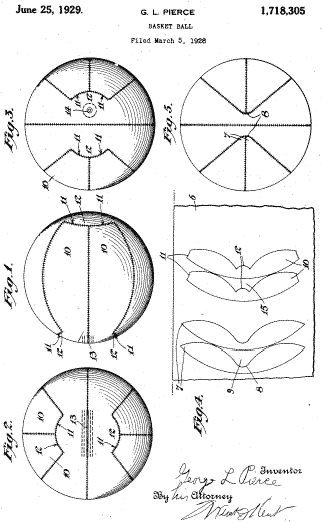
U.S. Patent 1,718,305 was granted to G.L. Pierce on June 25, 1929 for the "basketball."

U.S. Patent 1,718,305 was granted to G.L. Pierce on June 25, 1929 for the “basketball.”

The ball is considered the most important piece of equipment. The original basketball was patented in 1929 (see U.S. Patent 1,718,305). It was made of leather on the outside and butyl rubber on the inside. Zinc and cooper plates imprinted the label onto the ball. Wilson has developed the Solution which is the official basketball for the NCAA championships. The company’s patented composite-leather technology absorbs moisture for better ball handling.

In 1893, iron hoops and hammock-style enclosed baskets were introduced to the game. It was another decade before open-ended nets were used. In the 1930s a flurry of patents were filed suggesting that the game was becoming a viably commercial sport. The game continues to evolve with technology enhancements such as breakaway rims, vision replay, and performance shoes. If only Dr. Naismith could have foreseen the future of his fun “athletic distraction.”

The Wilson Sports Good Company is maker of the official basketball for the NCAA.  They hold a plethora of patents related to the basketball.   This includes United States Patent 4570931 which relates to the pebbled triangle design on the surface of the basketball.

References

The Physics of Basketball (Engineering Library QC26 .F66 2006)

Two Guys From Barnum, Iowa and How They Helped Save Basketball: A History of U.S. Patent 4,534,556 by Francis B. Francois (2008)

Basketball STEM Project

America’s Story from America’s Library

The Coach’s Clipboard

Top 5: Early Basketball Patents


Iowa Climate Festival – April 26

Detail from Iowa River Ideology/Function (2011) by Brendan BaylorClimate in Iowa: What is happening?  How does it work?  And what can you do?  Come talk with climate scientists, learn about local climate issues, conduct climate science experiments, and join us for an ice cream social!  All events will be held at the University of Iowa’s Museum of Natural History on April 26, 2014.  Visit our website for free registration and details.

This morning opened out very beautiful, and all nature seems to be praising God

Joseph Culver Letter, March 27, 1864, Page 1

Head Quarters, 1st Brigade, 1st Division, 11th Army Corps
Wauhatchie, Tenn., March 27th 1864
My Dear Wife

This morning opened out very beautiful, and all nature seems to be praising God for his goodness. I had the blues yesterday badly but succeeded in driving them away before I went to bed. I feel very happy and contented this morning.

I returned from a visit to Joe Shellenbarger & just finished writing to his mother.1 I am very much afraid he will not recover. The Dr. allows no conversation with him, so that I do not know how he feels about it. I intend to visit him this afternoon & talk a little with him if I can get permission. All the rest are well.

I expect Capt. Hoskins in a few days and look for a letter and all the news. I wish to write to the Sabbath School this afternoon.

The train came this morning without any mail, so that I shall get no letter to-day. The roads are drying up & in a few days will be in a passable condition. Our snow has nearly all disappeared, except on the mountains we can still see it.

We heard from [Lieutenant] Mitchell yesterday, he is improving rapidly and will soon return to duty. If the campaign does not open very shortly after his return, I will try for a leave, though I see no probability of my getting it.

There is a report afloat here this morning that Hoskins is commissioned Major and that Plattenburg has been recommended for the Captaincy of Company “A.”2 It is only an alarm I think among the boys. The news reached me from the Company this morning.

I am so closely confined to the office here that I gather but little information. Alf Huetson is appointed Topographical Engineer of this Brigade and is now on duty here. An effort is being made to get him a Commission. McCartney is expecting James Murphy here to-day.3 I do not know why Bro. Johnie has not written to me. I have written twice or three times since we went into Camp. I have recd. no letters lately from any source.

I heard singing in the Camp of the 129th Ills. this morning & think there was preaching there. I may possibly take time to write to Sis. This afternoon. I shall look for a long letter from you written to-day. The mail is just going & I must close. Give my love to All. May God bless you & help you to enjoy this holy Sabbath.

Ever your Affectionate Husband
J. F. Culver

  1. Private Shellenbarger was confined in the brigade hospital with pneumonia. Compiled Service Records of Union Soldiers, NA.
  2. Captain Hoskins was not promoted major of the 129th until June 28, 1864, but he was to rank from February 27. He would occupy the billet vacated by promotion of Thomas H. Flynn to lieutenant colonel. There was no truth to the rumor that Adjutant Plattenburg was to replace Hoskins as captain of Company A. Ibid.
  3. Edward McCartney, a 44-year-old farmer, was mustered into service as a private in Company B, 129th Illinois, on Sept. 8, 1862. He was detached as a musician in the brigade brass band on Feb. 2, 1864, and was mustered out near Washington, D.C., June 8, 1864. Ibid.